RTL-SDR dongles and other SDRs are often used on single board computers. These small credit sized computers are powerful enough to run multiple dongles, and run various decoding programs. Currently, the most popular of these small computers is the Raspberry Pi 3.
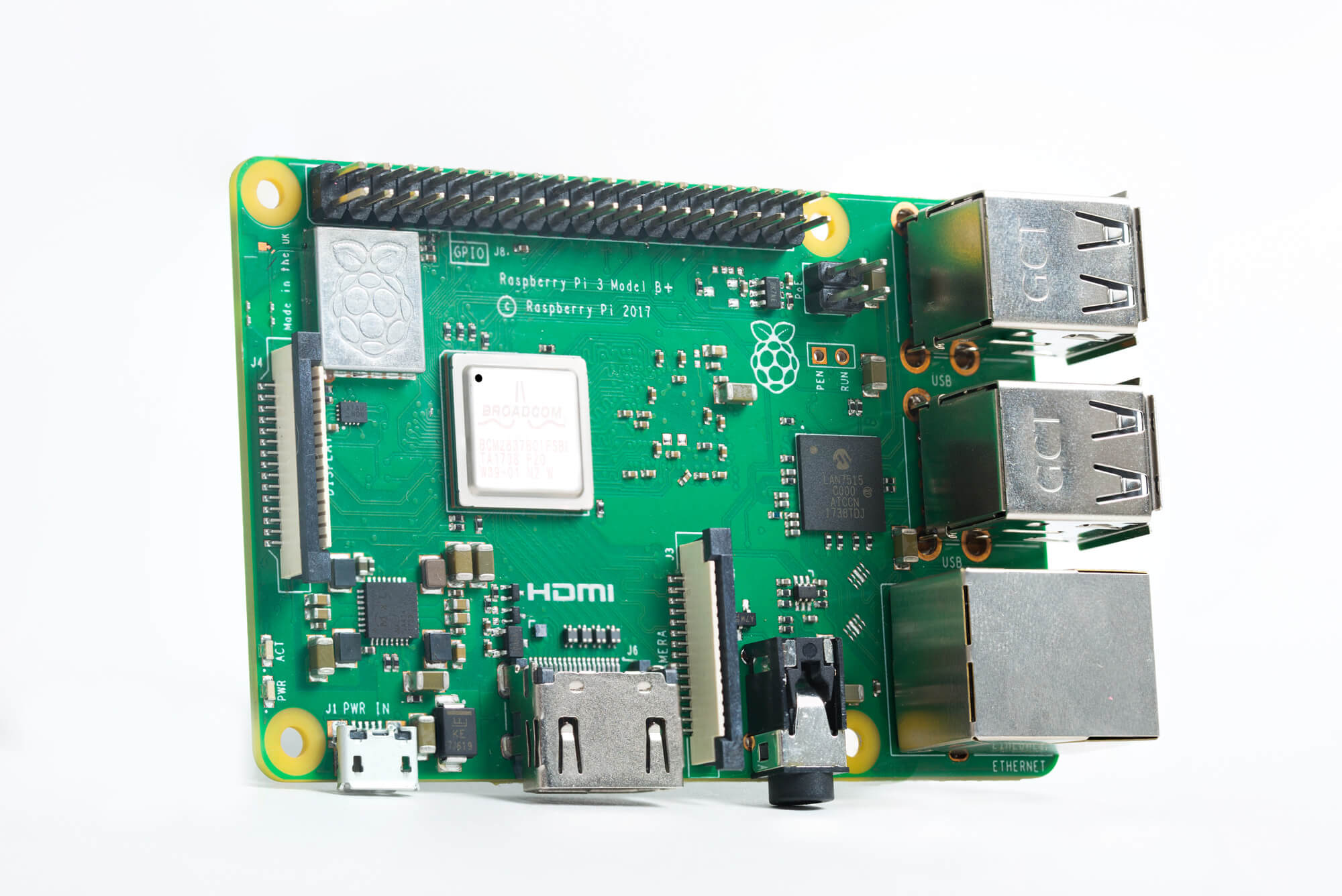
Just recently the Raspberry Pi 3 B+ was released at the usual US$35 price. It is an iterative upgrade over the now older Raspberry Pi 3 B. The 3B+ has an improved thermal design for the CPU, which allows the frequency to be boosted by 200 MHz. WiFi and Ethernet connectivity has also been improved, both sporting up to 3x faster upload and download speeds.
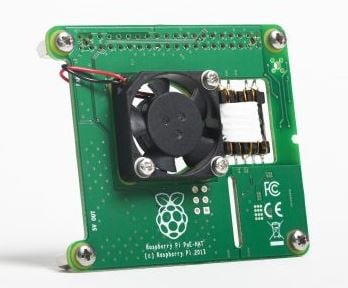
The Raspberry Pi 3 B+ Power over Ethernet Hat
The 3B+ also implements new Ethernet headers which allows for a cleaner Power over Ethernet (PoE) implementation via a hat. Previous PoE hats required that you connect the Ethernet ports together, whereas the new design does not. PoE allows you to power the Raspberry Pi over an Ethernet cable. The official PoE hat is not released yet, but they expect it to be out soon.
The faster processing speed should allow more processing intensive graphical apps like GQRX to run smoother, whilst the improved WiFi connectivity speeds should improve performance with bandwidth hungry applications like running a remote rtl_tcp server. PoE is also a welcome improvement as it allows you to easily power a remote Raspberry Pi + RTL-SDR combination that is placed in a difficult to access area, such as in an attic close to an antenna. Placing the Pi and RTL-SDR near to the antenna eliminates the need for long runs of lossy coax cable. If the Pi runs rtl_tcp, SpyServer or a similar server, then the RTL-SDR can then be accessed by a networked connected PC anywhere in your house, or even remotely over the internet from anywhere in the world.
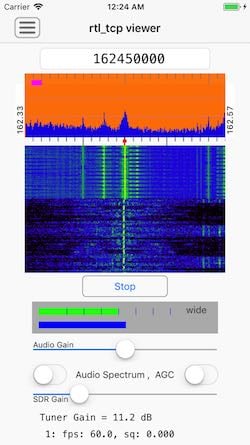
Over on our forums poster hotpaw2 has released news about his new RTL-SDR app for iOS (iPhones/iPads). If we're not mistaken, this will be the first app that enables RTL-SDR usage on iOS. However, as iOS devices don't allow RTL-SDRs (or any arbitrary USB device) to connect directly to devices, you still need to use a Raspberry Pi or other network connected computing device as an rtl_tcp server. So the RTL-SDR does not plug directly into the iOS device. Currently he is looking for beta testers to help test a pre-release of the software. Hotpaw2 writes:
Hi. A first version of my iOS SDR app is nearing completion. So I'm interested finding a few users who would like to beta test a pre-release of the app, and provide some feedback. The beta test requirements are having a 64-bit iOS device (iPhone or iPad) running iOS 11.2.x or newer, having Apple's TestFlight app installed, having a Mac, PC, Raspberry Pi (or other Linux box) that already has rtl_tcp installed and ready to run. (And an RTL-SDR obviously.) The rtl_tcp server must be on a fast WiFi network reachable by your iOS device. Note that iOS TestFlight app distributions do have an expiration date.
iOS does not recognize arbitrary USB devices such as an RTL-SDR. This is even true when using Apple's Lightning Camera Connection kit to provide an iPhone with a wired USB port. So an adapter must be used. I use a headless Raspberry Pi 3 running rtl_tcp as the USB adapter to provide raw IQ samples from the RTL-SDR to the iOS app. A Raspberry Pi Zero W would also work. I then connect to the server either over WiFi, or via wired ethernet.
This iOS SDR app is fairly simple. I've been experimenting with developing low-level DSP code in Swift. So this SDR app was written from scratch in the Swift programming language. Because the app is targeted for the iOS App store, it uses none of the existing SDR C++ code base.
The app currently demodulates AM, N-FM, and mono W-FM. It also displays a spectrum and rudimentary waterfall, and allows one to swipe-to-tune. There are not a lot of controls, as screen real-estate on an iPhone is quite limited. But I can walk around the house and, from my iPhone, monitor if my RTL-SDR or AirSpy HF+ are picking up any interesting signals.
Source code to librtlsdr and rtl_tcp can be found in many repositories on github, but zero support for finding or installing such, and/or setting up your Raspberry Pi, will be provided by me.
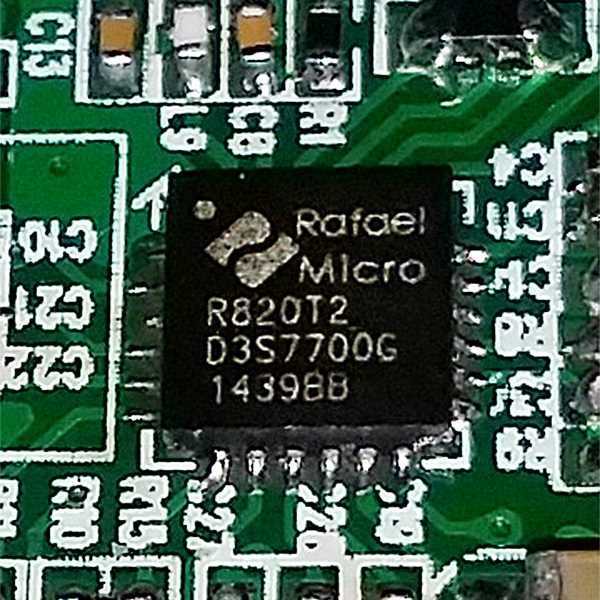
The R820T2 is the main tuner chip used in most RTL-SDR dongles. Several months ago Rafael Micro ceased regular production of their R820T2 chip, and the older R820T has also been discontinued for some time too.
However, Rafael are still producing new quality R820T2 chips for factories if they make very large bulk orders. Since it is one Chinese manufacturer producing all of RTL-SDR.com V3, NooElec, FlightAware and most generically branded dongles, the volume restriction is not a problem for them as long as the RTL-SDR is still in demand. So most dongles using R820T2 RTL-SDRs should be able to continue business as usual for the forseeable future. But we have also recently seen that a lot of generically branded RTL-SDR dongles presumably produced at other factories have started to ship with the less desirable FC0012/13 tuner chips instead.
The R820T chip is already 8 years old, and the R820T2 has been around for the last two years. The R820T2 was a slight improvement on the R820T, due to a higher quality manufacturing process used to produce it. The change in manufacturing process resulted in mostly higher yields, less chip-to-chip variance, better sensitivity, reduced L-band heat VCO lock issues, and wider filters.
Recently the Youssef from the Airspy team announced the likely early retirement of their Airspy Mini and R2 line of products(see update below, Airspy Mini/R2 production will continue) These are SDRs that used the R820T2 tuner chip combined with a 12-bit ADC, allowing for significantly better performance compared to an RTL-SDR. It seems that they were able to acquire R820T2 chips from a distributor, but the stock proved to be very low yield. Possibly once discontinued a lot of low quality chips were dumped onto the distributors for final sale. They write:
I have some bad news. Rafael Micro officially discontinued the R820T2 since a few months. This is the tuner we use in the Airspy R2 and Airspy Mini.
We tried to secure an extra batch from Rafael (even at a higher price) but the quality of the silicon of the samples we received wasn't very good and most units didn't pass our automated QA tests. Sacrificing the performance is out of question. The alternatives proposed by Rafael are not pin compatible and require both a significant hardware redesign and new tuner control code - and this is a large investment with very little guarantees on the final result.
I can say this has been one of the longest running designs that resisted the new silicon tuner SDR's popping in and out while setting a standard for performance and price.
For now, our distributors are running out of R2/Mini's very quickly and, until a final solution is found or a new replacement is designed, there won't be any new batches out.
I was checking my notes for alternatives to the current Airspy R2/Mini design and wondered if consulting the community would give some constructive input. As the market is already crowded with low cost receivers and transceivers, but yet Icom manages to sell a 4 figures SDR, I was thinking of making something that is as open as possible for extensions and work good enough for the most demanding operators and pro's, all while being affordable.
The idea is to replace the R820T2 tuner with one of its latest high performance siblings, then replace the old LPC4370 with the brand new i.MX RT1020. This MCU can be interfaced with a good ADC and has enough processing power for oversampling and decimation through the Cortex M7 core, which will bring the final resolution higher. The general goals:
Better RX performance than the general purpose low cost silicon transceivers
12 bit RX at 10MHz bw and up to 16bit at narrow band
Coverage from 30 MHz to 1.8 GHz or more
Switched pre-selectors
Open source
Same form factor as the Airspy HF+ (same box actually)
Leverage the RF manufacturing and testing capability developed at Itead Studio
Affordable
UPDATE (May/2018): The Airspy team have managed to acquire a new batch of good R820T2 chips, so production of the R820T2 based Airspies can continue as per usual.
So in conclusion there is no need to panic buy R820T2 RTL-SDRs as production will continue as per normal for the forseeable future as the RTL-SDR demand is high enough for factories to make large bulk orders of new R820T2 chips. Even if the R820T2 is fully discontinued, there are alternative tuners with the same performance that we can switch to after a minor redesign.
Note that we're currently out of stock of RTL-SDR V3's on Amazon and low in stock on our store but this is not related to R820T2, but rather simply shipping delays. We should be fully back in stock within a few weeks.
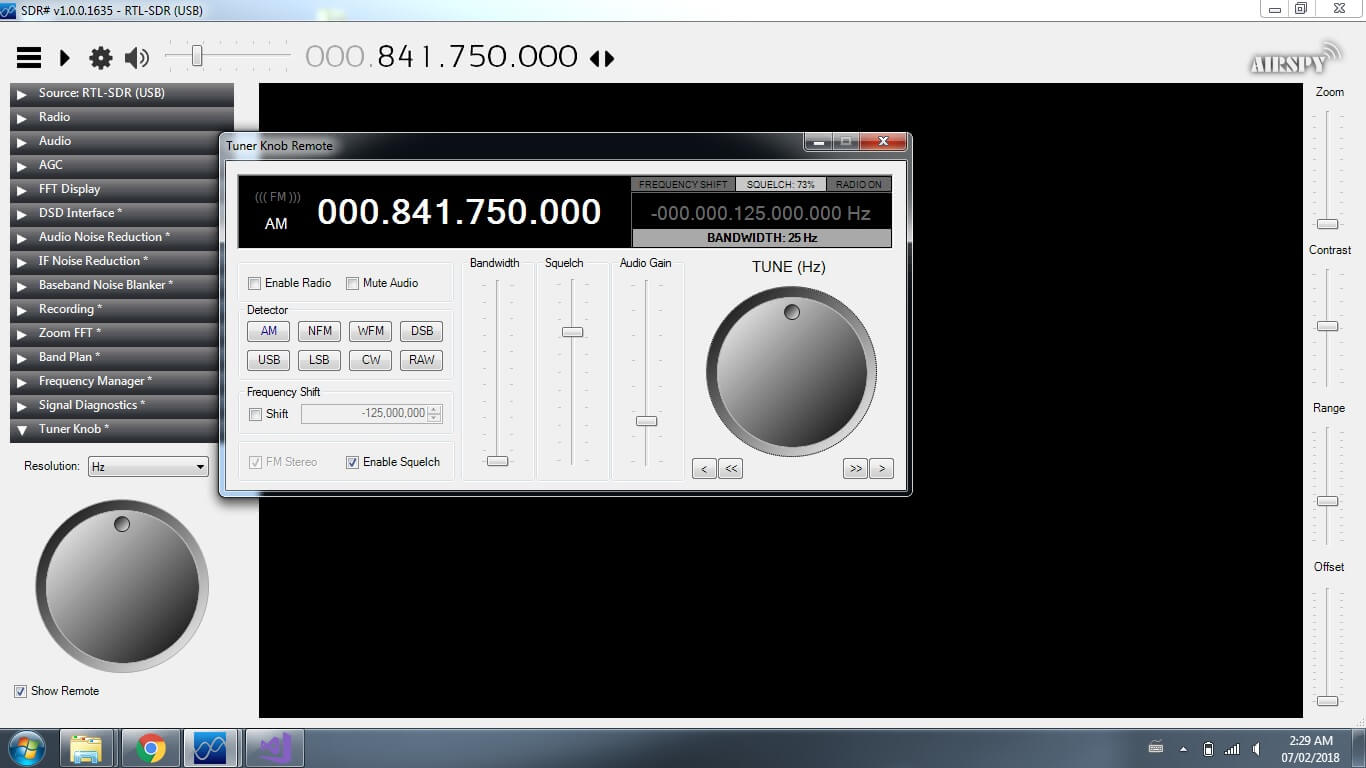
Recently we've posted about Eddie MacDonald's several releases of new plugins for the popular SDR# software. Recently he's released a tuner knob plugin which provides a visual frequency tuning knob that is useful for those running on touchscreen hardware, a 'dark mode' plugin which reduces the brightness of SDR# and compresses the UI a little, and an FFT grabber plugin which allows for easy screenshots of the FFT and waterfall spectrum's to be taken.
Eddie notes that all his plugins now have an actual home website at https://sdrplugins.com. This is where he will release updates and new plugins from now on.
If you are interested in discovering more SDR# plugins, we have a large list available here.
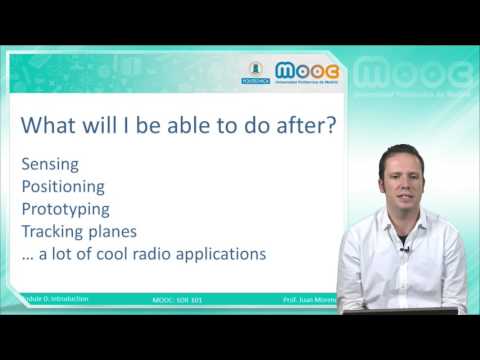
Back in September 2017 we posted about the start of a MOOC (massive open online course) run by Juan Moreno and some collegues from the Technical University of Madrid that aims to introduce students to DSP techniques and MATLAB using an RTL-SDR. The original course has already finished, but Juan has written in noting that the second run of the course is scheduled to start on March 12 2018. The course if free and if you are interested be sure to register on their website. Note that while the registration forms are in Spanish & Portuguese, the course itself is presented in English.
One useful improvement from the first course is that Mathworks, the company behind MATLAB have agreed to provide a free MATLAB licence to all students for the duration of the course. This should significantly lower the cost barriers to learning.
The course blurb reads:
SDR is a reality around us. It is present in a lot of systems everywhere and is a versatile technology which can be used for many things (not only academics and industrial). The purpose of this course is to introduce students into general-purpose SDR tools. The SDR hardware platform chosen for this course is the RTL-SDR. It is worldwide available, it’s cheap ($15) and there is a lot of help in the Internet. But, as far as we know, there is no other MOOC focused on an introduction to SDR as this MOOC. Here we will not only learn about SDR but also a lot of related areas like antennas, digital signal processing, radio frequency and communication electronics.
GNU Radio have today released their latest 'Signal Challenge'. This is an online competition that contains three digital signal processing related problems. They write:
At 1222 EST on 21 Feb 2018, we posted a new signals challenge! There are *three* different challenges hidden in this signal capture, and the solution to each is a text message. One is on the easier side, and the two others are more advanced. If you believe you have found a solution, DM the answer to @gnuradio on Twitter or e-mail [email protected]!
The first THREE people to solve each of the three challenges will be declared winners. There will be nine winners in total. One person can only win one challenge; if correct solutions are submitted for multiple challenges, the first will count as the win.
The winners will receive honor and glory, plus some awesome GNU Radio stickers!
Thanks to RTL-SDR.com reader Lee Donaghy for writing in and little us know that RTLSDR-Airband was recently updated to include SoapySDR support. This allows the software to now work with almost any SDR including the RTL-SDR, Airspy, SDRplay, HackRF, LimeSDR and more. They have also removed the 8-channels per device limitation and applied various bug fixes too. The full changelog is posted at the end of this post.
RTLSDR-Airband is a Linux based command line tool that allows you to simultaneously monitor multiple AM or FM channels per SDR within the same chunk of bandwidth. It is great for monitoring narrowband communications such as aircraft control and can be used to feed websites like liveatc.net, or for use with a Icecast server, or simply for continuously recording multiple channels to an MP3 file locally. It is also very useful for those running on low powered computing hardware who want software that uses less CPU power than a full GUI program like GQRX or CubicSDR.
Version 3.0.0 (Feb 10, 2018):
Major overhaul of the SDR input code - now it's modular and hardware-agnostic (no longer tightly coupled with librtlsdr).
Support for SoapySDR vendor-neutral SDR library - any SDR which has a plugin for SoapySDR shall now work in RTLSDR-Airband.
Support for Mirics DVB-T dongles via libmirisdr-4 library.
Support for RTLSDR is now optional and can be disabled at compilation stage.
Removed the 8-channels-per-device limit in multichannel mode.
Configurable per-device sampling rate.
Configurable FFT size.
Support for multibyte input samples.
Support for rawfile outputs (ie. writing raw I/Q data from a narrowband channel to a file for processing with other programs, line GNUradio or csdr).
INCOMPATIBLE CHANGE: removed rtlsdr_buffers global configuration option; buffer count can now be adjusted with a per-device "buffers" option.
INCOMPATIBLE CHANGE: removed syslog global configuration option; syslog logging is now enabled by default, both in foreground and background mode. To force logging to standard error, use -e command line option.
Added -F command line option for better cooperation with systemd. Runs the program in foreground, but without textual waterfalls. Together with -e it allows running rtl_airband as a service of type "simple" under systemd. Example rtl_airband.service file has been adjusted to reflect this change.
Added type device configuration option. It sets the device type (ie. the input driver which shall be used to talk to the device). "rtlsdr" is assumed as a default type for backward compatibility. If RTLSDR support has been disabled at compilation stage, then there is no default type - it must be set manually, or the program will throw an error on startup.
Frequencies in the config can now be expressed in Hz, kHz, MHz or GHz for improved readability.
SDR-Console V3 is the latest in the line of the free SDR-Console software packages from developed Simon Brown. Recently SDR-Console V3 left its 'preview' software status and moved into 'beta' production status.
SDR-Console is a general purpose SDR program similar to other software like SDR#, HDSDR and SDRUno. SDR-Console V3 however sets itself apart by being one of the most feature rich packages with goodies like advanced DSP and NR options, frequency favorite lists, IQ recording and playback with reverse and fast forward, built in CW Skimmer and satellite tracker, independent receiver control with matrix view, signal history export, a recording scheduler, remote server and in the future support for SDRs with transmit capability.
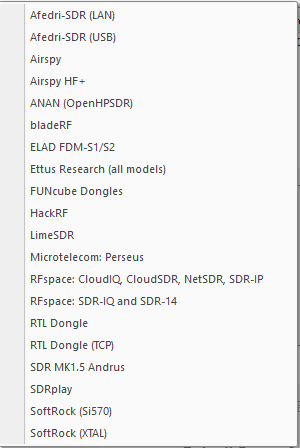
SDRConsole V3 Beta Supported Radios
One interesting feature released with the beta version is the SDR-Console server, which allows you to use an SDR remotely over a network such as a local LAN or over the internet. We tested the server on our local machine. After setting up the server account, adding an RTL-SDR radio definition and installing the server Windows service we were able to successfully connect and receive flawlessly. The server appears to limit the maximum bandwidth to 1 MHz.
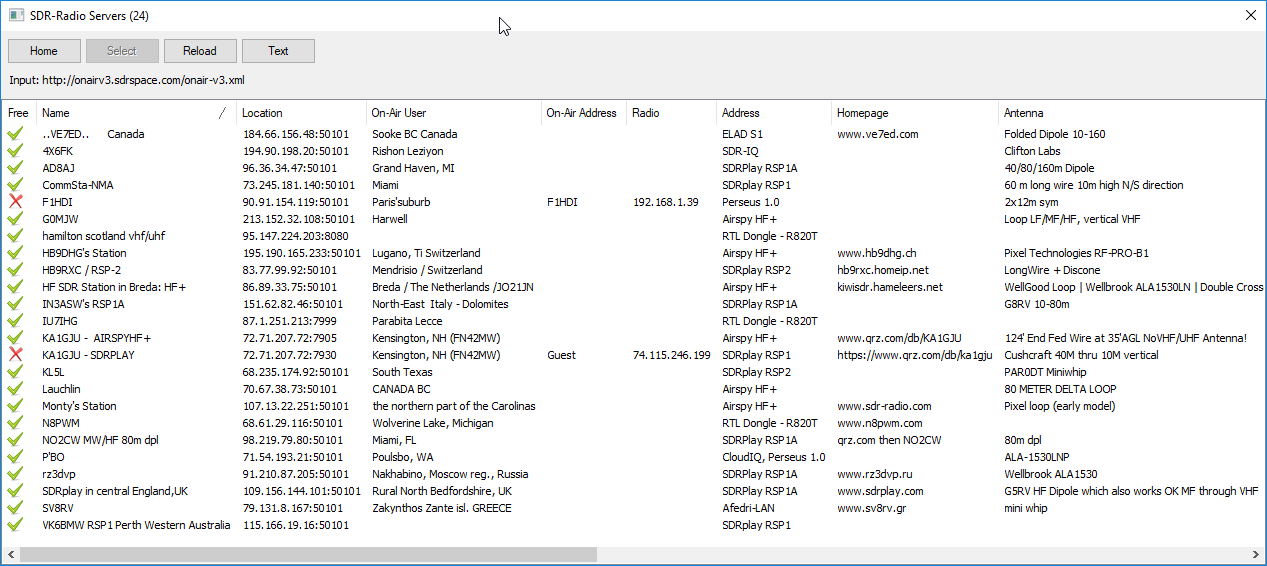
SDR-Console and the server currently support multiple SDR hardware including the RTL-SDR. SDRplay have blogged about support for their line of RSP products too, and have also created a public internet connected RSP1A demo which anyone can connect to and use (assuming that you have a decent enough internet connection). A list of public Console V3 servers can be found by clicking on the 'SDR Space' button when adding a 'V3 server' radio definition in SDR-Console V3. Currently there are multiple locations and SDR hardware publically available including ELAD FDM-S1's, SDRplay units, Airspy HF+'s as well as RTL-SDR's. We tested a few remote servers and were able to easily connect to most of them and get good smooth throughput.
Below we show a screenshot of SDR-Console V3 Beta 1 receiving from a remote SDRplay RSP1A with multiple IF channels selected and with matrix view active on a second screen.
SDR-Console V3 Beta 1 Receiving Remote RSP1 in Matrix View