Last month we posted that the website for the popular NOAA APT weather satellite decoding software known as WxtoImg went down. Since then we've been in contact with the developer of the software, and he did indicate that he may restore the site at some time in the future, but is currently busy with other projects so doesn't have much time to devote to his old software at the moment.
In the meantime (or perhaps permanently) a WXtoImg fan has created a clone of the original website which he's called "WXtoImg Restored". The site contains most of the downloads as well as a professional edition update key, which was released for free by the original author before. If you don't trust the third party site, some downloads are also still available from the internet archival project's copies of the original WXtoImg website.
There are still some files missing on WXtoImg Restored, and these are outlined on the new website's homepage, so if you have them please contribute them to the site email.
Thanks to the work of Lucas Teske, GQRX is now able to connect to SpyServer servers. SpyServer is the IQ streaming server software solution developed by the Airspy SDR developers. It can support Airspy and RTL-SDR devices, and can be used to access these SDRs remotely over a network connection. It is similar to rtl_tcp, but a lot more efficient in terms of network usage, meaning that it performs well over an internet connection. On a previous post we have a tutorial about setting up a SpyServer with an RTL-SDR.
The code modified by Lucas is the gr-osmosdr module, and Lucas' code can be downloaded from his GitHub at github.com/racerxdl/gr-osmosdr. It doesn't yet appear to have been merged into the official osmocom branch. The gr-osmosdr module is a generic block used to access various SDR hardware, so any software that utilizes it (such as GNU Radio) should be able to connect to a SpyServer connection too.
moRFeus is a low cost wideband signal generator and frequency mixer. It can be used to generate a tone anywhere from 85 MHz to 5400 MHz, and can also be used as a frequency mixer, allowing you to implement upconverters and downconverters. In past posts we've reviewed and seen it being used as a PC based signal generator with open source GUI's, downconverter, CW generator, and most recently as a tracking generator for measuring filters and antenna VSWR.
Currently Outernet are having a half price sale on the moRFeus. Normally it's US $199, but now with the coupon code "rtlsdrblog" it's only US $99. The sale only lasts until Saturday 09 June 2018, so get in fast if you want one.
Osmocom are some of the people behind the original discovery and development of the RTL-SDR (in particular Steve M), and today it looks like they have done it again by releasing exciting news of a way to turn a commodity $5 USB to VGA adapter into a TX-only capable SDR. They call their discovery 'osmo-fl2k', as the magic chip that makes it all happen is a Fresco Logic FL2000.
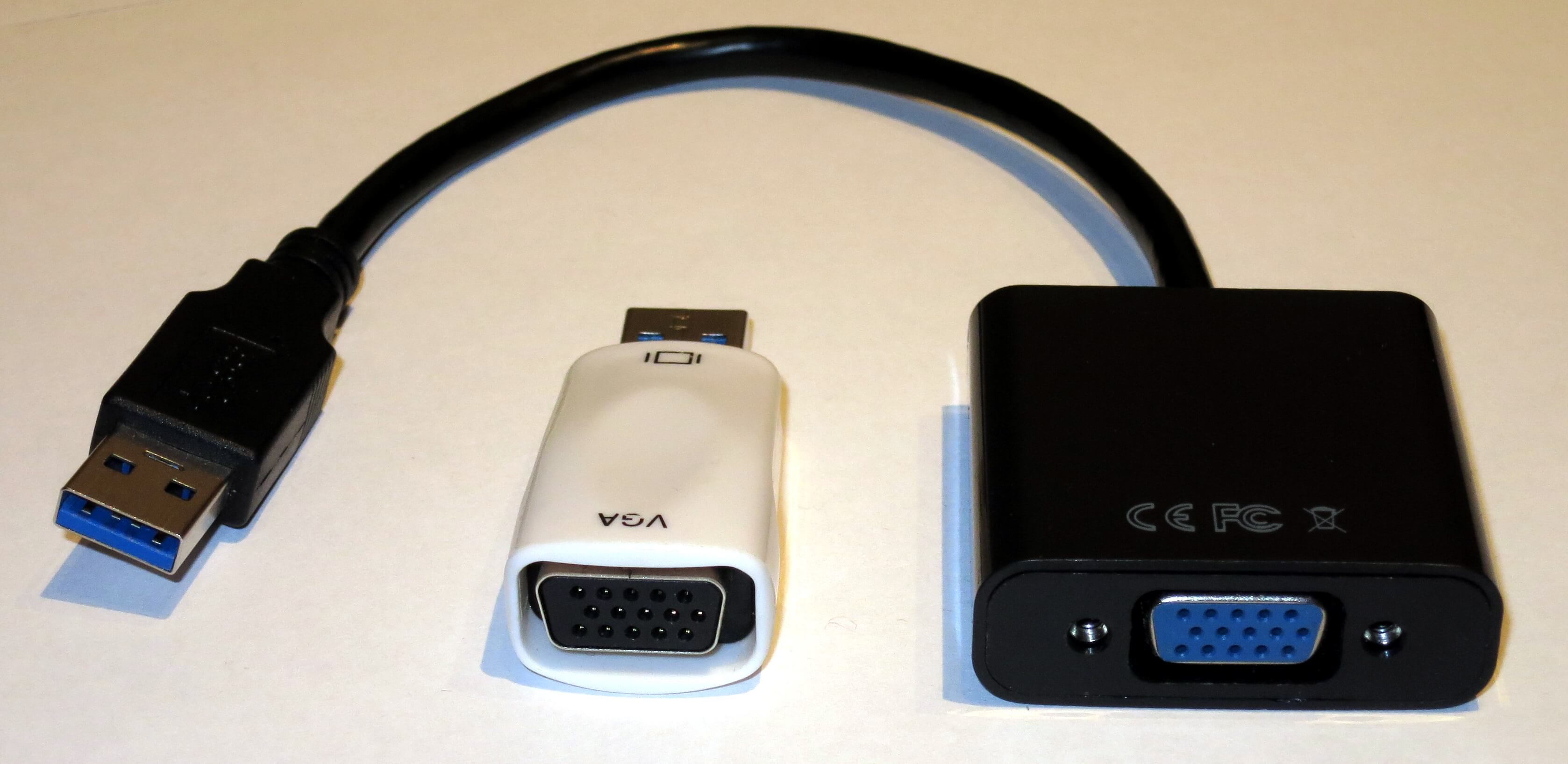
Examples of compatible Osmo-FL2K USB to VGA Adapters.
The discovery is based on the fact that the VGA specific HYSYC/VSYNC synchronizations on the FL2000 chip can be disabled, allowing for a continuous stream of samples to be sent to the VGA digital to analog converter (DAC). The FL2000 also implements a cheaper method of streaming data compared to other devices which allows these to be $5 devices.
The supported hardware appears to be any USB to VGA adapter that uses the FL2000 chip. They note that these are often advertised as "USB 3.0 to VGA" adapters with a maximum resolution of 1920 x 1080 for USB 3.0 and 800 x 600 for USB 2.0. Over on Amazon the cheapest one we've found (note not yet confirmed to be compatible) that meets the Osmocom description appears to be going for $7.49 and is fulfilled by Amazon. We've seen prices of $5.11 on Aliexpress and $5.99 on eBay too. There appears to be no difference between the brands of these units, as the 'brands' are just private labelled from the same factory, as anyone can add a brand to a generic product.
Once sellers catch on to the fact that these devices are going to be popular we expect them to most likely start raising prices.
The Fresco Logic FL2000 Chip
In terms of TX performance and functionality, osmo-fl2k should be better than RPiTX as it uses an actual DAC, instead of just PWMing a pin. It appears that the device can transmit on a fundamental frequency anywhere from HF up to about 157 MHz, and then signal harmonics can be used to extend the range all the way up to around 1.7 GHz or maybe even higher. Having harmonics does mean that like other cheap TX methods, the signal is not clean and so proper filtering would be required before any sort of higher power transmission would be legal.
The highest fundamental frequency available also appears to be related to the performance of your PC's USB 3.0 controller. The worst USB 3.0 controller that they tested maxed out at 115 MS/s, whereas the best was 157 MS/s (theoretical max should be 160 MS/s). A USB 2.0 controller only gets a maximum sample rate of 14 MS/s.
So far the team have released software examples for transmitting DVB-T, GSM, UMTS (3G) and GPS, and have mentioned that they have also successfully transmitted LTE and DAB too. There is also an example for transmitting WBFM audio with RDS via the pacat Linux command and sox. The image below shows the FL2K-SDR working as a GSM base station.
Osmo-FL2K being used as a GSM Basestation
If you're interested in more information, Osmocom have released the slides from a presentation that they made at a OsmoDevCon presentation on April 22. The video presentation is also expected to be released soon at media.ccc.de.
Airspy have recently released an update to their ADSBspy decoder, which is an Airspy One/R2 compatible decoder for 1090 MHZ ADS-B signals. According to 'prog', the software developer of ADSBSpy, his setup can see almost double the number of aircraft and with fewer false positives when using the updated software. Prog writes that the secret to the improvement is some reworked DSP code that aims to exploit oversampling in the Airspy to the maximum.
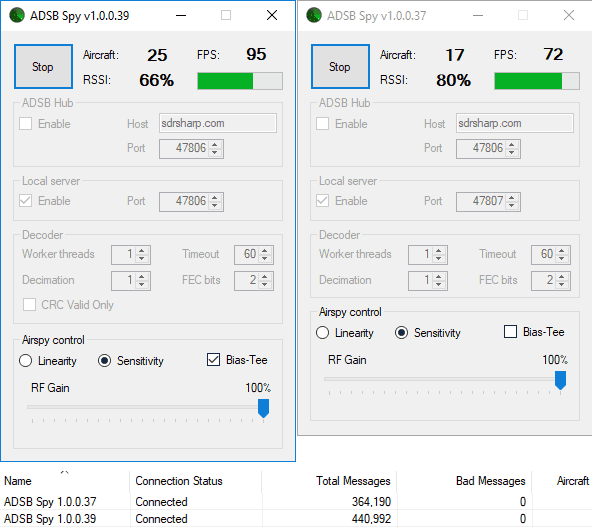
We compared the new (1.0.0.38/39) decoder against the old decoder (1.0.0.37) which used to get similar performance to dump1090. The test setup was two Airspy dongles connected to a dipole antenna via a splitter, with our Triple Filtered ADS-B LNA used by the antenna. One Airspy was used to power the LNA via it's bias tee, and both units received the same amplified signal. We found indeed that the new version of ADSBSpy receives a good number more aircraft in our set up, and an increased number of ADS-B messages too.
It seems that most of the additionally received aircraft must be from extremely weak signals, because when looking in Virtual Radar Server the extra aircraft usually only show their ICAO and maybe altitude and speed until they get closer.
So far this software appears to provide the best performance on ADS-B that we've seen so far, so if you are using an Airspy for ADS-B tracking we'd like to hear results from anyone who upgrades.
The New ADS-B Spy Receives More Aircraft and Messages
Back in March of this year we posted about Nexmon SDR which is code that you can use to turn a Broadcom BCM4339 802.11ac WiFi chip into a TX capable SDR that is capable of transmitting any arbitrary signal from IQ data within the 2.4 GHz and 5 GHz WiFi bands. In commercial devices the BCM4339 was most commonly found in the Nexus 5 smartphone.
Recently Nexmon have tweeted that their code now supports the BCM43455c0 which is the WiFi chip used in the recently released Raspberry Pi 3B+. They write that the previous Raspberry Pi 3B (non-plus) cannot be used with Nexmon as it only has 802.11n, but since the 3B+ has 802.11ac Nexmon is compatible.
Combined with RPiTX which is a Raspberry Pi tool for transmitting arbitrary RF signals using a GPIO pin between 5 kHz to 1500 MHz, the Raspberry Pi 3B+ may end up becoming a versatile low cost TX SDR just on it's own.
We are proud to announce that #nexmon now turns Raspberry Pi B3+ computers' Wi-Fi chips (BCM43455c0) into software-defined radios. Visit https://t.co/wku9Go9kRt to try it out! The RPi3 cannot be supported due to its 802.11n PHY which is incapable of raw transmissions.
During development of the Outernet project the engineering team developed several tools to help them in their RF testing. One tool that they created has now been developed further into a commercial product that they are calling 'moRFeus'. moRFeus is a small handheld RF signal generator and frequency mixer. It can be used to generate an RF tone at any frequency between 85 MHz - 6 GHz and to upconvert or downconvert signals via the mixer with an input/output frequency range between 30 MHz - 6 GHz. This type of tool is useful for people working with RF hardware as it can be used for testing and prototyping.
morRFeus is currently selling for US$149 over on CrowdSupply, and the units are ready to ship out soon. They note that the current price is a special, and that it may be increased in the future. We think that this is a fairly good deal considering that similar products can cost much more. If you are interested in the technical details the datasheet includes figures on phase noise and conversion losses. There is also a user guide that explains how the buttons work, and what each screen on the menu is for. The morRFeus press release reads:
Outernet launches sales for wideband frequency converter and signal generator with complete field-level configuration.
Today, Outernet announced the launch of moRFeus - a wideband (30MHz - 6GHz) frequency converter and signal generator with complete field-level configurability. The product is available on Crowd Supply for $149. The price will increase after the 30-day launch campaign.
The device has an LCD display and button interface for complete field-level configuration - from setting the LO frequency to toggling between mixer and generator mode, and more. It’s in a precision-milled all-aluminum enclosure for durability and aesthetics.
moRFeus was built for hams and hackers, people with a traditional amateur radio background, as well as a makers and researchers that are interested in RF experimentation. It was designed for easy integration into a wide variety of RF projects.
In mixer mode, moRFeus enables dynamic frequency up- and down-conversion. In generator mode, it is one of the most, if not the most, affordable tools to generate a stable +/-2.5 ppm CW signal. Additional information on features, specifications, and performance metrics can be found in the datasheet.
The team already has 100 units in stock and another 900 are going through final assembly and quality assurance in Chicago. The first 100 units will ship one week after launch and orders beyond the initial stock will ship within 30 days of the close of the campaign, or earlier.
Outernet has been working on novel RF projects since the founding of the company in 2014. moRFeus was developed because from an internal need for a wideband field-configurable frequency converter for testing purposes. The company identified a huge gap in the market for a solution that met the needs of others with similar problems add their own. Outernet’s founder describes the development process:
“The idea was hatched about a year ago because we needed an easy, quick way to dynamically up-and down-convert the various radios we were experimenting with for a new product. By the summer of 2017, we had our first prototype and functional firmware. The design still required some slight tweaking. The current version of moRFeus is its third iteration. Oddly enough, the last phase of the project, industrial design, ended up being the most time-consuming. We worked with a local designer/machinist with decades of experience to come up with a custom-made all-aluminum enclosure.”
For more information and to purchase moRFeus, visit Crowd Supply.
Furthermore the product features, description, and also some of the applications and use cases for moRFeus are quoted below:
Features
RF Input Frequency: 30MHz–6GHz
RF Output Frequency: 30MHz–6GHz
LO Frequency: 85MHz–5400MHz
Fractional-N Synthesizer
LO Step Size: 1.5–3Hz1
2.5 ppm precision TCXO
USB programmable
Generator/Mixer Function Toggle
Input IP3 +23dBm
Small, Portable Form Factor
Adjustable Mixer Bias Current
LCD Display With Backlight Feature
Button Control Interface
Dimensions: 88mm x 38mm x 68mm
Weight: 7.4 oz
Product Description
moRFeus is a 30MHz–6GHz programmable Fractional-N wideband frequency converter and generator designed for low spurious emissions and dynamic configuring of the LO frequency. moRFeus is designed for easy integration into popular RF environments using SMA connectors and is powered using an external micro-USB 5V supply. The LCD display and button interface provide a dynamic way to program the mixer LO frequency in the field with a step size of 1.5–3Hz.1 The device is USB programmable, enabling automatic operation from a PC (must be running Linux). Dynamic toggling between mixer and generator modes adds to field-level functionality. An optional bias voltage of 5V is available via RF choke to the mixer input to supply active antenna systems.
Applications
Wideband Radios
Distributed Antenna Systems
Diversity Receivers
Software Defined Radios
Frequency Band Shifters
Point-to-Point Radios
WiMax/LTE Infrastructure
Satellite Communications
Wideband Jammers
Remote Radio Heads
Frequency Up/Down Conversion
Automated Test Equipment (ATE)
Wireless Communication Systems
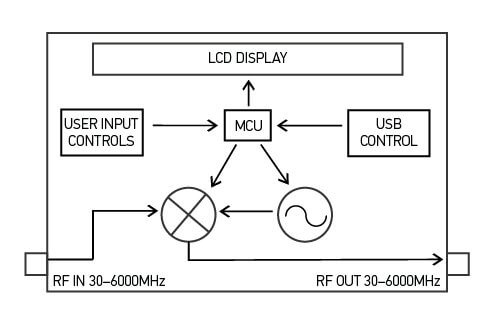
moRFeus Block Diagram
Review and Testing
The Outernet team sent us a moRFeus unit for testing a few days ago. It comes in a portable 3.5 x 2.7 x 1.5 inch (8.9 x 6.9 x 3.8 cm) conductive milled aluminum enclosure and weighs 7.4 ounces (210 grams). The construction is very solid, and should easily survive being thrown around in a carry bag, although we'd still advise caution as the LCD screen is not protected by a window.
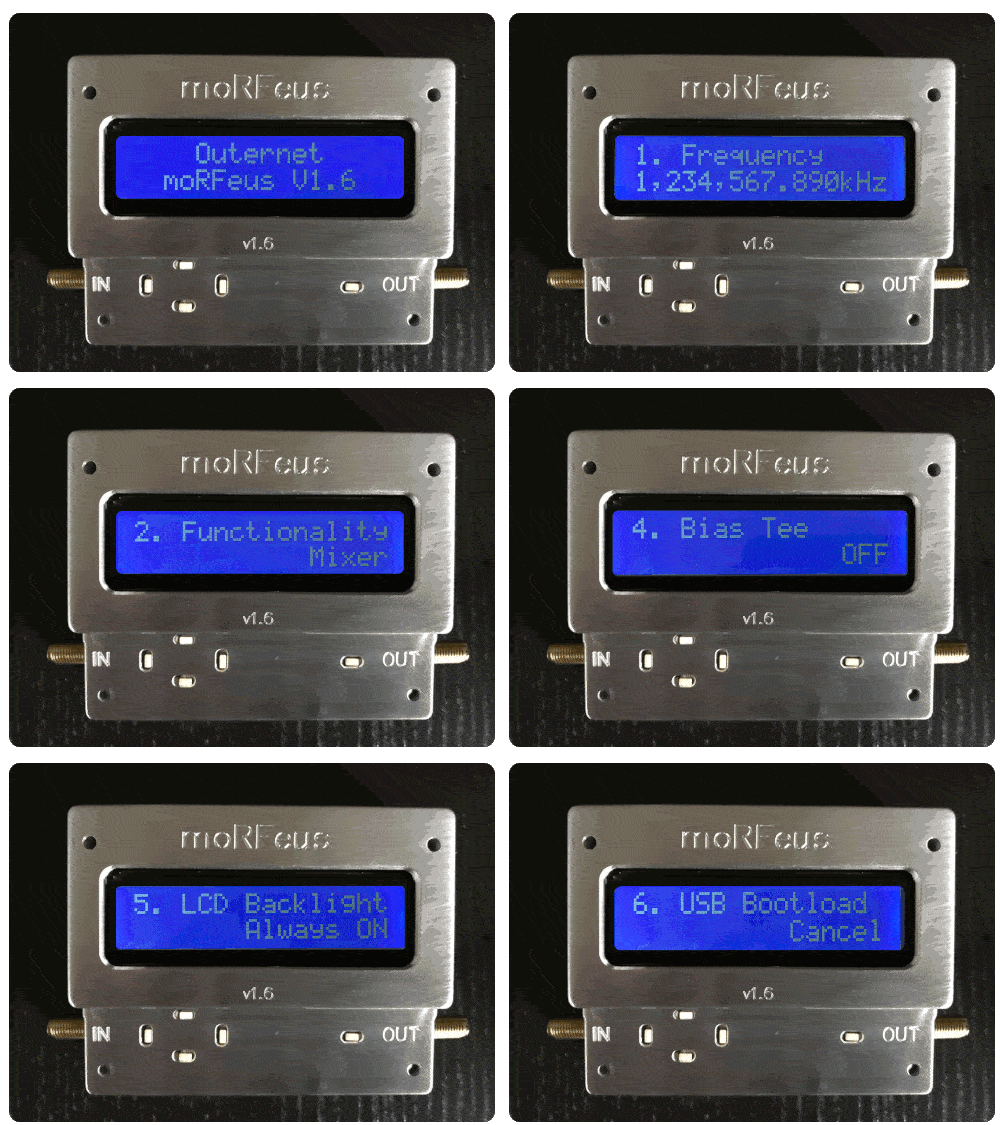
The unit is powered via a standard micro USB port. After connecting a USB cable the unit immediately powers up shows a frequency selection screen on the LCD display. Five small buttons are used to control the interface, and we found it very easy to adjust the output frequency using these buttons.
Using the interface the unit can be switched between the "Generator" and "Mixer" modes. In the generator mode moRFeus simply generates a CW tone at the desired frequency. In the mixer mode moRFeus takes an input signal, mixes it with the generated tone and puts the result on the out port. Mixing a signal with a tone is the core concept behind devices like upconverters, downconverters and tuners. For example, by generating a mixing tone at 2 GHz with the moRFeus, we are able to view 2.4 GHz WiFi signals at 2.4 GHz - 2 GHz = 400 MHz.
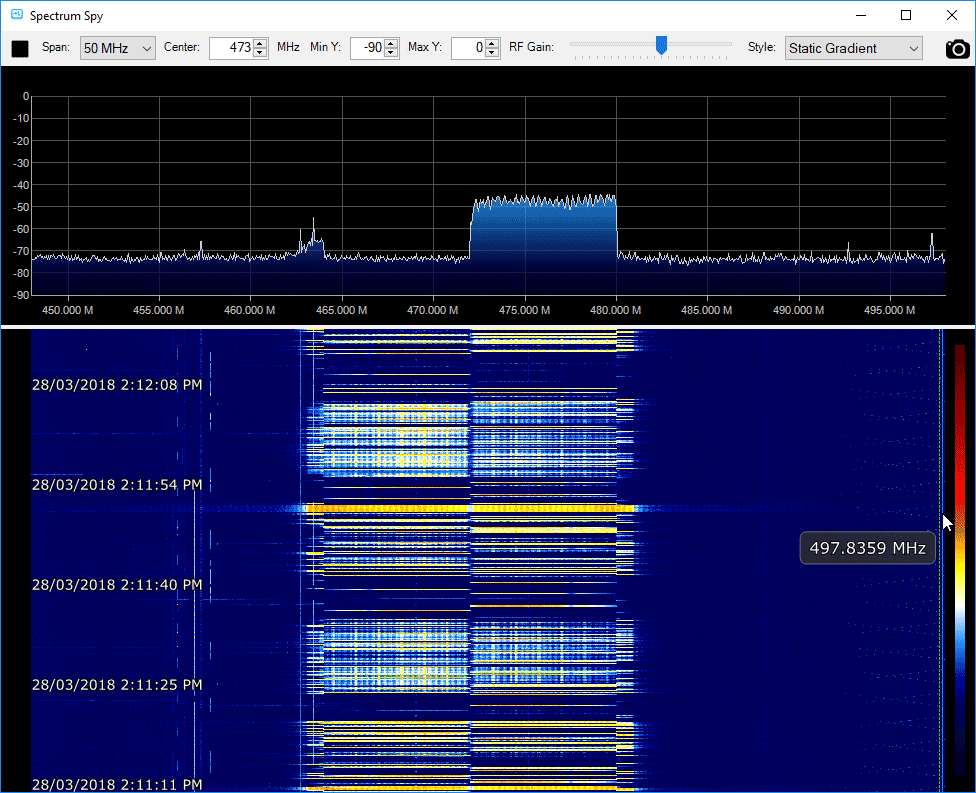
In the screenshot below we set moRFeus to run in mixer mode with the LO frequency set at 2 GHz. This allows us to view an active WiFi signal at 2.475 GHz using an Airspy and the SpectrumSpy software. The Airspy can only tune up to 1.8 GHz by itself, so it can't view the WiFi band directly. Of course to use as a proper downconverter filtering is required to remove any images and interfering signals, but by being able to easily change the LO frequency you are able to move the signals around quite easily to avoid images or interference.
Unfortunately one limitation is that moRFeus' lowest input frequency is 30 MHz, so it can't be used to upconvert HF signals.
Viewing a 2.4 GHz WiFi signal on an Airspy by using moRFeus as a downconverter with LO set to 2 GHz.
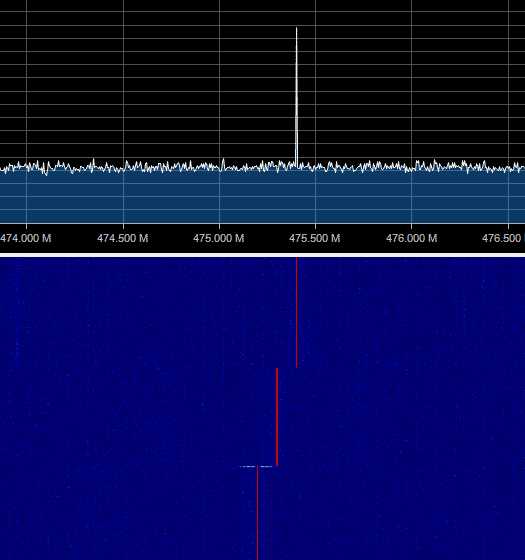
moRFeus also works well as a standard RF signal generator, and we were able to get a clean CW tone on any frequency between 85 MHz - 6 GHz.
moRFeus as a RF signal generator
moRFeus also shows up a a device on the PC, and the team write that it is possible to control it programatically via Linux, however documentation for this does not exist yet although it is scheduled to be released later. We would love to see a sweep feature which should be possible with PC control.
In conclusion if you are looking for a low cost signal generator or mixer to use in your experimental RF projects, then moRFeus certainly does seem like a good deal. A tool like this is very handy to have in your RF kit.
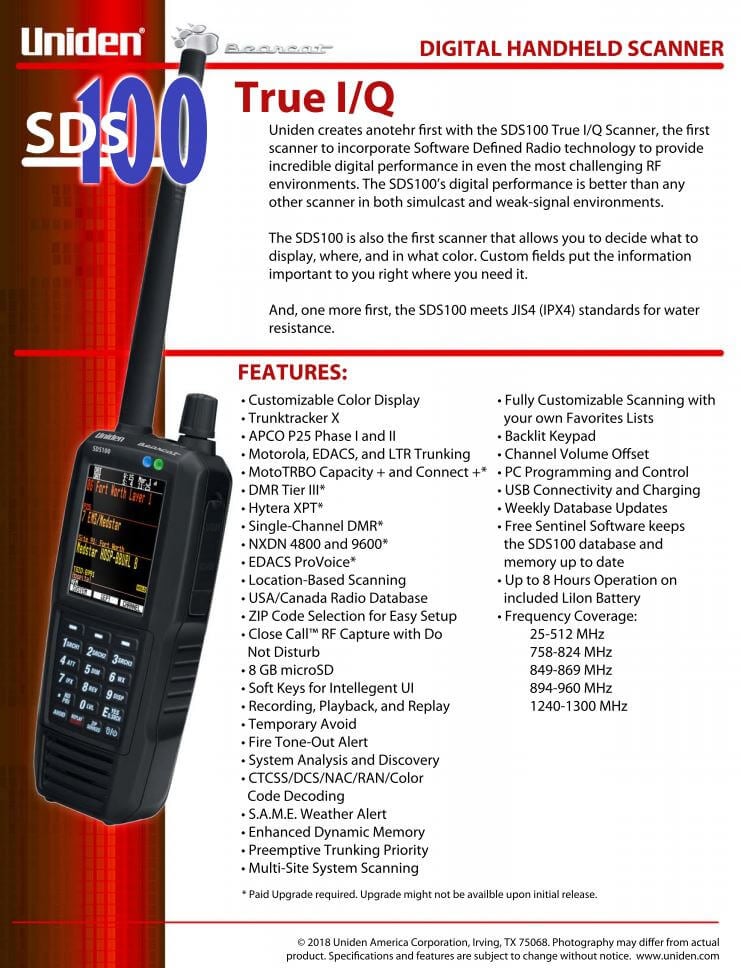
Radio manufacturer Uniden have just released news about their latest product called the SDS100 which is a handheld software defined radio scanner specifically for digital voice and trunking modes. The scanner will retail for USD699, and aims to be released in the 2nd quarter of 2018 pending FCC approval. Note that certain software decoders will require paid upgrades, but it will be capable of all the major digital voice modes such as P25 Phase I and II, DMR, NXDN and trunking modes. It doesn't seem to support TETRA since it's marketed at the American consumer, however, it seems plausible that simple software update could enable this feature in the future.
As far as we know this is the first handheld scanner to incorporate SDR and is probably one of the bigger leaps in scanner technology to date. Compared to hardware based scanners, the SDS100 should provide significantly better decoding capabilities, even in weak signal and simulcast conditions. Simulcast is when multiple overlapping base stations transmit a signal at the same frequency. This can cause multi-path distortion problems, but an IQ based radio like an SDR is able to overcome these issues.
Uniden creates another first with the SDS100 True I/Q Scanner, the first scanner to incorporate Software Defined Radio technology to provide incredible digital performance in even the most challenging RF environments. The SDS100’s digital performance is better than any other scanner in both simulcast and weak-signal environments.
The SDS100 is also the first scanner that allows you to decide what to display, where, and in what color. Custom fields put the information important to you right where you need it.
And, one more first, the SDS100 meets JIS4 (IPX4) standards for water resistance.
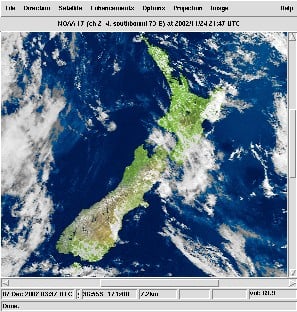 Last month we posted that the website for the popular NOAA APT weather satellite decoding software known as WxtoImg went down. Since then we've been in contact with the developer of the software, and he did indicate that he may restore the site at some time in the future, but is currently busy with other projects so doesn't have much time to devote to his old software at the moment.