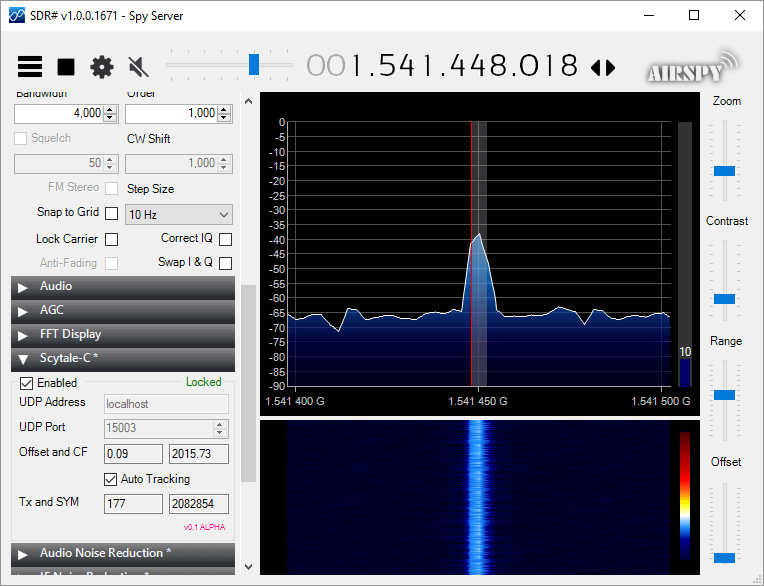
Microp11, the programmer of Scytale-C a standalone Inmarsat decoder has just released a new Inmarsat decoder SDR# plugin. The plugin is currently in the "pre-alpha" stages, so is still missing some functionality and may be buggy. However, it does appear to be functional at this point in time. It can be used with RTL-SDRs, and any other SDR# compatible SDR including units running on remote SpyServers. Microp11 writes:
I ran it with SDR# version v1.0.0.1761.
If it crashes you SDR# I apologize in advance.
The auto-tracking (default on) will alter your SDR# frequency and follow the signal’s CF. When the SNR is very low, please disable it and manually tune the SDR# to try to get the CF as close to 2000 as possible.The demodulator still has plenty ideas of its own.
Use USB mode with 4000 Hz bandwidth.
For now the interface is missing the usual scatter plots.
UDP Address and UDP Port are for sending the decoded frames to the Scytale-C UI.
Offset and CF are the difference from zero error and the CF frequency of the demodulated BPSK signal.
Tx and SYM are the transmitted over UDP frames and SYM is showing the number of demodulated symbols.
A bunch of libraries are attached as extra files. Please be gentle and accept the package as it. Will clean-up in the future.
Use in conjunction with the Scytale-C UI from the archive: “x64-UI1.6-Decoder1.4.zip” (link below)
The magic line is included in the archive: “SDRSharp.ScytaleC-1.0-alpha.zip”
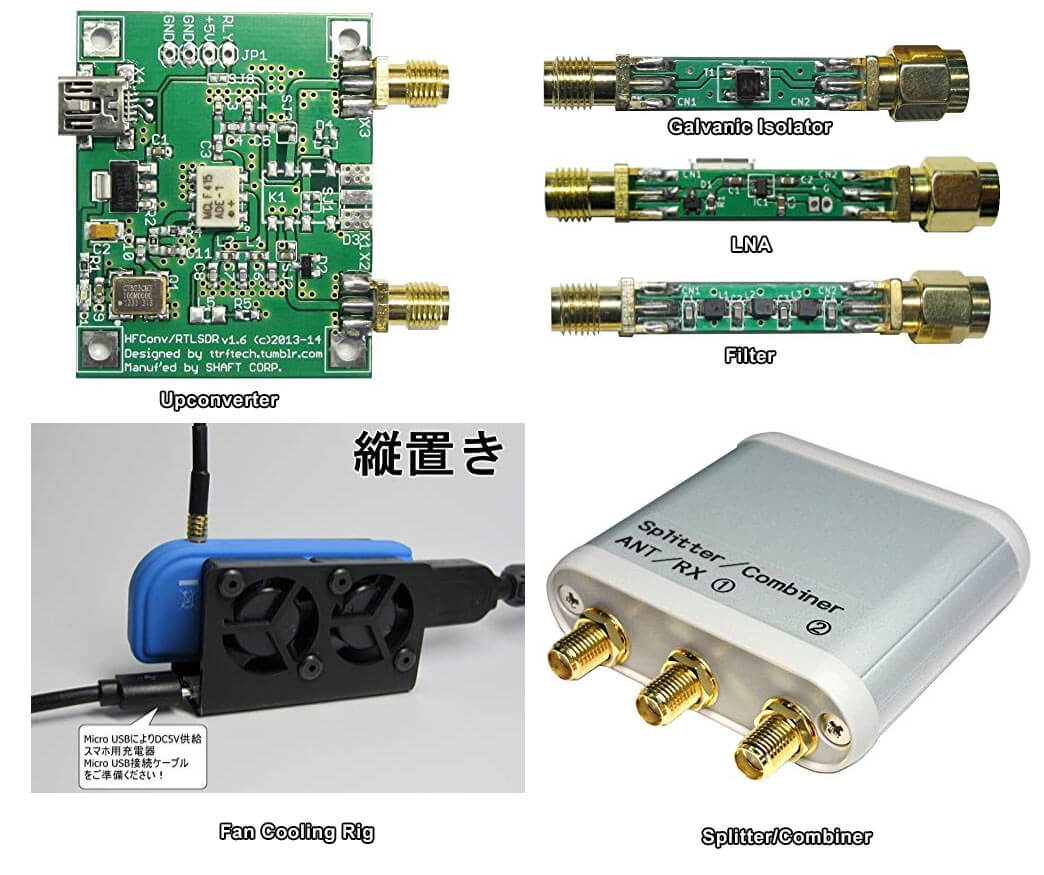
Japan has a strong RTL-SDR scene, with a few small Japanese companies and individuals (including Nobu) selling custom RTL-SDR products on their local Amazon store. Products such as upconverters, galvanic isolators, LNAs, filters, cooling products and more are available. Back in 2015 we reviewed some of these products in a post available here. Since then we've found continued use in particular with the galvanic isolator which helps reduce noise from the computer and nearby electronics at HF frequencies.
Some Custom Japanese RTL-SDR/RF Products available for International Shipping on Amazon.co.jp
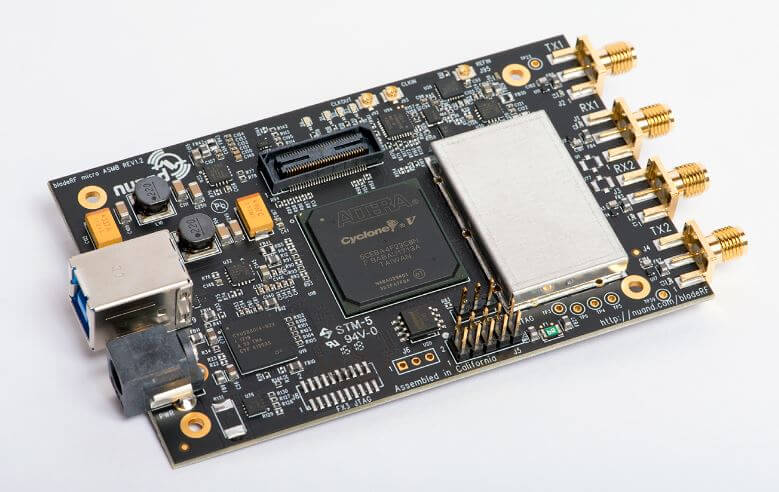
There are two options for sale, the US$480 xA4 version and the US$720 xA9 version. The differences between the two appear to be entirely in the FPGA, with the more expensive version having an FPGA that contains many more logic elements which means that more DSP hardware can be synthesized on it. The RF transceiver chip used is the AD9361, which is the chip used on most high end SDRs like USRP's.
The bladeRF 2.0 micro is the next-generation 2x2 MIMO, 47MHz to 6GHz frequency range, off-the-shelf USB 3.0 Software Defined Radio (SDR) that is easy and affordable for students and RF enthusiasts to explore wireless communications, yet provides a powerful waveform development platform expected by industry professionals.
Support is available for Linux, macOS, and Windows. The bladeRF libraries, utilities, firmware, and platform HDL are released under open source licenses, and schematics are available online. The FPGA and USB 3.0 peripheral controller are programmable using vendor-supplied tools and SDKs that are available online, free of charge.
The bladeRF 2.0 micro features support for: GNU Radio via gr-osmosdr, Pothos via SoapySDR, SDRange, SDR Console, SDR # via sdrsharp-bladeRF, YateBTS, OpenAirInterface, srsUE & srsLTE, MathWorks MATLAB® & Simulink® via libbladeRF bindings.
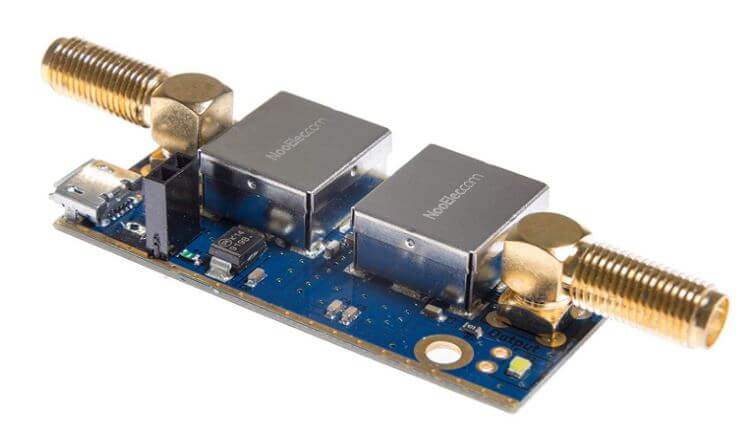
NooElec has just released their new "SAWbird" GOES LNA for sale. This is an LNA and filter combination designed to help receive GOES weather satellite images. On the PCB is a 1688 MHz SAW filter and a low noise amplifier. It can be powered with 3V - 5.5V connected directly or via bias tee. The SAWbird is currently available on Amazon and their store for US$34.95. They also have a version for Inmarsat and Iridium, so make sure you choose the correct one.
GOES 15/16/17 are geosynchronous weather satellites that beam high resolution weather images and data. In particular they send beautiful 'full disk' images which show one side of the entire earth. As GOES satellites are in a geosynchronous orbit, the satellite is in the same position in the sky all the time, so no tracking hardware is required and images can be constantly pulled down throughout the day without having to wait for a satellite to pass over.
However, compared to the more familiar and easier to receive low earth orbit satellites such as NOAA APT and Meteor M2 LRPT, geosynchronous satellites like GOES are quite a bit further away, and transmit at 1.7 GHz. So to receive the signal you'll need a dish antenna that you can accurately point, a good low noise figure LNA and possibly a filter. So setting up a receiver is a bit more difficult when compared to receivers for NOAA and Meteor satellites. The SAWbird should help however, by providing a ready to use LNA+Filter combination.
Over the past few months several testers have already received engineering samples of the SAWbird and have been successful at receiving GOES images. From the results of several experimenters, it appears to be possible to use a cheap 2.4 GHz WiFi grid antenna with some minor modifications as a GOES satellite antenna. Get one with at least a one meter long width and bend the feed as described here or here to tune reception for the 1.7 GHz GOES frequency. Pieter Noordhuis has also shown that it's possible to use an RTL-SDR to receive GOES images, so an entire GOES system can be built on a budget.
NooElec SAWbird LNA + Filter for GOES reception.GOES Full Disk Image of the Earth
Hackaday's Hack Chats are a weekly live community chat session where some knowledgeable guests are brought in to chat with the audience. This weeks upcoming chat on Friday is all about GNU Radio, a block based programming language that is commonly used with SDRs like the RTL-SDR. They write:
Our guests for this week’s Hack Chat will be Derek Kozel and Nate Temple, officers of the GNU Radio project. They’re also organizers of this year’s GNU Radio Conference. Also joining in on the Hack Chat will be Martin Braun, community manager, PyBOMBS maintainer, and GNU Radio Foundation officer.
GNU Radio is perhaps the most important bit of any software defined radio toolchain. This is the software that provides signal processing blocks to implement software defined radios. GNU radio is how you take a TV tuner USB dongle and pull images from satellites. You can use it for simulation, and GNU Radio is widely used by hobbyists, academics, and by people in industry.
The Hack Chat starts on Friday August 31, 2018 at noon PDT. You can leave a comment for the Hack Chat now by leaving a comment on the event page.
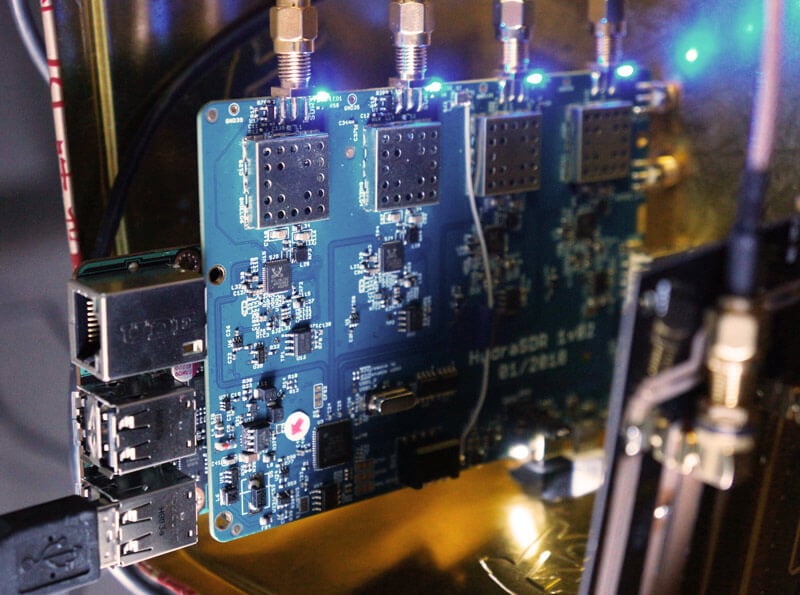
Over the last few months we've been working on a 4-input coherent RTL-SDR called 'KerberosSDR' (formerly known as HydraSDR) that is designed to be a low cost way to get into applications such as RF direction finding, passive radar, beam forming and more. It can also be used as a standard 4-channel SDR for monitoring multiple frequencies as well.
Phase coherent RTL-SDRs have been worked on and demonstrated several times over the past few years, but we've been disappointed to find that so far there hasn't been any easy way to replicate these experiments. The required hardware has been difficult to build and access, and the software has been kept as unreleased closed source or has been too complicated to install and use. With KerberosSDR we aim to change that by making phase coherent applications easier to access and run by providing ready to use hardware and software.
Thanks to our developer Tamás Peto, a PhD student at Budapest University of Technology and Economics whom we hired via the ad in our previous post, and the Othernet (formerly Outernet) engineering team who are our partners on this project, we've been able to build a working system, and demonstrate coherent direction finding and passive radar working as expected (demo videos below). We plan to eventually release Tamás' code as open source so that the entire community can benefit and build on it. Also if KerberosSDR turns a profit, we plan to reinvest some of the profits into continually improving the software and expanding the list of use cases.
KerberosSDR will be usable for coherent applications from ~80-100 MHz up to 1.7 GHz (as a standard receiver it will work down to 24 MHz like a regular RTL-SDR). The lower coherent limitation is due to the phase calibration board, and could be improved by custom creating a larger calibration PCB.
At the moment we are finalizing our prototype, and plan to begin final production within the next 2-3 months.
If you have any interest in KerberosSDR, please sign up to our Kerberos mailing list.
Direction Finding
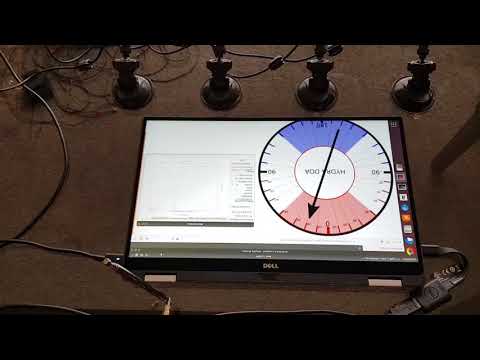
KerberosSDR can be used to find the bearing towards a signal using it's coherent direction finding capabilities. The software by Tamás currently implements several direction finding algorithms such as Bartlett, Capon, Maximum Entropy (MEM) and MUSIC. In the video below we show a quick test of the direction finding system working with a HackRF being used as a signal source, and four dipole antennas connected to KerberosSDR in a linear array. The MUSIC algorithm is used.
KerberosSDR Direction Finding Test
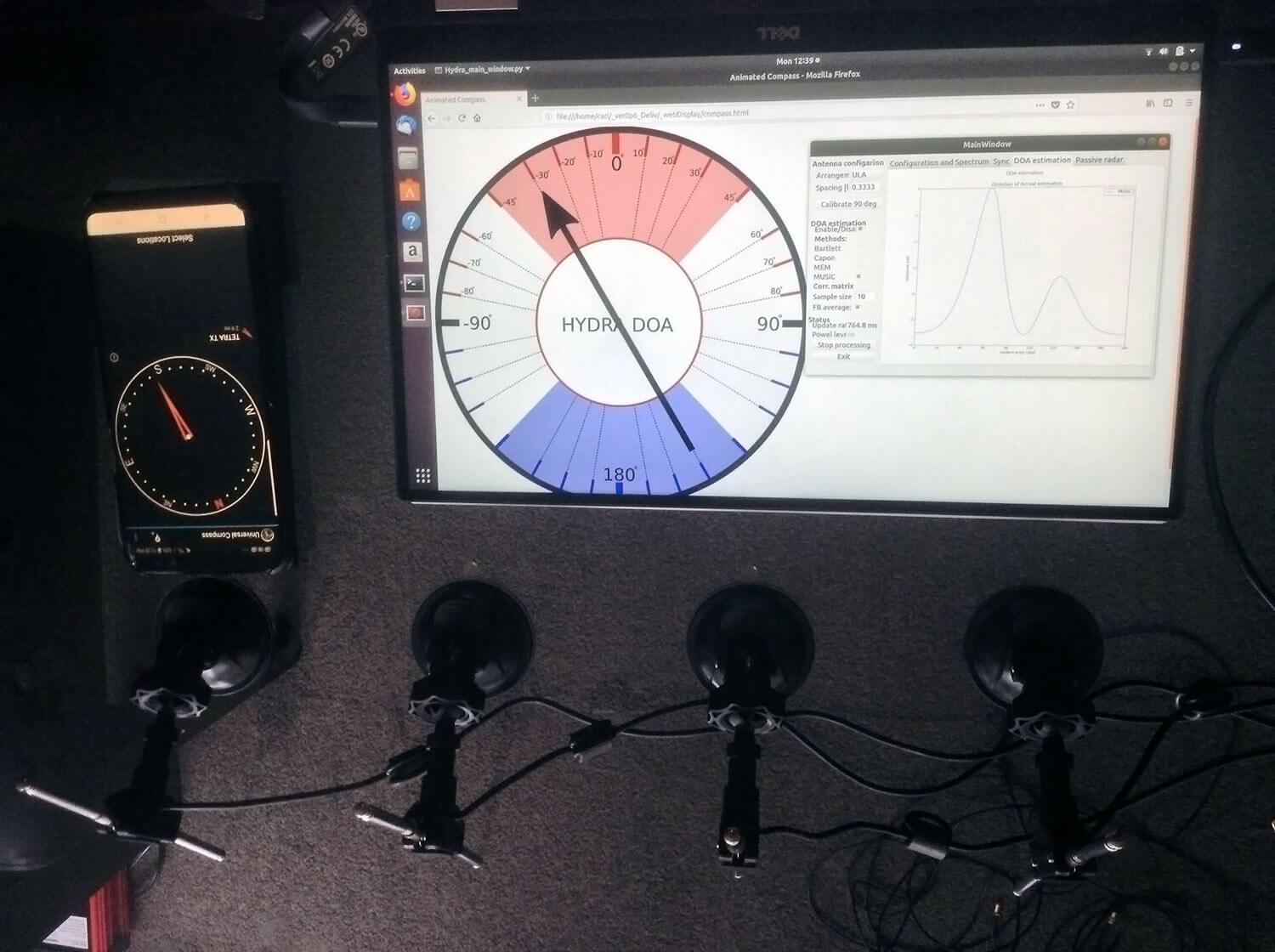
In the image below we also attempted to find the direction towards a known TETRA transmitter. We were able to confirm the direction with an Android compass app that points towards the known transmitter location. As the two angles match, we can be confident that Kerberos is finding the correct direction to the transmitter.
Finding the direction of a TETRA Transmitter
Passive Radar
KerberosSDR can also be used for passive radar. Normal radar systems work by transmitting a pulse of RF energy, and listening to the reflections from objects like planes, cars and ships. Passive radar works by using already existing transmitters such as those for FM/TV and listening for reflections that bounce of objects.
With a simple passive radar system you need two directional antennas and two coherent receivers. One antenna points at the transmitting 'reference' tower, and the other at the 'surveillance' area where you want to listen for reflections. It's important to try and keep as much of the reference signal out of the surveillance antenna as possible, which is why directional antennas like Yagi's are used.
The result is a doppler vs time delay graph, where the reflection of aircraft, cars, ships and other objects can be seen. The doppler gives you the speed of the object relative to your antenna and the transmitting tower, and the time delay gives you the distance relative to your antenna and the transmitter tower.
Below is an example time lapse video of KerberosSDR being used for passive radar. The reference antenna points towards a DVB-T transmitter at 588 MHz, and the surveillance antenna overlooks a small neighborhood, with aircraft sometimes flying over. The antennas we used were two very cheap TV Yagis.
You can constantly see the reflections from vehicles at small doppler values (low speeds), and every now and then you see an aircraft reflection which shows up at much higher doppler (speed) and further time delay (distance) points.
More information about KerberosSDR
KerberosSDR includes:
4x Coherent R820T2 based RTL-SDR dongles with standard 24 MHz - 1.7 GHz frequency range
On board GPIO switched wide band noise source for sample sync and phase calibration
Special phase calibration PCB for 4x inputs. Required to make the Kerberos phase coherent.
On board USB Hub, so only one USB port is required on the PC
Shielded metal enclosure
KerberosSDR can also be extended to 8x receivers by daisy chaining two boards together, so that their clocks and noise sources are connected. We've also taken into account undesirable effects such as heat related PLL drift which can be an issue for phase coherence.
At the moment we are also investigating whether singleboard computers like the Raspberry Pi 3 or Tinkerboard can be used, and there will be a header available for powering them via the Kerberos PCB. In the future we also plan to work on optimizing the code and potentially using CUDA/OpenCL GPU optimizations for passive radar so everything runs smoothly.
Once released we plan to have extensive tutorials and documentation that show exactly how to set up and replicate direction finding and passive radar experiments with low cost antennas.
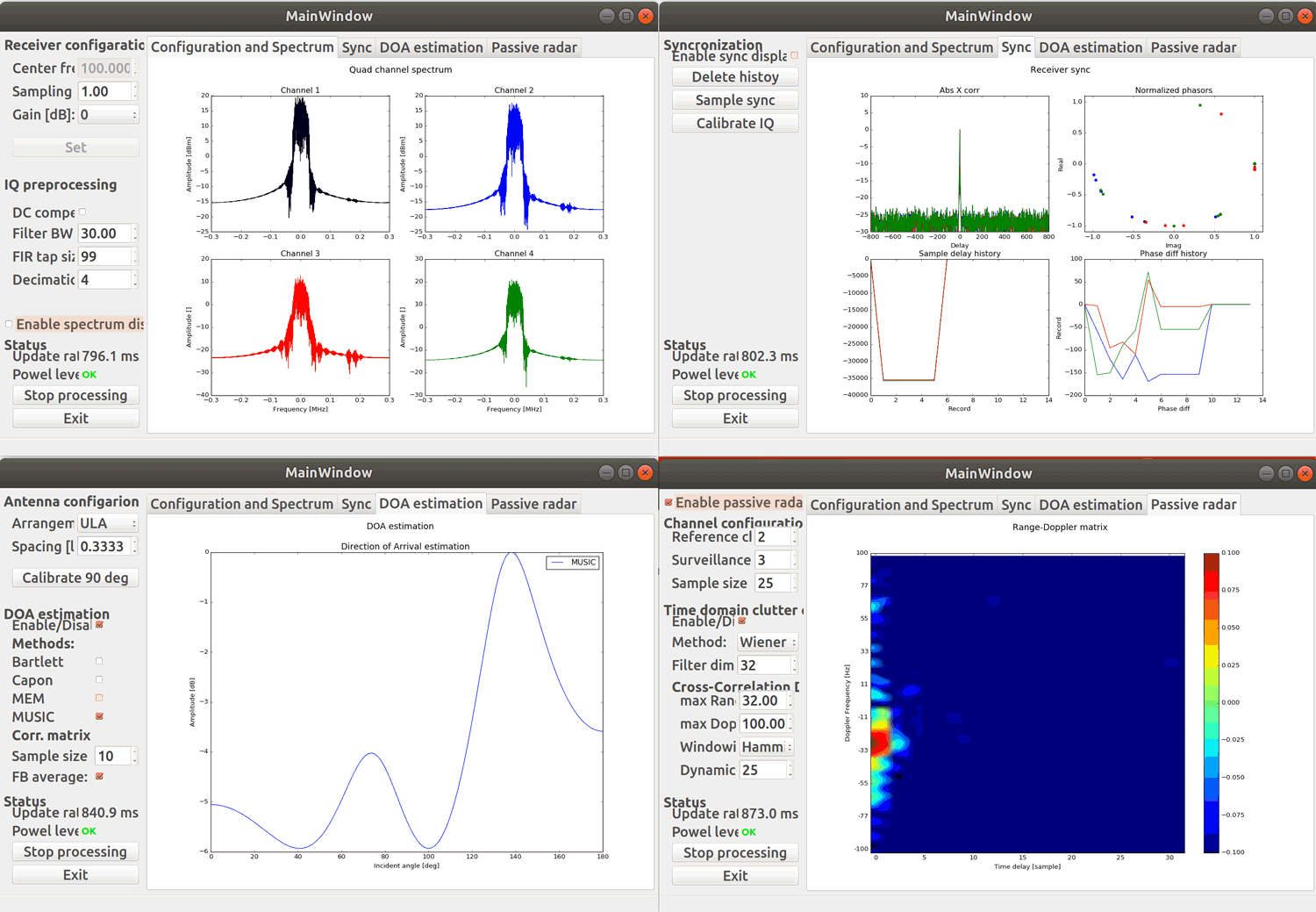
Screenshots of KerberosSDR software:
Screenshots of each KerberosSDR software screen
Remember, if you're interested please sign up to the KerberosSDR mailing list for announcements and the chance to get in early with the cheaper first 100 units.
Be on the look out for more interesting demos that will be posted in the coming weeks!
[the_ad id="14114"]
Update: Please note that due to a Trademark complaint, we have changed the name of this unit from HydraSDR to KerberosSDR.
KerberosSDR Updates: 27 August 18
This week we've managed to get the KerberosSDR demo software made by Tamás Peto functioning on a TinkerBoard. The TinkerBoard is a US$60 single board computer. It's similar to a Raspberry Pi 3, but more powerful. We've also tested the app running on the Raspberry Pi 3 and Odroid XU4. The Pi 3 is capable of running the software but it is a little slow, and the Odroid XU4 is a little faster than the TinkerBoard. In the future we hope to further optimize the code so even Raspberry Pi 3's will be smooth.
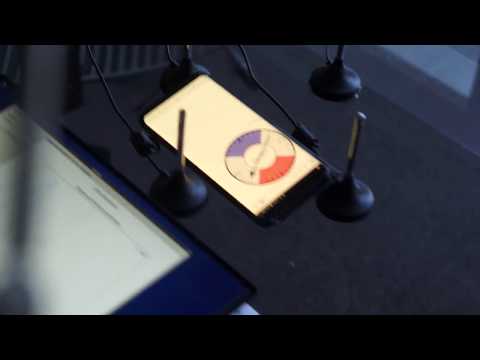
In the video below we used a circular array of four whip antennas connected to KerberosSDR. The TinkerBoard is connected to KerberosSDR and is set up to generate a WiFi hotspot, which we connect to with an Android phone and a Windows laptop. The Windows laptop connects to the TinkerBoard's desktop via VNC, and the Android phone receives an HTML/JavaScript based compass display via an Apache server running on the Tinkerboard. With this setup we can wirelessly control and view information from KerberosSDR and the TinkerBoard.
We've also tested the KerberosSDR system on a real signal, and have found it to work as expected. More demo's of that coming later.
KerberosSDR Direction Finding Test 2: Tinkerboard + Circular Array
KerberosSDR Prototype with TinkerBoard Running Computations
KerberosSDR Updates: 4 September 2018
In this post we'll show an experiment that we performed which was to pinpoint the location of a transmitter using KerberosSDR's coherent direction finding capabilities. RF direction finding is the art of using equipment to determine the location of a transmitting signal. The simplest way is by using a directional antenna like a Yagi to try and determine the bearing based on signal strength. Another method is using a pseudo-doppler or coherent array of antennas to determine a bearing based on phase information.
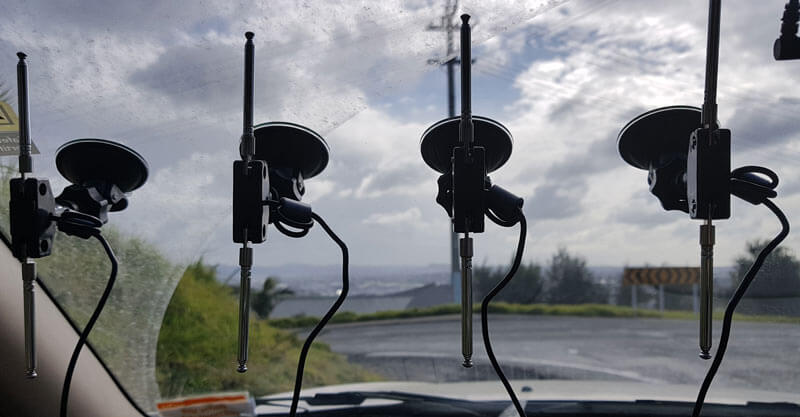
For the test we tuned the KerberosSDR RTL-SDRs to listen to a signal at 858 MHz and then drove to multiple locations to take direction readings. The antennas were set up as a linear array of four dipole antennas mounted on the windshield of a car. To save space, the dipoles were spaced at approximately a 1/3 the frequency wavelength, but we note that optimal spacing is at half a wavelength. The four dipole antennas were connected to KerberosSDR, with a laptop running the direction finding demo software.
Low cost direction finding array mounted to vehicle windshield.
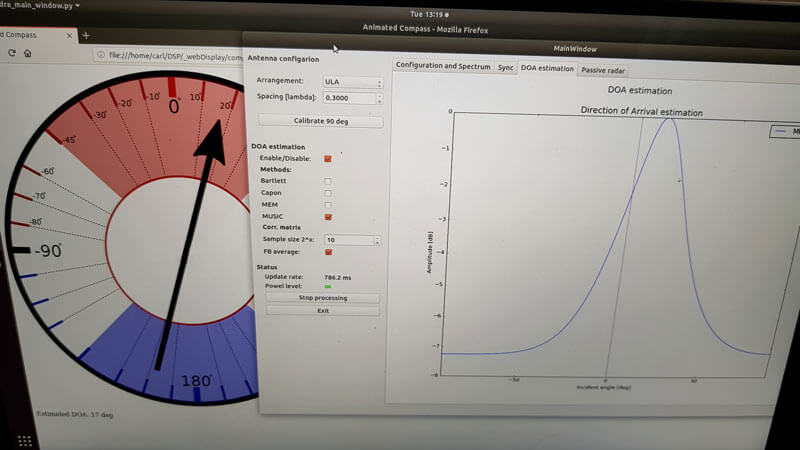
Our open source demo software (to be released later when KerberosSDR ships) developed by Tamás Peto gives us a graph and compass display that shows the measured bearing towards the transmitter location. The measured bearing is relative to the antenna array, so we simply convert it by taking the difference between the car's bearing (determined approximately via road direction and landmarks in Google Earth) and the measured bearing. This hopefully results in a line crossing near to the transmitter. Multiple readings taken at different locations will end up intersecting, and where the intersection occurs is near to where the transmitter should be.
KerberoSDR SDR Directing Finding DOA Reading
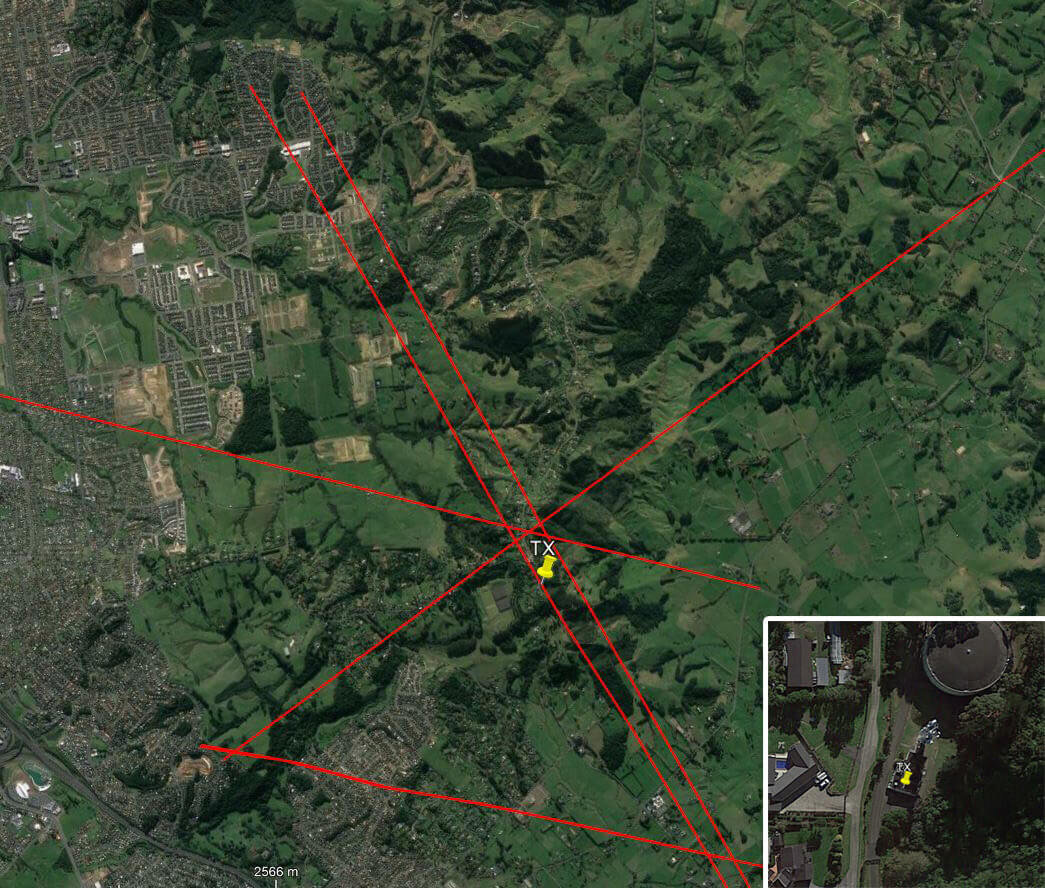
In the image below you can see the five bearing measurements that we made with KerberosSDR. Four lines converge to the vicinity of the transmitter, and one diverges. The divergent reading can be explained by multipath. In that location the direct path to the transmitter was blocked by a large house and trees, so it probably detected the signal as coming in from the direction of a reflection. But regardless with four good readings it was possible to pinpoint the transmitting tower to within 400 meters.
In the future we hope to be able to automate this process by using GPS and/or e-compass data to automatically draw bearings on a map as the car moves around. The readings could also be combined with signal strength heatmap data for improved accuracy.
This sort of capability could be useful for finding the transmit location of a mystery signal, locating a lost beacon, locating pirate or interfering transmitters, determining a source of noise and more.
KerberosSDR pinpointing a transmitters location
KerberosSDR Updates 7 September 2018
For this test we parked our car to the side of a highway and pointed a cheap DVB-T Yagi antenna towards a DVB-T transmission tower, and another cheap Yagi down the road. The video shown below displays the results captured over a 5 minute period. The blips on the top half of the display indicate vehicles closing on our location (positive doppler shift), and the blips on the bottom half indicate objects moving away (negative doppler shift).
DVB-T Antennas In Car
The resolution of each individual vehicle is not great, but it is sufficient to see the overall speed of the highway and could be used to determine if a road is experiencing traffic slowdowns or not. When larger vehicles pass by it is also obvious on the display by the brighter blip that they show. The display also shows us that the highway direction coming towards us is much busier than the direction moving away.
In the future we'll be working on optimizing the code so that the display updates much faster and smoother. It may also be possible in the future to use the third and fourth tuners to obtain even greater object resolution.
KerberosSDR Updates 27 September 2018
In this post we're showing some more passive radar demos. The first video is a time lapse of aircraft coming in to land at a nearby airport. The setup consists of two DVB-T Yagi antennas, with KerberosSDR tuned to a DVB-T signal at 584 MHz. The reference antenna points towards a TV tower to the west, and the surveillance antenna points south. Two highlighted lines indicate roughly where reflections can be seen from within the beam width (not taking into account blockages from mountains, trees etc).
The second video shows a short time lapse of a circling helicopter captured by the passive radar. The helicopter did not show up on ADS-B. On the left are reflections from cars and in the middle you can see the helicopter's reflection moving around.
We are expecting to receive the final prototype of KerberosSDR within the next few weeks. If all is well we may begin taking pre-orders shortly after confirming the prototype.
Cyberspectrum #23 is now live and can be viewed via the YouTube live stream below. It should be available for delayed viewing after the event as well. The talks include SDR and radio related topics on subjects such as:
HAARP ionosphere research
An open source implementation of DVB-S2 and DVB-S2X for both satellite and terrestrial amateur radio use
An open source SpyServer based tool for automatically demodulating/recording and parsing RF data
Reverse engineering X-Band satellites
An RTL-SDR powered web based trunking scanner with timeshifting capabilities.
Cyberspectrum Special: DEF CON Wireless Village
Since out last post previewing the event, some new talks have been added, and we've posted the line up and info below.
At this years DEFCON conference SDR evangelist Balint Seeber will be hosting Cyberspectrum #23. DEFCON is a yearly conference with a focus on hacker topics, which often include SDRs and other radio topics too. This years conference will be help on August 9 - 12 a Caesars Palace & Flamingo in Las Vegas. Cyberspectrum is an almost monthly meetup of SDR enthusiasts and researchers that is normally held in the San Francisco Bay Area, but often hosts remote speakers via teleconference. This months meetup will be held at DEFCON on August 9, hosted by the Wireless Village.
Chris Fallen, Ph.D. (@ctfallen):"Opportunities for radio enthusiasts and heaters of the ionosphere: HAARP is just another instrument, or is it?"
Preview of a future #cyberspectrum talk: Background of passive and active ways to get involved with HAARP experiments (and perhaps with other natural natural ionosphere events) based on prior and ongoing work.
Open Research Institute (ORI) is a new non-profit research and development organization which provides all of its work to the general public under the principles of Open Source and Open Access to Research.
One of our projects is called Phase 4 Ground. Our mission is to provide an open source implementation of DVB-S2 and DVB-S2X for both satellite and terrestrial amateur radio use. Phase 4 Ground radio system has a 5GHz uplink and a 10GHz downlink. We are developing SDR software that heavily leverages IP multicast and RTP protocols to set up and tear down distributed remote radio functions.
The reference designs are in GNU Radio and we will provide recipes for as many SDRs as possible.
Phase 4 Ground radios are intended to be reusable and reconfigurable, supporting payloads at GEO (AMSAT Phase 4B), HEO (AMSAT Phase 3E), and beyond (such as NASA's Cube Quest Challenge). Additionally, our radios will work as terrestrial microwave stations. These 'Groundsats' on mountaintops or towers establish a fun and flexible digital microwave experience. If you want to build up your radio from SDRs, you can. If you want to build it entirely from scratch, then you can. Our manufacturing partner for an off-the-shelf design is Flex Radio.
Lucas Teske (@lucasteske): SegDSP SpyServer Segment Digital Signal Processor
SegDSP is a WIP "Segment Digital Signal Processor" that is tuned for connecting into a SPY Server and do automatically demodulation/recording/parsing of RF data. This talk will be about what it does today, how was the development, how it works, how it will work and what are the uses for it. Tired of losing the pass of a LEO satellite? Want to hear the recording from last week? SegDSP is a Open Source tool made in Go for both learning and monitoring Satcom and Terrestrial Com.
Luigi Freitas (@luigifcruz): "Reverse Engineering X-Band Satellites Datalink And The Worst Software Defined Radio Ever"
This talk will be about the reverse engineering process of the next generation X-Band datalink signal on-board of Sun Synchronous Satellites like Suomi (NPP) and NOAA-20 (NPOESS/JPSS-1). From the RAW I/Q recording to the decompressed high-resolution Earth pictures. This is the latest addition to the Open Satellite Project, a non-profit organization that is committed to develop and publish software tools and hardware projects that enable the Open-Source Community to access spacecraft non-sensitive data.
The other half (or so) of this talk will be about the “Worst SDR Ever” that is made entirely of dirty cheap parts readily available from China. This project is intended to demonstrate how a Software Defined Radio works utilizing real hardware and comprehensive modular software.
At this years DEFCON conference SDR evangelist Balint Seeber will be hosting Cyberspectrum #23. DEFCON is a yearly conference with a focus on hacker topics, which often include SDRs and other radio topics too. This years conference will be help on August 9 - 12 a Caesars Palace & Flamingo in Las Vegas. Cyberspectrum is an almost monthly meetup of SDR enthusiasts and researchers that is normally held in the San Francisco Bay Area, but often hosts remote speakers via teleconference. This months meetup will be held at DEFCON on August 9, hosted by the Wireless Village.
The planned talk overviews are listed below, and Balint would like to note that any physical attendees are welcome to get in contact with him and submit more talks. Previous Cyberspectrum talks can be viewed on this YouTube playlist.
Open Research Institute (ORI) is a new non-profit research and development organization which provides all of its work to the general public under the principles of Open Source and Open Access to Research.
One of our projects is called Phase 4 Ground. Our mission is to provide an open source implementation of DVB-S2 and DVB-S2X for both satellite and terrestrial amateur radio use. Phase 4 Ground radio system has a 5GHz uplink and a 10GHz downlink. We are developing SDR software that heavily leverages IP multicast and RTP protocols to set up and tear down distributed remote radio functions.
The reference designs are in GNU Radio and we will provide recipes for as many SDRs as possible.
Phase 4 Ground radios are intended to be reusable and reconfigurable, supporting payloads at GEO (AMSAT Phase 4B), HEO (AMSAT Phase 3E), and beyond (such as NASA's Cube Quest Challenge). Additionally, our radios will work as terrestrial microwave stations. These 'Groundsats' on mountaintops or towers establish a fun and flexible digital microwave experience. If you want to build up your radio from SDRs, you can. If you want to build it entirely from scratch, then you can. Our manufacturing partner for an off-the-shelf design is Flex Radio.
Lucas Teske (@lucasteske): SegDSP SpyServer Segment Digital Signal Processor
SegDSP is a WIP "Segment Digital Signal Processor" that is tuned for connecting into a SPY Server and do automatically demodulation/recording/parsing of RF data. This talk will be about what it does today, how was the development, how it works, how it will work and what are the uses for it. Tired of losing the pass of a LEO satellite? Want to hear the recording from last week? SegDSP is a Open Source tool made in Go for both learning and monitoring Satcom and Terrestrial Com.
Luigi Freitas (@luigifcruz): "Reverse Engineering X-Band Satellites Datalink And The Worst Software Defined Radio Ever"
This talk will be about the reverse engineering process of the next generation X-Band datalink signal on-board of Sun Synchronous Satellites like Suomi (NPP) and NOAA-20 (NPOESS/JPSS-1). From the RAW I/Q recording to the decompressed high-resolution Earth pictures. This is the latest addition to the Open Satellite Project, a non-profit organization that is committed to develop and publish software tools and hardware projects that enable the Open-Source Community to access spacecraft non-sensitive data.
The other half (or so) of this talk will be about the “Worst SDR Ever” that is made entirely of dirty cheap parts readily available from China. This project is intended to demonstrate how a Software Defined Radio works utilizing real hardware and comprehensive modular software.