Back in April we posted about the RFNM, an upcoming software defined radio project which will have eight 12-bit ADCs, up to 612 MHz real time bandwidth, and two DACs for transmitting with up to 153 MHz bandwidth. The standard board will support tuning from 600 - 7200 MHz, with tuning expanded down to 10 MHz via an RFFC2071A mixer.
They also updated their pricing, noting that they have upgraded a few specifications. The motherboard is set to be priced at $299. It will be available for preorder in August, with an expected October delivery date.
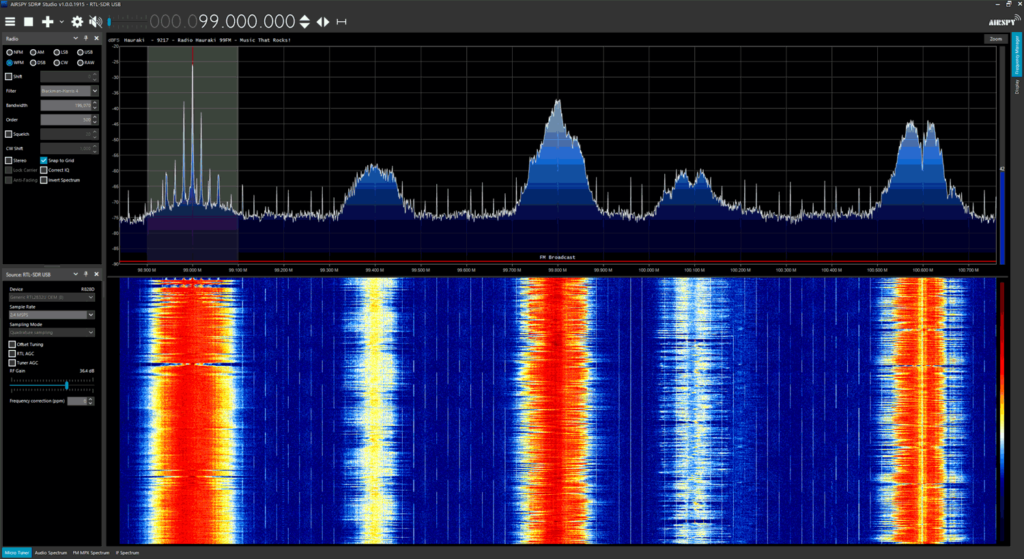
Thank you to SDR# author Youssef for updating SDR# (SDRSharp) and fixing a recent bug that was causing RTL-SDR units to crash whenever the frequency was changed. We are putting this post out to inform everyone who was having this issue to please update their SDRSharp version to 1915 which can be downloaded from airspy.com/download. Our guide at www.rtl-sdr.com/QSG can be used to walk you through the installation procedure for RTL-SDR dongles in SDR#.
The new update brings the RTL-SDR control menu down to the sidebar making it much easier to control the gain and sample rate settings. Other recent changes have also brought improvements to the RDS decoder which will be useful for DXers.
Please remember to show your appreciation to Airspy for allowing RTL-SDR users on their platform by checking out their range of higher end softwire defined radio products at airspy.com.
Meteor-M satellites are Russian owned weather imaging satellites that are in polar orbit. They transmit images to earth in the LRPT format at 137 MHz, making them almost as easy to receive as the older NOAA APT satellites. Unfortunately all prior Meteor M satellites have suffered an early ending or partial ending to their mission from technical faults or micro-meteorite collisions.
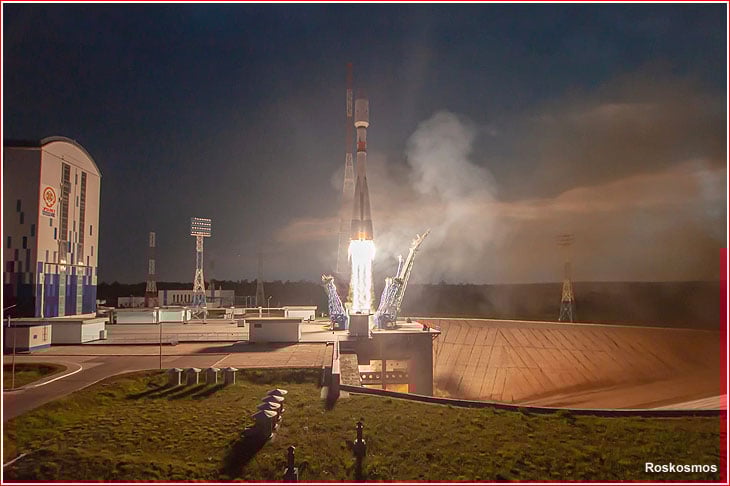
However, on June 27th 2023 the latest Meteor M2-3 satellite was successfully launched on a Soyuz-2 and has been reported to be already transmitting LRPT images of the earth.
Soyuz-2 Launch of Meteor M2-3 and 42 Cubesats
To receive images from the Meteor M2-3 satellite you will need an appropriate 137 MHz satellite antenna such as a v-dipole, Turnstile or QFH. An RTL-SDR or any similar SDR can be used as the receiver.
These days, the easiest software to use to receive Meteor M2-3 is probably SatDump, whose Windows and Android binary releases can be downloaded from the GitHub Releases page. Linux users can follow the build guide in the SatDump Readme. We note that we've found the SatDump GUI to run well on an Orange Pi 5, which makes this a good portable solution too.
To determine when the satellite is over your location you can use satellite tracking software such as Gpredict on Linux and Mac, or Orbitron on Windows. (For Orbitron, remember to run the software as Administrator, and to update the TLEs so that the Meteor M2-3 weather.txt TLE tracking data is downloaded).
Over on Twitter we've already seen various Tweets about successful reception.
1st try w/ 137 MHz LRPT from the new METEOR-M N2-3 1500utc. So nice to have a higher resolution weather sat back on VHF! Images from I/Q replay in SatDump (https://t.co/A7V0MeqeGE) pic.twitter.com/OMs1zjpKb4
Second pass of the newly launched Meteor-M 2-3
This time all worked like a charm and the picture is superb. I tried dual band to compare both LRPT in 137.900 and HRPT in 1700. Although decoded shown picture is from the HRPT stream.
@aang254, the author of SatDump has also noted that he is working on finalizing projections for Meteor M2-3 and this should be ready to use in SatDump shortly.
METEOR-M 2-3 is active, and I have added initial support including projections in SatDump already.
We also note that a Meteor Demodulator has also now just been added to SDR++.
The OQPSK mode has been added to the #Meteor demodulator to decode Meteor M N2-3. Enable it when receiving said satellite. It will be available for download in a few minutes when the nightly build is done building.
Note that some more tuning will be done in the coming days.#SDRpic.twitter.com/DB307Q5ObD
Another interesting fact is that along with Meteor M2-3 the UmKA cubesat was launched will transmit astronomical images at 2.4 GHz. To receive this, you will most likely need a 2.4 GHz WiFi dish, and also a motorized tracking system to track the satellite as it fly's overhead. Decoding of this is already supported in SatDump according to the programmer.
METEOR-M 2-3 is launching tomorrow, and with it UmKA that @HRPTEgor worked on.
It will transmit astronomical imagery on amateur bands 2.4Ghz. As such, I have added support for it in SatDump just now :-)
SDR# (SDRSharp) is our recommend software for RTL-SDRs due to it's high popularity in the community, relatively simple to learn and use interface, and host of features and third party plugins available.
Recently we're starting to see a lot of Facebook and forum posts about a new bug introduced in SDR# 1911 - 1913 so we thought we'd make a global post. This new bug has introduced a problem which causes a crash when attempting to change frequencies with RTL-SDR dongles (of any make or brand). It appears to be an issue stemming from libusb, but the exact issue is still unknown. The SDR# author is aware of the issue, but as RTL-SDR dongles are supported in SDR# for free with no guarantee, it may be several weeks until he has the time to investigate the issue fully. In the meantime we want to note some some partial fixes that we have found.
The first fix is to use our "rtl-sdr-blog" drivers instead of the default osmocom drivers. Our Quickstart guide now shows how to download these drivers and install them into SDR#, so if you want to try this solution, please see the guide. We're not exactly sure why this driver helps, but it may be due to our version being compiled against a newer version of libusb. However, this fix is only partial. While it no longer crashes on every frequency change, it will still crash approximately 5% of the time on a frequency change, which can add up when surfing through the spectrum rapidly, or when using frequency scanners.
We have also found a second fix that almost completely eliminates the crash, but it appears that it only works on some PCs. This fix is to use our rtl-sdr-blog drivers, and at the same time use Zadig to install the "libusb-win32" version of libusb, instead of the WinUSB version. However, the libusb-win32 is old, and it only appears to work on some PCs. On others it causes SDR# to crash as soon as the RTL-SDR is loaded.
Alternatively you can simply use a legacy version of SDR# by clicking the "Latest dotnet x.x build" links on the SDR# downloads page.
The final alternative would be to use another program like SDR++, which is very similar to SDR#, but without a large amount of plugins available yet. We have also added a SDR++ installation guide to our quickstart guide.
Airspy is currently holding their annual summer sale which gives 15% off their line of products until June 25. The sale brings the price of the popular Airspy receiver products down to the following in US dollars (note that actual pricing may vary across local resellers):
Airspy R2: $169.00 $143.65
Airspy Mini: $99.00 $84.15
Airspy HF+ Discovery: $169.00 $143.65
Airspy SpyVerter R2: $49.00 $41.65
YouLoop Antenna: $39.95 $33.95
The sale is active at all participating resellers, which includes our own store where we have the YouLoop on sale for US$33.95 including free shipping to most countries in the world. Please note that due to new EU VAT collection laws, EU customers must purchase the discounted YouLoop from our eBay or Aliexpress stores.
Back in May we posted about pre-release news of the uSDR, a duplex TX & RX capable software defined radio, with a frequency range of 300-3700 MHz, and up to 30.72 MSPS of sampling rate. It also has an interesting defining feature in that it can be controlled via a web browser and that it connect via an M.2 slot (with a USB adapter available too).
The CrowdSupply page has been updated and includes full details about the SDR, noting it's use of the LMS6002 SDR chip from Lime Microsystems and a Xilinx Artix 7 XC7A35T FPGA.
They also show screenshots of their web software which is looking pretty slick. It appears that you can instantiate various apps from the web interface. The apps include a 2G cellular network, FM receiver, IQ generator, IQ playback, frequency spectrum monitor, device sharing, signal analyzer, signal inspector and spectrogram.
uSDR. A Tiny M.2 single component SDR controlled from a Web browser
In May we posted about how Great Scott Gadgets (GSG), the team behind the HackRF SDR and several other popular products, are in the early stages of developing a new type of SDR product called the "Universal Radio Test Instrument" or URTI for short.
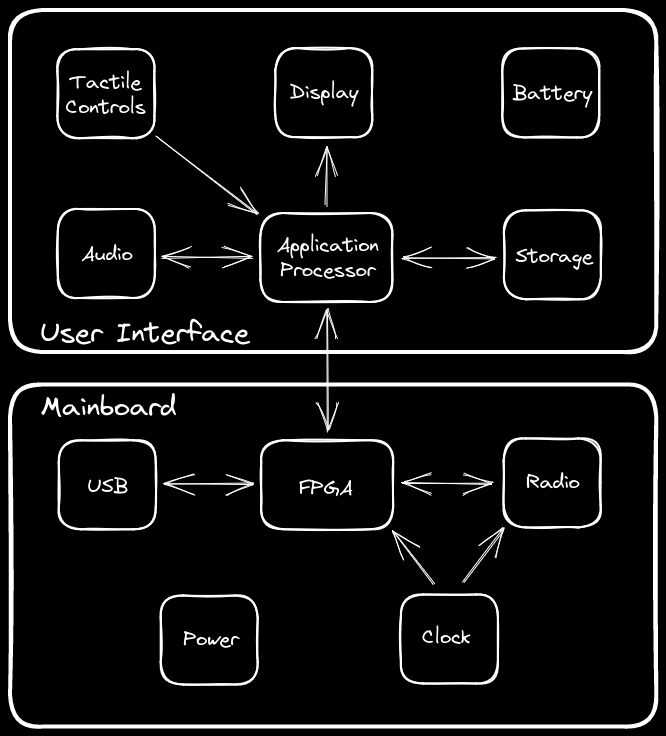
Thank you to a few blog readers for pointing out that earlier this month the URTI GitHub lab-notes were updated with a progress report, and some further information about the architecture. The URTI will be split into a mainboard PCB, and a user interface PCB. The former will contain the USB interface, FPGA computing, and radio, and the latter will run a display and tactile controls.
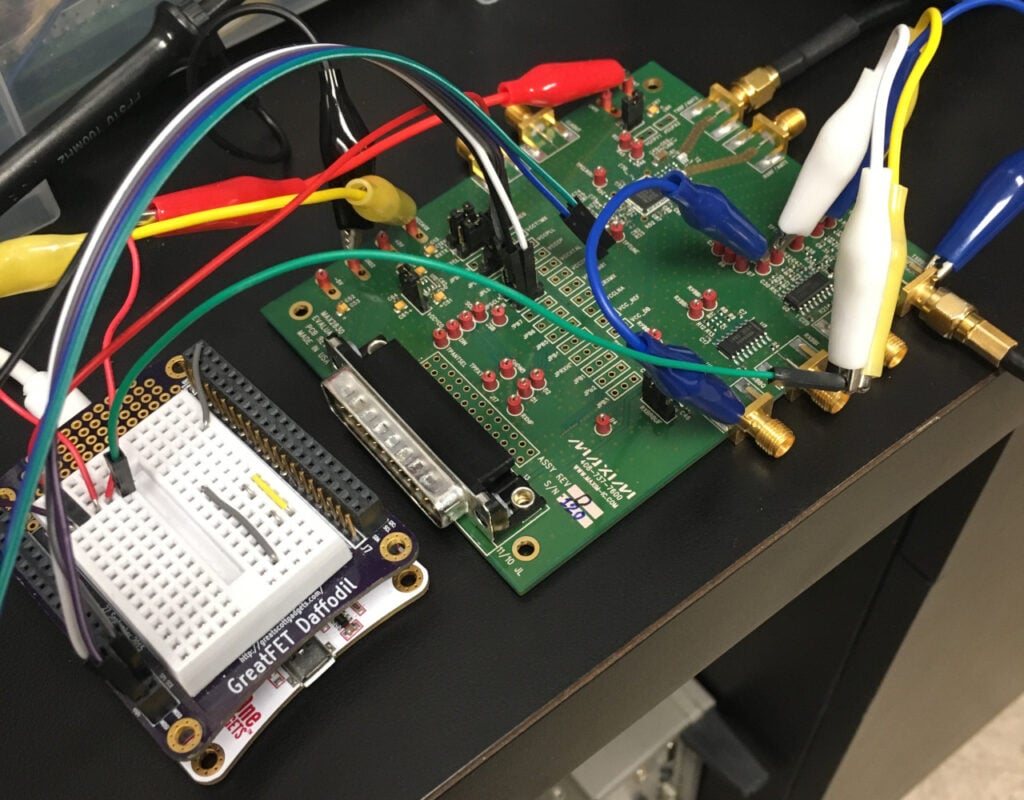
For the radio components, the team appear to be using similar components to what is used in the HackRF. They have selected the MAX5865 as their analog to digital converter (ADC) chip which is a faster sampling version of the MAX5864 which is used in the HackRF. They've also chosen either the MAX2831 or MAX2830 as their quadrature transmitter, and the MAX2120 as their quadrature receiver. They are also using the RFFC5072 chip as their mixer. These are again similar or the same as parts used in the HackRF.
In the update they also make notes on their SMA connector selection, PCB trace width selection, and their selection of Unun, RF switch, clock generator and RF limiter parts. They also note progress on their software which will provide a DSP library for the FPGA, and their tests of a display via a hand held game console.
In the next stage of development the team will be designing and assembling the mainboard to try and quickly make a platform available for software developers to get started on.
Testing the MAX2830 Chips with a GreatFETURTI Overall ArchitectureURTI Mainboard Architecture
Thank you to Marcus Müller for letting us know that a call for participation and registration for GRCon'23 (GNU Radio Conference 2023) is currently open. GNU Radio conference talks are generally about cutting edge radio research topics and applications that involve the use of GNU Radio, a popular DSP framework for SDRs. If you are interested, previous years talks can be found on the GNU Radio YouTube channel.
The deadline for participation to present is still open, having been extended to June 23. If you wish to submit an abstract you can do so here. Registration for in person attendance is also open. Alternatively, the talks can be viewed via livestream online for free or via a small donation.
GRCon'23 is happening in early September this year – so our submission deadlines are a bit tighter than usual.
Submission for talks, papers, workshops, and other contributions are accepted through the GRCon'23 website:
This call for participation closes on 5 June 2022! [Now extended to June 23]
A tiny bit about the GNU Radio conference:
GRCon is GNU Radio's annual conference, being held in changing cities in the U.S., and also live-streamed and chat-interacted online. Watching the main track online and interacting with the audience and speakers via chat are free. Registration for the in-person event started in March.
GRCon'23 happens 5 – 9 September in Tempe, Arizona at ASU.
What GRCon offers is a main track of presentations with topics on GNU Radio, applications of SDR / high-rate signal processing, computational radio science, scientific and industry developments, policy and technological breakthroughs.
Next to that, there's tutorials on specific topics, a poster session, Special Interest Groups and the developer's summit, which is the get-together for the project developers.
Oh, and of course, there's social events, happening at local highlight locations.
If you have *any* question (and I mean that – we're trying to make GRCon as accommodating as possible) about GRCon, be it about attendance, online participation, content submission or other problems related to the conference, we want you to reach out: Here on the mailing list, on the chat (https://chat.gnuradio.org), or in a private email to the GRCon organizers ([email protected]).