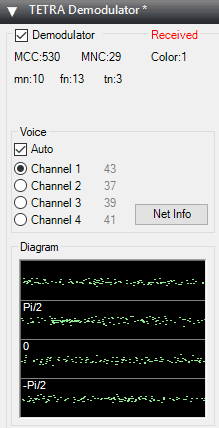
Last week we posted about the release of a new TETRA decoder plugin for SDR#. The plugin made setting up a TETRA decoder significantly easier compared to previous methods, but it still required the installation and use of the MSYS2 environment on Windows.
Thanks to reader Zlati for letting us know that the TETRA plugin has recently been updated once again and now no longer requires MSYS2 to be installed first. Now it is as easy to install as any other plugin, just drop the .dlls into the SDR# folder and add the magicline to the plugins.xml file. We tested it out and decoding worked fine. At the moment the "Net info" button is not working however.
In the future news and download lines for newer versions will probably be available on the programmers radioscanner.ru forum thread which is available here (use Google Translate to read): http://www.radioscanner.ru/forum/topic50051-9.html
A "Ghost Box" or "Spirit Box" is a tool used by paranormal investigators to talk with spirits via the claimed electronic voice phenomenon (EVP). Some believers in paranormal activity theorize that electronic radio devices or EM fields are susceptible to manipulation by other worldly spirits, and thus this can be used as a communications method. A Ghost Box is a radio device that rapidly tunes through broadcast FM radio stations, hoping to catch EVP replies by spirits from questions asked.
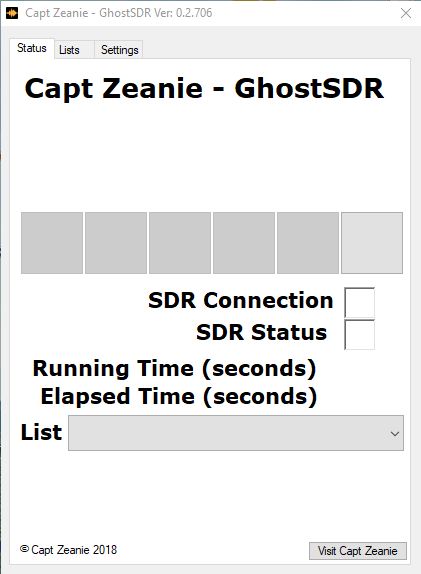
In the past we've seen that the RTL-SDR has been used for this purpose with the gqrx-ghostbox software. However as gqrx-ghostbox only runs on Linux, EVP researcher 'Capt Zeanie' decided to create 'GhostSDR' which is a ghostbox program that works with SDR# in Windows. The software interfaces with SDR# via the Remote Net SDR# plugin which allows SDR# to be controlled via a network connection. Note that when we tried to run it we got an invalid memory error, so it might still be a little buggy. If you have problems you can contact Zeanie over on our forums, where he has posted the following:
This is my version of a Spirit Box or Ghost Box but using a V3 instead of a complete handheld radio as these modified are quite expensive.
I use SDR# and the main application to interface with the V3, and I also use the Net Remote Plugin which allows me to control SDR# from my software.
A Ghost Box is a radio that is modified to quickly scan through the frequencies without stopping on an particular signal. So essentially it skips between frequencies. This supposedly help spirits be able to speak through the white noise etc. Any TV Paranormal show has one..
I have been researching EVP (Electronic Voice Phenomenon) and trying for over 2 years to see if EVP actually exists. As of yet after 100's of hours of recording on various equipment I have not had anything really come through. In EVP terms I am talking about Class A to Class B EVP's (ie loud and clear).
I started this research into EVP 2 years ago after my Father-in-law passed away at his home. A few months later Mother-in-law saw a man in a brown suit appear in her bedroom whilst getting into bed, after 10-15secs he just faded away. Now my Mother-in-law is trustworthy and does not lie, so I thought with my interest in the paranormal and my long experience with working in IT I thought I could try and see for myself and ended up being more interested in EVP's.
So to help me create a Ghost Box I have written GhostSDR
A pre-bought modified Ghost Box just usually scans through the AM or FM bands, whereas GhostSDR allow you to choose which frequencies you want to use, you are only limited to the capabilities of your chosen SDR Device (ie V3)
My software allows a user to create various frequency lists that has a starting Frequency, Ending Frequency, Skip frequency and bandwidth. ie Start at 72MHz, ending at 108MHz, skipping xxHz and using a user selectable bandwidth. It will sequential skip through the frequencies of be totally random (which modified handheld Ghost Boxes can not do)
There are few more features to add over time but I am trying this version for a few months before tweaking/adding things.
Over on YouTube user SignalSearch has uploaded a video showing how he uses an active magnetic loop antenna indoors to identify local noise sources. Magnetic loop antennas are directional, meaning that they receive best when pointing towards a signal. This means that they also receive noise better when pointed at a noise source. In the video SignalSearch uses a W6LVP receive loop antenna and demonstrates noise being emitted from his lightbulb, and from a plug in Ethernet over powerline adapter, which are known to be huge sources of HF noise.
If you are interested in the noise produced by these Ethernet over powerline adapters then we did a previous post on this problem over here.
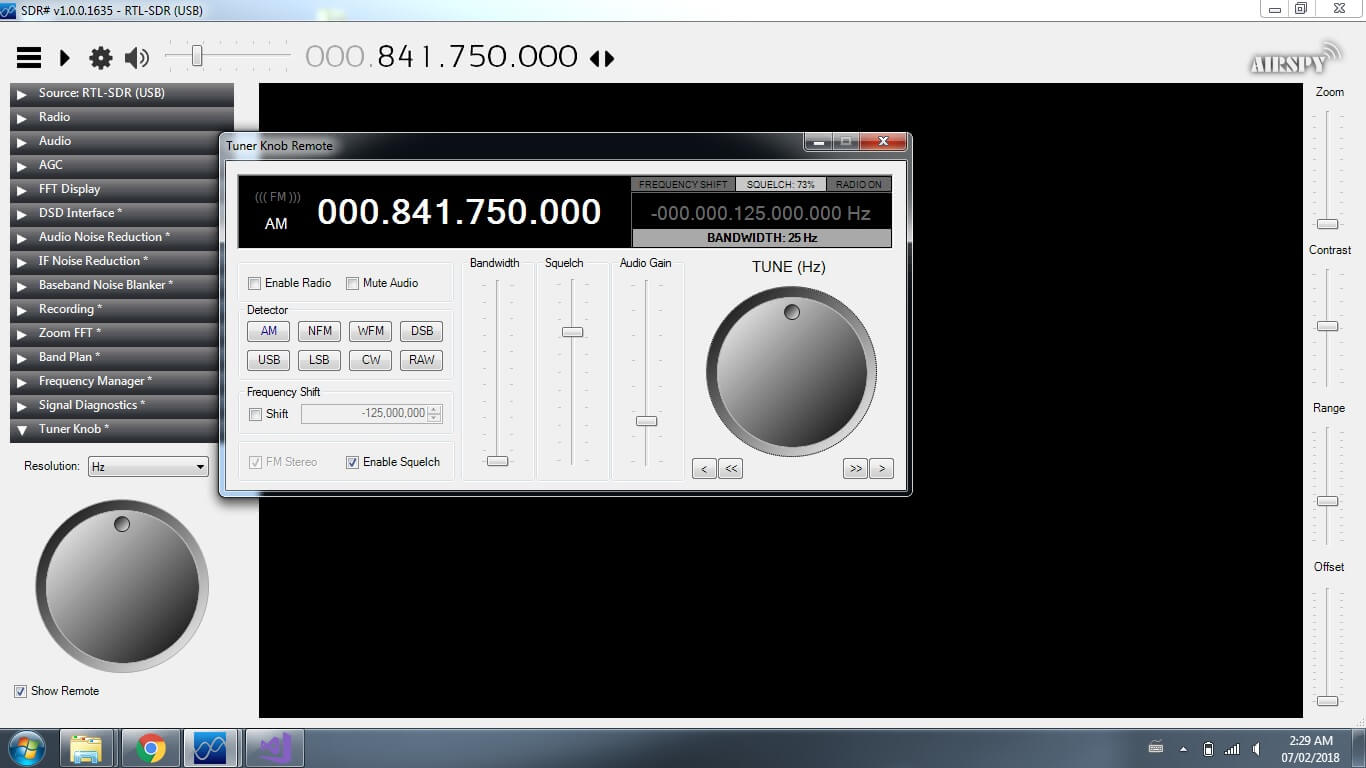
Recently we've posted about Eddie MacDonald's several releases of new plugins for the popular SDR# software. Recently he's released a tuner knob plugin which provides a visual frequency tuning knob that is useful for those running on touchscreen hardware, a 'dark mode' plugin which reduces the brightness of SDR# and compresses the UI a little, and an FFT grabber plugin which allows for easy screenshots of the FFT and waterfall spectrum's to be taken.
Eddie notes that all his plugins now have an actual home website at https://sdrplugins.com. This is where he will release updates and new plugins from now on.
If you are interested in discovering more SDR# plugins, we have a large list available here.
Back in September 2017 we posted about the start of a MOOC (massive open online course) run by Juan Moreno and some collegues from the Technical University of Madrid that aims to introduce students to DSP techniques and MATLAB using an RTL-SDR. The original course has already finished, but Juan has written in noting that the second run of the course is scheduled to start on March 12 2018. The course if free and if you are interested be sure to register on their website. Note that while the registration forms are in Spanish & Portuguese, the course itself is presented in English.
One useful improvement from the first course is that Mathworks, the company behind MATLAB have agreed to provide a free MATLAB licence to all students for the duration of the course. This should significantly lower the cost barriers to learning.
The course blurb reads:
SDR is a reality around us. It is present in a lot of systems everywhere and is a versatile technology which can be used for many things (not only academics and industrial). The purpose of this course is to introduce students into general-purpose SDR tools. The SDR hardware platform chosen for this course is the RTL-SDR. It is worldwide available, it’s cheap ($15) and there is a lot of help in the Internet. But, as far as we know, there is no other MOOC focused on an introduction to SDR as this MOOC. Here we will not only learn about SDR but also a lot of related areas like antennas, digital signal processing, radio frequency and communication electronics.
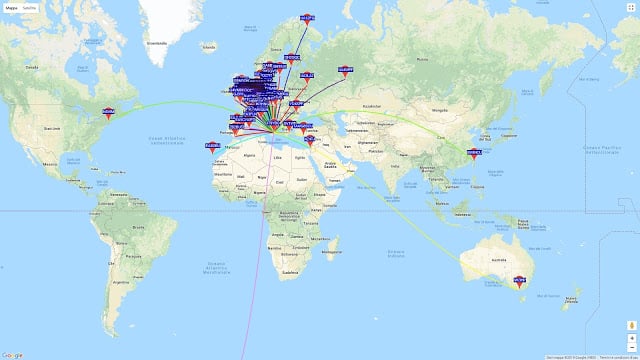
WSPR (pronounced "Whisper") is short for Weak Signal Propagation Reporting, and is a HF ham mode typically run on very low power levels such as 1W. The data from WSPR reception can be used to determine how good or bad HF propagation is currently around the world as each WSPR message contains a callsign, 6-digit locator and the transmit power level used. Received messages are all reported to the internet and can be viewed on an online map at http://wsprnet.org/drupal/wsprnet/map.
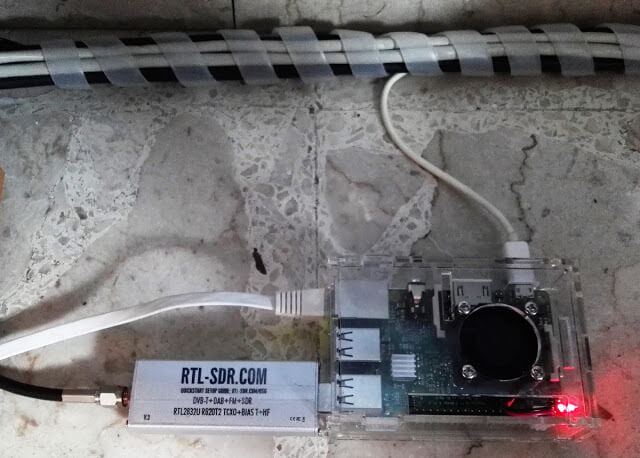
With an RTL-SDR V3 running in direct sampling mode it is possible to receive and decode these messages on a Raspberry Pi 3 using the WSPRD software.
Over on his website IT9YBG has uploaded a tutorial for a method that allows the WSPRD software to automatically change bands depending on the time of day. The method simply uses the crontab in Linux to automatically run a script that stops and then restarts WSPRD on a new frequency at certain times of the day. This is useful because different WSPR bands tend to become active at different times of the day due to changing HF propagation conditions.
WSPR messages received by IT9YBG from all over the world.
Jon Hudson, head of marketing at SDRplay has recently released a helpful tutorial that shows how to access remote servers in SDR-Console V3, and also how to set up your own server too. As you may already know, SDR-Console V3 provides a remote server platform which allows you to access all sorts of SDR hardware remotely over a network connection or over the internet. Some SDR hardware owners even opt to share their radio hardware publicly over the internet for anyone to access. The video description reads:
This video is a screen-by-screen guide to both accessing, and setting up your own, remote SDR radio using the new (Feb 2018) SDR Console V3 software from SDR-Radio. Although the guide uses an RSP2 from SDRplay, this will work with all the popular SDRs
Please note - you need to have a good internet connection since (unlike in V2), the entire I/Q data is being sent over the internet. This also limits how much visual bandwidth you are can see at any one time.
SOME IMPORTANT WARNINGS IF YOU ARE ADDING YOUR OWN SDR! Be careful not to plug multiple SDRs into a single USB2 socket - for multiple SDRs, you may need a powered hub ( like this: https://www.amazon.co.uk/UGREEN-Adapt... )
Once you are up and running - please go to http://www.sdr-radio.com/Software/Ver... and view your listing - if there is a yellow triangle, then you are not accessible outside your own firewall - attention is needed! Just because you can access it on your own LAN doesn't mean it's accessible via the internet!!!
The RSP family of SDRs from SDRplay cover 1kHz to 2 GHz with no gaps and give up to 10MHz spectrum visibility.
Jon's video first shows how to use SDR-Console V3 to access those publicly shared SDR radios over the internet. The second part of the video demonstrates how to set up your own server that you can use remotely for personal use, or to share over the internet.
The SDR-Console V3 server accepts various kinds of SDR hardware including RTL-SDR, Airspy, SDRplay, HackRF, Elad, LimeSDR and many more SDR units so this is a good way to explore various types of hardware, or simply to explore signals from different areas around the world.
Over on the YouTube channel Tech Minds the presenter has uploaded two new RTL-SDR based tutorial videos. The first video gives a bit of background and shows how to decode Morse code with an RTL-SDR. He uses SDR-Console V3 and the Morse code decoder CwGet. With this he's able to decode a few calls from some ham radio operators.
In the second video Tech Minds shows how to decode Weather Fax with the RTL-SDR. Weather faxes are images of weather charts sent over HF frequencies. In the video he uses SDR-Console and SeaTTY to do the decoding and demonstrates reception of an example fax.
The Real Matrix - Decoding Morse Code Using An RTL SDR Receiver
Receiving HF Weather FAX Using An RTL SDR Receiver