Thank you to Benjamin Larsson for submitting news about a FC0013 tuner patch he's submitted for the Osmocom RTL-SDR driver code. FC0013 based RTL-SDRs have been relatively unpopular due to the reduced tuning range of only 22 - 1100 MHz, compared to the larger 24 - 1766 Mhz range provided by the R820T2 chip. However, they have been found in some cheaper units.
Benjamin's patch reportedly improves UHF performance above 862 MHz, and also seems to make ADS-B reception usable.
The patch was submitted to the Osmocom GitHub, however, this Git is not monitored as Osmocom have their own patch submission system via mailing list. But if you have a FC0013 dongle and want to try it, the entire change consists of only a single register value change which could easily be manually modified in the driver code before compilation.
Register change to improve UHF performance on FC0013 RTL-SDR dongles.
A ground penetrating radar (GPR) is a system that uses RF pulses between 10 to 2.6 GHz to image up to a few meters below the ground. A typical GPR system consists of a transmitting radio and antenna that generates the radar pulse aimed towards the ground, and a receiving radio that receives the reflected pulse.
GPR is typically used for detecting buried objects, determining transitions in ground material and detecting voids and cracks. For example, in construction it can be used to determine rebar locations in concrete, and in the military it can be used to detect non-metallic landmines and hidden underground areas.
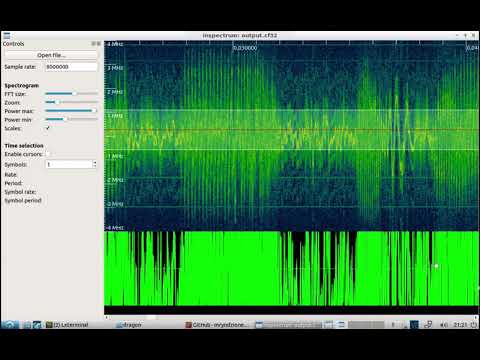
Their system uses a step-frequency continuous waveform (SFCW) signal which scans over multiple frequencies over time, and the software was written in GNU Radio. In their tests they were able to detect a dry block of sand buried 6 cm below the ground, and a wet block 20 cm below.
Ground Penetrating Radar with two HackRF software defined radios.
Thank you to Arty Bishop for submitting news about his recently released Android App called Look4Sat. Look4Sat is a satellite tracker and pass predictor with a focus on amateur radio and weather satellites. The app is free, ad free, and open source on GitHub. Arty writes that he's programmed this as a learning exercise and notes:
I always wanted to have an offline and not bloated satellite tracker on my phone, as carrying the laptop at all times is kinda not too handy.
The app uses predict4java library under the hood and is written in Kotlin. The TLE files are from Celestrak and the transmitters info is from SatNOGS and once they are ownloaded the app doesn't need an internet connection.
The app creation and design is hugely inspired by Gpredict which is an absolutely brilliant piece of software. Thank you, Alexandru!
Obviously there is no ads and it's totally free. Hope more people find Look4Sat useful.
The features include:
Calculating satellite passes for up to one week (168 hours)
Calculating passes for the current or manually entered location
Showing the list of currently active and upcoming satellite passes
Showing the active pass progress, polar trajectory and transceivers info
Showing the satellite positional data, footprint and ground track on a map
Offline first: pass prediction is done offline. It's up to you to decide when to update the TLE file and the transceivers DB. (Updates once a week are recommended)
Thank you to Happysat who has shared with us a useful tutorial that explains how we can run Linux only SDR programs on a Windows 10 system using the Windows Subsystem For Linux (WSL) feature. WSL is a feature available on Windows 10 which is a Linux compatibility layer designed for running Linux binaries natively on Windows 10. This means that no Virtual Machine with shared resources is required, instead the full resources of your system are available.
Happysat writes:
Many people using Windows 10 now since Windows 7 is EOL, and WSL is part of the system kinda "free" so why not use it :)
Together with a X-Server and and Desktop like XFCE4, it can be great for running SDR applications in Linux thru rtl_tcp.
Very fast startup in seconds and not much packet loss thru tcp, quite alot linux sdr applications are working very good.
No allocating resources like a VM.
Sometimes better then Ubuntu on a VM.
Software tested: AX-25 Packet Radio, Dab Radio, DSD, Es-Hail Beacon Tracker, Sat Tracking with Gpredict and Gqrx, NOAA Reception WxToImg, Radiosonde Decoding, Shortwave Reception and some more tips and tricks about WSl and SDR.
The steps appear to be fairly simple. Just enable WSL in the Windows 10 Features panel, download a Linux distro built for WSL and run the .exe file. Then you'll have access to a Linux terminal where you can install a GUI desktop environment, the RTL-SDR drivers, and other Linux SDR programs. Happysats tutorial shows how to install and use various Linux programs via WSL.
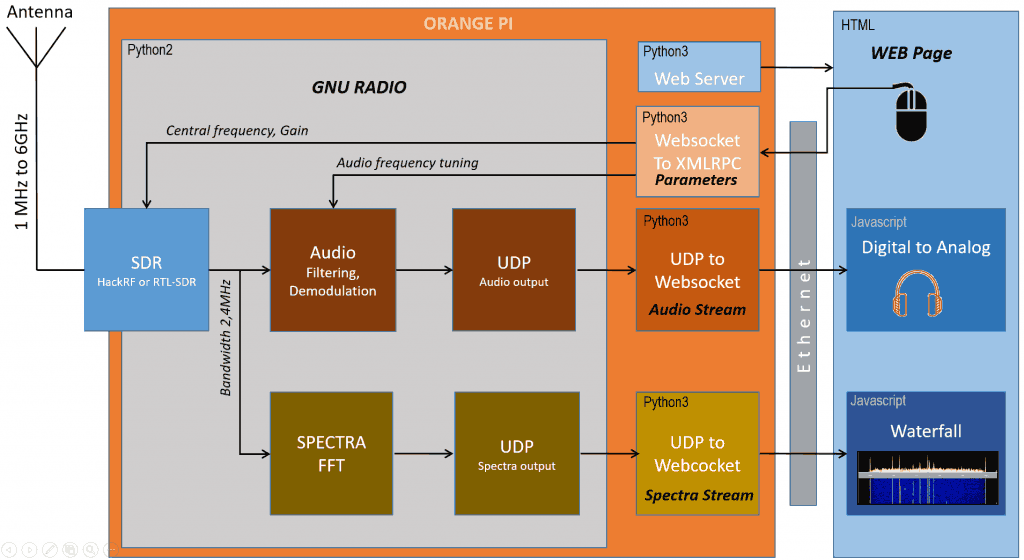
It seems that the RTL-SDR cannot be directly accessed via the USB in WSL, however, by the workaround is to simply run rtl_tcp in your Windows environment, and connect to the local IP in the Linux environment. This means that only programs that accept rtl_tcp as an input, or demodulated audio from a program like GQRX can be used.
The Elad FDM-S3 is an upcoming high performance Hf speciality SDR that is expected to be released this year with a price of 949.90 € ($1040 USD). Over on the swling.com blog, and the Elad website we've seen some recently released information about the new specs.
Real Time I/Q Stream Bandwidth 192khz, 384KHz, 1536KHz, 12880KHz, 24576KHz
122.88 MSPS - 98.304 MSPS 16bit A/D converter
Clock synchronized to GNSS Global Navigation Satellite System or 10MHz Ext Ref
GNSS works with GPS, GLONASS, GALILEO, BEIDOU
Auxiliary USB used to monitor GPS status or for clock firmware updates
10MHz Clock reference Output
10MHz internal standart TCXO 100ppb referenced, optional 3ppb OCXO referenced
Compared to the FDM-S2 the FDM-S3 looks to have significantly increased bandwidth, meaning now that almost the entire HF spectrum could be monitored. ALso the optional built in downconverter would allow tuning up to 2 GHz, where it was previously limited to only 160 MHz on the FDM-S2. The new GNSS referenced clock and improved TCXO/OCXO is also going to mean significantly improved frequency stability.
Over on YouTube, Elektor have uploaded an overview of their Elektor SDR Hands-on kit. The €49.46 kit is an Arduino shield, that turns an Arduino microcontroller board into a 150 kHz to 30 MHz capable SDR receiver. It is based on the G8JCFSDR, which is an RF front end downconverter that allows a PC soundcard to be used as an SDR analog to digital converter.
To compliment the SDR is a book that goes over introductory topics such as shortwave reception, explains signal to noise ratio and interference, different types of antennas, software, digital modes, SDR measurements, receiving and finally WSPR and QRP transmissions. Overall this looks like a good kit for learning about the technical basics of SDRs.
During the 2019 IEEE International Symposium on Broadband Multimedia Systems and Broadcasting conference, authors Xuemei Huang, Kun Yan, Hsiao-Chun Wu and Yiyan Wu presented a research paper titled "Unmanned Aerial Vehicle Hub Detection Using Software-Defined Radio". In their work they describe how they were able to use three HackRFs to determine the location of a UAV drone transmitter. The method they use is fairly simple as it makes use of path loss propagation models to determine an estimated distance from each HackRF, so prior knowledge of the transmitter properties is still required.
The applications of unmanned aerial vehicles (UAVs) have increased dramatically in the past decade. Meanwhile, close-range UAV detection has been intriguing by many researchers for its great importance in privacy, security, and safety control. Positioning of the UAV controller (hub) is quite challenging but still difficult. In order to combat this emerging problem for public interest, we propose to utilize a software-defined radio (SDR) platform, namely HackRF One, to enable the UAV hub detection and localization. The SDR receiver can acquire the UAV source signals. The theoretical path-loss propagation model is adopted to predict the signal strength attenuation. Thus, the UAV hub location can be estimated using the modified multilateration approach by only three or more SDR receivers.
Unmanned Aerial Vehicle Hub Detection Using Software-Defined Radio
The Spin Semiconductor FV-1 is a digital reverb chip designed for creating custom audio effects in products. As it is a digital chip it makes use of an ADC and DAC, with the audio effects DSP placed in the middle of the chain. However, by using custom code Ray was able to convert the ADC into an SDR by creating custom AM/FM and LSB demodulators on the programmable DSP instead of the audio effects.
His post contains the full schematics, code and PCB files required to recreate his work if desired.