Signals and Bits A New SDR Podcast by the President of the GNU Radio Project

[Ben Hilburn] the president of the [GNU Radio Project] has recently started a new podcast called [Signals and Bits]. If you were unaware, GNU Radio is the defacto open source framework for implementing digital signal processing code. Without it, many SDR programs that we take for granted may have never been developed as it is responsible for a lot of community DSP knowledge and algorithm development.

This podcast is scheduled for a new release every Wednesday and will be composed in an interview style focusing on a multitude of topics from Software Defined Radio to Spectrum Enforcement, Radio Astronomy and so much more.

In the first episode Ben interviews Harold Giddings AKA Corrosive of [Signals Everywhere] where they discuss the state of Software-Defined radio and how he got started with radio communications having come from an IT/Computer Networking background.

Ben has already pre-recorded several episodes which will ensure great content is always just around the corner. Ben would love it if you could also send feedback his way over on the [Signals and Bits Twitter] page.

Ben Hilburn President of GNU Radio (Left), Harold Giddings AKA Corrosive of Signals Everywhere (Right)

Artemis 3 Released: Offline Signal Identification Database

The Signal ID Wiki (sigidwiki) is our sister site that we started a few years ago as a way to collect and catalog various types of signals that an SDR user might see and hear on the airwaves. The idea is that a user could search the database to learn about and identify unknown signals. Over time it has grown significantly, with now almost 400 known signals with both waterfall images and sound samples available in the database. Special thanks to lead admin Carl Colena for maintaining and playing a huge role in the databases' growth.

Artemis is an open source Windows/Linux/MacOS compatible application initially programmed by Marco Dalla Tiezza. It brings the sigidwiki website into an offline searchable database with an easy to use UI. Today version 3.0 was released to the public. The new version has been completely rewritten from scratch in Python, as the previous versions were written in BASIC (a now abandoned programming language). The new version has an improved UI, and paves the path for future improvements. 

Marco notes that in the future they hope to add an Autocorrelation function, which might help users automatically identify certain types of repetitive signals simply by playing the raw audio into Artemis.

Note that in order to download the software you will need to sign up to their forum, which is free.

Artemis 3.0 Screenshot

rtlSpectrum: A New GUI for rtl_power

Thank you to Andrey for submitting news about the release of his new open source program called "rtlSpectrum". rtlSpectrum is a GUI for rtl_power, which allows you to scan a wide swath of bandwidth with an RTL-SDR dongle. The scan can then be plotted with rtlSpectrum, and peaks of activity can then be determined. Some of the features include:

  • load from .csv file produced by rtl_power
  • run rtl_power directly. it should be available in the $PATH
  • add multiple graphs for analysis
  • subtract one graph from another
  • save/export graph in the rtl_power based format

In particular, the ability to subtract one graph from another is useful for analyzing filters. Andrey has posted about doing this with rtlSpectrum, a noise source and an RTL-SDR V3 over on his blog (note that the blog is in Russian, so please use Google Translate if necessary). He notes how the dynamic range of the RTL-SDR is limited, so that the true blocking power of a filter cannot be determined, but it is enough to see the shape and frequency response.

rtlSpectrum Screenshots

SignalsEverywhere: Creating a 2.4 GHz Amateur Television Station with a Barbie Camera

In this episode Corrosive from the SignalsEverywhere YouTube channel begins a series on reverse engineering an old 90's Barbie branded 2.4 GHz wireless camcorder toy, and using it for Amateur Radio TV. The camcorder toy consists of the wireless camera, and a base station that plugs into a TV.

After taking the camcorder apart Corrosive discovered a potentiometer on the PCB which allows the transmit frequency to be adjusted, and that the camera's CCD sensor can actually output composite video, possibly allowing for improved video quality. In addition he found the datasheet for the main FM demodulator chip on board the base station, and saw that it is designed to operate from 350 to 550 MHz. So he speculates that elsewhere in the circuit is a 2.4 GHz downconverter which may be useful for other projects too.

Two Antenna Diversity For the SDRPlay RSPDuo now Available in SDRUno

The SDRplay RSPDuo is a 14-bit dual tuner software defined radio capable of tuning between 1 kHz - 2 GHz. It's defining feature is that it has two receivers in one radio, which should allow for interesting phase coherent applications such as diversity.

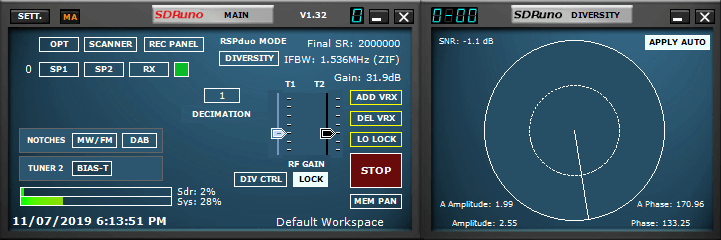
In the latest v1.32 release of SDRUno a diversity feature has been added. Diversity reception was demo'd back in May at Hamvention, and we have a previous post with video about that. Diversity works by subtracting or adding two signals from the two receivers running independent antennas. The result is an up to 3 dB increase in SNR, and better performance with fading signals. They write:

From V1.32 onwards, MRC (Maximal Ratio Combining) Diversity is supported using the RSPduo. MRC Diversity can be used to combine the 2 tuner input streams together to potentially improved the SNR (signal to noise ratio). The same frequency is used for both tuners in the RSPduo and the gain can be adjusted either on each tuner independently or locked together (the default method).

Diversity mode is enabled by clicking on the RSPduo MODE dropdown and select DIVERSITY. Make sure both the 50 ohm ports are connected to the correct input source and note that the HiZ port is not available for Diversity mode. Trying to use the HiZ port will result in an error message being displayed.

Diversity Controls in SDRUno

Meteor M N2-2 Successfully Launched: Awaiting LRPT Signal

On July 5 the Russian Meteor M N2-2 weather satellite was successfully launched into orbit and appears to be healthy. The LRPT weather camera signal is not yet broadcasting however, and we expect it to still take roughly 1-2 months before it begins (if all goes well) as satellites typically run through a long list of qualification tests before becoming operational. During this time there may be broadcasts of test patterns that can be caught. Meteor M N2-2 can currently be tracked in Orbitron and online at N2YO.

To try and dispel any confusion over the naming scheme, "Meteor M N2" is the currently operational LRPT satellite. "Meteor M N2-1" unfortunately failed in 2017 as it did not separate from the rocket. "Meteor M N2-2" is the new satellite which has just been successfully launched. Meteor M N2 and M N2-2 is often abbreviated as just "Meteor M2" and "Meteor M2-2". In the past there was Meteor M N1, but this satellite is no longer operational. We have upcoming launches for Meteor M2-3, M2-4, MP-1 and M3 to look forward to which are scheduled for 2020 and 2021.

Back on June 28 we posted about how Meteor M2 was experiencing orientation issues for a few days. Those issues appear to have been rectified now. Hopefully if M2 remains stable we'll have two Meteor LRPT weather satellites to receive alongside the three NOAA APT satellites.

If you're interested, there were also several other payloads onboard the rocket carrying M2-2, including a low cost Czech experimental cubesat called Lucky7 whose telemetry can be received in the amateur radio band at 437.525 MHz. There is an onboard camera too, but no details on how to receive it yet.

Soyuz Rocket carrying Meteor M2-2 Launched successfully. [Source: spaceflightnow]

Homebrew SDR Transceiver for HF Operation

Traditionally when we think about Software-Defined Radio we’re thinking about little USB adapters that unlock a world of radio in the palm of our hands. This is done by allowing us to directly sample the IQ data from the mixer within the SDR.

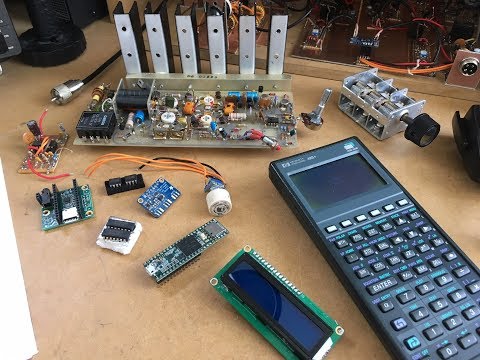
However, this isn’t the only way to experience Software-Defined Radio. Ham Radio operator [Charlie Morris] has uploaded a 10 part series on YouTube explaining how he implemented his own HF transceiver, including custom software. Some of the components such as the amplifier and filters are built completely from scratch, other components use a little DSP magic from a “Teensy” microcontroller. 

Charlie actually samples the I and Q data in a similar way that today’s SDRs do and even implemented the transmit side of the radio so he can make contact with other radio operators around the world, and man… it sounds good!

You can find a complete playlist from Charlie with well-explained videos that go over his entire process from planning, schematics, layout and final operation. The channel appears to be quite active and will surely continue to pump out amazing content.

Homebrew SDR SSB Rig - Part 1 Design Ideas and Thoughts

KiwiSDR Conference Talks: KiwiSDR and it’s GPSDO, TDoA Geo-Location and GNURadio Sources

Thank you to John ZL/KF6VO (creator of the KiwiSDR) for submitting some interesting KiwiSDR related conference talks that might be of interest to some readers. If you were unaware the KiwiSDR is a US$299 HF SDR that can monitor the entire 0 - 30 MHz band at once. It is designed to be web-based and shared, meaning that the KiwiSDR owner, or anyone that they've given access to can tune and listen to it via a web browser over the internet. Many public KiwiSDRs can be found and browsed from the list at sdr.hu or by signal strength and location on this website. One of the most interesting KiwiSDR features is it's TDoA capabilities, which allow users to geographically locate HF transmitters.

Introduction to the KiwiSDR and Bodnar GPSDO

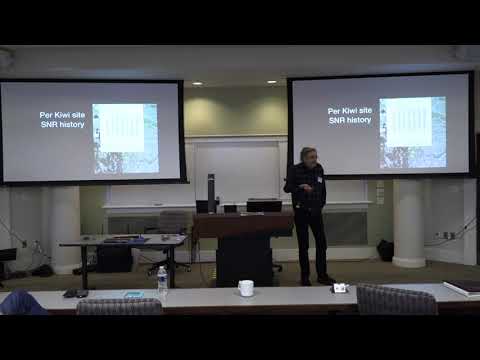
Rob Robinett, AI6VN, gave a talk at the HamSCI Workshop 2019 (USA) “Introduction to the KiwiSDR and Bodnar GPSDO”. In addition to Kiwi basics he shows a live demo of the performance advantages in using an external GPSDO as the Kiwi ADC clock. A line-of-sight measurement of frequency/time station WWV in Colorado using the Kiwi’s internal GPS-compensated crystal oscillator (XO) is compared against using an external Bodnar GPSDO. The Kiwi’s IQ display extension shows the frequency/phase difference between the ADC clock, internal or external, and WWV. Rob also discusses the publicly available (kphsdr.com:8074) eight Kiwi installation he made at coastal radio station KPH north of San Francisco. 

Introduction to the KiwiSDR

KiwiSDR as a new GNURadio source and TDoA geo-location

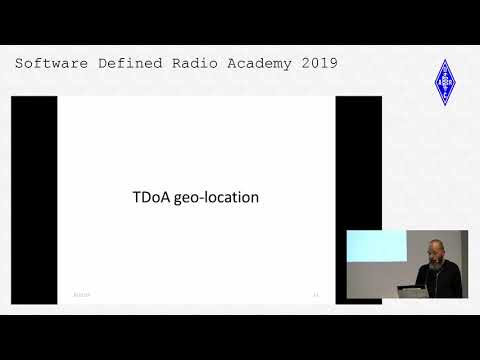
Christoph Mayer, DL1CH, is the author of the Kiwi’s TDoA algorithm. His talk “KiwiSDR as a new GNURadio source and TDoA geo-location” was given at the Software Defined Radio Academy (SDRA) as part of HAM Radio 2019 in Friedrichshafen, Germany. He includes a very technical description of the TDoA process used by the Kiwi including a live demo of direction finding a 16 MHz over-the-horizon-radar (OTHR) signal from Cypress.

Christoph Mayer, DL1CH: KiwiSDR as a new GNURadio Source