A Complete Linux based Receiver and Decoder Application for Meteor M2

Thank you to Neoklis (5B4AZ) for writing in and letting us know about his recently completed project which is a RTL-SDR compatible receiver and decoder application for the Meteor M2 weather satellite. It is a combination of other open source programs and he writes:

I combined the recently released Meteor-M2 LRPT demodulator by Davide Belloli (dbdexter-dev), and the older image decoder (translated to C) released by Artem Litvinovich (artlav), with relevant code from my own "sdrx" SDR Receiver application to create a complete monolithic Meteor-M2 Receiver and Image Decoder application, "glrpt".

Neoklis' glrpt application is available on his website www.5b4az.org under the "Weather Imaging -> Meteor M LRPT Receiver" menu. The application is open source and appears to be Linux only. In order to install it you'll need to download and compile the source code, and compilation instructions are available in the documentation stored in the doc folder. Neoklis also writes that you can find his older APT image decoder called "xwxapt" under the same Weather Imaging heading of his website.

GLRPT User Interface Showing Processed Meteor M2 Images

Comparing the Airspy HF+ And KiwiSDR on Shortwave Radio

The Airspy HF+ and the KiwiSDR are two HF specialty SDR radios. The HF+ advertises excellent dynamic range and sensitivity, whilst the KiwiSDR has it's strength in it's internet connectivity and 30 MHz wide live bandwidth.

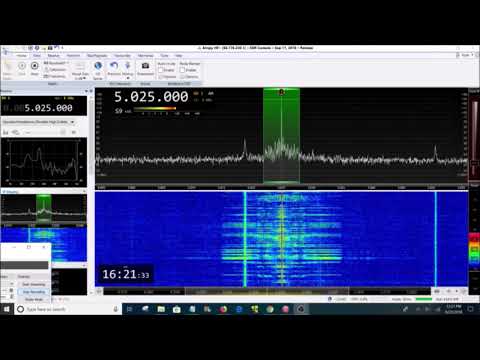
Over on YouTube icholakov has uploaded a video comparing the two SDRs on daytime medium wave and shortwave reception with a W6LVP amplified magnetic loop antenna. It is expected that the two SDRs should be quite similar in easy receiving conditions, but the Airspy HF+ should shine in challenging conditions with strong blocking signals and weak signals being received at the same time. The Airspy HF+ should also be a bit more sensitive in all conditions. It's not clear if there were any strong blocking signals in the tests, but the results appear to confirm the sensitivity expectations.

KiwiSDR and Airspy HF+ comparison

Using the HackRF PortaPack To Perform a Mag-Stripe Audio Spoof

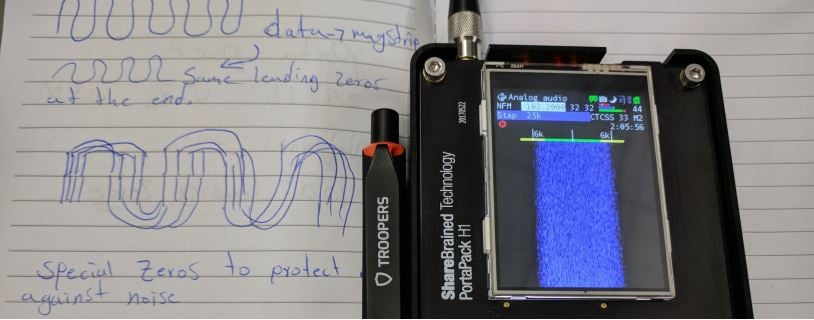
Over on his blog author "netxing" has uploaded a post describing how he was able to use a Portapack to spoof mag-stripe info stored on credit/debit cards. The idea based around an old trick called magnetic stripe audio spoofing. This is essentially using an electromagnet and a music player like an iPod or smartphone to trick a magnetic card reader into thinking that you're swiping a card through it.

Netxing's idea was to use an FM transmitter connected to a computer to transmit known magnetic stripe card data via FM to the Portapack. The Portapack then receives and outputs this as FM audio to an electromagnet connected to the audio out jack, allowing it to activate the magnetic card reader.

Using this method it could be possible to make a payment by transmitting card data remotely over an FM signal. We're not sure on why you'd want to do this, but it is an interesting experiment regardless.

HackRF Portapack Mag-strip Spoofing

LimeNET Micro Now Crowdfunding

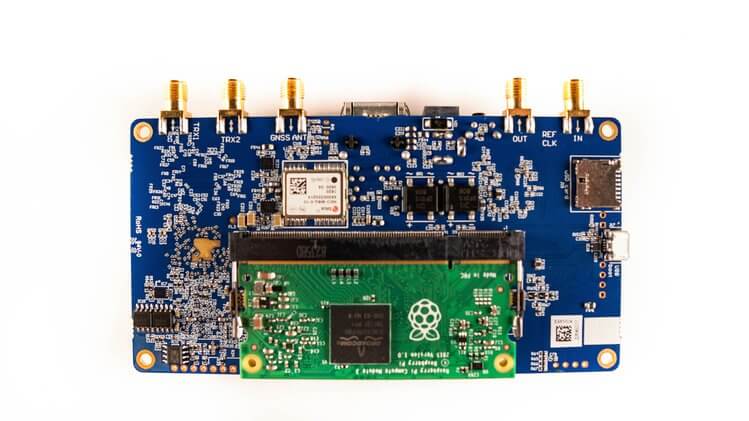
Lime Microsystems, creators of the LimeSDR, LimeSDR Mini and LimeNET SDR devices have recently begun crowdfunding for a new product they are calling LimeNET Micro. LimeNET Micro is described as a software defined radio platform with an integrated processor for creating self contained wireless networks. In other words it is a LimeSDR LMS7002M SDR transceiver chip with an included Raspberry Pi Compute Module 3, FPGA, GNSS module, EEPROM and Flash memory attached to it.

The LimeNET Micro is capable of full duplex TX and RX (1 port each) with the typical LimeSDR frequency range of 10 MHz - 3.5 GHz. However a major difference is that the LimeNET Micro is only capable of a 0.27 MHz bandwidth, whereas other LimeSDR products are capable of bandwidths up to 30.72 MHz. One interesting additional feature is that the LimeSDR Micro comes with a GNSS module that can be used to receive GPS/GLONASS etc for high accuracy timing if required.

Some use cases that they envision LimeNET micro being useful for include:

  • Inexpensive enterprise and personal networks
  • Rural, autonomous, and resilient networks
  • Universal IoT communications hubs
  • Rapid deployment infrastructure for emergency response
  • Remote radio solutions for amateur radio and radio astronomy
  • Integration into application-specific RF appliances
  • Radio spectrum survey
  • Passive wireless geolocation
  • PHY and security research
  • RF-aware robotics

The price is $269 USD and this includes a Raspberry Pi Compute Module 3. Higher end kits can be purchased which include Acrylic ($399) or Aluminum enclosures ($459).

LimeNET Micro with Raspberry Pi Compute 3 Module attached.

Tracking People Through Walls with WiFi Passive Radar

For a while now researchers at MIT and several other universities have been investigating methods for using frequencies in the WiFi bands to see through walls using a form of low power radar. The basic concept is to track and process the reflections of these signals from peoples bodies.

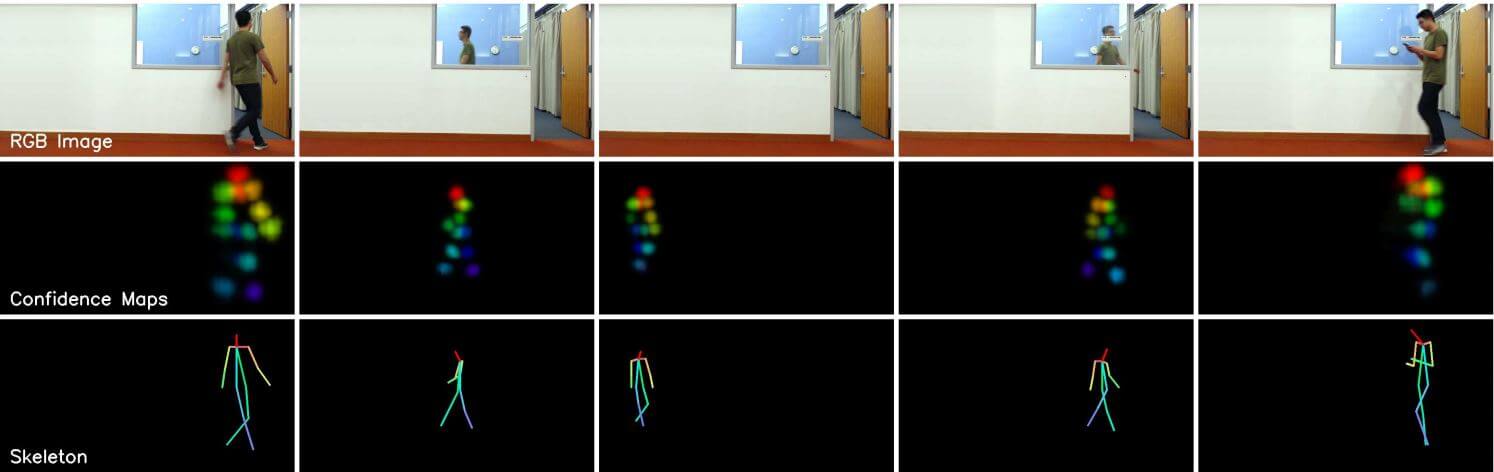
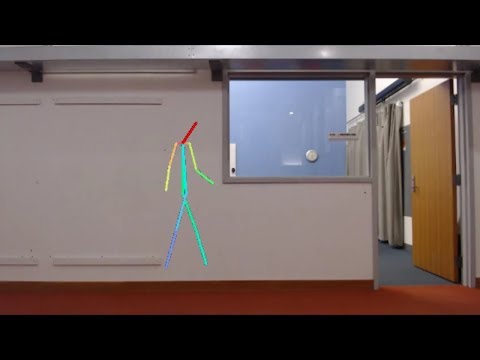
Recently researchers at MIT have taken this idea a step further, combining the radar results with machine learning in a project they call RF-Pose. The result is the ability to recreate and track full human post information through walls. The abstract from their paper reads:

This paper demonstrates accurate human pose estimation through walls and occlusions. We leverage the fact that wireless signals in the WiFi frequencies traverse walls and reflect off the human body. We introduce a deep neural network approach that parses such radio signals to estimate 2D poses. Since humans cannot annotate radio signals, we use state-of-the-art vision model to provide cross-modal supervision.

Specifically, during training the system uses synchronized wireless and visual inputs, extracts pose information from the visual stream, and uses it to guide the training process. Once trained, the network uses only the wireless signal for pose estimation. We show that, when tested on visible scenes, the radio-based system is almost as accurate as the vision-based system used to train it. Yet, unlike vision-based pose estimation, the radio-based system can estimate 2D poses through walls despite never trained on such scenarios.

The hope is that this technology could one day be used as a replacement for camera based computer vision. It would be a non-intrusive method for applications like gaming, monitoring the elderly for falls, motion capture during film making without the need for suits and of course for gathering data on peoples movements.

It is not mentioned in the paper, but it is likely that they are using some sort of SDR like a USRP for receiving the signals. It's possible that a lower resolution system could be set up cheaply with a HackRF and some passive radar software.

RF Pose Estimating Human Pose Behind walls using RF signals in the WiFi frequencies.
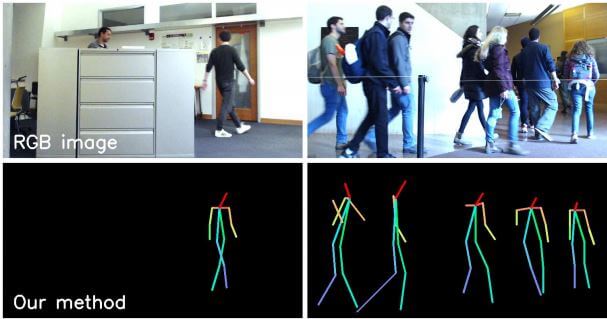
Multiple people tracked with RF-Pose
AI Senses People Through Walls

KerberosSDR Now Available for Pre-order on Indiegogo

We're happy to announce that KerberosSDR is now available for pre-order on Indiegogo.

As promised we announced the release to KerberosSDR mailing list subscribers first, so that they'd be the first to get the initial discounted early bird units. However due to much higher than expected interest, we have released a few "second early bird" units at a still discounted price of $115 + shipping. We're only going to release 300 of these so get in quick before the price jumps up to $125. Our pre-order campaign will last 30 days, and afterwards the retail price will become $150.

If you weren't already aware, over the past few months we've been working with the engineering team at Othernet.is to create a 4x Coherent RTL-SDR that we're calling KerberosSDR. A coherent RTL-SDR allows you to perform interesting experiments such as RF direction finding, passive radar and beam forming. In conjunction with developer Tamas Peto, we have also had developed open source demo software for the board, which allows you to test direction finding and passive radar. The open source software also provides a good DSP base for extension.

More information available on our KerberosSDR page, and the Indiegogo page.

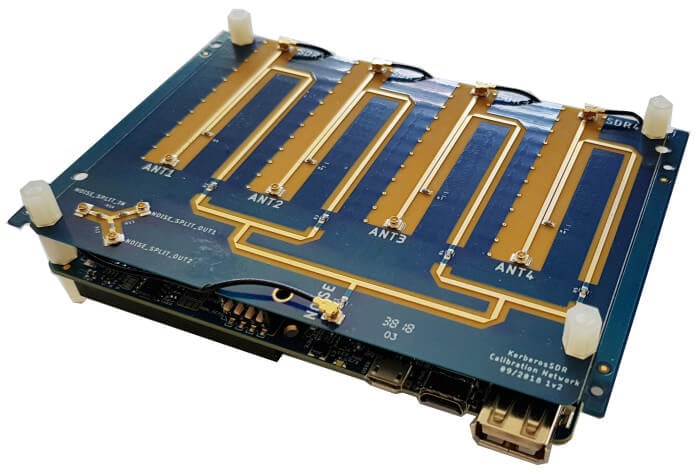
KerberosSDR with Calibration Board Attached (Metal Enclosure with SMA connectors Not Shown)
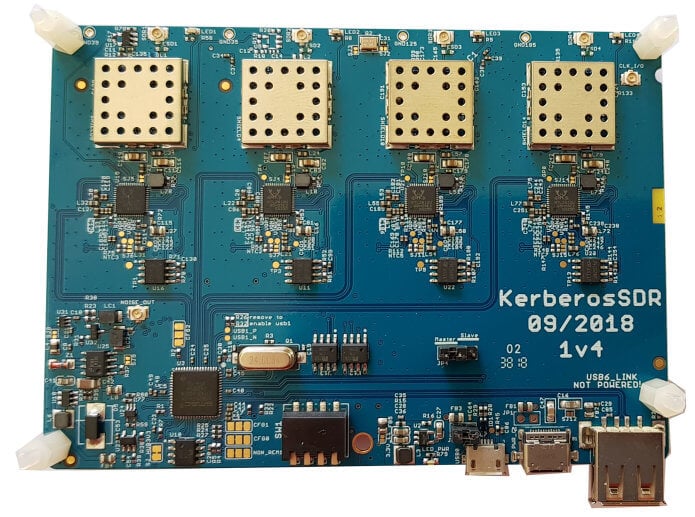
KerberosSDR Main Board (Metal Enclosure with SMA connectors Not Shown)

Using a LimeSDR To Detect Aircraft Reflections from a 2.3 GHz Beacon

Over on his blog author Daniel Estevez has described how he's been listening to aircraft reflections from a 2.3 GHz 2W beacon. The beacon is 10km away from Daniels location and transmits a tone and CW identification at 2320.865 MHz. As aircraft fly nearby to his location Daniel was able to observe aircraft reflections of the beacon, and was able to match them with ADS-B position and velocity reports.

The hardware that he used was a LimeSDR and a 9dBi 2.4GHz planar WiFi antenna patch. By aiming the antenna away from the transmitter, and using his car as a shield to block the transmitter he was able to receive some reflections. Daniel recorded several reflections including one produced by a nearby car.

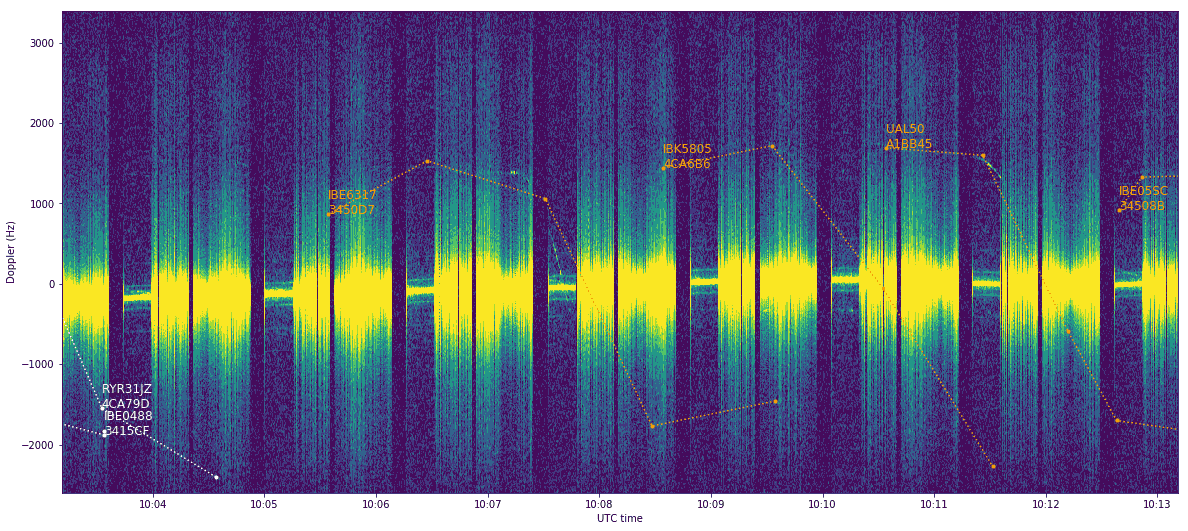
By combining his results with ADS-B data he was able to superimpose the results, and color aircraft tracks by either a negative or positive doppler shift which was observed from the reflection. By combining the ADS-B data with the time stamps, he was also able to mark the reflections from each aircraft.

Marking Aircraft Reflections at 2.3 GHz against ADS-B Data

YouTube Talk: Evaluating 9 of the Best Single Board Computers for Ham Radio SDR Systems

Over on YouTube the Ham Radio 2.0 channel has recently uploaded a talk that Scotty Cowling (WA2DFI) did at the 2018 TAPR digital communications conference. His talk centers around single board computers and his findings on the nine best single board computers (SBC) for ham radio SDR setups.

Scotty's talk begins by discussing why you'd want to use SBCs in your ham radio SDR setup, and explains why you might want to place them with the SDR close to the antenna, and then distribute the data over ethernet cable. He then reviews 9 boards listed below: 

  • Hardkernel Odroid C1
  • Raspberry Pi 3B
  • Hardkernel Odroid XU4
  • ASUS Tinker S
  • FriendlyElec NanoPC-T4
  • Pine64 RockPro64
  • 96 Boards Mediatek X20
  • 96 Boards HiKey 960
  • UDOO X86 Ultra

The boards are compared against CPU clock speeds, architecture, cache, debut year, RAM, boot ROM, bus speeds, OS support, and more. Scotty also discusses the need for low latency operation, but is yet to compare this on the boards. The best value for money boards that Scotty recommends end up being the Odroid XU4, Tinkerboard, NanoPC-T4 and the RockPro64.

Ham Radio 2.0: Episode 151 - Evaluating 9 of the Best Single Board Computers for Modern SDR Systems