Receiving the STEREO-A Solar Orbiting Satellite with a 66cm Dish

STEREO-A is a satellite launched in 2006 which is orbiting the sun and used for making solar observations. Usually it is so far away that massive deep space satellite dish's are required to receive this satellite. However for the first time since it's launch, STEREO-A's orbit is taking it close enough to Earth for small home satellite ground stations to be able to receive the data and download some images of the sun. 

Over on his Blog Scott Tilley has written up an article showing how it is now (temporarily) possible to receive and decode STEREO-A with a small 66cm dish. The satellite will be closest to Earth on August 17 2023, however Scott notes that since mid June the signal has already been dramatically increasing.

Scott's blog post explains the orbit, how the satellite transmits at 8.443.579 GHz, and shows his feed and hardware setup which involves a few filters, LNAs, GPS reference clock, a mixer and an Ettus B200 SDR. He also notes how he uses a modified motorized telescope mount to automatically track the satellite as it moves through space.

The rest of Scott's post explains how to use the "CCSDS Turbo R6 K8920" Decoder in SatDump to decode the signal and recover images, noting that some tuning of parameters was required and that because of the slow data rate it can take hours to get even one megabyte of data. He goes on to acknowledge everyone who figured out how to decode the image and telemetry data from the satellite, some observations on the STEREO-A beacon and finally some amazing images and animations he's received.

A weak signal from STEREO-A received back in mid June 2023
Image of the sun from STEREO-A

SDRSharp 1915 Released: RTL-SDR Crashes Fixed

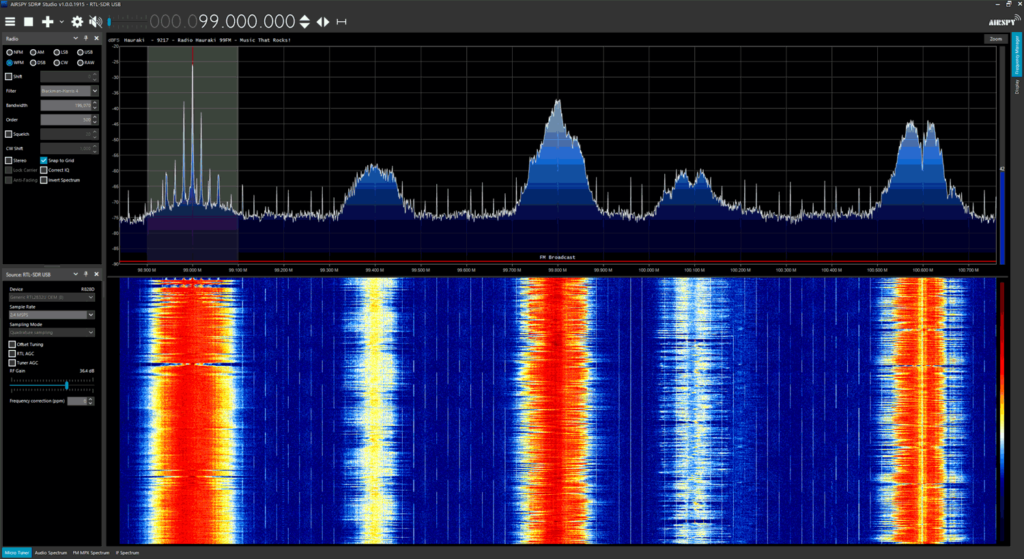
Thank you to SDR# author Youssef for updating SDR# (SDRSharp) and fixing a recent bug that was causing RTL-SDR units to crash whenever the frequency was changed. We are putting this post out to inform everyone who was having this issue to please update their SDRSharp version to 1915 which can be downloaded from airspy.com/download. Our guide at www.rtl-sdr.com/QSG can be used to walk you through the installation procedure for RTL-SDR dongles in SDR#.

The new update brings the RTL-SDR control menu down to the sidebar making it much easier to control the gain and sample rate settings. Other recent changes have also brought improvements to the RDS decoder which will be useful for DXers.

Please remember to show your appreciation to Airspy for allowing RTL-SDR users on their platform by checking out their range of higher end softwire defined radio products at airspy.com.

SDR# 1915
SDR# 1915

Receiving Images from the US DoD Coriolis Satellite

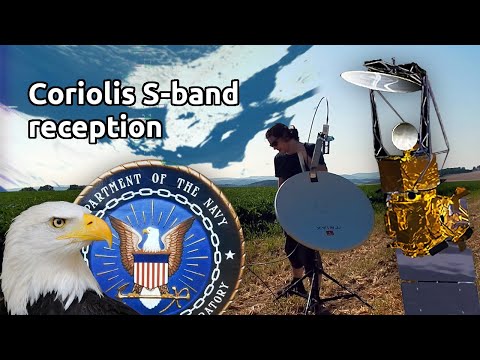
Over on dereksgc's YouTube channel another recent video from his satellite decoding series shows how to download images from the Coriolis satellite, a US Department of Defense satellite launched in 2003, that is among other uses designed to measure wind speed and direction from space using a radiometer.

The entire history of an orbit is only downlinked in the S-band when over an official ground station, however it also has a 'tactical' downlink for live data that the US Navy uses. As the data is unencrypted, with a satellite dish, 2.2 GHz feed, LNA and a software defined radio like the HackRF, anyone can receive the data.

In his video dereksgc explains the satellite, shows his hardware, and demonstrates reception. He then passes the recording into SatDump which results in the images. The images themselves are nothing interesting to look at, as they are produced by a sensor designed to measure wind. But dereksgc shows how multiple images can be composited into something a little more interesting.

Receiving Unintentional Voice Transmissions from GPS Satellites

Over on dereksgc's YouTube channel we've discovered a few more recent interesting videos from his satellite decoding series that people may be interested in. One from two weeks ago shows how it's possible to receive voice transmissions on navigation satellites such as GPS.

Many navigational and meteorological satellites carry a search and rescue (SAR) repeater which is intended to receive UHF emergency locator beacons and rebroadcast them in the L-band or higher. However the repeaters appear to be picking up all sorts of other signals from the ground, including voice transmissions. Dereksgc notes that the theory is that there are some land based communications systems in some countries that are sharing frequencies that emergency locator beacons use, or that malicious pirates may be actively using these SAR repeaters for their own communications.

Dereksgc shows examples of retransmitted signals on the Beidou, GLONASS and Elektro-L satellite downlinks at 1.5442 GHz and at 2.226 MHz for the GPS satellites. He also shows what sort of satellite dish and feed setup you need. In the video he uses a HackRF as the SDR, but you could also use an RTL-SDR for the satellites that transmit at 1.5442 GHz.

Receiving voice transmissions from GPS satellites || Satellite reception pt.10

Video on Meteor M2-3 LRPT, HRPT and Telemetry Reception

Over on YouTube dereksgc has another video on Meteor M2-3 reception. In the video Derek goes over the history of Meteor M launches and then goes on to test reception of the 3.4 GHz telemetry signal which he recorded early after the satellites launch.

The next day he sets up 1.7 GHz HRPT reception using a hand tracked satellite dish and is successful as receiving it. He then goes on to test 137 MHz LRPT reception with a V-dipole antenna and RTL-SDR and is also successful. Finally he decodes the recordings using SatDump and is able to get some great images.

Derek also notes that there might be a problem with the LRPT antenna which could explain some reports of poor reception at some elevations of the satellite. He notes that it seems likely that the QFH antenna extension process on the satellite didn't extend fully or at all.

André shares his QO-100 Ground Station and HF/VHF/UHF Station

Thank you to RTL-SDR.com reader André for submitting and sharing with us his QO-100 ground station setup. The setup also includes antennas and equipment to receive HF and VHF/UHF. His setup can serve as an example of a well set up permanent installation.

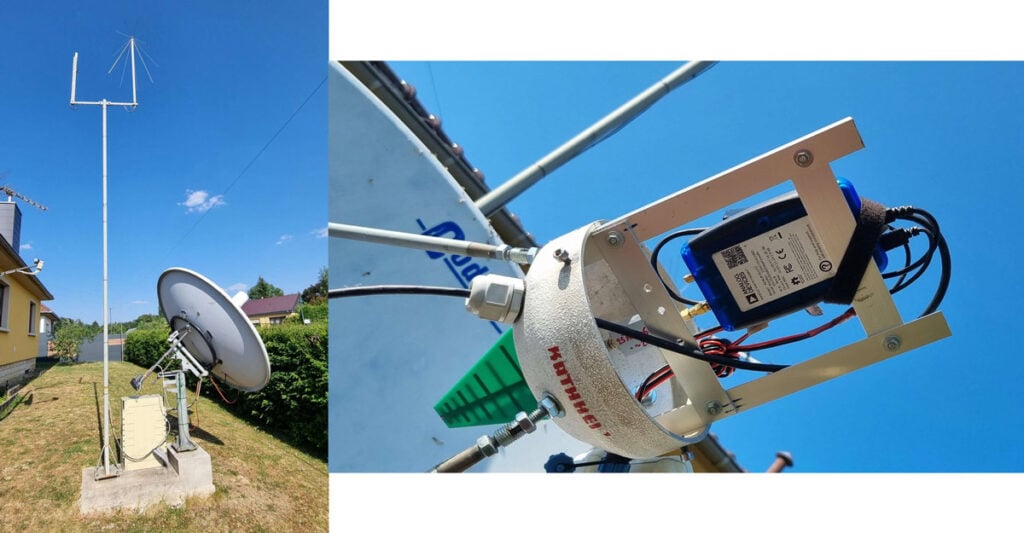
André's set up consists of a 1.8 meter prime focus dish, Raspberry Pi 4, GPIO connected relay, Airspy R2, Ham-it-up upconverter, coaxial relay for switching between Mini-Whip and Discone Antenna, and FM bandstop filter and a power terminal rail block. The Airspy R2 is used for HF/UHF/UHF reception and the antennas and upconverter are all controlled via a web connected relay system. All equipment is enclosed in an outdoor rated box, and André notes everything has been working well from temperatures range from -10C to 35C.

Inside the satellite dish feed is housed an Adalm Pluto SDR, and a wideband LNA and a USB to LAN converter with power over Ethernet. A small log periodic Yagi serves as the feed. In order to work the wideband DATV band on Qo-100, André' swaps out this feed for a custom feed and brings the PlutoSDR indoors where it is connected to a 120W Spectran Amplifier and modulator.

For the full writeup of his setup, we have uploaded André's document here.

André's ground station setup for QO-100 and HF/VHF/UHF

Saveitforparts: Receiving Images from the new Russian Satellite Meteor M2-3

A few days ago we posted about the successful launch and deployment of the latest Russian Meteor M2-3 weather satellite. The satellite is currently actively transmitting LRPT weather images.

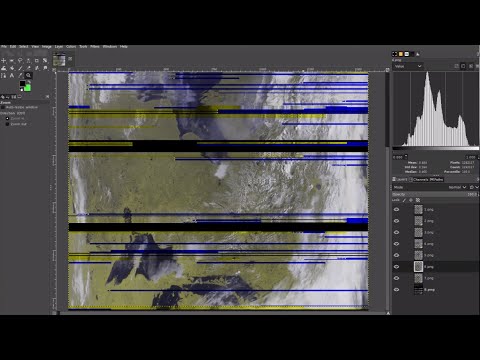
Over on his YouTube channel, "saveitforparts" has uploaded a video showing how he received images from the new satellite using his RTL-SDR. His method involves first recording the signal pass on a Raspberry Pi with rtl_fm, and then passing that wav file into SatDump for decoding and image generation.

We note that it is also possible to directly live decode the pass using SatDump, however a Raspberry Pi may be a little too slow to run the GUI version of SatDump. Instead you could use rtl_tcp on the Pi and run SatDump on a networked PC, or simply run the RTL-SDR and SatDump on the PC or a more powerful device like an Orange Pi 5.

Ultimately he experiences some unresolved problems with the decoding process, but is able to end up with a decent image.

Grabbing Images From New Russian Satellite (Meteor M2-3)

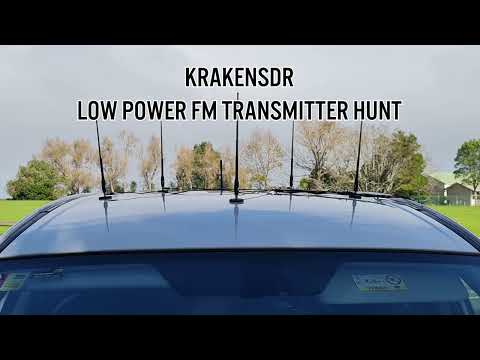
KrakenSDR Low Power FM Transmitter Hunt

If you weren't already aware, KrakenSDR is our 5-channel coherent radio based on RTL-SDRs, and it can be used for applications like radio direction finding. KrakenSDR is in stock and can be purchased from CrowdSupply or Mouser. More information is also available on our website at krakenrf.com.

In this video we are using a KrakenSDR to hunt for the location of a low power FM transmitter (LPFM) station at 106.7 MHz. These low power FM transmitters are legal as unlicensed transmitters as long as they operate under certain restrictions, the main one being that they transmit at under 1 watt EIRP. LPFM stations are typically operated by local communities or niche radio stations.

Because they are unlicensed, there is no official record and their location doesn't show up in the radio spectrum management database. A requirement of LPFM is that the station broadcast the contact information of the owners regularly, but it can be difficult to locate non-compliant stations that don't do this. But the KrakenSDR makes finding them easy.

The array is 45cm in radius, which is about the maximum that my RAV4 car roof can fit. Some of the antennas sit on a slight curve on the roof, but this appears to have negligible effect. The spacing factor is about 0.19 (optimal is 0.5 - a much larger radius), but even 0.19 is sufficient to find the transmitter fairly easily.

KrakenSDR Low Power FM Transmitter Hunt