Tech Minds: Running the SDR++ Multiplatform Server on MacOS, Windows and Raspberry Pi

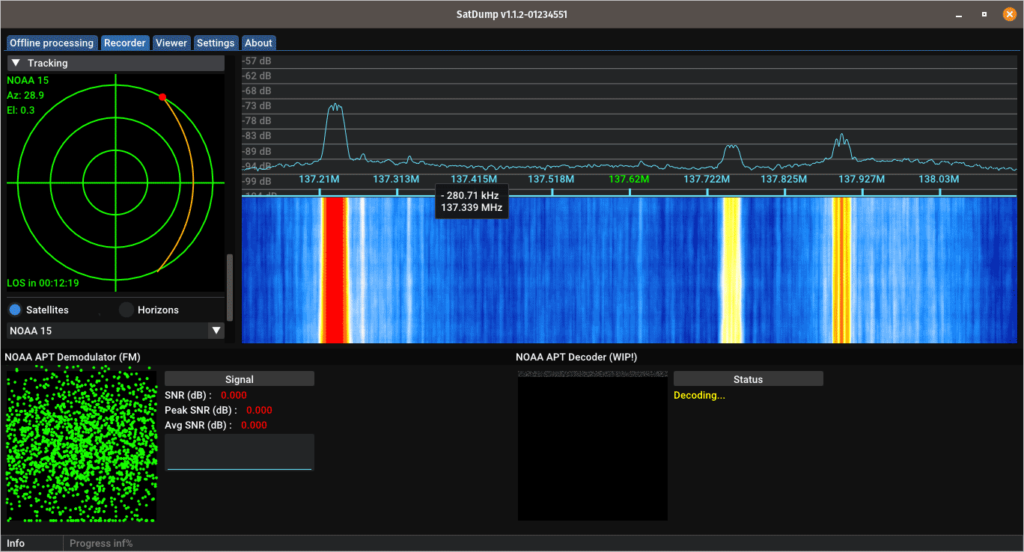
SDR++ is an open source receiver program compatible with most software defined radios including the RTL-SDR that has been going through rapid development making it now one of the top software choices. In runs on almost every platform, including Windows, Linux, MacOS and Android.

One feature that SDR++ has is it's remote server. This is similar to applications like rtl_tcp which allow an SDR on a remote device like a Raspberry Pi to be accessed over a network.

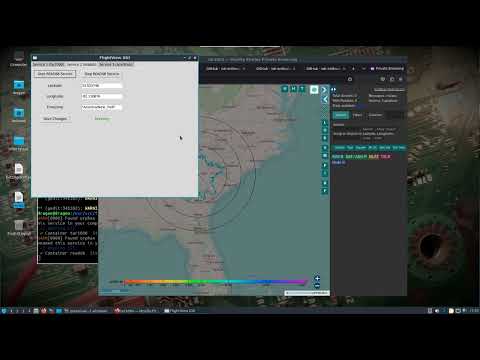
Over on YouTube, Matt from Tech Minds has uploaded a video showing how to run the SDR++ Server on MacOS, Windows and Raspberry Pi platforms.

SDR++ Multi-Platform SERVER

Watch Duty: California Wildfire Watch Driven by RTL-SDRs

Over on Hackaday we've seen an interesting post about the non-profit "Watch Duty" wildfire reporting smart phone app for Californians. Several populated regions of California are extremely prone to wildfires, and it's important that residents get timely notifications about nearby wildfires so they can evacuate early and/or prepare their defensible spaces.

Often by the time official notifications have gone out, it is too late. To solve this, the approach Watch Duty takes is to have volunteers monitoring public safety radio channels, and ADS-B aircraft positions in order to gather information in real time. Once critical information is established, the watch duty volunteer can push out a notification via the smart phone app. 

The volunteers make use of receiver stations that consist of multiple RTL-SDR dongles with each dongle monitoring a different EMS radio system, and one additional RTL-SDR is used for ADS-B aircraft monitoring of helicopters and fire fighting aircraft. The stations appear to uplink radio data to the volunteers via a cellular modem or Starlink.

Earlier in the year Popular Science and Wired reported on Watch Duty as well, but did not mention the use of RTL-SDRs.

A Watch Duty monitoring station with multiple RTL-SDR Blog V3 dongles.

Upgrading the Mahahit DSP1 and Malahit Chinese Clones into the Mahahit DSP2

Mahiteam is a Russian company that produces the relatively popular Malahit DSP1/DSP2 and Malahit DDC portable SDR radio which are great for shortwave listening, but can also cover up to 2 GHz. Manuel L. has been following developments and notes that Malahiteam are offering the ability to upgrade their DSP1 (and any DSP1 Chinese clone) into Malahit 2 units by sending the device in for a chip replacement. Manuel writes:

Hi. Recently it is possible to upgrade the Malahit DSP1 (original) and also the China clones (if registered in Russia) of the Malahit with a new CPU and if necessary a new audio codec chip. This upgrade has been officially released by the Malahiteam the developers.

This allows custom DSP2 firmware to run on the DSP1 and clones. This makes the device more powerful and also has the option of installing a Bluetooth board and controlling it via the software, as is the case with the DSP2.

This upgrade can be carried out directly in Russia by the Malahit team.

For Europe this is done by Jochen Köster DC9DD (Malahit Servise Europa) who converted the first DSP1 and China clones outside of Russia.

In the US, the future KD9NXV makes Mark Roy (USA Service Malahit).

I have tested the first conversions outside of Russia and it is a very big upgrade of the devices. They work a lot better now. I have shown this in several YouTube films. More information and contacts to the service teams outside of Russia can be found at Telegram and the Malahit Facebook group

https://t.me/+BOQmKPgV4lM2NDZi

https://www.facebook.com/groups/malahitsdrinternational/

YouTube Video Upgrade Malahit DSP1 and China Clone:
https://youtu.be/h9zepfkyK3Q
https://youtu.be/-v5Iuv7pmHU
https://youtu.be/6Z-hecUeMG0
https://youtu.be/iBWN2HHLQ94

The Malahit DSP2
The Malahit DSP2

Elon Musk’s Twitter Suspends Live ADS-B Aircraft Tracking Accounts Including @elonjet and ADS-B Exchange

As a reaction to an altercation with a stalker that endangered Elon Musk's child, Twitter has taken action to suspend all Twitter accounts that involve the real time tracking of aircraft and individuals. This includes the famous @elonjet handle which was an account run by a teenager known as Jack Sweeny that used data from adsbexchange.com to tweet live updates on the location of Elon's private jet.

It also appears that the Twitter account for ADS-B Exchange @ADSBexhchange itself has been suspended too, as well as various other flight tracking Twitter bots that were using data from ADS-B Exchange. Elon Musk's tweet indicates that legal action is being taken against "Sweeney & organizations who supported harm to my family". It is unclear if this implies that legal action will be taken against ADS-B Exchange.

Elon Musk's Real-Time Doxxing Tweet

ADS-B (Automatic Dependent Surveillance–Broadcast) is a radio signal that is required to be broadcast by all aircraft for the purposes of air traffic control and collision avoidance. The ADS-B signal provides real time unencrypted location information that anyone with a low cost radio receiver like an RTL-SDR and cheap computer like a Raspberry Pi can receive, decode and turn into a live map of aircraft in the surrounding area.

ADS-B Exchange is an ADS-B aggregator that collects ADS-B data received from volunteers all over the world that are running RTL-SDR and other SDR dongles or radios operating as ADS-B receivers. Compared to more commercial flight tracking services like FlightAware and FlightRadar24 (who also make use of volunteer stations), ADS-B Exchange guarantees that they will not censor the tracking of military, police or private jets. This has generated debate in the past over whether this philosophy is either more moral or less moral.

ADS-B Exchange has been key to projects like "Dictator Alert" which tracks the real time location of the private jets of known dictators.

The Organized Crime and Corruption Reporting Project (OCCRP) has also made use of ADS-B Exchange data in the past to uncover the role that US civilian aircraft contractors are playing in the East African "kill chain".

Media have also used ADS-B Exchange to track the movements of the military aircraft like Black Hawk Helicopters and CBP Predator drones that were used to monitor crowds during the George Floyd protests.  

On Twitter John Wiseman @lemonodor has also been using ADS-B Exchange data for various projects like "Advisory Circular Bots" which automatically detects circling aircraft (which may be of interest, as a circling aircraft may indicate an incident in the area), and for highlighting areas of the globe with possible GPS jamming which can be inferred from the GPS location data transmitted by aircraft. He also uncovered a massive, secret FBI operation involving the use of 'spy planes' operating over American cities.

Unrelated to ADS-B Exchange, live ADSB tracking is also used by hedge fund investors to gain an edge by tracking the movement of company aircraft in order to try and predict deals and by UN investigators investigating arms embargo violations.

Previously Elon Musk indicated that he would not ban the account following his private jet, however after the stalker altercation he appears to have rapidly changed his tune. Even without the Twitter bot, private jets can easily be tracked via ADS-B Exchange so any dedicated person could still gather this information without too much hassle. So it seems likely that legal action will be taken against ADS-B Exchange as per Elon's tweet. Other ADS-B data aggregators like FlightRadar24 and FlightAware should be safe from legal action as they do censor private aircraft upon request. Hopefully ADS-B exchange has prepared for this legal battle, which was probably an inevitable unfortunate outcome from their policy. If not from private jet owners, then the military or police would likely eventually take action if the data ever became a problem.

ADSBExchange.com new tar1090 interface
ADSBExchange.com Interface

KrakenSDR Locates a Repeater Jammer in 1 Hour

Over on YouTubem channel NotaRubicon Productions has uploaded a video describing how a KrakenSDR was used to find the location of a person jamming a repeater site. Amateur radio enthusiasts can utilize VHF or UHF repeater towers, which receive signals from lower power handheld or other radios, and retransmit that signal at high power on a slightly different frequency over a much wider area. Unfortunately malicious people can jam these repeaters by transmitting at the same time as other users, effectively denying use of the repeater by legitimate users.

If you weren't already aware, KrakenSDR is our 5-channel coherent radio based on RTL-SDRs, and it can be used for applications like radio direction finding. We successfully crowd funded the device on Crowd Supply, and the device is currently available for sale on Crowd Supply, Mouser and direct from our website krakenrf.com.

In this video I read the story of how we caught the jammer that had been jamming our GMRS repeater for months, and how by using the KrakenSDR Radio Direction Finder (RF locator), we were at his house in 1 hour.

The KrakenSDR can track a signal being transmitted from 100Mhz to 1Ghz - so I can track ham repeater jammers, GMRS repeater jammers, ham-radio transmitters, GMRS radios - pretty much any transmitter with a signal strong enough for you to receive.

How The KrakenRF Located Our Repeater Jammer In 1 Hour. Overview of the KrakenSDR Radio Locator

SDRplay RSP1A Metal Enclosure Upgrade Back in Stock at Amazon

We just wanted to note that after a few months delay due to a missing shipment carton which has just been found, the SDRplay RSP1A Enclosure Upgrade set is back in stock at Amazon for US customers. We also have stock available in our store and affiliated marketplace sites for non-US customers.

This is a premium aluminum metal upgrade enclosure for the SDRplay RSP1A. Helps block RF interference and protects the RSP inside the sturdy enclosure. We don't make batches of this enclosure often, and this batch could be the last if demand dwindles, so if you are interested please order before stock runs out for good.

The kit includes 1x black aluminum metal enclosure with two labelled side panels, 1x black semi-hardshell carry case, 1x thermal pad to keep the RSP1A cool and mechanically stable inside the enclosure, 1x accessory set including enclosure screws, GND lug bolt set and 3M anti-slip rubber feet.

Please note that the set does not include the RSP1A.

RSP1A Metal Case Upgrade

uSDR Updated to Version 1.6.0

Thank you to Viol for submitting news about the latest update of his uSDR software. uSDR (aka microSDR) is a lightweight general purpose multimode program for Windows that supports the RTL-SDR, Airspy, BladeRF, HackRF and LimeSDR radios. Viol highlights the latest features in the new update below: 

  • Airspy HF+ Discovery frontend support
  • ExtIO*.dll interface support. Copy ExtIO*.dll and all dependencies to the root folder and have a fun
  • ExtIO_USRP.dll and all dependencies for USRP B210 included. Just install Zadig libusb driver and go
  • LimeSDR multiple frontends switch fixed
  • FM demodulator with inverted audio spectrum
  • DCS decoder
  • additional C/C++ source examples for remote IQ passband processing TCP client
  • advanced IQ file playback options
  • display hold peak spectrum mode, zoomable and panable plot, customized colors

As always all descriptions, screenshots and binaries could be found on 

https://sourceforge.net/projects/u-sdr/

uSDR aka microSDR. A lightweight SDR receiver program for Windows.

tinySA Ultra Reviews: A 0.1 MHz – 6 GHz Spectrum Analyzer for $120

A few weeks ago the tinySA Ultra was released. This is a spectrum analyzer capable of operating between 0.1 - 800 MHz, or 0.1 MHz - 6 GHz with the 'Ultra' mode enabled. A spectrum analyzer is a tool that allows users to visualize signals on the radio spectrum.

Previously the standard tinySA was released back in 2020. The Ultra version brings enhancements to the frequency range, signal generator range, bandpass filter range as well as an optional 20dB LNA, and a larger 4 inch color display. 

The TinySA Ultra costs US$119 + shipping direct from the Aliexpress store in China, or $129.95 from R&L in the USA (currently out of stock). The full list of resellers can be found at https://tinysa.org/wiki/pmwiki.php?n=Main.Buying.

We wanted to thank RTL-SDR.com reader Ben for providing us with links to a bunch of reviews of the tinySA Ultra which we are posting below.

The tinySA Ultra
The tinySA Ultra