SDR Videos from DEFCON 29

Recently some videos from this years (mostly virtual) DEFCON 29 conference have been uploaded to YouTube. Defcon is a major yearly conference all about information security, and some of the talks deal with wireless and SDR topics. Some interesting talks that we've found from the main Defcon and Villages are posted below.

You can view all the talks directly as well as the many others via the main stage DEFCON YouTube channel, the ICS Village Channel, RF Village Channel and the Aerospace Village. There are also several talks from the Ham Radio Village recorded on Twitch. Did we miss any interesting talks? Please let us know in the comments.

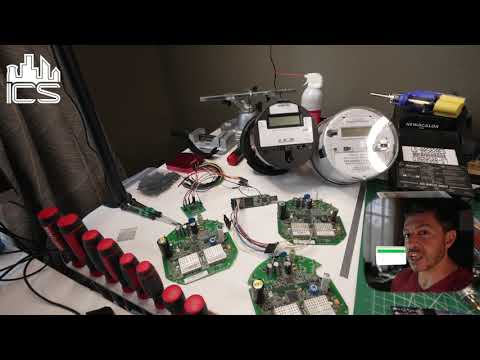
Smart Meters: I'm Hacking Infrastructure and So Should You (Hash Salehi)

Why Smart Meters? This is a question Hash is often asked. There's no bitcoin or credit card numbers hiding inside, so he must want to steal power, right? Openly analyzing the technology running our critical infrastructure and publishing the findings is something Hash is passionate about. In the wake of the great Texas freeze of 2021, we can no longer "hope" those in power will make decisions that are in the people's best interest. This talk will present research on the Landis+Gyr GridStream series of smart meters used by Oncor, the largest energy provider in Texas.

Cyber attacks on Industrial Control Systems (ICS) differ in scope and impact based on a number of factors, including the adversary's intent, sophistication and capabilities, and familiarity with ICS and automated indutrial processes. In order to understand, identify and address the specific points that can prevent or stop an attack, a systematic model known as "Cyber Kill Chain" is detailed, a term that comes from the military environment and registered by the Lockheed Martin company. While most are familiar with terms and theoretical diagrams of how security should be implemented, in this talk we want to present live how an attack chain occurs from scratch to compromise industrial devices, the full kill chain, based in our experiences. The goal is to land these threats into the real world without the need to carry out these attacks with a nation-state budget.
Smart Meters: I'm Hacking Infrastructure and So Should You (Hash Salehi)

DEF CON 29 - Paz Hameiri - TEMPEST Radio Station

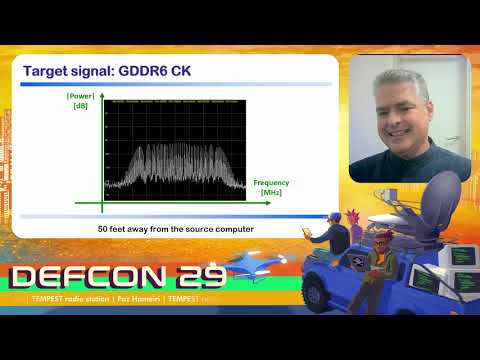
TEMPEST is a cyber security term that refers to the use of electromagnetic energy emissions generated by electronic devices to leak data out of a target device. The attacks may be passive (where the attacker receives the emissions and recovers the data) or active (where the attacker uses dedicated malware to target and emit specific data).

In this talk I present a new side channel attack that uses GPU memory transfers to emit electromagnetic waves which are then received and processed by the attacker. Software developed for this work encodes audio on one computer and transmits it to the reception equipment positioned fifty feet away. The signals are received and processed and the audio is decoded and played. The maximum bit rate achieved was 33kbit/s and more than 99% of the packets were received.

Frequency selection not only enables maximization of signal quality over distance, but also enables the attacker to receive signals from a specific computer when several computers in the area are active. The software developed demonstrates audio packets transfers, but other types of digital data may be transmitted using the same technique.
[Slides Link] [Whitepaper]

DEF CON 29 - Paz Hameiri - TEMPEST Radio Station

DEF CON 29 RF Village - cemaxecuter - RF Propagation and Visualization with DragonOS

"Today's presentation will start with a brief history of DragonOS, where it started and where it's at today. After a short introduction, I'll dive into the subject of visualizing RF propagation with DragonOS. I'll be showing a fresh OS install and the necessary steps to generate a rough estimate of a transmitter based on SRTM-3 elevation data, as well as a new feature enabling visualization/calculations of the path between transmitter and receiver .

Topics and hands on (pre-recorded) demonstrations will include the following,

  • SPLAT! is an RF Signal Propagation, Loss, And Terrain analysis tool for the electromagnetic spectrum between 20 MHz and 20 GHz.
  • Signal Server Multi-threaded RF coverage calculator
  • Dr. Bill Walker's role
  • Signal Server and DragonOS integration
  • DF-Aggregator Developer / Modifications for visualization

I’ll conclude talking about future improvements to RF propagation and visualization tools."

DEF CON 29 RF Village - cemaxecuter - RF Propagation and Visualization with DragonOS

Continue reading

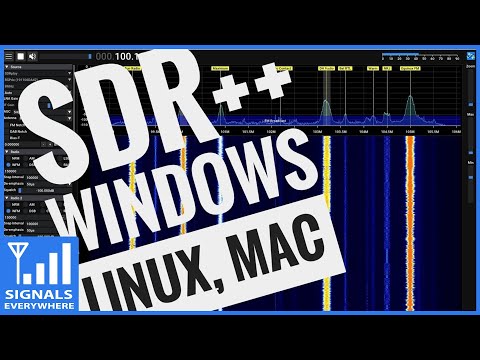
SignalsEverywhere: Testing SDR++ A Hands on Overview

On on YouTube on the SignalsEverywhere channel Sarah has uploaded a new video where she gives a hands on overview of the SDR++ software. Last week we posted about the release of SDR++ V1.0.0, which is an open source, cross platform, C++ based GUI general receiver program for various SDRs including the RTL-SDR.

In the video Sarah shows it's basic usage in action and highlights many of the great features that SDR++ has. Overall Sarah notes that she is very impressed with SDR++, praising it as one of the best SDR applications released in a while, and we agree.

SDR++, The Cross-Platform bloat-free SDR software | A Hands on Overview

OpenWebRX Updated to V1.1.0

Thank you to Jason for writing in and letting us know that OpenWebRX Version 1.1.0 has been released on August 03. OpenWebRX is an open source program that allows users to make RTL-SDRs, KiwiSDRs and other SDRs accessible over the internet via a web browser. It is is currently available as a Raspberry Pi SD card image, in the Debian + Ubuntu repositories, as a docker image, or for manual installation. 

The latest version adds an AMBE voice data decoder, new decoders and metadata displays for NXDN and D-Star, and crisper SVG graphics.

Since we last posted about OpenWebRX updates in early 2020, there has also been support added for the Perseus-SDR, RadioBerry 2, Hermes HPSDR, Funcube Dongle Pro+ software defined radios. New decoders and support for external decoders such as JS8Call, FreeDV, Wideband FM, DREAM DRM,  FST4, FST4W, Q65 and M17 digital voice have been added.

There is also now a site called Receiverbook.de that aggregates a list of publicly available OpenWebRX receivers.

OpenWebRX Interface

Layering Geo-Spatial Fire Data onto GOES Satellite Imagery

Thank you to Carl Reinemann (aka usradioguy) for writing in and sharing with us how he has developed a script to layer FIRMS data (Fire Information for Resource Management System US / Canada) onto GOES satellite images (usradioguy blog post) that can be received with an RTL-SDR. We have a tutorial on GOES reception here.

The script is a Windows batch file that downloads FIRMS data from the internet every 12 hours, then converts that data into a format that can be processed by goestools. Once converted the resulting JSON file is uploaded to the Raspberry Pi running goestools. A custom goestool process is then used to layer the data onto the received images.

The result is accurate red polygons on the satellite image in areas where fires have been recorded. With this data visualized it is easy to see where smoke seen on the satellite images is coming from. For example, the image below shows the location of wildfires in the Western USA and the resulting smoke trailing across the continent.

Carl has also tested the fire data layer with GK-2A and Himawari-8 and notes that it works well with images from those satellites as well. 

Fires data in Western USA layered on top of received GOES satellite images.

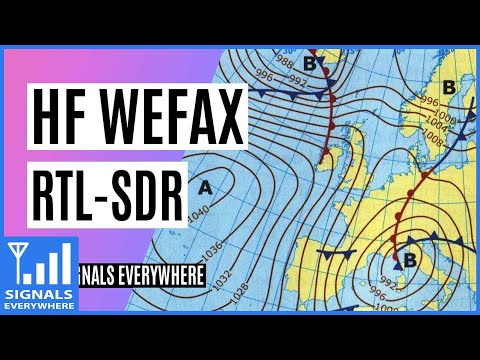
SignalsEverywhere: Decoding HF WEFAX Weather Fax with an Airspy HF+ Discovery SDR

Over on YouTube Sarah is back this week with a new video on her channel SignalsEverywhere. In this video she shows how to decode HF WEFAX (weather fax) images using an Airspy HF+ Discovery software defined radio with a YouLoop antenna. HF weather faxes are daily weather chart images transmitted as an analogue signal over the HF bands by coastal stations. They are mostly used by ships at sea.

First Sarah shows where to find a lists of WEFAX frequencies and schedules for her area, and then goes on to demonstrate a WEFAX signal being received and decoded using SDR#, VB-Audio Cable and the FLDIGI decoder.

Decoding HF WEFAX Weather Fax with SDR Software Defined Radio | Airspy HF Discovery

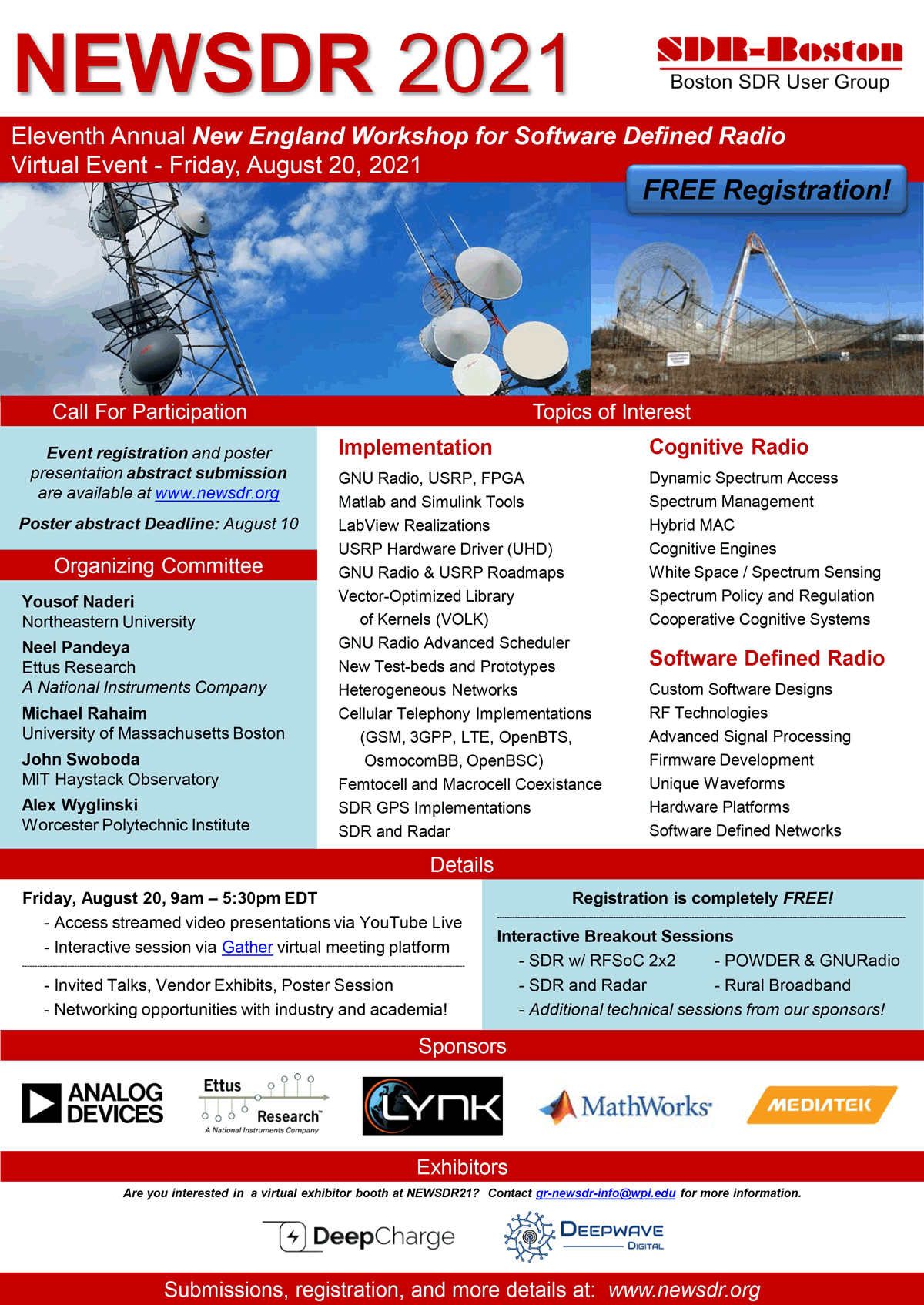
NEWSDR 2021 Conference to be held Virtually on August 20

The 11th New England Workshop on Software Defined Radio (NEWSDR 2021) will again be held online this year due to the ongoing pandemic. It is due to begin on Friday, 20 August 2021, 9:00 AM (EDT) – 5:30 PM (EDT). Registration is completely free. 

The 11th iteration of NEWSDR will be held in a fully virtual format on August 20, 2021. The event will include a series of talks from invited speakers and our industry sponsors (Analog Devices, Ettus/NI, Lynk, MathWorks, and MediaTek) along with interactive breakout sessions, poster sessions, and sponsor/exhibitor booths within the Gather virtual meeting platform.

Registration is completely free and we are also accepting submissions for poster presentations and elevator pitches!

A livestream link has already been set up on YouTube for the 20th, so if interested you can set a reminder using the YouTube reminder feature.

All presentations from the 2020 NEWSDR virtual conference can be viewed on the YouTube video below.

NEWSDR 2020 :: 10th New England Workshop on Software-Defined Radio

Running an RTL-SDR on a QNAP NAS

Thankyou to M.Khanfar for submitting news about his latest project which involves running an RTL-SDR dongle on a QNAP NAS (network attached storage). Running a dongle on a NAS machine might be useful if you need to record large amounts of IQ data, or need fast network speeds. Khanfar writes:

In this video , I will show you step by step how to make QNAP NAS Recognize and Running SDR Dongle and connected directly via USB and then launching rtl-sdr tools by installing dependencies tool to run like rtl_tcp.

The tools we need to install its calling QPKG. QNap Nas has it's own operating system called QTS, and NAS it mean ( Network Attached storage ) and I'm successfully implementing dependencies and make QNAP Recognize my SDR Dongle Stand alone. 

The QPKG it's like. exe in windows, but its special extensions for qnap operating system QTS .

The two qpkg (software) we will install them from third party delevopper for qnap , not from official qnap store, and I will install them inside my QNAP and you will see step by step how it's easy to turn your QNAP NAS to SDR Server without any pc needed ! 

And the advantage is the qnap is stand alone, and it has a high speed gigabit LAN speed, and it have SSL certificate that I buy it from qnap store for secure connection from outside and it has like fix up adrress it's called qnap Id.

So I can easy running my sdr# from my work directly TCP to my SDR dongle ! using qnap Id with plus port number for TCP like 1234.

If you have +3mbps internet speed for uploading in your home, you can easy access and making connection to rtl_tcp from different country, and secured with ssl and qnap I'd ! I will post in future video for WAN Access secure and fast to rtl_tcp from outside.

The two QPKG we need : 

1-Entware-3x-std: its install many dependencies packages to use in terminal like OPKG tool that we need it to install rtl-sdr package! .
2-Gotty : its terminal emulator I use it inside qnap to install commands. 
follow my video for understanding!

My qnap model in this video: QNAP TS-228 

The command I use after install all dependencies:
opkg install git rtl-sdr

Command for update opkg :
opkg update

Resources:

https://www.qnap.com/en/
https://www.qnapclub.eu/en

Implementing SDR Dongle Under QNAP NAS - QTS os

SDR++ Version 1.0.0 Released

SDR++ is an open source, cross platform, C++ based GUI general receiver program for various SDRs including the RTL-SDR. Since it's alpha release in mid 2020, it has undergone huge amount of development, and is quickly becoming the main program of choice for many users due to it's efficiency, cross platform and multi-SDR hardware support and increasing feature set. And with an easy GUI very similar to that of SDR#, it's easy for most users to learn.

Recently version 1.0.0 of the SDR++ software has recently been released. This is the first non-beta stable version, so represents a major milestone in development. Over on Reddit programmer u/xX_WhatsTheGeek_Xx summarizes the latest developments.

After over a year of work, I'm proud to released version 1.0.0 of SDR++!

For those who don't know, SDR++ is a crossplatform (Windows, Linux, MacOS, BSD) and open-source (https://github.com/AlexandreRouma/SDRPlusPlus/releases) general purpose receiver software meant to be simple and easy to use. It has advances features like multi-vfo and uses a fully custom DSP making it very efficient.

Here are the following additions compared to the last version:

  • Support for the SpyServer protocol
  • Support for all SDRplay devices
  • Support for all BladeRF devices
  • Support for all LimeSDR devices
  • Optional IQ correction
  • Optional Decimation
  • Broadcast FM Stereo
  • Frequency manager to create lists of frequency and optionally display them directly on the FFT/Waterfall
  • Network sink to stream the audio output via TCP or UDP
  • Options to set the FFT framerate, FFT size and FFT window.
  • Theming with Dark and Light themes supplied by default
  • RigCTL server module to control SDR++ from, for example, gpredict.
  • A bunch of keyboard shortcuts (see wiki on the github page)
  • SNR meter
  • More info when hovering a VFO
  • Colored VFOs to easily identify which is which at a glance
  • Meteor M2 demodulator compatible with LRPTOfflineDecoder and Satdump
  • Ability to resize VFOs by directly dragging the sides on the FFT and waterfall
  • Module manager to easily add or remove any module on the fly without having to restart or edit the config manually
  • File dialogs to select directories in the recorder or files in the file source (instead of having to type in the path)
  • Ability to disable modules that support it (Radio and Meteor M2 demodulator) with one click (to save CPU power or just if they're not needed)
  • Lots of performance improvements
  • Ludicrous amounts of bugfix :)

I'd like to thank the many contributors, patrons and companies (SDRplay, Airspy, Nuand, LimeMicro) who helped make this project possible!

If you have any issue with the software, please open a github issue or contact me directly on the SDR++ discord (see readme on github)

I hope this software comes in useful to at least some of you ;)

We also wanted to highlight the fact that SDR++ runs smoothly with about 50% CPU usage on a Raspberry Pi 4 with an RTL-SDR.

Also according to @cemaxecuter who created DragonOS, if rtaudio is installed on Linux , then an easy to use virtual audio sink becomes usable from SDR++, allowing audio to be easily passed to other programs such as WSJT-X just like on Windows.

A ready to use zip file for Windows is available on the GitHub Releases page, as well as amd64 .deb and .pkg install files for Ubuntu, Debian and MacOS systems. For other systems the compilation instructions are available on the readme or Git main page.

SDR++ V1.0.0 Screenshot