In Rob's latest episode of his excellent aviation communications series on his Frugal Radio YouTube channel he shows how to decode aircraft HF ACARS (HFDL) using a software defined radio. HFDL is short for "high frequency data link", and is a method aircraft use for sending text and data communications to ground stations. It is an alternative to VHF or satellite ACARS communications methods.
In the video he shows how he's been able to receive HFDL from all over the world using a simple HF dipole antenna and an Airspy HF+ Discovery. He goes on to show how to find HFDL signals, and how to decode signals using SDR# and the PC-HFDL software. Finally he shows examples of aircraft received, and how to interpret some of the information being received, including location information.
How to decode HF ACARS (HFDL) free with your SDR - Monitoring Aviation Communications Episode 8
Thank you to Antonio from the Polytechnic University of Madrid, Department of Photonic Technology and Bioengineering for writing in and sharing with us his teams latest research titled "Dual-Comb Spectrometer Based on Gain-Switched Semiconductor Lasers and a Low-Cost Software-Defined Radio". The research involves the use of an RTL-SDR Blog V3 dongle in place of an expensive digital oscilloscope for measuring the output of a dual-comb spectrometer. The abstract of the paper reads as follows:
Dual-comb spectroscopy has become a topic of growing interest in recent years due to the advantages it offers in terms of frequency resolution, accuracy, acquisition speed, and signal-to-noise ratio, with respect to other existing spectroscopic techniques. In addition, its characteristic of mapping the optical frequencies into radio-frequency ranges opens up the possibility of using non-demanding digitizers.
In this paper, we show that a low-cost software defined radio platform can be used as a receiver to obtain such signals accurately using a dual-comb spectrometer based on gain-switched semiconductor lasers.
We compare its performance with that of a real-time digital oscilloscope, finding similar results for both digitizers. We measure an absorption line of a H13C14N cell and obtain that for an integration time of 1 s, the deviation obtained between the experimental data and the Voigt profile fitted to these data is around 0.97% using the low-cost digitizer while it is around 0.84% when using the high-end digitizer.
The use of both technologies, semiconductor lasers and low-cost software defined radio platforms, can pave the way towards the development of cost-efficient dual-comb spectrometers.
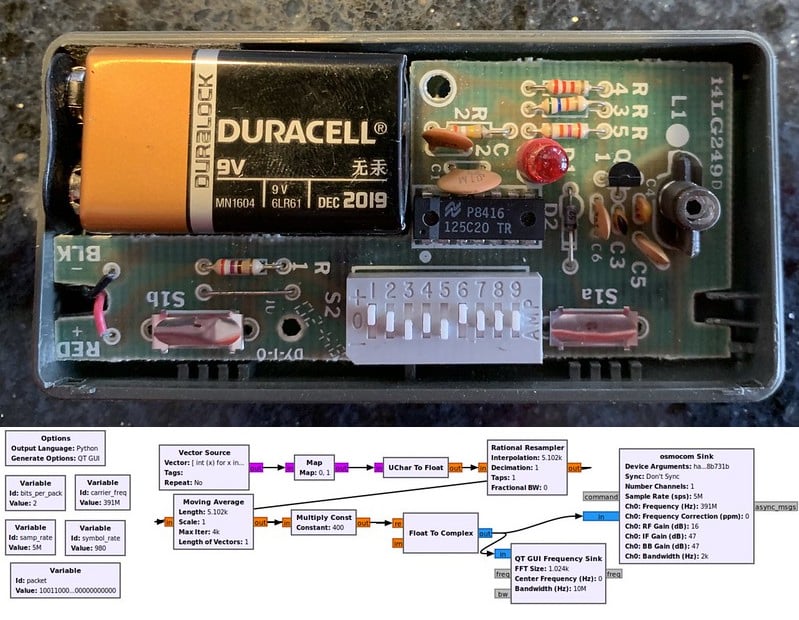
Back at home he pulled up the FCC filing for the device, which unveiled that it is OOK-PWM modulated, and operates at 433.92 MHz. The rest of the filing also had information noting that the implant transmits a 59-bit data packet every 12 seconds, and contained a nice breakdown of the packet structure, making it easy for decoding.
With all the information about the device's wireless transmissions now known, James grabbed his RTL-SDR and fired up SDR# to confirm that the signal was indeed transmitting every 12 seconds at 433.92 MHz. Next he was able to decode the data from the device by inputting the protocol information learned from the FCC filing into an rtl_433 command line string.
After a bit of further work James discovered that the pH data was actually two readings in one data string. At this stage he finally had the pH reading, however it was represented as an 8-bit ADC reading with a value between 0 to 255. James plotted the relationship between the 8-bit raw ADC reading, and the pH value shown on the official Medtronic receiver. With this he was able to determine a linear relationship between the ADC reading and real pH reading, but notes that there may be a more accurate calibration curve required for actual medical use.
Decoding pH readings from a stomach implant with an RTL-SDR
Thank you to Viol Tailor for submitting news about the release of his general purpose multimode software defined radio receiver program for Windows called "uSDR" or "microSDR". Viol writes that uSDR is designed as a lightweight binary with a simple and compact user interface and highly optimized DSP to minimize CPU, hence the "micro" part of the name.
The software is compatible with RTL-SDR, Airspy, BladeRF, HackRF and LimeSDR radios. It has features including demodulation, base band and pass band recording, playback, and spectrum and waterfall visualizations.
uSDR aka microSDR. A lightweight SDR receiver program from Windows.
In this weeks video Rob from his Frugal Radio YouTube channel shows us how he's turned an old piece of scrap electrical extension cord into an effective HF antenna for his Airspy HF+ SDR. The scrap wire is combined with a US$15 NooElec 9:1 balun which helps improve the impedance match of the antenna. He then stretches the dipole out through his backyard and then hooks it up to his Airspy HF+.
The results show good reception across the 20m, 80m, 40m amateur radio bands, as well as on HF ATC aircraft communications, US coast guard weather information broadcasts and the AM broadcast band.
I made an HF Dipole for free! Reception was good on my AirSpy HF+ Discovery SDR!
Thank you to Jasper for writing in and letting us know about the release of his new open source software called "AIS-Catcher". AIS-Catcher is a MIT licensed dual band AIS receiver for Linux, Windows and Raspberry Pi. It is compatible with RTL-SDR dongles and the Airspy HF+.
AIS stands for Automatic Identification System and is used by marine vessels to broadcast their GPS locations in order to help avoid collisions and aide with rescues. An RTL-SDR with the right software can be used to receive and decode these signals, and plot ship positions on a map.
Jasper notes that his software was intended to be a platform for him to experiment with different receiving model algorithms. On the GitHub readme he explains how he's experimented with a coherent demodulation model that estimates the phase offset, a non-coherent model which is similar to what most existing decoders use, a modified non-coherent model with aggressive PLL, and an FM discriminator model which assumes the input is the output of an FM discriminator.
The readme goes on to show some comparison results indicating that the coherent model is the best although it uses 20% more computation time. He also compares AIS-Catcher against some other AIS decoders like AISRec and rtl-ais, showing that AIS-Catcher appears to be comparable or better than AISRec, which is one of the most sensitive decoders available for SDR dongles.
A Windows binary is provided on the releases page and compilation instructions for Linux are provided on the Github Readme.
Some results from AIS-Catcher. Different algorithms and different software compared.
Airspy is currently holding a 20% off summer promotion which runs from June 28th until Julty 4th 2021. The sale is active at all participating resellers, which includes our own store where we have the YouLoop on sale for US$27.96 including free shipping to most countries in the world, instead of the usual US$34.95. Please note that due to new EU VAT collection laws, EU customers must purchase the discounted YouLoop from our eBay or Aliexpress stores.
The YouLoop is a low cost passive loop antenna for HF and VHF. It is based on the Möbius loop design which results in a high degree of noise cancelling. However the main drawback is that it is a non-resonant design, which means that it works best when used with ultra sensitive receivers like the Airspy HF+ Discovery.
Back in early 2014 Crimea was annexed from the Ukraine by Russian forces. Recently we've heard news that a Crimean resident was arrested by the Russian Federal Security Service under the suspicion of being a Ukrainian informant who was intending to transfer, or was transferring military data abroad using RTL-SDRs.
A video of the arrest has been uploaded to YouTube, and RTL-SDR dongles running with the Airspy SDR# software on his laptop can clearly be seen as having been photographed. The photos of the SDR# screen appear to show that he was monitoring the commercial aviation band with a scanner plugin.
The YouTube description is translated below:
Today it was reported about the arrest of a Crimean resident, either intending to transfer, or transferring military data abroad.
The FSB has published footage of the arrest. The time on the laptop caught on the video during the search of housing 07:40 date 06/22/21. The laptop is turned on, the AIRSPY radio frequency scanning program is running, the laptop is in the dust - only traces of pressing some keys are visible, and the touchpad was not used. There are many icons in the room, books on radio engineering, a Ukrainian flag, aircraft models, several pennants "Tavria 1958", an ICOM IC-R6 radio, maps.
The detainee transferred the information received to Ukraine on one basis, collected it on the other and intended to transfer it.
The court sent the man to the pre-trial detention center for 2 months. If his guilt is proven, then high treason "shines" and does not shine to see the will for 25 years.
According to an article on RadioFreeEurope, the man was detained as he was "collecting data on the flights of Russian military planes for Ukrainian intelligence".
It is unclear if the man was knowingly providing intelligence services, or is simply an aviation hobbyist caught up in politics. If anyone has more information about his story, please let us know in the comments.
UPDATE 29 June 2021: More information on the story at this link.
Украинский осведомитель был футбольным фаном. Болел за «Таврию»
Crimean resident arrested for using RTL-SDRs to monitor the airbandCommercial Aviation Frequencies Monitored