Over on the SWLing (Short Wave Listening) Post blog Thomas has just uploaded his review of the YouLoop in a post titled "The Airspy Youloop is a freaking brilliant passive loop antenna". If you weren't aware, we are currently selling this loop in our store for US$34.95 incl. free worldwide shipping to most countries. Sales are currently in pre-order as our first batch of units ordered sold out within a day, but we're soon going to receive the second batch in the next few days.
Thomas is a seasoned shortwave listener who has used many antennas, and in the review he notes that he is extremely impressed with the performance. In his review he tests the antenna in a location that is swimming with RFI and places the loop in the middle of a bedroom. Although the situation is not ideal, Thomas was surprised at the number of signals he was able to receive.
To work properly the YouLoop requires a low noise figure radio like the recommended Airspy HF+ discovery, but Thomas notes that he's also had excellent success with the SDRplay RSPdx running in HDR mode.
YouLoop Portable Passive Magnetic Loop Antenna for HF and VHF
A few days ago we posted about our release of the first batch of YouLoop passive HF/VHF loop antenna kits. We underestimated the demand and sold out of kits in less than a day! We now have a second batch currently being manufactured and it should be ready to ship out in about a week from now (late March/early April).
You can currently pre-order this item from our store, and we will ship it out as soon as the stock hits the shelves on our warehouse. For this product we are focusing on non-US customers and US customers can purchase locally from airspy.us. Though we will still fulfill US orders if you want to order from us instead.
If you are interested in further information, search YouLoop on Twitter to see a bunch of new tweets about people talking about and demonstrating this antenna design.
YouLoop Portable Passive Magnetic Loop Antenna for HF and VHF
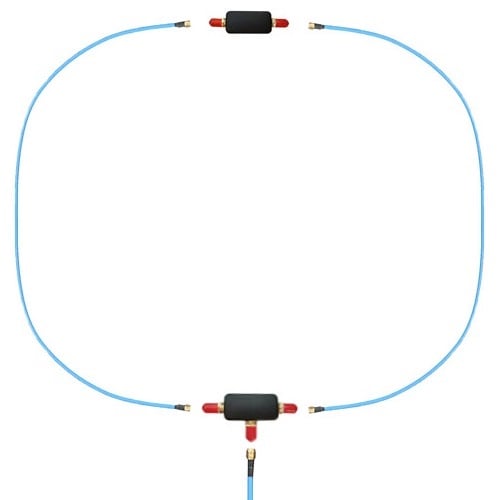
We have recently been able to obtain a small number of YouLoop HF/VHF portable receive only passive antennas that were produced by the owner of Airspy. The YouLoop is available in our store priced at US$34.95 including free worldwide shipping. It comes with the balun "tee" connector, coax inverter, 2x 1m semi-rigid coax cables for a ~60cm loop, and 1x 2m semi-rigid coax for the feedline. Note that US customers may wish to purchase from airspy.us as they have local US stock. We are focusing on non-US orders for this product and we only have very limited stock at the moment - UPDATE: Now out of stock. We have reordered more and should be back in stock by end of March.
YouLoop Portable Passive Magnetic Loop Antenna for HF and VHF
If you don't know what a "YouLoop" is, it is a simple passive magnetic loop antenna design which consists of a ring of coax cable and a low loss 1:1 or 4:1 balun. The design was recently popularized by Youssef (prog) the owner of Airspy, and he has put up a page explaining how the design works here. Many users on Twitter have been reporting good results with HF reception with the design. It appears to be especially useful in urban environments where there is lots of local noise.
Left Discovery with YouLoop Antenna, Rigth Discovery with HF Hoxin Vertical Antenna.
Same configuration in sdr#, both in roof with 25m RG213 cable.
A lot of noise in the vertical antenna, Barcelona noisy city. pic.twitter.com/NNYdpsmNTo
Being passive, it has no amplification and so it works best with a low noise SDR like an Airspy HF+. However we have also found decent results with SDRplay SDRs, and a standard RTL-SDR Blog V3 running in direct sampling mode, although RTL AGC mode needs to be turned on for an extra boost. Improved results can be obtained by using a low cost HF amplifier on the front end, and even our wideband LNA which is advertised as working down to 50 MHz still does actually give a decent boost from 5 MHz and up.
Also the design has some advantages in that it has very low electrical interference pickup, and has no electronics that can overload from signals that are too strong. Overloading from strong signals is something that can easily affect cheap magnetic loop antennas like the MLA-30, and even higher end loop antennas too. Being a magnetic loop, it also naturally filters out electric field interference which is extremely common in urban environments, and is the reason why e-field antennas like miniwhips often perform poorly.
The antenna is designed to be extremely portable, being lightweight and easy to assemble/disassemble. As such it is not designed to be weatherproof, so if you do decide to mount it permanently please make use of weatherproofing tape.
Unlike fixed magnetic loops, the YouLoop design is also easy to experiment with. By using longer coax cables you can easily create a larger loop which can result in stronger signals. We found that replacing the 1m loop cables with 2m lengths gave quite nice results for us. If you have the space you could try even larger loops too.
The design also doubles as a great VHF antenna with reception up to 300 MHz possible when used in a folded dipole configuration. To do that, simply flatten the loop into a dipole shape.
Finally, if you prefer the YouLoop can also be constructed by yourself. The Twitter post below shows the basic design. Search Twitter for "YouLoop antenna" for more discussion on the design too.
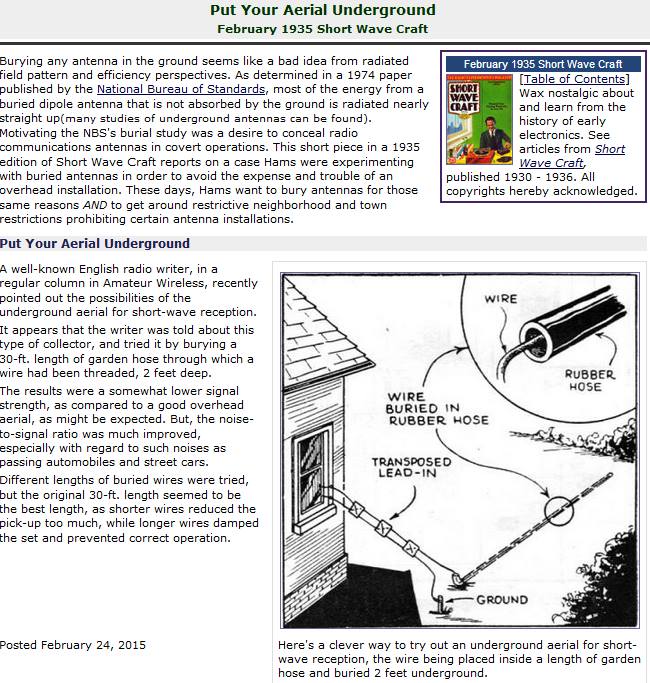
Thank you to Jean-Marie Polard (F5VLB) for letting us know about his work in creating underground "earth probe" antennas that work for both RX and TX between 0 - 14 MHz, and are especially good at VLF and below. He writes:
Can't install an antenna at home? Madame refuses the masts, taut son? One solution, The Earth probes antenna.
Our group (https://www.facebook.com/groups/earthprobes/) started in January 2019. At first everyone made fun of me, the professionals called me crazy and today with more than seven hundred members, we installed underground antenna systems and the results are there.
Between 0 and 14MHz, in transmission and reception, it works!
This system dates from 1914/1918 but has been brought up to date.
It doesn't take much to get started, just the urge to try.
To access the Earth Probes and VLF.ULF.ELF groups you'll need a Facebook account. The groups contain a number of research papers documenting the concept, and the photos section. From the photos, an earth probe antenna appears to consist of two long grounding rods spread over a distance, or a grounding rod and long buried wire, combined with a balun.
An example of an underground antenna setup from a 1935 shortwave magazine.
Over on his YouTube channel TechMinds has uploaded a video reviewing the X1-HF 1 - 50 MHz Trapped Coil Receiving antenna from Moonraker.eu which goes for £69.95. This is a small electrically short antenna for HF reception which is easy to setup and install, requiring no radials. However, like all short HF antennas it is a compromise.
In the review he uses an SDRplay RSP2 SDR to test HF reception with the antenna. Later in the video he also tests it outside the advertised 1 - 50 MHz range. He concludes that the antenna works very well for it's small size.
HF RX SWL Antenna For Small Spaces And Apartments RTL SDR
The Spin Semiconductor FV-1 is a digital reverb chip designed for creating custom audio effects in products. As it is a digital chip it makes use of an ADC and DAC, with the audio effects DSP placed in the middle of the chain. However, by using custom code Ray was able to convert the ADC into an SDR by creating custom AM/FM and LSB demodulators on the programmable DSP instead of the audio effects.
His post contains the full schematics, code and PCB files required to recreate his work if desired.
To do this he used an Android app called "DRM+SDR Receiver" which is available for US$4.99 on the Play store. The app supports RTL-SDR and HackRF devices. So all you need to do is set the RTL-SDR Android driver to run in Q-branch direct sampling mode, then tune to a DRM signal for it to begin decoding.
A demonstration video uploaded to his Google drive account shows clean decoding of the DRM AAC audio, as well as the app displaying Journaline and live metadata. He notes that his signal was very strong, so he only required a short wire, but DXers would need an appropriate antenna.
DRM Received on an Android phone with an RTL-SDR Blog V3 running in direct sampling mode.
Over on YouTube the TechMinds channel has uploaded a new video about decoding Differential GPS (DGPS) using an SDRplay RSPdx SDR. DGPS is a terrestrially transmitted long wave signal that is used to help correct and improve GPS position data calculations which may have timing errors due to atmospheric propagation delays. It works by broadcasting correction data calculated by the difference in received GPS location and the known location of the DGPS transmission site. DGPS is typically transmitted on longwave between 285 kHz and 315 kHz, but in Argentina there are two stations at 2570 and 2950 kHz.
In the video TechMinds explains how DGPS works, and some location around the world from where it is transmitted from. Later in the video he shows a DGPS signal being received by a SDRplay RSPdx SDR, and then show a demo of how it can be decoded with MultiPSK.
We note that there also various other DGPS decoders available including decoders for Android and iOS. A list of decoders can be found on the DGPS sigidwiki page.
DGPS Differential GPS Decoding With RSPdx And MultiPSK