Tagged: limesdr

Designing an Ultra Wideband Vivaldi Antenna

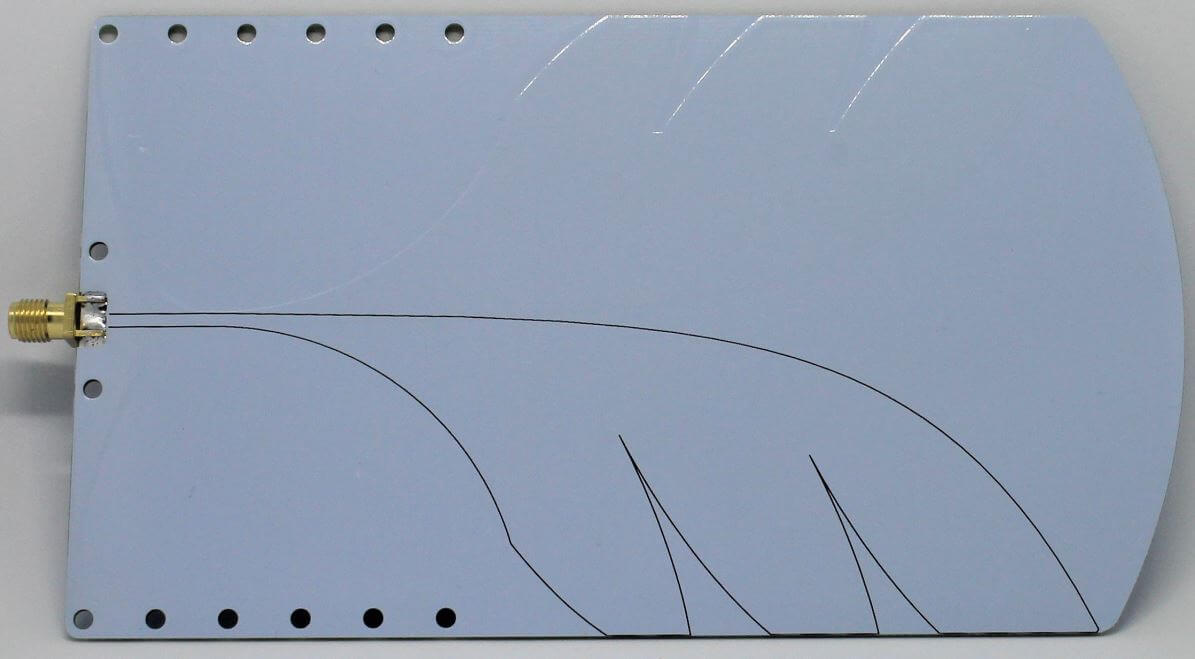
The LimeSDR mini is able to receive over a huge frequency range (10 MHz - 3.5 GHz), so having recently bought one "hexandflex" wanted to build an ultra wideband antenna to go along with it. On his three part blog post hexandflex introduces us to various ultra wideband antennas, introduces us to and shows us how to design and build a Vivaldi ultra wideband antenna, and measures the performance of the Vivaldi that he built.

The Vivaldi is a fairly well known ultra wideband antenna that is directional. It is fairly easy to build out of a PCB board, but requires some careful design considerations to work well. In the second post hexandflex goes over all the design considerations that he put into his Vivaldi incliding the feed design, substrate choice and additional improvements like adding corrugations and crafting the geometry for a lens effect.

The results show that the antenna works well as a directional antenna above 1.7 GHz, and begins to work more like a standard dipole below 1.7 GHz. Directional gain is greater than 5dB above 1.7 GHz, and becomes negative below 1 GHz. Although hexandflex notes that the gain below 1 GHz is still reasonable, and probably still better than any untuned monopole.

Hexandflex has put up a small number of Vivaldi antennas that he's produced up for sale on Tindie for US$18. Currently he has a limited batch of units to sell, but notes that he may run additional batches if they are popular.

Hexandflex's Vivaldi Antenna

A Pocket DATV Transmitter and Receiver with Raspberry Pi, LimeSDR Mini and RTL-SDR

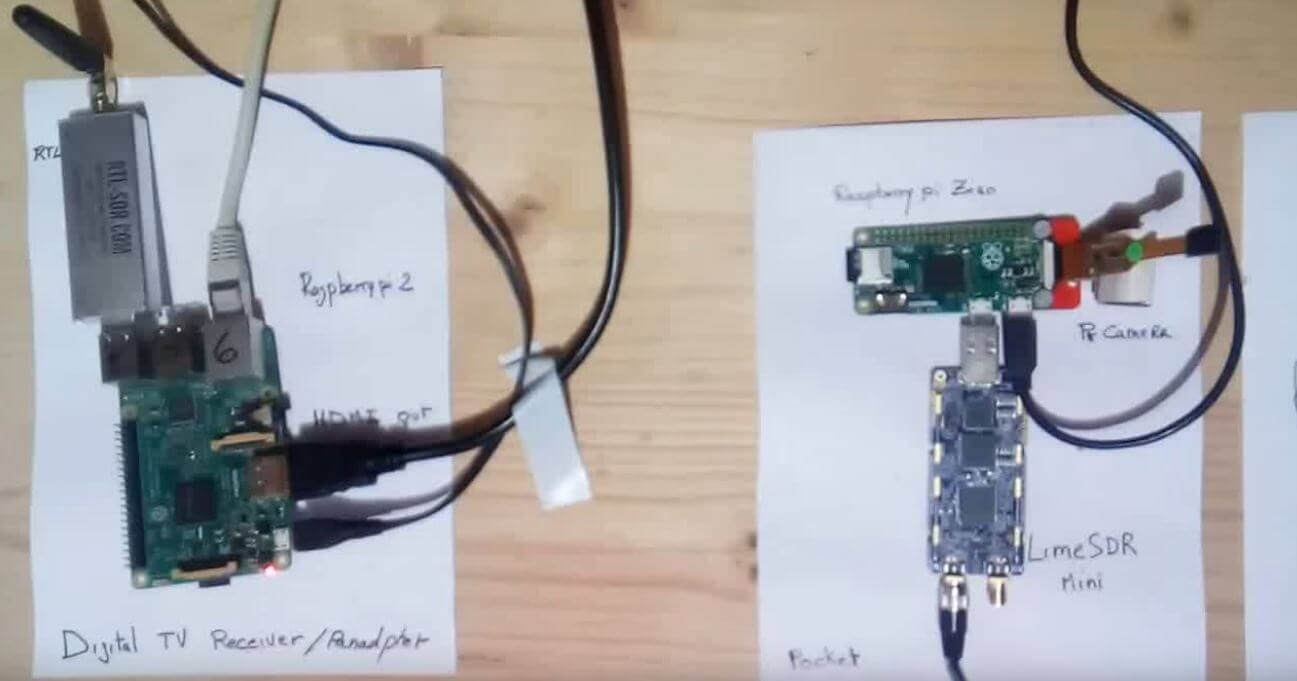
Over on YouTube user Evariste Okcestbon has uploaded a video showing his simple pocket DATV system that consists of a LimeSDR running on a Raspberry Pi Zero transmitting live camera images via DATV which is received by an RTL-SDR running on a Raspberry Pi 3.

If you didn't already know, DATV stands for Digital Amateur Television and is a digital mode somewhat similar to digital over the air TV signals that can be used by hams for transmitting their own TV signals on the ham bands. The LimeSDR Mini is a $139 US transmit and receive capable SDR that is currently crowdfunding and available for pre-order on Crowdsupply. It is expected to ship at the end of February 2018.

Evariste uses a range of software packages on each Raspberry Pi. He writes the following in the video description:

Description of a minimal Digital Tv chain : Transmitter and Receiver.

Hardware used on Tx : PiZero,Picam,LimeSDR Mini

Hardware used on Rx : Raspberry Pi 2, RTL-SDR,Monitor

Software used on Tx : avc2ts,dvb2iq,limetx

Software used on Rx : rtl_sdr,leandvb,kisspectrum,ts2es,hello_video

Softwares available on https://github.com/F5OEO
Special Thx to G4GUO, F4DAV and LimeSDR

Evariste is also the author of Rpidatv which allows you to transmit DATV directly from the GPIO pins of a Raspberry Pi without the need for any transmit capable SDR.

A Portable SDR Transceiver with LimeSDR Mini, Android Phone and QRadioLink

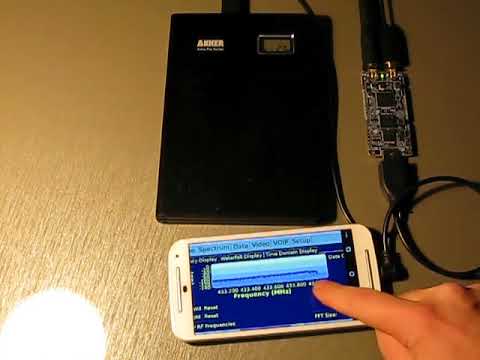
QRadioLink is a Linux and Android compatible radio app that can run on smartphones. It can be used to receive and transmit digital radio signals with a compatible SDR such as an RTL-SDR (RX only), or a LimeSDR Mini (TX and RX). The following video by Adrian M shows QRadioLink running on an Android phone with a LimeSDR Mini connected to it. An external battery pack is also connected to maintain power levels over a longer time.

In the video Adrian shows how this combination can be used as a fully portable radio transceiver. The video first shows him receiving broadcast FM, digital amateur radio voice (Codec2 & Opus is supported), narrowband FM and SSB signals. Later in the video he transmits a digital voice signal using the microphone on his Android phone. He notes that an external amplifier would still be needed if you wanted more transmission power.

Portable SDR transceiver: LimeSDR-mini, mobile phone and QRadioLink


Updates to the HF Performance of the XTRX SDR

Late last month we posted about the Fairwaves XTRX SDR which is a Mini PCIE TX/RX capable SDR with 10 MHz - 3.7 GHz tuning range and 120 MSPS sample rate that costs $199 US and is currently crowdfunding on CrowdSupply. At the time of this post the XTRX is currently 84% funded.

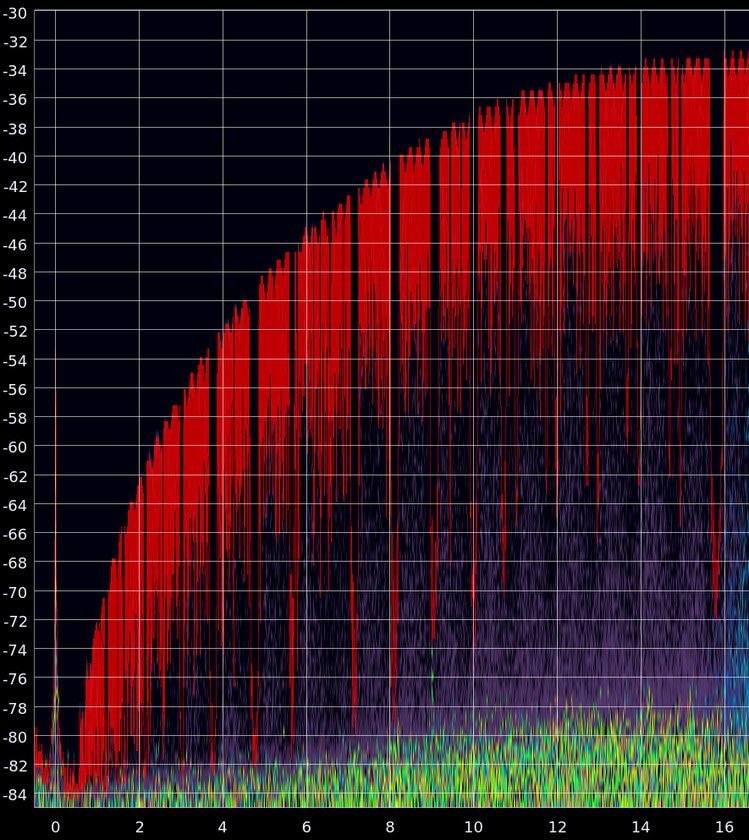
Recently the XTRX team released an update regarding the HF performance below 30 MHz. The update shows that signal attenuation starts to significantly reduce in the HF bands with the 3dB point being at 11 MHz. At 6 MHz the attenuation is at 13 dB, and at 2 MHz it's up to 29 dB. This attenuation may not be too bad though especially for strong HF signals, or perhaps a preamp like the LNA4HF could be used. They attempted to review their design to reduce the attenuation, but found that there is no easy fix especially with having such restricted space as in a PCIE card.

They also note that HF reception with the LMS7002 chip used on the XTRX can be problematic as the LO is fixed to a minimum of 30 MHz. So to receive below 30 MHz the receiving bandwidth needs to be increased which can cause saturation from any strong out of band signals. However, they tested with some very simple external bandpass filters for the 49m band (5.8 - 6.2 MHz) and had decent results.

The XTRX team also added a new breakout header to the board which provides direct connections to the LMS7002 chip ADCs for direct sampling. This could provide even better HF performance with an appropriate custom frontend.

XTRX HF Attenuation Graph

XTRX: Soon to be crowdfunding Mini PCIe based TX/RX SDR

Over on the crowd funding site crowdsupply.com there have recently been several updates on the Fairwaves XTRX SDR. The XTRX is an upcoming TX/RX capable SDR in a tiny Mini PCIe form factor. Mini PCIe is the expansion slot system used on some laptops. The SDR itself will be 2 x 2 MIMO, with a tuning range of 10 MHz - 3.7 GHz (down to 100 kHz with some degradation), and have a sample rate of up to 120 MSPS. It uses the LimeSDR RF chipset which provides most of the hardware required.

The XTRX is not yet for sale, and is planned for a crowdfunding run on Crowdsupply 'soon'. You can subscribe to future updates on their page. No word yet on pricing, but according to one of the developers comments on Reddit the price will be somewhere between the LimeSDR ($299 USD) and LimeSDR Mini ($139 USD). Eventually in the future if they can tap into a mass market they hope to get the price down to $50 USD.

Features & Specifications

  • RF Chipset: Lime Microsystems LMS7002M FPRF
  • FPGA Chipset: Xilinx Artix 7 35T
  • Channels: 2 × 2 MIMO
  • Tuning Range: 30 MHz - 3.8 GHz
  • Rx/Tx Range:
    • 10 MHz - 3.7 GHz
    • 100 kHz - 3.8 GHz with signal level degradation
  • PCIe Bandwidth:
    • PCIe x2 Gen 2.0: 8 Gbit/s
    • PCIe x1 Gen 2.0: 4 Gbit/s
    • PCIe x1 Gen 1.0: 2 Gbit/s
  • Sample Rate: ~0.2 MSPS to 120 MSPS
  • Reference clock:
    • Frequency: 26 MHz
    • Stability: <10 ppb stability after GPS/GNSS lock, 500 ppb at start up
  • Form Factor: full-size miniPCIe (30 × 51 mm)
  • Bus Latency: <10 µs, stable over time
  • Synchronization: synchronize multiple XTRX boards for massive MIMO
  • GPIO: 4 lines @ miniPCIe connector, 3 lines @ FPC edge connector
  • Accessories: miniPCIe-USB3 converter, miniPCIe-PCIe converter, etc
XTRX Prototype
XTRX Prototype

SDR Programming For Kids: LimeSDR Mini with Scratch on a Raspberry Pi 3

Scratch is a visual block based programming language aimed at getting kids into programming. Recently the LimeSDR team have been working at creating a Scratch interface for their LimeSDR Mini. It is basically working as a wrapper/interface to the processing backend which is handled by LuaRadio.

The idea is to keep the barrier of entry to SDR as low as possible, by making SDR programming accessible to kids as well. The software is currently a work in progress, but they write that they are attempting to develop the Scratch blocks necessary to enable the transmission and reception of text messages. Something like that would make a great learning tool for educators.

The video demo shows Scratch and the LimeSDR running on a Raspberry Pi 3. During the demo he creates a simple 433 MHz spectrum display by connecting up several blocks.

Scratch running with a LimeSDR Mini on a Raspberry Pi

LimeSDR Mini Updates: Demonstrations with Universal Radio Hacker, LattePanda, PothosSDR and GNU Radio

Over on their CrowdSupply crowdfunding site LimeSDR have been releasing several short tutorials and demonstrations showing their new LimeSDR Mini in action. The latest update shows a short tutorial on using the LimeSDR Mini together with Universal Radio Hacker (URH) to reverse engineer a 433 MHz remote control

Other previous updates include showing how to use the LimeSDR Mini and Wireshark to analyze WiFi signals, using it with a LattePanda mini computer, creating an FM demodulator in PothosSDR and decoding a 433 MHz keyfob in GNU Radio.

The LimeSDR Mini is a smaller and cheaper version of their LimeSDR which has slightly reduced specifications. The main changes are the slightly restricted frequency range of 10 MHz – 3.5 GHz, and half the maximum bandwidth at 30.72 MHz. The mini also only has 1×1 TX/RX channels. 

Recently the LimeSDR was released for crowdfunding on crowdsupply.com and already has raised $165,000 of it’s $100,000 threshold with 12 days remaining. Currently you can back the project for $139 with shipping expected on Dec 31.

LimeSDR Mini Renderings

LimeSDR Transmitting on the LattePanda

Just last week we posted about how Marty Wittrock was able to get his LimeSDR receiving perfectly on his LattePanda mini Windows 10 PC with SDRAngel. Now Marty has uploaded a new video which shows the LimeSDR running on the LattePanda and SDRAngel again, but this time transmitting 40m LSB voice. At this stage Marty is well on his way to creating a fully portable LimeSDR based ham transceiver. He writes about his setup:

Setup: LattePanda Win10/64-bit, LCD, Capacitive Touchscreen, LimeSDR and SDRAngel Win32 with a transmit device loaded…Also using a USB 2.0 audio device to make the microphone and speaker audio connections…WORKS GREAT..!!

The LimeSDR is a RX and TX capable SDR with a frequency range of 100 kHz – 3.8 GHz, bandwidth of up to 61.44 MHz, 12-bit ADC and 2×2 RX/TX channels. Recently the LimeSDR team have been crowdfunding for their new ‘LimeSDR Mini’ which is a smaller and cheaper feature reduced version of the standard LimeSDR. While all the early bird $99 USD units have been sold out, they are still available at the $139 USD price. Currently the crowdfunding campaign has already reached it’s $100,000 USD target with 35 days left.

One important ‘feature reduction’ to note is that the LimeSDR Mini can only tune down to 10 MHz, so it may not be as useful as the full $289 USD LimeSDR for creating a SDR based ham transceiver like what Marty is doing.

LimeSDR, LattePanda, and SDRAngel Transmitting on 40m LSB Voice