Tagged: rtl2832u

LNA4All Low Noise Amplifier Review

Over on the SDR for Mariners blog, author Akos has reviewed the LNA4All low noise amplifier. The LNA4All is a 25 euro amplifier designed to improve the performance of the RTL-SDR.

His results show that the LNA works very well. Akos tested the LNA4ALL on multiple frequencies and applications including commercial radio, airband, NOAA weather satellites, AIS and ADSB. As an example of the improvement, his ADSB reception was improved from 83km to 94km. In his review Akos also shows how to provide power to the LNA, and puts the LNA through some simple stress tests.

LNA4ALL Airband Performance

Potential Major Security Flaw on HP Laptop Discovered with RTL-SDR

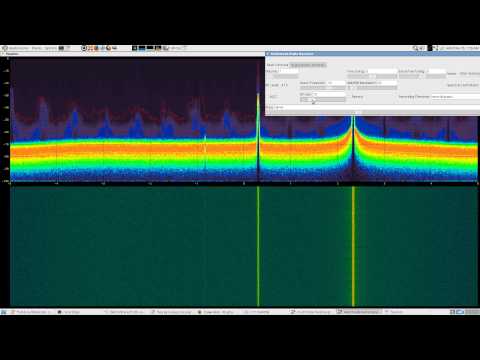
Over on Reddit, user cronek discovered by using his RTL-SDR that the microphone on his HP EliteBook 8460p laptop computer was continuously and unintentionally transmitting the audio from the built in microphone at 24 MHz in FM modulation. He found that the only requirement needed for the microphone to transmit was that the laptop needed to be turned on – even muting the microphone did nothing to stop the transmission.

Click here to read the original post.

I accidentally stumbled upon a signal in the 24MHz range, appearing to be 4 carriers. I tuned to it and heard silence, then someone came into my office and started talking and I could hear them speak. The signal appeared to be coming from my other laptop (not the one running the SDR) and was pretty weak (my antenna, the crappy one that comes with the dongle, stuck to a metal stapler was right next to the HP laptop).

This is of potential concern as as the US Military is apparently transitioning to this particular laptop. However, this may be an isolated incident, as in the thread cronek explains that other laptops he tested did not display this behavior.

HP Laptop Microphone Leak at 24 MHz

RTL-SDR and RDS Spy with HDSDR

On YouTube user pe1etr shows us a video where he uses his RTL-SDR combined with HDSDR, Virtual Audio Cable and RDS Spy to decode a distant RDS signal. RDS Spy is a free advanced software program capable of decoding weak RDS signals contained in many broadcast FM radio stations.

RDS stands for Radio Data System and is a digital signal embedded into broadcast FM signals. It is used by radio stations to display the name of the radio station and current song playing on an LCD screen.

HDSDR & RDS Spy side by side

ViewRF – RTL-SDR Spectrum Analyzer Software for the BeagleBone Black Released

Last month we showed a video of a spectrum analyzer project by Stephen Ong. He used a BeagleBone Black (mini embedded Linux capable computer similar to a Raspberry Pi), a touch capable LCD screen, and an RTL-SDR dongle to create a portable spectrum analyzer.

Now Stephen has released ‘ViewRF’, which is the software that powers his spectrum analyzer. It is released under the GPL licence. Also on his post are the download and install instructions.

Spectrum Analyzer using Beaglebone Black and RTL-SDR

Rain Scatter 10 GHz Reception with the RTL-SDR

YouTube user feri67000 who last month showed us that the RTL-SDR can receive 10 GHz signals with a cheap avenger LNB PLL now shows an interesting experiment where he uses a technique known as rain scatter to receive a 10 GHz beacon with his satellite dish pointed in the opposite direction of the beacon transmitter.

Usually communications at 10 GHz are line of sight only, but by using the rain scatter technique, the 10 GHz signal can be bounced off a precipitation cloud and received with line of sight to the cloud, rather than the transmitter.

rain scatter 10ghz LX1DB beacon

NOAA Weather Satellite Antenna and Software Guide

Over on the SDR for mariners blog, author Akos has written two new beginners posts on getting up and running with receiving and decoding NOAA weather satellite APT images.

The first post discusses antennas that are useful for NOAA satellite reception, and shows how to build a homemade turnstile and QFH antenna. His second post shows a beginners guide to the software that can be used to decode the APT signal in order to obtain a live weather satellite image.

sdrformariners_apt_image QFH Antenna

RTL-SDR Running on an Aria G25

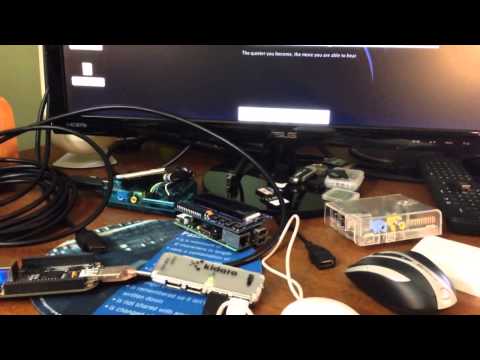
Blogger and ham radio enthusiast F4GKR has written a brief tutorial post on his blog showing how he got an RTL-SDR working with an Aria G25, and in another post some benchmarking results. The Aria G25 is a very small low cost, Linux capable embedded computer, similar to the Raspberry Pi.

He was able to get rtl_tcp running with a 2 MSps sampling rate and found it used about 60% of the CPU.

Aria G25 running the RTL-SDR

New Command Line Utility: rtl_power

A new command line wideband spectrum monitor utility called ‘rtl_power’ has been released by keenerd on Reddit. See the original thread here. This tool let’s you gather signal data over a very wide area of the frequency spectrum, and then that data can be used to find active areas of the spectrum.

Rtl_power is a small CLI tool for logging wide swaths of bandwidth. You can specify any chunk of spectrum, with any FFT bin size and any logging rate. (For sane values of any.)

For example

rtl_power -f 150M:200M:2k -i 10 logfile.csv

will monitor everything between 150MHz and 200MHz. The resolution will be at least 2kHz fine. It will integrate for 10 seconds and dump those numbers to the logfile. The structure of the logfile is:

date, time, Hz low, Hz high, Hz step, samples, dbm, dbm, ...

So it is not quite the traditional CSV file. Each frequency hop gets its own line and the frequencies of each column are extrapolated.

Coupled with a python script, a heatmap can be generated from the excel data.

I’m scanning the region between 150MHz and 160MHz, where there is local emergency services chatter. Each pixel is 10kHz wide and 10 seconds long, over a period of seven hours

rtl_power heatmap

This is command line tool is somewhat similar to the Scanner Metrics SDRSharp plugin, which allows large areas of the frequency spectrum to be monitored from within SDRSharp.