Category: Antennas

DragonOS: Running GNSS-SDR and Obtaining a GPS Position with an RTL-SDR and Patch Antenna

Over on his YouTube channel Aaron who created and maintains the DragonOS SDR Linux distribution, has uploaded a video demonstrating how to use the GNSS-SDR software together with an RTL-SDR and patch antenna to obtain a live GPS position.

Previously we had only seen a Windows method involving GNSS-SDRLIB and RTKNAVI working as GNSS-SDR on Linux seemed impossible to get running. However, Aaron managed to find a working RTL-SDR configuration for GNSS-SDR which made it come alive. This is great as now GNSS-SDR should be able to run on a portable single board computer like a Raspberry Pi.

The video is a tutorial that shows how to install all the required dependencies, how to compile GNSS-SDR, how to configure it for an RTL-SDR, and how to use it with our RTL-SDR Blog L-band patch antenna.

DragonOS FocalX Setup GNSS-SDR and Obtain GPS Position w/ RTLSDR (Patch Antenna, WarDragon)

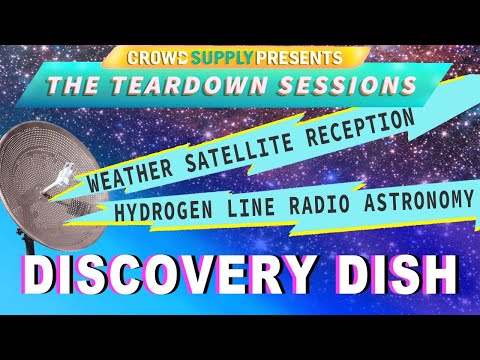
Discovery Dish Now Available for Crowd Funding! A Lightweight Dish and Feed for L-Band Weather Satellites, Hydrogen Line and Inmarsat

Today our Crowd Funding campaign for the Discovery Dish has gone live! Thank you to anyone who supports this project and our goal of bringing affordable products that make getting into various radio projects easier.

Our launch announcement reads:

We decided to develop Discovery Dish because we were disappointed by the lack of ready-to-use, low-cost, lightweight dish antennas on the market that are suitable for software-defined radio projects like receiving L-Band geostationary and polar-orbiting weather satellites, as well as for 1.5 GHz Inmarsat reception and 1.42 GHz hydrogen line radio astronomy. With excellent open source weather satellite decoding software, like SatDump, now available, it’s time for a complementary, easy-to-use hardware solution.

Through testing over several years, we chose 65 cm as the diameter, as we found that 60 cm is close to the minimum diameter required for perfect GOES weather satellite reception at 24° elevation, so this size should be suitable for most of the world that has GOES reception available. For LRPT satellites like GK-2A, and HRPT polar-orbiting satellites, it is more than large enough. We combined the dish with a carefully tuned feed that has a built-in low-noise amplifier (LNA) and dual filtering, which means there is no loss from feed to LNA. This also means we can use thinner and less stiff coax cable, which is a lot easier to handle and route. Finally we ensured that the entire dish and feed system is waterproof.

The only other ready-to-use dish offering we found is based on a modified 2.4 GHz grid Wi-Fi dish, which is still in our opinion too big and heavy. Size and weight is especially the important if you want to be able to use a low-cost, light-duty antenna rotator, which typically can only handle less than 1 kg in weight. We found that the grid Wi-Fi dish offering also has no solution for waterproofing the LNA, so the LNA needs to be placed indoors and very thick and unwieldy coax is used to avoid feed to LNA losses.

Other ways to receive these weather satellites and carry out hydrogen line experiments typically involve modifying a 2.4 GHz Wi-Fi grid antenna, or an old satellite TV dish. But these modifications can be time-consuming and difficult to get right, and even 60 cm satellite TV dishes are too heavy for light-duty antenna rotators.

Finally, we developed Discovery Dish with an eye toward it being used with a low-cost antenna rotator, and we are in the process of prototyping our own rotator design. Our antenna rotator is not ready for crowdfunding yet, as there are still some things to work out and long-term stress testing to be done, but please keep an eye out for it in 2024! An antenna rotator is a great addition if you want to use a dish antenna to decode images from the polar-orbiting HRPT weather satellites.

Note that you don’t need an antenna rotator to receive geostationary satellites like GOES, or to do drift hydrogen line observations. For polar-orbiting HRPT satellites, the lightweight nature of Discovery Dish also makes tracking the satellites by hand a much easier prospect.

Learn more about Discovery Dish on our main campaign page. Thank you to everyone who supports the Discovery Dish project in any way!
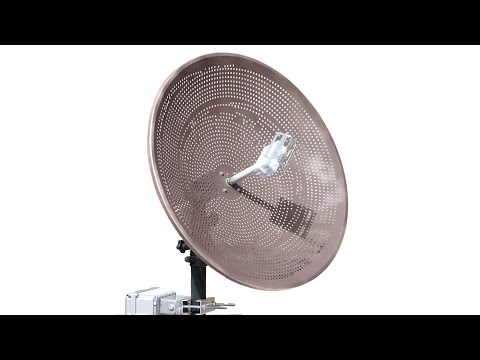
Discovery Dish: Simplified system for weather satellite reception and hydrogen line radio astronomy


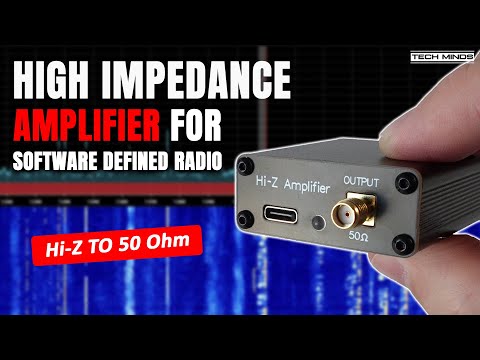
Tech Minds: Testing a High Impedance Amplifier for Software Defined Radio

Antenna impedance matching is important for antennas and software defined radios as impedance mismatches can result in poor reception. For transmitting SDR's the situation is more dire because impedance mismatches can actually damage the transmitting hardware or at least cause high power efficiency losses.

Over on his YouTube channel Tech Minds has uploaded a video where he tests out a battery powered HF high impedance amplifier for software defined radios. The amplifier is designed to be used with long wire antennas on the HF bands as these antennas typically have high impedances which don't match the 50 Ohm impedance that most SDRs expect to see. This device is an amplified alternative to using a passive unun.

The results in his video show that the signal to noise ratio is indeed boosted when the impedance matching amplifier is used. Later the device is opened to show the battery, charging management chip and amplifier chip.

High Impedance Amplifier for Software Defined Radio

Repurposing a Wireless networking Dish for L-Band HRPT Satellite Reception

Over on his YouTube channel, "saveitforparts" has uploaded a video showing how he's modified an old wireless networking dish for L-band HRPT satellite reception. L-band satellites that transmit HRPT are polar orbiting, meaning that some sort of tracking solution is required to point the satellite dish at the sky as the satellite passes over. However, lacking any sort of motorized solution, saveitforparts simply removes the dish mount so that the dish can be manually held and tracked.

He notes that he uses the paid version of the Stellarium app for augmented reality tracking of the satellite. In the past there was a great app called "Satellite AR" which did this for free, however within the past few years it has unfortunately been removed from the Google Play store.

The modifications to the dish involve removing the feed from the satellite and installing a custom built helical feed. He also uses a small handheld PC with RTL-SDR on the rear. However in the end the handheld PC turns out to be problematic so he switches to a laptop.

The dish used in saveitforpart's project is quite similar to our upcoming Discovery Dish crowd funding project, so please check that out if you are interested.

Handheld Cyberdeck Dish For Live Satellite Data

Wok-The-Hydrogen: A Low Cost Wok Based Hydrogen Line Radio Telescope

In addition to the last Hydrogen Line radio astronomy post from a few minutes ago, we've also recently seen a post on Hackaday about a research paper (PDF) that describes a Hydrogen Line Radio Telescope made from a cooking Wok, LNA and RTL-SDR dongle.

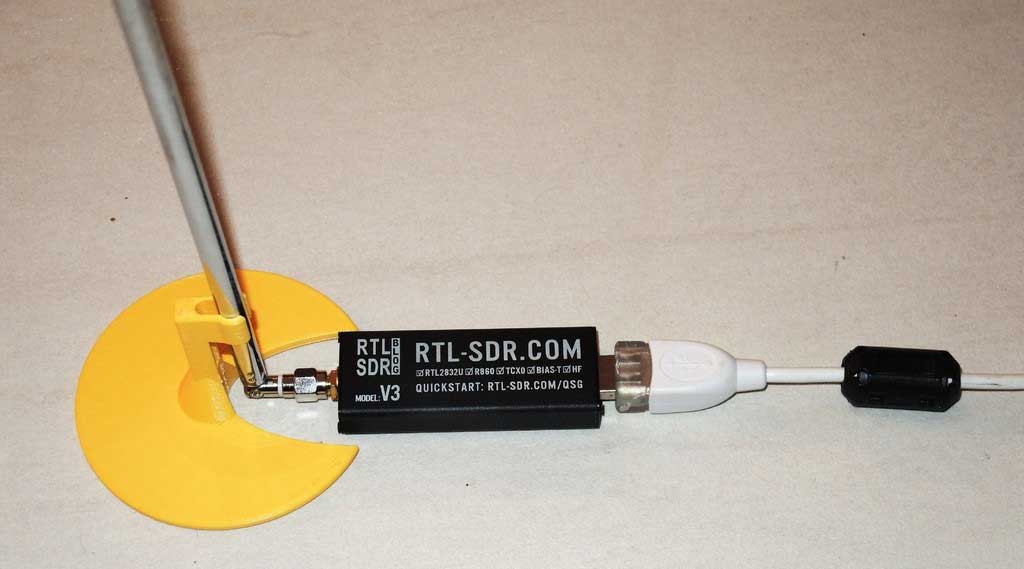
In the paper Leo W.H. Fung et al of Hong Kong University of Science and Technology uses a 61cm cooking Wok with a custom made dipole feed at the calculated focal point. A filtered LNA sits after the feed, and is connected to an RTL-SDR Blog V3 dongle enclosed within a metal cookie box for additional shielding.

The results show that the Hydrogen Line was indeed detected, and measurements of the galactic rotational velocity were possible.

Again we note that we will soon by crowdfunding for a product called the 'Discovery Dish' that will be fairly similar in size and shape. It is designed for receiving L-band weather satellites, but can also be used as a Hydrogen Line telescope too.

The Wok Hydrogen Line Telescope Setup

TechMinds: Using a Software Defined Radio as a Radio Telescope

Back in 2020 we released a tutorial about how to use a 2.4 GHz WiFi Grid Dish antenna as a radio telescope which can detect and measure the Hydrogen line emissions in our Milky Way galaxy.

Recently matt from the TechMinds channel has uploaded a video showing this same project but using the NooElec mesh antenna that has been slightly modified for improved performance on 1.7G and 1.4G.

In his video Matt sets up a drift sky scan, where the rotation of the earth drifts the Milky Way through the beamwidth of the dish. Matt uses Stellarium to virtually visualize the live sky map, SDR# and the IF average plugin to average the spectrum, and an Airspy software defined radio.

We note that we will soon be crowdfunding for our 'Discovery Dish', which we believe will be a superior solution for detecting and measuring the Hydrogen Line on a budget.

Using Software Defined Radio As A Radio Telescope

Discovery Dish Pre-Launch: A Lightweight Dish and Feed for L-Band Weather Satellites and Hydrogen Line Reception

For the past few years we have been working on finding the best way to help beginners get started with L-band weather satellite reception and basic radio astronomy. We have now come up with a solution that we're calling the 'Discovery Dish' - a lightweight 65 cm diameter dish and active filtered feed set.

Discovery Dish: Simplified system for weather satellite reception and hydrogen line radio astronomy

The Discovery Dish will be crowd funded, and we currently have a pre-launch page set up on Crowd Supply. So if you are interested, please visit the pre-launch page and click on the Subscribe button for updates.

Discovery Dish is a 65-cm diameter aluminum satellite dish and active filtered feed designed for receiving GOES HRIT, GK-2A LRIT, FengYun LRIT, NOAA HRPT, Metop HRPT, Meteor M2 HRPT and other weather satellites that operate around 1.69 GHz. The dish is designed to weigh under one kilogram, and it splits into three petals, making it easier to ship worldwide. The 1.69 GHz feed contains a built-in LNA right at the feed point, as well as filtering, which means that there is almost no noise figure loss from cables or connectors.

Note that the prototype images show an early non-petalized prototype with rough laser cut wind holes. The production version will obviously be a lot neater looking! 

In testing the 65 cm diameter Discovery Dish with it's highly optimized feed has proven effective at receiving the GOES HRIT satellite signal with SatDump. We typically achieve SNR values of 3-4 dB to GOES-18 at 24 deg elevation, and with SatDump an SNR of 1 dB is about the minimum required to receive images so there is plenty of margin. It can also easily receive LRIT from GK-2A and Fengyun, and also when combined with an antenna rotator (or manual hand rotating) can receive HRPT weather satellites too.

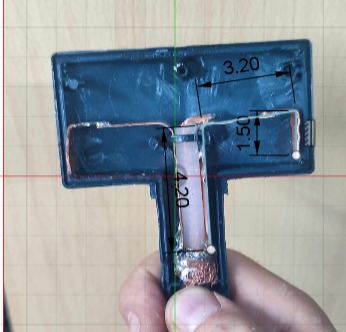
The feed on the Discovery Dish consists of a tuned dipole feed with two 5V bias tee powered low noise figure LNAs, and two SAW filters (centered at 1680 MHz with 69 MHz Bandwidth). The feeds are also easily swapped out, and we will also be selling a 1.42 GHz Hydrogen Line feed for those who want to use the dish to get started with radio astronomy. Because the LNA's are right by the feed there is are no losses from feed to LNA, so we can use thinner and easier to handle cabling like RG58 without any loss issues.

In the past we've recommended and relied on 60 x 100 cm WiFi dish antennas for L-Band geosynchronous satellites and Hydrogen Line reception, but at 1.6kg these are too heavy, wide and exert too much torque for light duty antenna rotators to handle. At about half the weight of an equivalent WiFi Dish, the Discovery Dish is much easier to handle.

In the future we hope to be able to provide a low cost light duty antenna rotator that compliments the Discovery Dish. Currently we have tested the Discovery Dish with the AntRunner antenna rotator and found it to be light enough for that rotator to handle, versus a WiFi dish which is far too heavy for it.

Also when compared to a WiFi dish, the Discovery Dish is much easier to optimally set the offset skew as you can simply rotate the feed, versus having to rotate the entire dish at 45 degree increments.

We will also be offering an outdoor electronics enclosure that can be used to house a Raspberry Pi, RTL-SDR and other components like POE splitters. In our tests we have been running an RTL-SDR Blog V4, Orange Pi 5 and POE splitter in the enclosure, and running the SatDump GUI directly on the Orange Pi 5. This results in a neat contained system where only one Ethernet cable needs to be run out to the enclosure. 

As we are in pre-launch, pricing is not yet confirmed, but we expect the Discovery Dish to sell for less than US$200 with reasonable worldwide shipping costs. It will be a similar cost to what you would pay if you purchased a WiFi dish, filtered LNA and cabling yourself. Obviously please check what satellites can be seen in your region.


GOES HRIT
GOES HRIT
Meteor M2 HRPT
Meteor M2 HRPT
FengYun LRIT
FengYun LRIT

Imaging TV Satellites with a DIY Radio Telescope

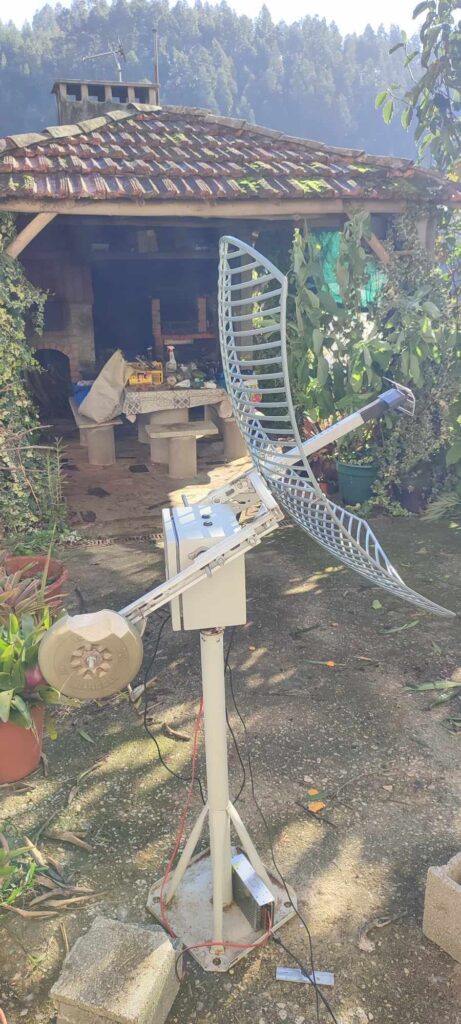
Over on the saveitforparts YouTube channel the creator has uploaded a video showing how he was able to image geosynchronous satellites with his modified motorized RV satellite dish. The idea is to scan the sky using the motorized dish, taking Ku-band RF power readings at each point in the sky. The result forms a heatmap image of satellite transmissions in the sky. For the most part, the satellites detected are TV satellites and they are at known positions in the sky.

However, in one of his recent scans saveitforparts appears to have detected an unknown satellite just outside of the geostationary plane. He goes on to discuss what it could have been, noting that it is most likely to be the AMSC 1 telecommunications satellite.

Recently I spotted a strange "UFO" with my homemade radio telescope / microwave imager. I've used this imager before to spot television satellites in geostationary orbit, but this unknown object was something new to me.

Spoiler Alert: I was able to determine that I'm probably seeing a geosynchronous (but not geostationary) satellite in an inclined / elliptical orbit. Specifically, I think this is the AMSC-1 telecom satellite, which is in a type of orbit designed to cover high latitudes like Northern Canada.

These types of satellites don't seem to show up too often on my telescope / imager setup, since they're not as common and aren't usually aimed directly at my location. This is the first time I've managed to spot one (if that's what I'm seeing), so it seems kind of rare to catch it with this particular equipment!

Folks might also ask if this "UFO" could be the sun or moon producing microwave signals, but those were both off to the left of the scan, not where the mystery signal showed up. It's also probably not a reflection / side lobe / "lens flare", I do get those, but they show up as rings around the main signals, and in fact this mystery signal has its own faint ring around it. Since my dish takes 3-4hrs to do a full scan, this also isn't something fast like a plane or low-orbit satellite as those don't show up on my imager (I'm essentially taking a very long time exposure).

I'm still planning to upgrade / rebuild this mini radiotelescope device in the future, hopefully with more flexibility to pick up different frequencies. That should let me see even more satellites (and maybe other space stuff!).

Mysterious Space Object Detected With DIY Radio Telescope