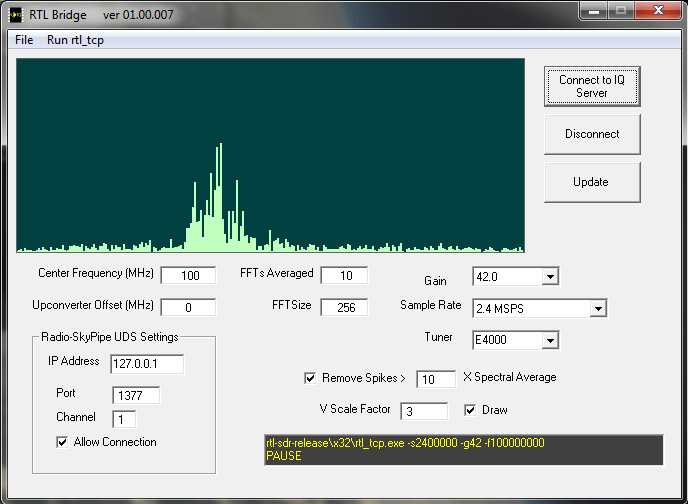
Gough shows how he was able to receive and decode the data from an Aldi weather station device and a wireless doorbell transmitter. He also was able to modify the rtl_433 code slightly to produce a CSV log file of the temperatures that were received and decoded from the weather station.
Smart meters are meters that monitor electricity usage and wirelessly transmit their data to the electricity company. They are a part of the “smart grid”, and allow for better electricity control and usage reporting.
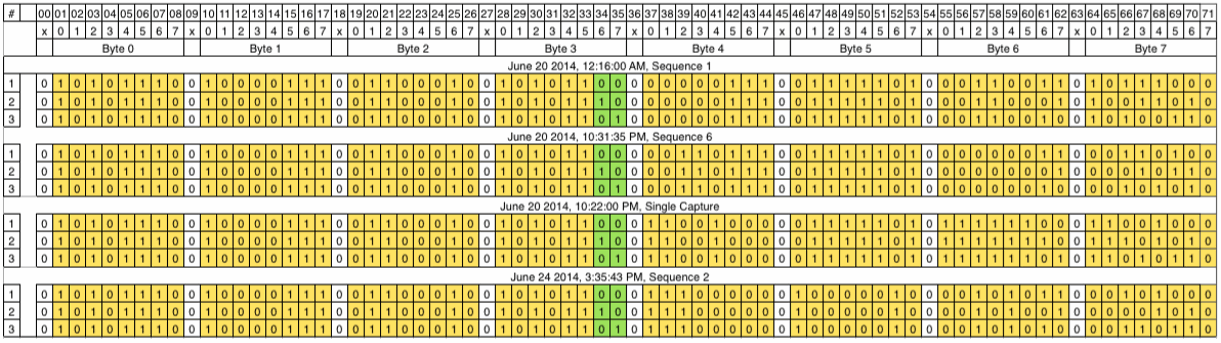
Clayton Smith was able to reverse engineer the data signal from the Elster R2S meters which are used in the Ottawa area on the 902-928 MHz band. The Elster meters use frequency hopping channels, and Clayton was able to receive 6 out of the 25 channels in his area, which should be sufficient, as most of the data packets are repeated on different channels.
He has released his GNU Radio program which will work the the RTL-SDR. Currently, it is capable of displaying meter readings and hourly electricity usage to a terminal.
There is an amateur radio group in Germany known as DL0SHF which transmits a 10 GHz (QRG = 10.368.025 MHz) beacon at the moon whenever it is visible at their site. The goal of this transmission is to detect the very weak beacon reflection.
Amateur radio hobbyist Rein (W6SZ) has written in to let us know about his, DK7IJ’s and the DL0SHF groups success with receiving the beacon using the RTL-SDR. He writes
DL0SHF transmit a signal to the moon when the moon is visible at the site. The run 2 modes 50 and 500 W output, 20 seconds on, 40 seconds off.
Last night, I managed to detect the beacon with a very simple receiving package. Amazing enough, using WSJT moon tracking data, the signal appeared right away when the moon appeared here above the trees.
The signal lasts only 20 seconds but then 40 seconds later, it returned! By the books.
I use a simple 10 GHz receiver here that I use for scouting signals on 10 GHz terrestrial as member of the San Bernardino Microwave Society.
It consists of a RTL Dongle IF block tuned to 618 MHz as IF.
Front-end is a PLL LNB, not modified, running with 9.750 GHz LO
The LNB is powered with 12 Volts by means of a Bias Tee.
Both items can be acquired for about USD 25.- on eBay and other places.
The antenna is a standard 18 inch satellite off-set dish.
The antenna has some elevation control and the feed ( LNB ) can be rotated for polarity control.
Every variable is manually operated.
At times I measured the beacon as high as 15 dB above the noise using HDSDR as DSP processor software.
The beacon was running in the 500 W output mode during these observations.
Moon bounce visible on the waterfallMoonbounce Equipment Setup
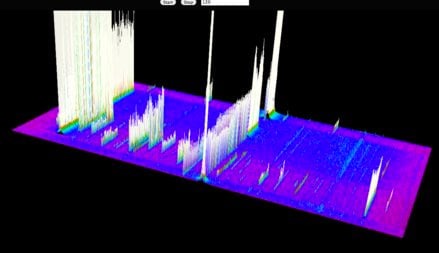
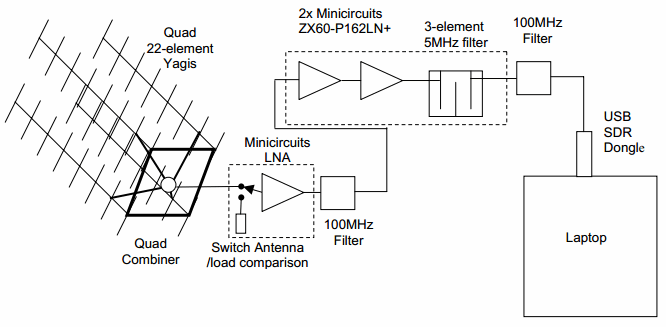
After checking for local causes of interference and finding nothing, they decided that the interferer must be coming from further away. To find the location of the jamming signal they did some radio direction finding. This involved driving around with Yagi and magnetic loop antennas and RTL-SDR and USRP N200 SDRs and then measuring the signal strength at various points.
For the software they used a custom GNURadio block which calculated the power spectra using the FFTW C library, and averaged the results to disk. They then post processed the data to calculated the RFI power, and correlated the data with GPS coordinates recorded on his phone.
After all the data was processed, they discovered that the interference originated from an FM radio tower which had a faulty FSK telemetry link. They notified the engineer responsible who then replaced the link and the interference disappeared.
The American Radio Relay League (ARRL) a.k.a The American National Association for Amateur Radio has put online a freely available ADS-B tutorial featured in their monthly QST magazine, written by Robert Nichols, W9RAN. The tutorial focuses on using an R820T RTL-SDR dongle to receive ADS-B signals, and then using computer software to decode the signals and create a virtual aircraft radar.
ADS-B is a protocol used by most modern aircraft to broadcast their position and altitude which is determined via GPS. ADS-B is intended to supplement and eventually replace traditional radar.
In this ADS-B tutorial, they show how to create a weatherproofed 1090 MHz collinear antenna from RG-6/U coax and PVC pipe and how to use the ADSB# and virtual radar server software to decode and visualize aircraft positions, like a radar.
To use the app, you will need an Android device that supports USB OTG, which most Android devices on Android 4.0+ should support. You will also need a USB OTG cable, and an RTL-SDR dongle. You may want to consider a USB OTG cable that has a second port for external charging capabilities, as the RTL-SDR can drain the battery quickly.
The app is cheaply priced at under $2, so give it a try!
YouTube user Brad Bowers has posted a video showing GQRX running on his BeagleBone Black with an RTL-SDR dongle. The BeagleBone Black is an embedded Linux computer, similar to the Raspberry Pi, but with significantly more processing power. He found that GQRX actually performed quite responsively on the BeagleBone.