Over on YouTube channel 'TAKEAPART' has uploaded a short video showing how he tracks aircraft via an RTL-SDR Blog V3 dongle and his car's Android head unit. The head unit is capable of running the ADS-B Radar App available on the Google Play store.
Once the app is installed, it's a simple matter of plugging in the RTL-SDR Blog V3 unit and running the app to start tracking aircraft.
How to ADS-B Radar in the CAR - Tracking Planes...
Back in 2022 we first posted about adsb_deku and radar-tui, a TUI (terminal user interface) for displaying ADS-B aircraft locations with an RTL-SDR receiver. A terminal user interface means that no desktop GUI is required, instead, the map and aircraft are drawn in the terminal window using just text characters.
adsb_deku and radar-tui are based on the open-source ratatui library. Recently, Orhun, one of the maintainers of ratatui wrote in and wanted to share a YouTube video he created demonstrating radar-tui in action. In the video, Orhun explains the RTL-SDR, shows how to set up radar-tui, and shows a demo of it in action.
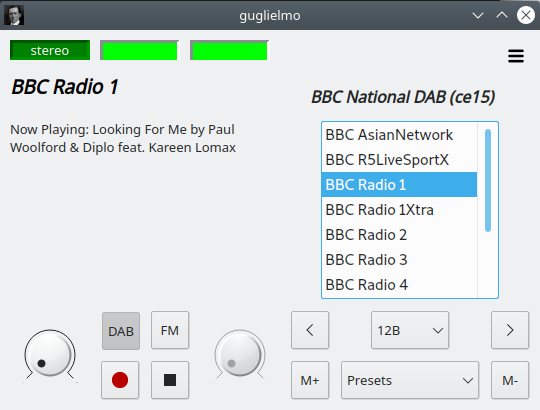
Guglielmo is Linux, Windows (and, in this recent update, x86 MacOS) based RTL-SDR FM and DAB tuner software that supports SDRs, including the RTL-SDR, Airspy, SDRplay, HackRF, and LimeSDR. It is designed to be easy to use for media users rather than hobbyist technical users.
Version 0.6 fixes bugs and adds the following features:
Software automatic gain control
Support for multiple devices for RTL-SDR and SDRplay
SatDump is a popular program used to receive and decode images and other data from various weather satellites. SatDump works great RTL-SDR Blog dongles and with our Discovery Dish, an easy-to-use dish and feed for receiving L-band and other weather satellites. Recently SatDump version 1.2.1 was released, which brings several new features including:
Meteor-M Calibration - Temperatures and radiances are now available from the Meteor-M infrared channels, including enhancements like Cloud Top IR.
Archive Loader & EUMETSAT Archives (and EUMETCAST) Support: Metop, Meteosat, Sentinel-3 and more! - Users can now open data from the EUMETSAT archives in SatDump.
Windows ARM64 Support - One of the few SDR programs that has Windows ARM64 support.
JUICE Support - JUICE (JUpiter ICy moons Explorer) is an ESA probe tasked to study three of the Galilean moons of Jupiter, namely Ganymede, Callisto and Europa. During a recent Earth slingshot it was possible to receive.
AIRS and CERES Support - Hyperspectral sounder and radiation budget instruments on the Aqua satellite
Arctic Weather Satellite Support - AWS is a weather satellite recently launched in July 2024 with 1707 MHz downlink and similar parameters to METOP, so it should be accessible to many.
IASI (imaging channel) Calibration - Calibration for the hyperspectral sounder onboard METOP satellites.
GOES-R L2 Product Support - Pre-processed models from NOAA that include Rain Rate per Quarter Hour, Land Surface Temperature, Sea Surface Temperature, and more.
GOME Fixes - True Color for METOP satellites.
Miscellaneous AVHRR and MHS Fixes - Calibration stripes and other strangeness is less likely to occur even with a bad signal.
Miscellaneous Composites - Many new composites are available.
We've recently come across an X post by Jamie Vital who notes that he has created a site called armsdr.com which is dedicated to tracking which SDR-related software has support for Windows 11 on ARM64.
The Windows OS is most commonly run on x86 and X64 CPU hardware. However, in recent years Microsoft have been pushing to add support for ARM CPUs as well. ARM CPUs are generally lower performance, but significantly more efficient in terms of power use, so they are excellent for battery-powered devices, and so they are commonly used in devices like phones and single-board computers.
Linux is well supported on ARM CPUs, and recently Apple have begun selling computers with ARM CPUs, the Apple M1 and M2. However, Windows support for ARM is still quite lacking, and not very popular. This leaves people who unwittingly purchase a Windows 11 ARM64 laptop mostly out of luck when it comes to running common SDR programs, as programs written and compiled for x86/x64 CPUs will not run on ARM64.
armsdr.com notes that currently only one program, SatDump, has official Win11 ARM64 support. Other programs like rtl_433 and SDR++ have unofficial support, and pretty much every other program has no support, although some may work in emulation mode. But to complicate matters, for emulation mode to work without dropping samples, you need to use librtlsdr drivers that have RAW_IO enabled.
We note that some developers of programs like SDR++ are also refusing to add official Win11 ARM64 support due to the feeling that Windows on ARM has too many issues to be worth supporting. Combined with how low the Win11 ARM64 userbase is, this is most likely the attitude of most developers. Because of these reasons, we strongly suggest avoiding purchasing Win11 ARM64 machines if you want to run SDR software.
Thank you to Jacopo (@lego11/IU1QPT) and Robin (@OK2AWO) for writing in and sharing with us his thoughts about how the SDR community as a whole should move on from the use of WXtoIMG, and instead switch to SatDump, which now has full feature parity with WXtoIMG and additional features too. SatDump is available on Windows, MacOS, Linux, and even on Android. An up-to-date guide for receiving APT with SatDump written by @lego11 can be found on his website here.
Historically, WXtoIMG has been the software of choice for the popular hobby of decoding NOAA APT weather satellite images with RTL-SDR and other SDRs. However, the software has unfortunately been abandoned by its authors for several years, and can now only be found on third-party websites which increases the possibility of downloading a virus. Also, a hack involving a proxy, or directly updating via a powershell script is now required to allow WXtoIMG to update its TLE/ Kepler files due to the celestrak.com to celestrak.org domain name change.
Lego11 also notes a whole host of other issues regarding vulnerabilities and bugs with WXtoIMG:
The software is ancient and uses obsolete libraries, such as Visual C++ 2002 with .NET. These libraries are the main concern when it comes to WXtoIMG, as I don't find it particularly likely for someone to find an entry point through the software itself. However, a much more likely scenario is a virus abusing the loaded library in memory when WXtoIMG is running and using it to gain an entry point. There are at least 20 vulnerabilities affecting MSVCR70.dll, and all are well known (such as CVE-2007-0025) which makes it even more concerning. CVE-2008-4255 in particular allows for remote code execution on the user's computer, which is very serious. There are certainly many more vulnerabilities that have been exploited regarding MSVCR70, but due to the obsolescence of this software component they are usually not tracked in a CVE.
In either case, just as nobody would use Windows XP as a daily driver in 2024, nobody should use WXtoIMG as a matter of caution, even if the above mentioned vulnerabilities were not present.
As for the bugs, there are many. Here's a list of the most important ones:
Cannot update TLE without external software, complicating the experience for newcomers and adding extra failure points
Map overlay doesn't work properly most of the times, especially if the user starts to receive the satellite before it is at least at 1° elevation
WXtoIMG will crash if Microsoft Defender starts a memory scan during a pass. This will lose the recording
WXtoIMG uses an outdated Win32 API to access audio. This doesn't always work on Windows 11 and Microsoft has stated that it will be removed soon.
WXtoIMG uses ALSA on Linux. The vast majority of Linux distributions don't support ALSA directly anymore, and WXtoIMG cannot work through an audio server (e.g. Pulseaudio) like all Linux applications are supposed to. Therefore, live recording doesn't work on Linux at all.
WXtoIMG doesn't run on MacOS anymore, as the system will refuse execution due to security problems and missing libraries.
WXtoIMG cannot support wav files from e.g. SDR# or SDR++ without using a third party tool such as NOAA-APT.
If a user moves or copies a recorded WAV file (see above), the map overlay will no longer work.
WXtoIMG is especially sensitive to concurrent CPU usage, which will result in "tears" on the image (as is evident on the images in the guy's tutorial). It cannot handle multitasking well on systems more modern than Windows XP due to changes in how the CPU scheduler works in more modern kernels.
WXtoIMG will lock up and then crash if the user starts it without first having updated TLEs due to missing NOAA-17. This is very serious, as it happens to newcomers all the time. It is one of the top support request emails/messages I receive. It is not possible to fix this crash easily.
WXtoIMG doesn't have updated coefficients for calibration, therefore NOAA-15 will look excessively cold compared to other satellites.
Over on YouTube Baltic Lab has uploaded a video showing how he was able to successfully use an RTL-SDR Blog V4 and the included multipurpose dipole antenna kit to receive images from polar-orbiting NOAA weather satellites.
In the video, Baltic Lab shows how to orient the dipole antenna in a "V-Dipole" shape which optimizes it for receiving from satellites. He also shows how to use a VNA to confirm that the telescopic elements on the dipole are extended to the correct length, noting that he was able to achieve a VSWR of less than 1.2 between the target frequencies of 135 to 138.1 MHz, with a near perfect match at 136.5 MHz.
He then demonstrates receiving the NOAA APT signals with his laptop, and successfully recovering the weather satellite image.
Over on YouTube "Sam's eXperiments logs" have uploaded a video showing how he was able to succeed when using TEMPESTSDR to eavesdrop on HDMI cables with his SDRplay. TEMPESTSDR software combined with a software defined radio allows a user to eavesdrop on TVs, monitors, and more by wirelessly receiving their unintentional RF emissions and recovering information from those emissions. In many cases it is possible to recover live images of the display, clear enough to read text.
Sam's video explains the challenges he faced with signal strength due to the highly effective shielding of his HDMI cables. To get around this Sam shows how he unshielded his HDMI cables for the test. This is good news for privacy, as it shows how effective shielding can be at stopping these kinds of attacks. He then goes on to show the results he obtained which show text being read from his screen.
I Finally Succeeded: HDMI Signal Eavesdropping with TEMPESTSDR