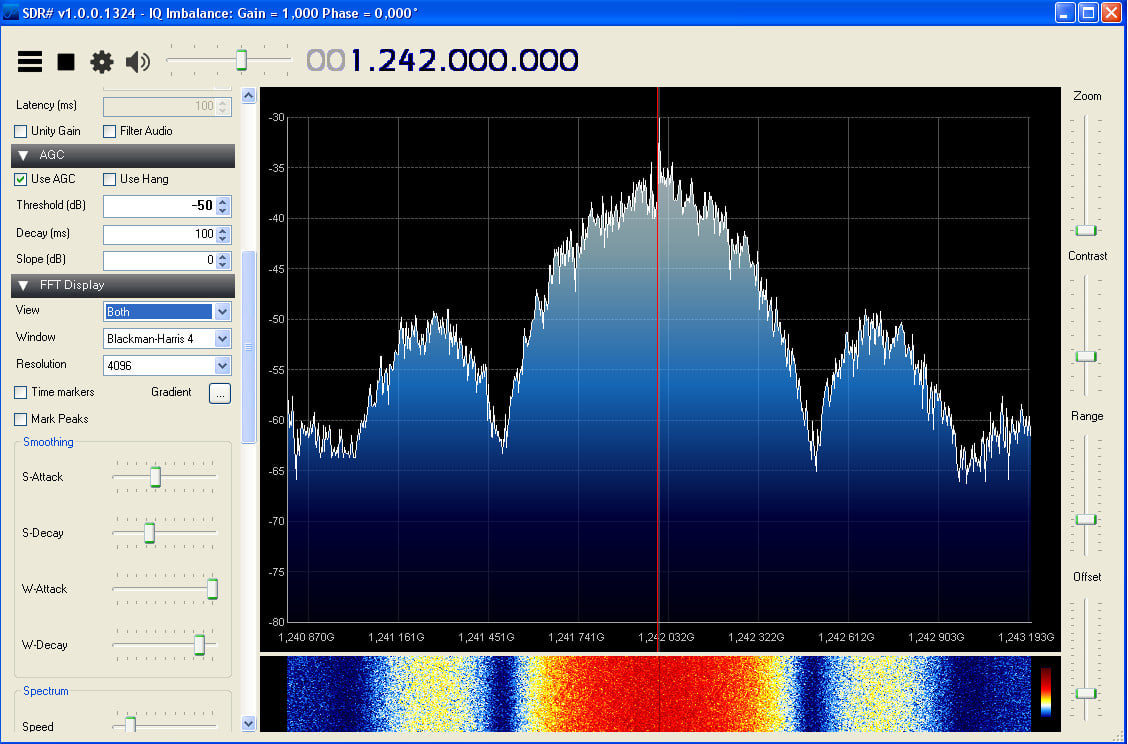
His results show that the dish outperforms the helix antennas by a significant amount, but only once he took it outdoors. The 10-turn helix antenna also worked better than the tin can helix, although he found that it required very accurate pointing.
Inmarsat are geostaionary satellites that transmit signals on L-band at around 1.5 GHz. They transmit signals that can be decoded with an RTL-SDR, such as STD-C EGC (weather, messaging and safety messages for boats), as well as AERO (the satellite version of ACARS for aircraft).
To show that a specialized antenna is not required to receive L-band Inmarsat AERO satellite signals, YouTube user SkyWatcher has uploaded a video showing how he was able to receive these signals with a cheap DVB-T antenna. SkyWatcher writes:
I’ve recently upgraded from my RTL-SDR sticks (E4000, R820T2) to an Airspy Mini.
I did some testing during the last week and found it very interesting that I was able to receive Inmarsat L-Band signals indoors, with just a DVB-T antenna and amplifier behind the window, no downconverter, no special antenna, no super low-noise amplifier. The window is facing south, with a few degrees to the east and the satellite I’ve received was Inmarsat 15.43W. So, angle antenna to satellite should be estimated 20 degrees.
I’ve used a 18dB DVB-T/Satellite-TV inline amplifier as a ‘LNA’ (noise < 5dB) and a VHF/UHF DVB-T antenna which seems to be a stacked dipole, and therefore should be quite wideband and should make a reasonable general purpose antenna. Anyway, I did not expect it to work on 1.5GHZ at all. Also, I want to mention that the inline amplifier is rated 5 to 18V, but it works just fine with the 4.5V from the Airspy Mini.
It seems that with 10dB S/N, Aero reception is possible and with about 12dB S/N, it is getting reliable.
In general, I am very satisfied with the upgrade to the Airspy Mini. It has a much lower noisfloor and a much cleaner spectrum, compared to my old RTL SDRs. Also, I am very happy with the CPU-usage which is only about 12% on my i5-3210M when using 2.4MHz bandwith, and 18-20% with a bandwith of 4.8MHz.
Together with the ability to use SpectrumSpy and the very useful decimation-feature, the Airspy Mini is the best option to upgrade from a RTL-SDR for me at the moment. Anyway, of course this is just my very personal opinion… 😉
AERO is essentially the satellite based version of ACARS, and the L-band signals contains short ground to air messages with things like weather reports and flight plans intended to be transmitted to aircraft. To decode it with an SDR, the JAERO software can be used.
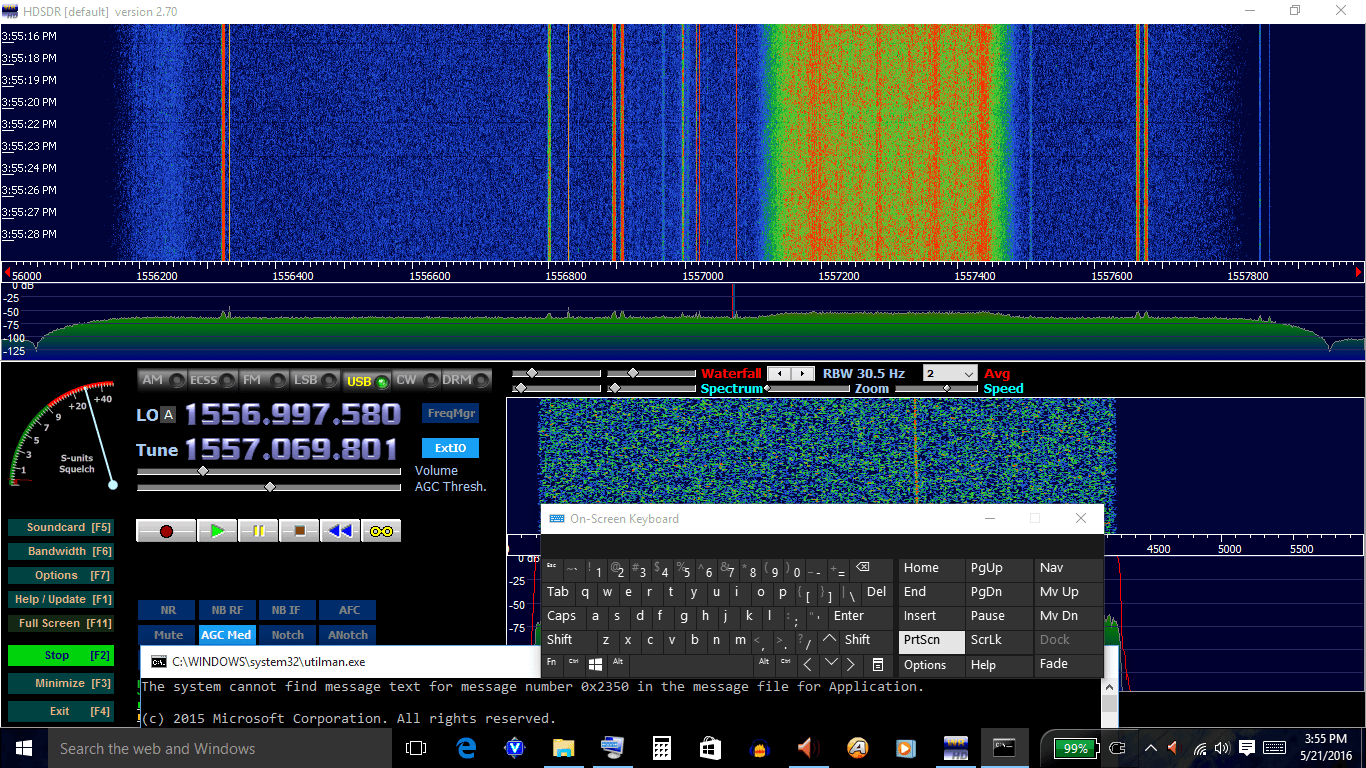
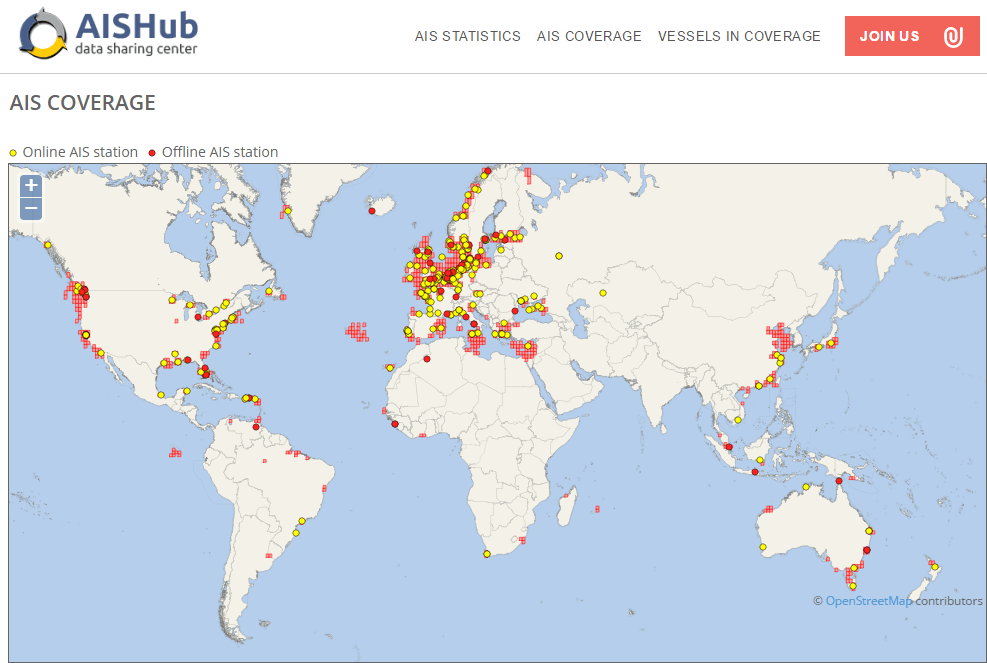
Recently SV3EXP wrote in to let us know that he has been documenting his experiences with trying to get aisdecoder to decode both AIS channels simultaneously. AIS stands for Automatic Identification System, and is a system used to track the locations of marine vessels. With an RTL-SDR or other SDR radio, and appropriate decoder software you can plot ship positions on a map. As the AIS system uses two separate channels for redundancy, you can get a faster and more reliable update rate if you monitor and decode both channels.
Of course the easier solution to decode both AIS channels at once is to use decoding software that already supports this, such as AISdeco2 or AISrec which can be downloaded at http://xdeco.org, and https://sites.google.com/site/feverlaysoft respectively. But regardless SV3EXP's method does show an interesting way to demodulate multiple streams using only command line tools.
SV3EXP also wanted to point out that he is selling a bias tee powered PSA4-5043+ based LNA on eBay which is compatible with the bias tee on our RTL-SDR Blog SDR units.
APCO P25 is a digital voice signal and is commonly used like public safety departments such as police and fire. With an RTL-SDR and the open source Linux based OP25 decoder these signals can be decoded, assuming they are unencrypted. Software like DSD+ can also be used, but OP25 can supposedly decode more systems. Before the RTL-SDR, hardware scanners like the $~360 USD Uniden BCD996T digital scanner radio were typically used.
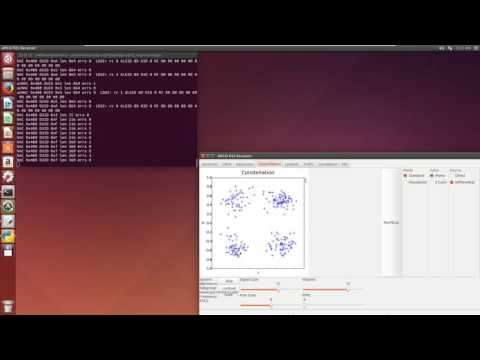
Over on YouTube user Rob Fissel has uploaded a video showing a comparison between an RTL-SDR using the OP25 decoder and a Uniden BCD996T. Both radios are used to decode a weak P25 Phase 1 LSM signal. He uses a Scantenna antenna with an antenna splitter to run both radios at the same time. His results show that even though the constellation is poor, OP25 does a good job at decoding the signal and producing voice, whereas the BCD996T doesn’t even manage to hear the control channel.
An updated set of windows binaries and build scripts have been posted. Quick summary:
1- Added gqrx to package 2- Patched 2 x issues which would cause the generic version to crash on non-AVX systems (one in volk, one in FFTW) 3- Added gr-newmod to package
Plus a number of improvements to make the scripts more robust.
To run GNU Radio for Windows you will need a 64-bit version of Windows 7/8/10. It appears that the installation is as easy as running the installer and waiting for it to download and install the 1.7 GB worth of files.
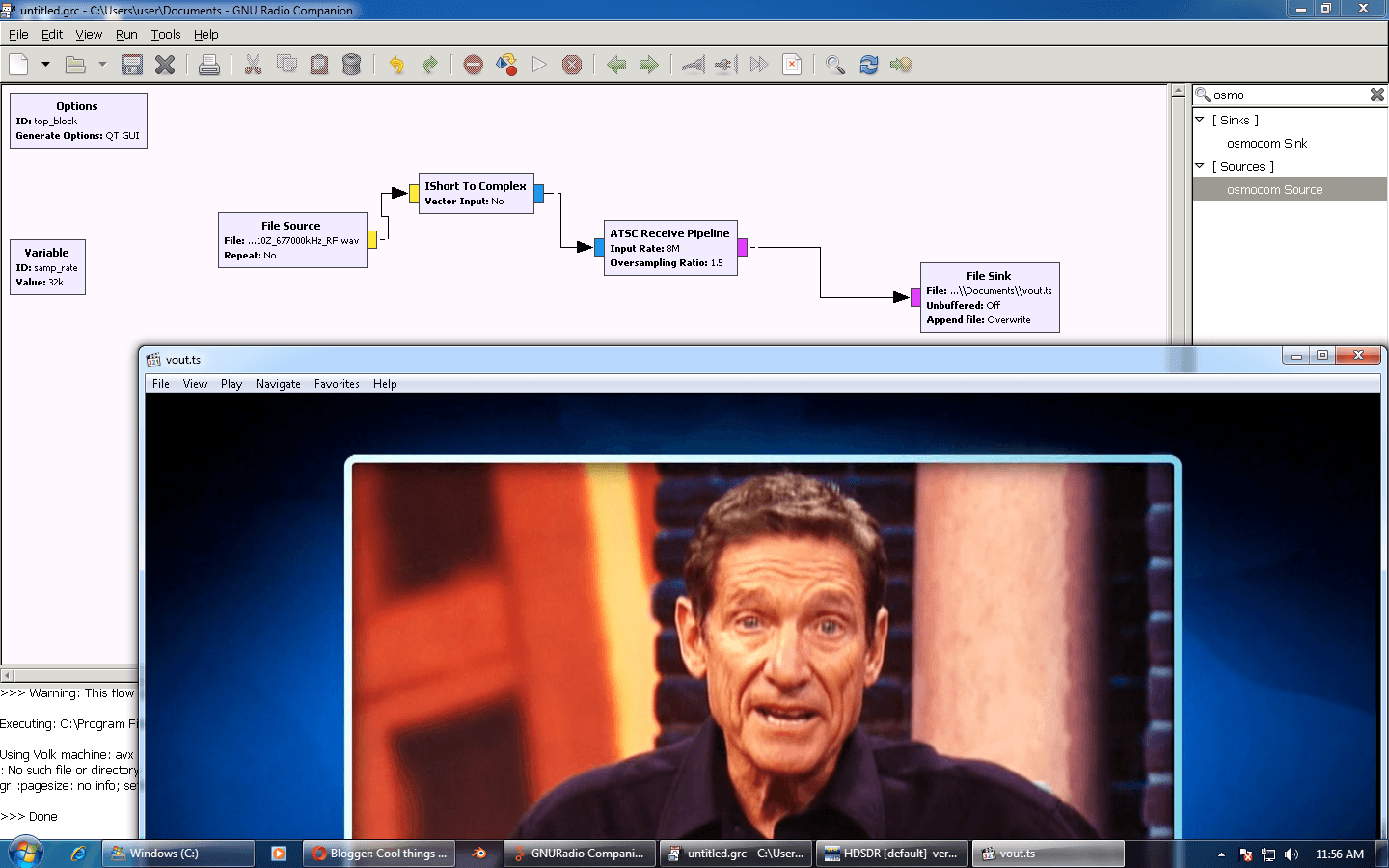
Also, over on his blog author designing on a juicy cup posted about how he’d been able to get the GNU Radio Windows binaries to run a ATSC HDTV decoder from a file recorded using an SDRplay RSP (ATSC is too wideband for an RTL-SDR to decode). ATSC is the digital TV standard used in North America, some parts of Central America and South Korea. He writes that one advantage to using GNU Radio on Windows is the ability to use a RAM drive for faster file processing.
Back in November 2015 we posted about Disney Research’s EM-Sense which was an RTL-SDR based smart watch that was able to actually sense and detect the exact (electronic) object the wearer was touching. It worked by using the RTL-SDR to detect the specific electromagnetic emission signature given off by various different electronic devices.
The Disney research team have put forward the idea that a low cost SDR like the RTL-SDR can be used in place of RFID tags when they would have been used to identify electronic devices. The idea is that the SDR can be used to read the electromagnetic emissions of the electronic device, which can then be used to identify the item, thus eliminating the need for an RFID tag or barcode. Their abstract reads:
Radio Frequency Identification technology has greatly improved asset management and inventory tracking. However, for many applications RFID tags are considered too expensive compared to the alternative of a printed bar code, which has hampered widespread adoption of RFID technology.
To overcome this price barrier, our work leverages the unique electromagnetic emissions generated by nearly all electronic and electromechanical devices as a means to individually identify them. This tag-less method of radio frequency identification leverages previous work showing that it is possible to classify objects by type (i.e. phone vs. TV vs. kitchen appliance, etc). A core question is whether or not the electromagnetic emissions from a given model of device, is sufficiently unique to robustly distinguish it from its peers.
We present a low cost method for extracting the EM-ID from a device along with a new classification and ranking algorithm that is capable of identifying minute differences in the EM signatures. Results show that devices as divers as electronic toys, cellphones and laptops can all be individually identified with an accuracy between 72% and 100% depending on device type.
While not all electronics are unique enough for individual identifying, we present a probability estimation model that accurately predicts the performance of identifying a given device out of a population of both similar and dissimilar devices. Ultimately, EM-ID provides a zero cost method of uniquely identifying, potentially billions of electronic devices using their unique electromagnetic emissions.
An EM-ID use case: Identifying difference laptop assets.
In the paper we can see that the EM-ID hardware is essentially just a direct sampling modified RTL-SDR and antenna. The RTL-SDR is modified to use direct sampling as this allows it to receive 0 – 28 MHz, and thus 0 – 500 kHz where the most useful EM emissions exist. The system process is to basically scan the device using the antenna and RTL-SDR, extract features such as power peaks from the recorded EMI spectrum and then turn this data into a device signature which can then be used to compare against a database of previously recorded and known device signatures. (e.g. light bulb, iPhone).
The EM-ID Hardware: Essentially an RTL-SDR and antenna.The EM-ID Process.
F5OEO writes that the software is capable of generating a symbol rate from 64k symbols to 1M symbols, which is enough to transmit one video with good H264 encoded quality. He also writes that using a low symbol rate may be useful for long distance transmissions as the signal will take up a smaller bandwidth. For example a 250K symbol transmission would only need 300kHz of bandwidth. He writes that this type of transmission could easily be used in the ISM band to replace WiFi video for FPV, but that at the moment video latency is about 1 – 2 seconds and is still being improved.
Once again we remind you that if you intend to transmit using these methods where a GPIO pin is modulated, then you MUST use a bandpass filter at the frequency you are transmitting at, and that you must be licensed to transmit on those frequencies.
A DATV transmission received from a Raspberry Pi transmitter.
Recently Marek Sebera of ITDS Consulting wrote in to let us know about two new TETRA decoders that they have released. TETRA is a trunked radio communications system that stands for “Terrestrial Trunked Radio”. It is used heavily in many parts of the world, except for the USA.
The first piece of software released is called TETRA Listener and is from the Brmlab hackerspace in Prague. They write that Tetra-Listener is a new program (based on osmo-tetra) that can decode unencrypted voice and data traffic. They also write that it is very easy to set up and install since it uses Vagrant, which is a system that can be used to automatically set up a VMWare or VirtualBox Virtual Machine that has everything set up and ready to go. The instructions for using the software can then be found in the readme of the main tetra-listener page on GitHub.
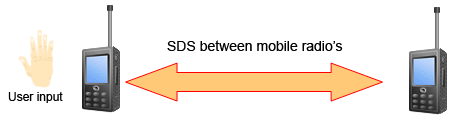
The second software they have written is what they believe is the world’s first open source TETRA Multiframe SDS decoder. SDS stands for short data service and is the TETRA equivalent to SMS text messages used on a GSM network. They write that their solution can assemble long multiframe SDS messages.
Previously we showed how unencrypted TETRA messages could be listened to using telive in our tutorial. It is good to see alternative solutions now coming out, and in the future we hope to test this new software out.