Category: News

Reviews of the NanoVNA: An Ultra Low Cost $50 Vector Network Analyzer

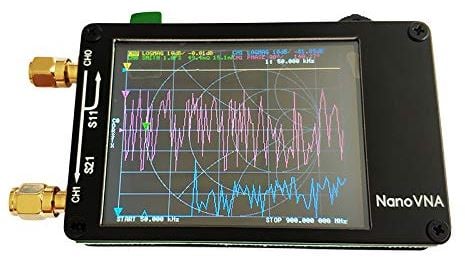
A vector network analyzer (VNA) is an instrument that can be used to measure antenna or coax parameters such as SWR, impedance and loss. It can also be used to characterize and tune filters. It is a very useful tool to have if you are building and tuning home made antennas, filters or other RF circuits. For example if you are building a QFH or ADS-B antenna to use with an RTL-SDR, a VNA can help ensure that your antenna is properly tuned to the correct frequency. Compared to a standard SWR or network analyzer a VNA supplies you with phase information as well.

Until just recently, VNA's have cost roughly US$500 for a decent USB PC based unit like the miniVNA or PocketVNA, and have set people back thousands to tens of thousands of dollars for bench top units.

However, the cost of owning a VNA has now been reduced to only US$50 thanks to the NanoVNA. The open source NanoVNA project by @edy555 and ttrftech has been around since 2016, but only recently have Chinese sellers begun mass producing the unit and selling them on sites like Aliexpress, eBay and now Amazon. We note that it seems that there are some sellers selling them without shielding, so it might be worth double checking the listing to see if they mention that. All the listings we've seen seem to come with simple calibration kits as well.

The NanoVNA: A $50 Vector Network Analyzer

The NanoVNA is a small credit card sized VNA. It has a built in LCD screen that can be used to display graphs directly, or it can also be connected to a PC and the graphs viewed via the NanoVNA Windows software. When purchasing you can opt to include a small battery for portable operation for a few dollars extra. The frequency range is from 50 kHz to 900 MHz, although you should note that above 300 MHz dynamic range performance is reduced.

Over on YouTube several hams and radio enthusiasts have recently uploaded videos demonstrating and reviewing the NanoVNA. The overall consensus is that the unit is accurate and works well. For additional support there is forum available at Groups.IO.

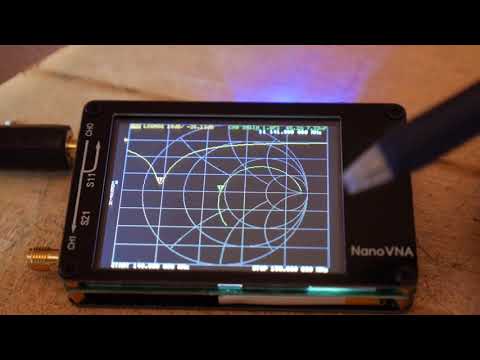
Below YouTube user IMSAI Guy reviews the NanoVNA. Check out IMSAI Guy's other videos too as he has several where he tests the NanoVNA on difference filters and antennas, and checks the accuracy.

#350 NanoVNA Vector Network analyzer 900MHz VNA for $50

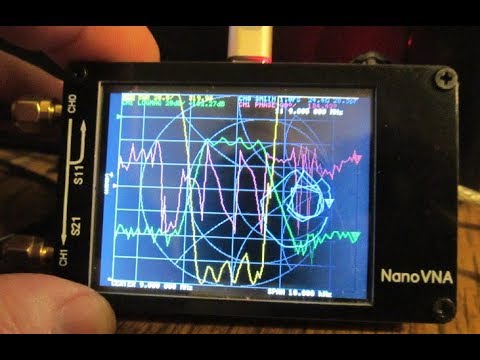
Below is YouTube user joe smith's review. He also has two other NanoVNA videos on his channel where he shows how to use the NanoVNA to measure antenna impedance, and how to use the NanoVNA to create SPICE models for simulation.

The NanoVNA, a beginners guide to the Vector Network Analyzer

Finally YouTube user Oli gives another overview. Please note that the following video is in Polish, but YouTube captions can be set to English.

NanoVNA - omówienie, kalibracja, pomiar anteny i filtra [english subtitles]

We've also seen several recent text reviews:

NanoVNA - A short review. In this review nuclearrambo shows off the calibration kit, and shows a practical measurements of a directional coupler and 137 MHz QFH antenna.

NanoVNA compared with a Keysight fieldfox N9952A. Here nuclearrambo provides a comparison between the $50 NanoVNA and the $40,000+ Keysight FieldFox N9962A.

The NanoVNA, a real VNA at less than 48 €!. A review written in French, but Google Translate can be used. In this review David Alloza compares the NanoVNA against an Agilent E5062A benchtop VNA, and results look comparable.

Talks from GNU Radio Days 2019

GNU Radio Days 2019 was a workshop held back in June. Within the last week recordings of the talks have been uploaded to YouTube by the Software Defined Radio Academy channel. The talks cover a wide range of cutting edge SDR research topics and projects. Many of the presenters have also made use of RTL-SDR dongles, as well as other higher end SDRs in their research.

All the talks are combined into two 3 hour long videos from the morning and day sessions from day one. Day two also has two videos that consist of recordings from the tutorial sessions which make use of the PlutoSDR. Finally there is also the keynote speech from Marcus Müller where he dives into the internal workings of GNU Radio.

Below we list the talks with timestamps for the YouTube video. Short text abstracts for each of the talks can also be found in the conference book. We note that not all the abstracts appear to have been presented in the videos, so it may be worth checking out the book for missed talks about passive radar, a 60 GHz link, embedded GNU Radio on a PlutoSDR, an SDR 802.11 infrared transmission system, PHY-MAC layer prototyping in dense IoT networks and hacking the DSMx Drone RC protocol.

Continue reading

SDRTrunk 0.4.0 Alpha 9 Updates Highlighted

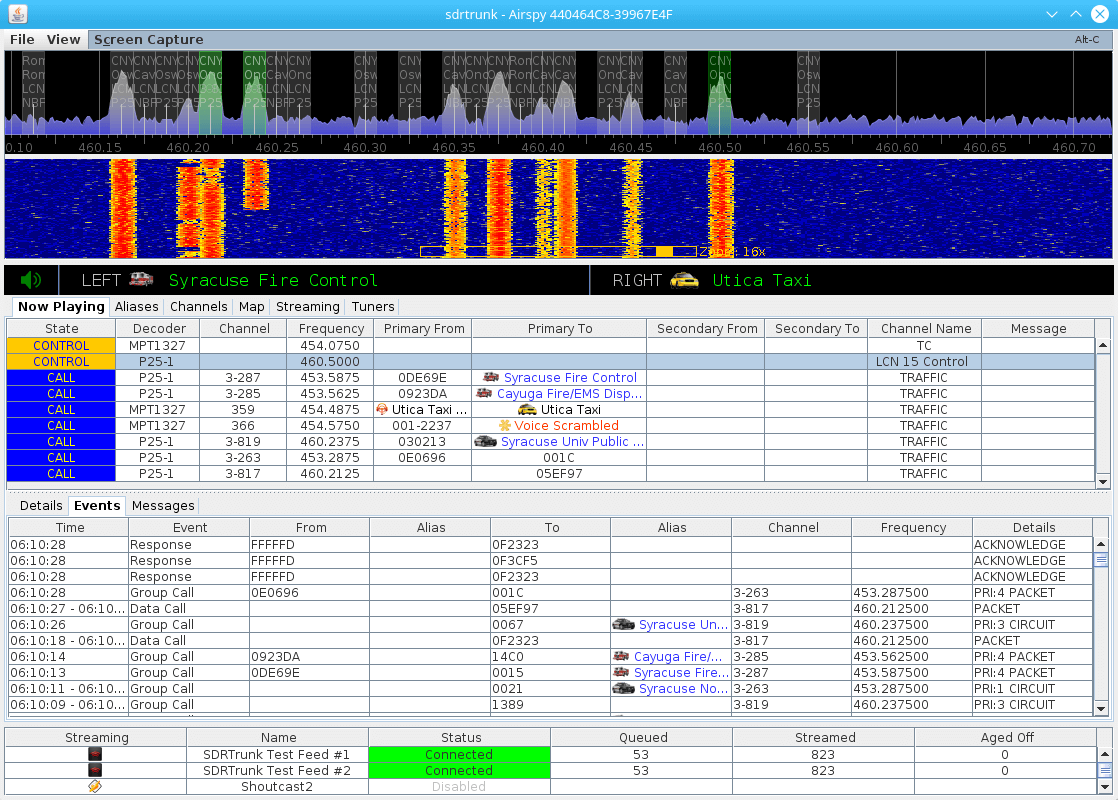
You may recall that a few years ago we released a tutorial on how to set up and use [SDRTrunk]. Fast forward a few years and the software has seen numerous changes. This application was designed primarily for tracking trunking radio systems but also has the ability to decode things like MDC-1200, LoJack and more.

The software is compatible with many Software Defined Radios such as our RTL-SDR v3, HackRF and the Airspy. Some of the newer improvements include a bundled copy of java so that an installation of java is not required on the host computer, as well as decoding improvements for P25 among other digital voice modes. You can find a full list of improvements along with the latest release on [GitHub]

The biggest feature many have been waiting for is the ability to import talk groups for their radio system into the application from radio reference. While this has not yet been implemented, user [Twilliamson3] has created a [web application] that will convert table data from radio reference into a format that is supported by SDRTrunk.

SDRTrunk Screenshot
SDRTrunk Screenshot

GNU Radio 3.8.0.0 Released – First Minor Release Version in Six Years

GNU Radio is an open source digital signal processing (DSP) toolkit which is often used to implement decoders, demodulators and various other SDR algorithms. Several SDR programs are based on GNU Radio code, and it is responsible for a lot of DSP development and knowledge within the SDR and radio community. It is compatible with almost all SDR devices, including the RTL-SDR.

Recently GNU Radio has been updated to version 3.8.0.0. The release is classed as the first "minor" release version in six years, as they are going from version 3.7 to 3.8. That doesn't mean there have been no changes for six years, it just means that over the last six years all releases have remained within the 3.7 version and they have mostly been bug fixes rather than larger changes like added features. Behind the scenes over the last six years developers have been working on these larger changes, and now is the time that they have been officially released.

Marcus Müller from GNU Radio writes:

Witness me!

Tonight, we release GNU Radio 3.8.0.0.

It’s the first minor release version since more than six years, not without pride this community stands to face the brightest future SDR on general purpose hardware ever had.

Since we’ve not been documenting changes in the shape of a Changelog for the whole of the development that happened since GNU Radio 3.7.0, I’m afraid that these release notes will be more of a GLTL;DR (git log too long; didn’t read) than a detailed account of what has changed.

What has not changed is the fact that GNU Radio is centered around a very simple truth:

Let the developers hack on DSP. Software interfaces are for humans, not the other way around.

And so, compared to the later 3.7 releases, nothing has fundamentally modified the way one develops signal processing systems with GNU Radio: You write blocks, and you combine blocks to be part of a larger signal processing flow graph.

With that as a success story, we of course have faced quite a bit of change in the systems we use to develop and in the people that develop GNU Radio. This has lead to several changes that weren’t compatible with 3.7.

The changelog is too long to quote here, but as a summary they have fixed bugs, updated dependencies to newer versions, enabled C++ code generation, changed XML to YAML, moved from QT4 to QT5 and removed a few stale projects. Some of these changes could break compatibility with older GNU Radio tutorials and programs. It also seems that unfortunately due to a lack of updates, support for the Funcube Dongle has been removed.

SignalsEverywhere 10,000 Subscriber Interactive Live Stream with Giveaways on August 10 12PM EST

The SignalsEverywhere YouTube channel is quickly growing in size, and has recently passed the 10,000 subscriber milestone. If you weren't aware, Corrosive (aka KR0SIV aka Harold) who runs the channel has been consistently putting out high quality videos related to the software defined radio hobby. He's also started a podcast which also covers some interesting topics.

Some Recent SignalsEverywhere YouTube Videos

To celebrate hitting the 10,000 subscriber mark, Harold is planning an interactive 6 hour+ YouTube live stream which will begin on Saturday August 10 12PM EST time (11 hours from the time of this post)If you want to be automatically reminded of the stream, go to the live stream place holder, and click on set reminder.

The stream will be interactive as he is planning on setting up several SpyServer's that will be running across the HF, VHF, UHF and L-Bands. This will allow the audience to use SDR# to connect to his SDRs that are being used on the stream, allowing people to follow along with what Harold is doing on the stream, and ask questions about what they are seeing.

We're also helping to sponsor his stream and will be donating 5x RTL-SDR dongle + antenna kits, 5x RTL-SDR dongles, 1x Radarbox bundle, as well as one KerberosSDR to any giveaways that he plans on doing throughout the stream.

We really like Harolds work on YouTube, and if you are a fan of the content on our RTL-SDR.COM blog, then you really should be subscribed to his channel too.

Interactive SDR Live Stream | 10K Subscriber Celebration and Giveaway!

Creating Wide Area Composite Images with WXtoIMG + Weather Satellite Failure Updates

With so many independent people receiving weather satellite images from the NOAA satellites daily, an interesting collaborative task is to stitch these images together to create a wide area composite image. Fortunately the WXtoIMG software already has stitching as a feature.

Over on his website "usradioguy" has created a tutorial explaining how to use WXtoIMG to stitch together multiple NOAA weather satellite images that have been uploaded to individuals websites. As well as the tutorial he has created a table of people's websites that contain recent and the required "pristine" processed images that can be used for stitching.

NOAA Weather Satellite Composite by Jeff Kelly (New Jersey, US), Mike Kimzey (Philadelphia, US), David Kunz (San Francisco, US), Cornelius Danielsen (Norway), Alan Hinton (UK), Michael Sørensen (Denmark), and Hans-Juergen Luethje (Germany).
NOAA Weather Satellite Composite created with images from Jeff Kelly (New Jersey, US), Mike Kimzey (Philadelphia, US), David Kunz (San Francisco, US), Cornelius Danielsen (Norway), Alan Hinton (UK), Michael Sørensen (Denmark), and Hans-Juergen Luethje (Germany).

Weather Satellite Failure Updates

We also wanted to provide a brief update on some weather satellites that we RTL-SDR users often receive.

NOAA 15: About two weeks ago NOAA 15 failed and was producing glitched images. However after a few days it came right again, only to have failed again at the end of last month. It appears that the camera scanning motor is getting stuck due to being low on lubricant as the satellite is now well past it's intended life cycle at 11 years old. If you're interested, some info on how the camera on these satellites works can be found here. There is currently no plan for a fix, the only hope is to wait and see if the motor unsticks.

Meteor M2-1: Meteor M2-1 has also recently suffered problems yet again with it's orientation control, and we're regularly seeing off-axis or distorted images that show the curvature of the earth. Over the weekend it was turned off, and should be reset this week. This problem seems to occur and be fixed often, so hopefully it will be back online soon.

Meteor M2-2: The recently launched Meteor M2-2 is functional, but it is still in the testing phase, so is sometimes being turned off. Do not be alarmed if no signal is received sometimes.

GOES-17: GOES-17 is reported to be experiencing problems with it's infrared camera due to a blocked heatpipe, however it appears that they are able to work around this issue and obtain 97% uptime.

A Distorted Meteor M2-1 Image from R4UAB Blog.

Weather Satellite NOAA 15 Appears to have Failed (Again)

Back in April 2018 we posted how the NOAA-15 APT weather satellite that many RTL-SDR users enjoy receiving images from was having problems with it's scan motor resulting in image errors. The satellite recovered from that problem, but today the problem appears to be back and in a much worse way now.

Users on Reddit and Twitter have reported bad images coming in from NOAA 15. Over on Reddit u/rtlsdr_is_fun has provided a post showing an example of a corrupted image, and also provided an IQ and Audio file. On his blog [Karsey] has also posted some interesting looking corrupted images that he's received.

Corrupted NOAA-15 Image Received by [Karsey]
Corrupted NOAA-15 Image Received by [Karsey] (See his post for the full sized images)

NASA have put out a statement indicating that yet again it is a problem with the scan motor, and the problem could be permanent.

The NOAA-15 AVHRR Scan Motor current began showing signs of instability at approximately 0400Z on July 23, 2019. At about 0435Z the current rose sharply to about 302mA where it has remained. Scan motor temperature began rising about the same time and is currently steady at ~26M-0C. Black body temperatures dropped sharply at about the same time. The instrument appears to no longer be producing data.
This behavior is consistent with a scan motor stall, but requires further investigation. Options for recovery are limited.

Having been launched in 1998 with a minimum spec of 2 years operation, NOAA-15 has already well outlived it's time and may finally be failing for real. We hope it will recover, but if not we should be thankful that Russian weather satellite Meteor M2-2 is now fully operational and transmitting beautiful high resolution images.

Slow Scan Moon Bounce Event for 50th Anniversary of the Moon landing

Fifty years ago Neil Armstrong became the first man to step foot on the moon. This weekend on June 20th and 21st 2019 Amateur Radio operators at the [PI9CAM] team have been transmitting Slow-Scan Television images in commemoration of this historic event at the Dwingeloo radio astronomy station in the Netherlands. This station is the oldest rotatable 25-meter radio telescope in the world. 

 Dwingeloo radio astronomy station
Dwingeloo radio astronomy station
An EME SSTV Image
An EME SSTV Image

Slow-Scan Television is a method often employed by ham radio operators to send photos over radio waves. You may be familiar with this from some of our previous articles on the SSTV event held by ARISS for the International Space Station.

Station [S1NDP] has previously sent slow-scan EME images between the PI9CAM team and himself. These images can potentially be heard by anyone within line-of-site with the moon during the operation of this event.

The team transmit in the 23cm band at a frequency of 1296.11 MHz, according to the ARRL even a 2.5 to 3meter dish should be enough for reception assuming you have a 23cm feed for your dish. It will be interesting to see what photos are heard by the end of this event.