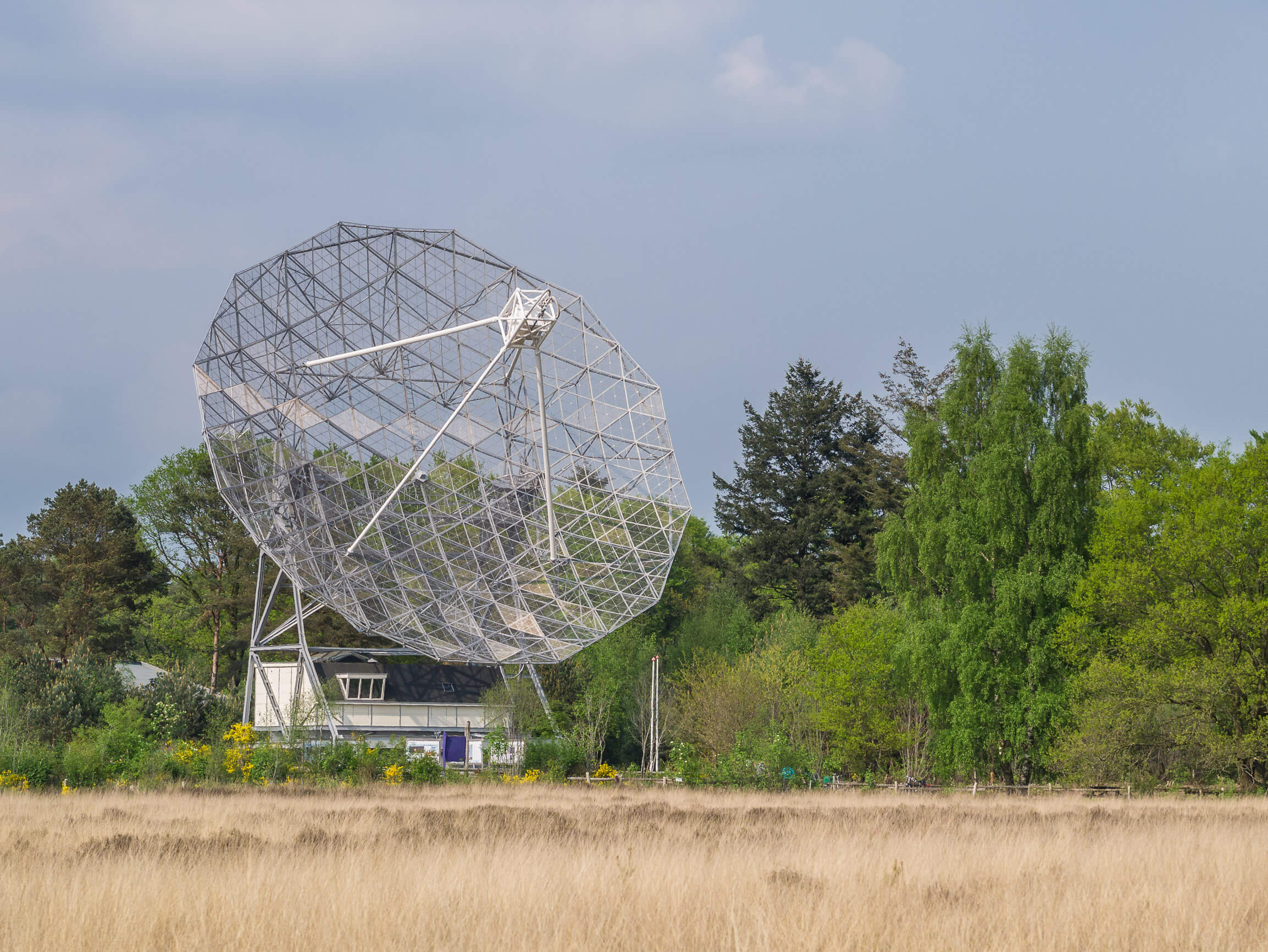
Fifty years ago Neil Armstrong became the first man to step foot on the moon. This weekend on June 20th and 21st 2019 Amateur Radio operators at the [PI9CAM] team have been transmitting Slow-Scan Television images in commemoration of this historic event at the Dwingeloo radio astronomy station in the Netherlands. This station is the oldest rotatable 25-meter radio telescope in the world.
Dwingeloo radio astronomy stationAn EME SSTV Image
Slow-Scan Television is a method often employed by ham radio operators to send photos over radio waves. You may be familiar with this from some of our previous articles on the SSTV event held by ARISS for the International Space Station.
Station [S1NDP] has previously sent slow-scan EME images between the PI9CAM team and himself. These images can potentially be heard by anyone within line-of-site with the moon during the operation of this event.
The team transmit in the 23cm band at a frequency of 1296.11 MHz, according to the ARRL even a 2.5 to 3meter dish should be enough for reception assuming you have a 23cm feed for your dish. It will be interesting to see what photos are heard by the end of this event.
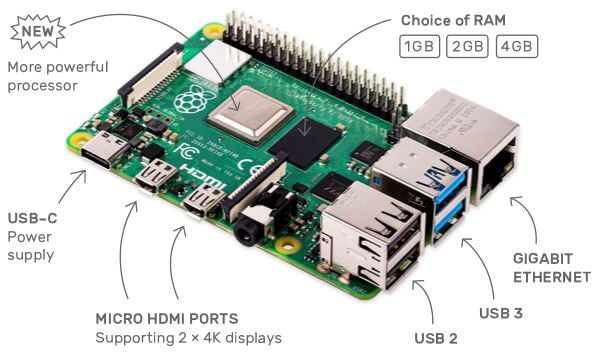
The Raspberry Pi is the most popular credit sized computing board in the world. It is commonly used as a low cost and portable computing platform for SDRs like the RTL-SDR. Today the Raspberry Pi 4 was released, bringing us a new US$35 single board computer with many improvements. Some of the main improvements that make the Pi 4 great for software defined radios are listed below:
CPU: The Pi 4 uses a Quad-Core Broadcom ARM A72 clocked at 1.5 GHz. This chip should be significantly faster compared to the older chip used on the Pi3B+ with performance now being similar to that of the Tinkerboard. This will be especially useful for CPU intensive SDR applications like the direction finding and passive radar software for our coherent 4-tuner RTL-SDR known as the KerberosSDR. It should also help allow OpenWebRX servers to serve more simultaneous users, allow graphical programs like GQRX to run smoother, and allow for higher sample rates on higher end SDRs.
GPU: The new faster GPU should help graphical SDR programs run smoother.
RAM: The Pi 4 comes with three RAM options, either 1GB, 2GB or 4GB of RAM. The versions with more RAM will be great for memory intensive applications such as GNU Radio (and compiling GNU Radio). It will also allow more programs to run in the background, and perhaps combined with the improved CPU speed allow for multiple SDRs to be used on demanding tasks.
Networking: The Pi 4 finally support Gigabit Ethernet which will be very useful to people using the board as an SDR server over the internet.
USB: There are now two USB 3.0 ports available which means that USB 3.0 SDRs like the LimeSDR could in theory be used at higher sample rates on the Pi 4.
There are also many other improvements such as dual 4K HDMI ports, a USB-C power supply port and faster SD card transfers.
Raspberry Pi 4 Improvements
It is not yet known if the very useful Raspberry Pi specific software known as RPiTX will continue to function on the new Pi 4. RPiTX is software that turns Raspberry Pi units into fully functional RF transmitters without the need for any additional transmitting hardware - just attach an antenna wire to a GPIO pin. It works by modulating the GPIO pin in such a way to create almost any type of RF transmission. RPiTX only functions on the specific proprietary Broadcom CPU chips that the Raspberry Pi's use. The Pi 4 does continue to use a Broadcom CPU, so we are hopeful.
The new changes bring the Raspberry Pi up to speed with rivals like the Tinkerboard, but at a lower price and with a much better amount of software and OS support provided. The boards currently cost $35 for the 1GB version, $45 for the 2GB version and $55 for the 4GB version. They are sold via local resellers which can be found on the official Pi 4 product page.
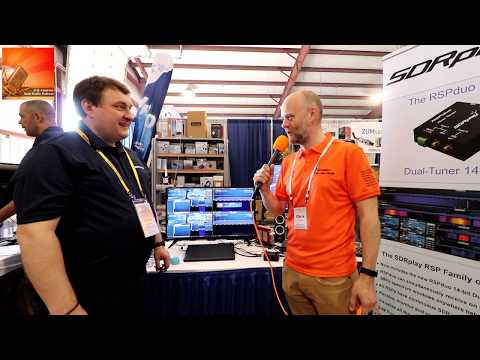
At this years Hamvention Chris Howard from ICQ Amateur interviewed Andy at the SDRplay booth. In the interview they discuss various new features and improvements to SDRuno, the official software for SDRplay devices.
Later they also discuss the RSPduo, and the new diversity feature coming in a new version of SDRUno that is due to be released in a few weeks. The diversity feature works with the two tuners on the RSPduo to combine or subtract signals from two different antennas. Andy notes that diversity should be able to achieve a net 3dB increase in SNR, and is most useful for a moving or dynamic signal environment.
Finally Andy discusses the future development of SDRUno and notes that they're working on a plugin environment which will allow the creation of third party demod/decoders, a multiplatform server for remote SDR, and eventually cross platform drivers and SDRUno.
SDRPlay Announce Update to SDRUno and Future Plans for Software Defined Radio at Hamvention 2019
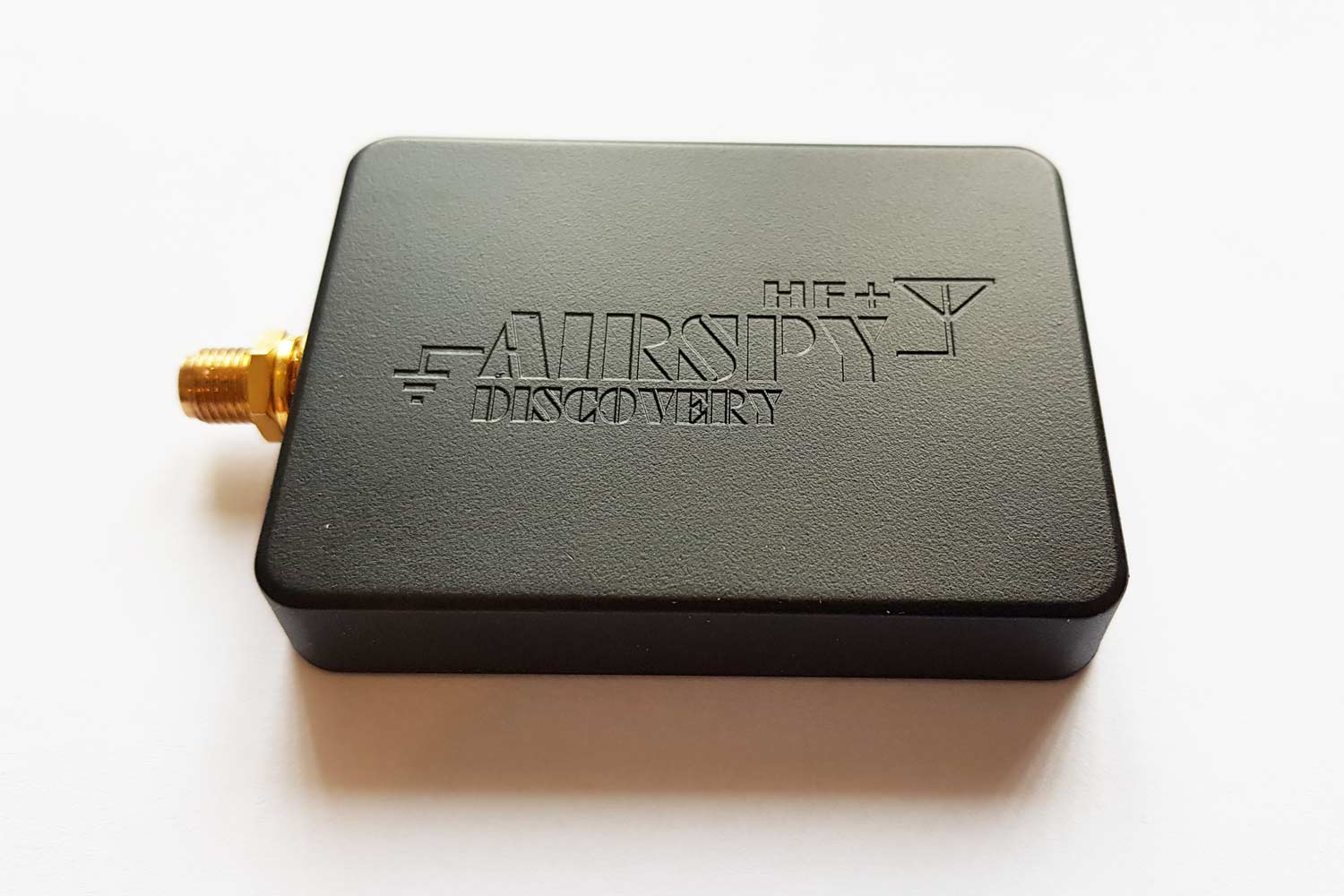
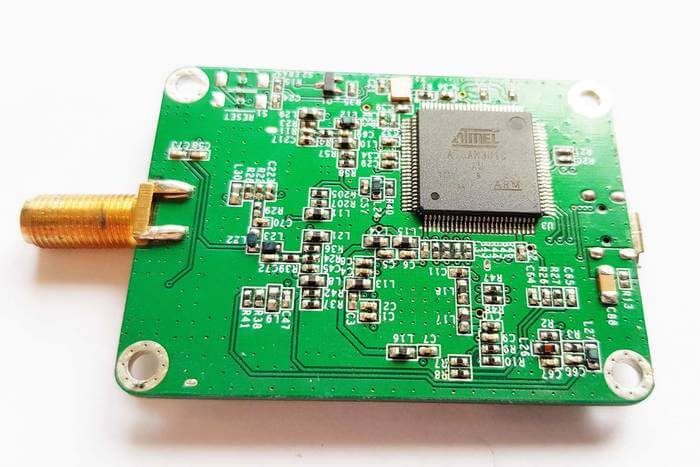
The Airspy team have recently announced the release of their new "Airspy HF+ Discovery". The Discovery is a smaller, lighter and improved version of the Airspy HF+. The frequency range, bandwidth and bit depth and specs all remain the same, but there are some improvements to the dynamic range due to the addition of preselectors. The original Airspy HF+ was released back in mid-2017 and it still is in our opinion one of the best low cost HF DX SDRs because of its very high dynamic range design, so strong interfering signals are not much of a problem. We have a previous review of the Airspy HF+ available here were we compare it against a number of other HF SDRs.
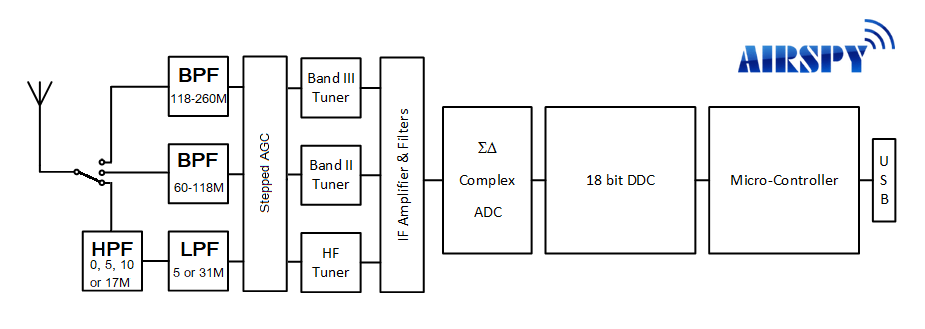
Although the dynamic range was very high, some users reported that extremely strong signals could still desensitize the HF+. So in response the new HF+ Discovery improves on the dynamic range even further by including multiple low insertion loss preselectors built in to the front end. For HF there is are 0, 5, 10 or 17 MHz High Pass Filter corners, and 5 or 31 MHz Low Pass filter corners in series which can provide filtering for a number of bands. For VHF, there are 60-118 MHz and 118-260 MHz filters. The designer boasts that the inclusion of these filters bring the HF+ Discovery up to the performance level of expensive new SDR based ham rigs like the Icom 7300.
Airspy HF+ Discovery Block Diagram
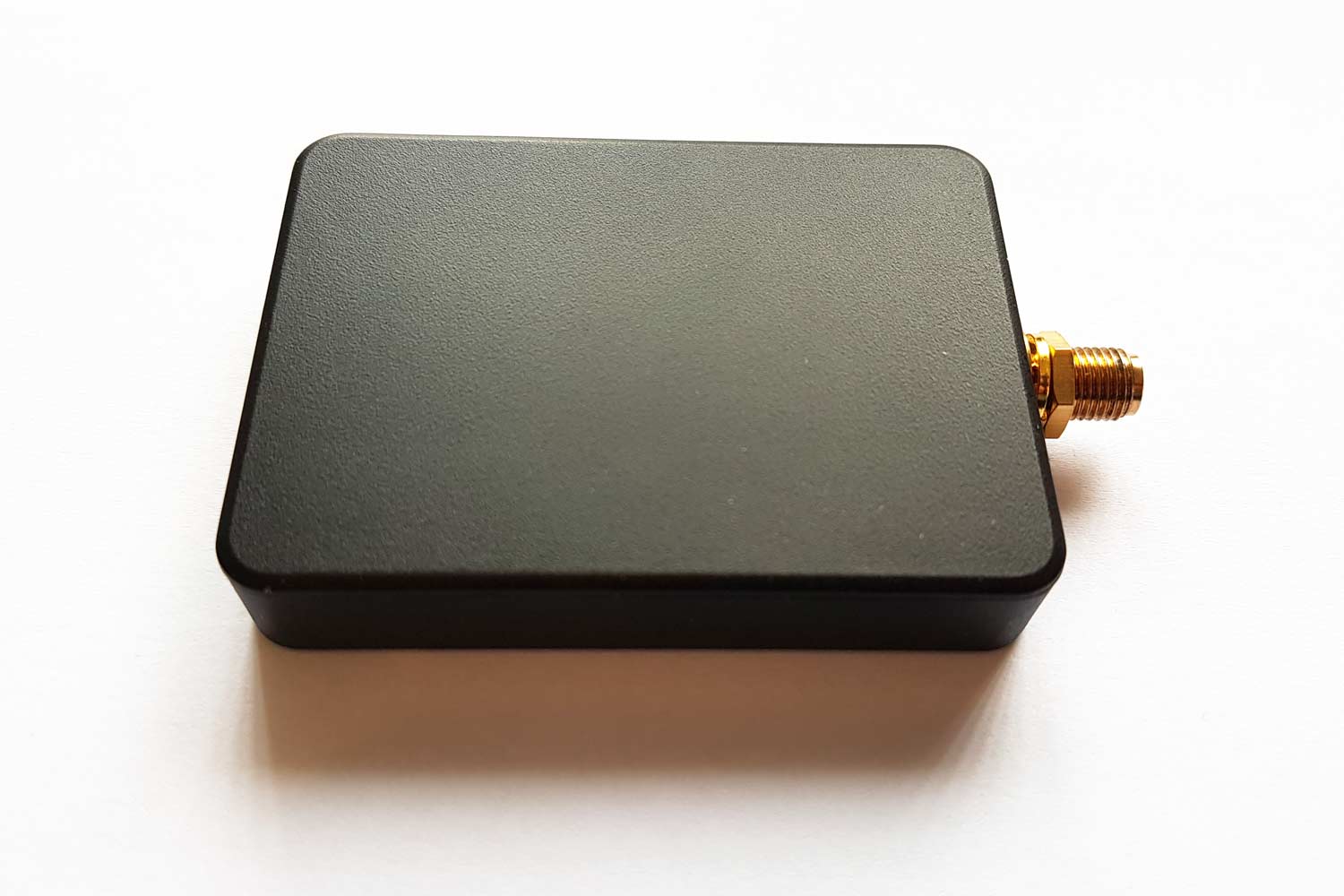
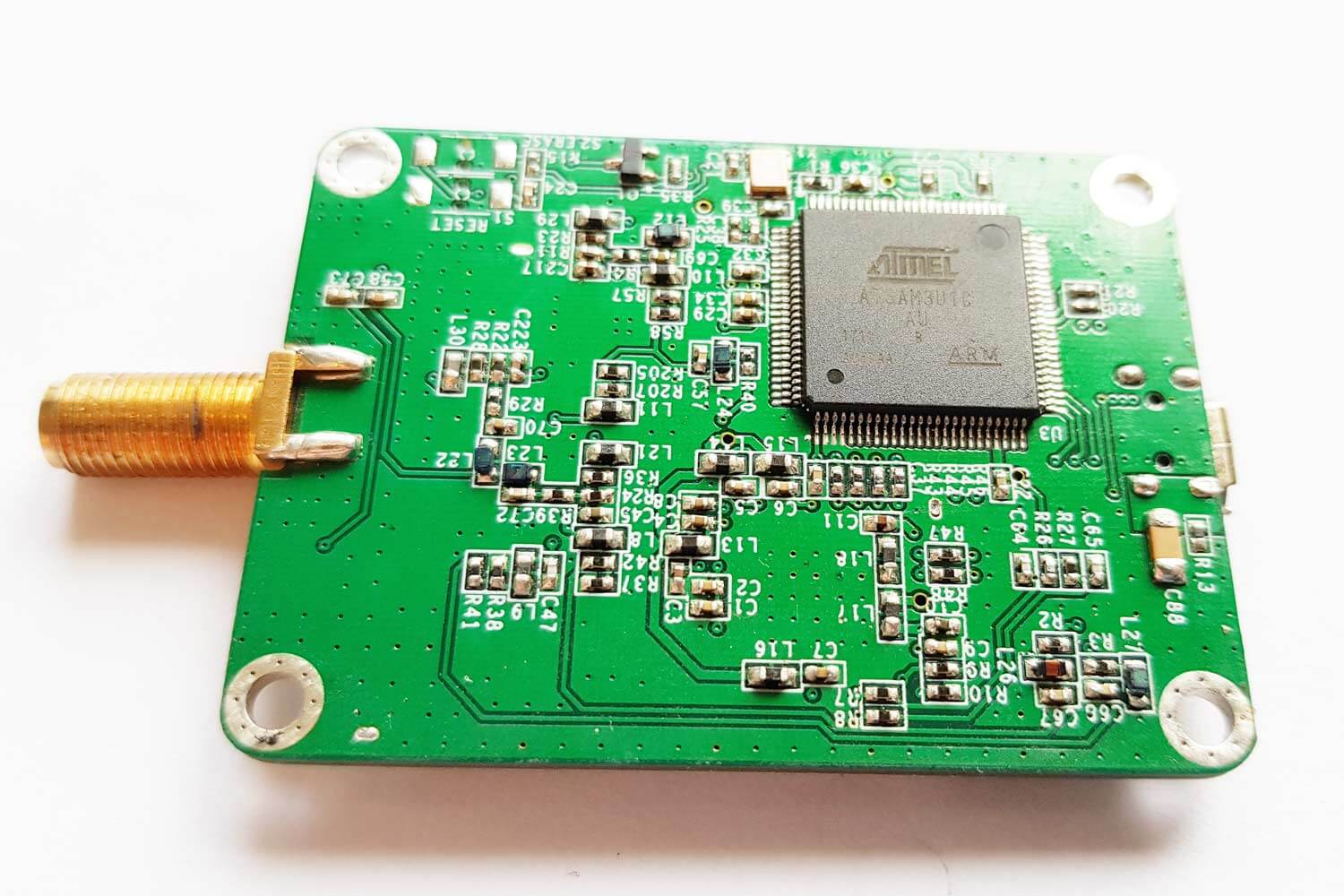
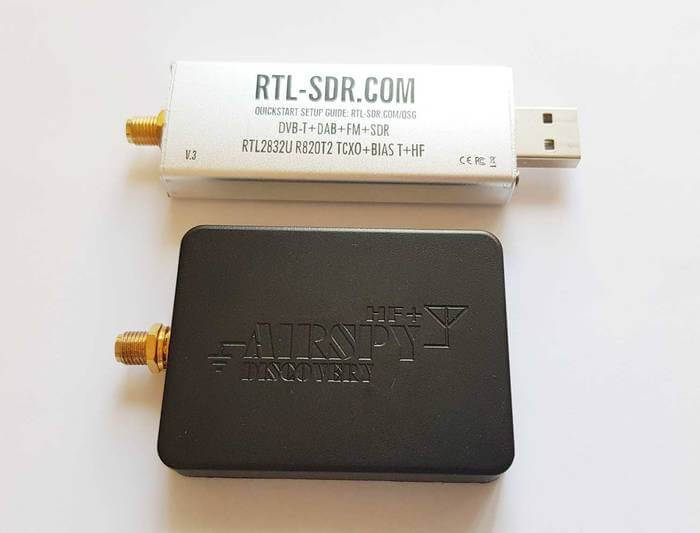
As for the physical design, the enclosure is now much smaller (60 x 45 x 10 mm) and made from plastic. These changes make the SDR very light at only 28 grams (1 oz). Although the case is plastic, local interference doesn't seem to be an issue as the PCB itself is fully shielded. The plastic case is rugged and will withstand a beating. Also, the original HF+ had two input ports, one for HF and one for VHF whereas the HF+ Discovery only has one input port which covers all bands.
Despite the improvements and additional circuitry, the Airspy HF+ Discovery is actually priced cheaper than the original. The original HF+ costs US$199, but the Discovery is only US$169. So unless you require the two input ports, the HF+ Discovery should be the way to go. Currently the HF+ Discovery is in preorder status, and can be ordered internationally from the manufacturer iTead, or within the US from airspy.us. As far as we can see no expected shipping date has been given yet, but we expect that it would ship soon.
Initial Testing
We were sent a prototype sample of the Airspy Discovery HF+ a few weeks ago. We note that the version we received was an early prototype and does not yet implement the 10 MHz and 17 MHz HF filters.
From our test on real world signals we find that it performs at least as good as the original Airspy HF+, if not better due to the additional filtering. The signals in our area were not strong enough to really overload the original Airspy HF+, so any benefit from the additional filtering may not be too apparent. Insertion loss from the filters seems to be not noticeable, as we saw no differences to SNR levels between the two units.
In our VHF tests we saw no differences between the two units, but as with HF we note that it would take some fairly strong signals to make a difference.
In a future post we'll follow up with some tests by injecting strong signals into the SDR, and seeing how well it can performs with the additional filtering compared to the original.
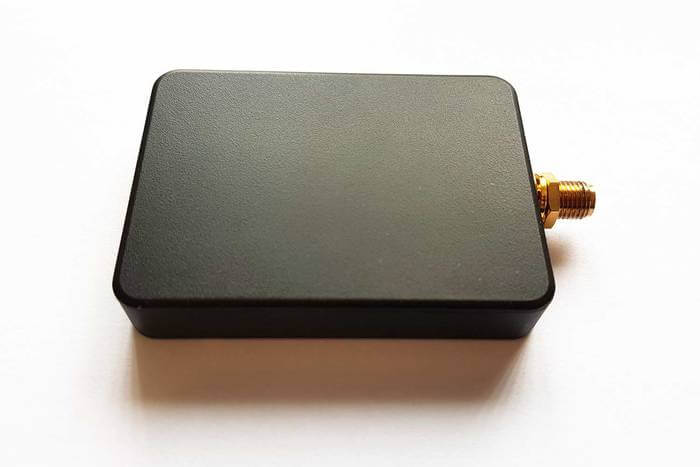
TOP: Airspy HF+ Discovery, BOTTOM: Original Airspy HF+
Conclusion
If you have an HF+ and were still troubled by really strong out of band interferers, the HF+ Discovery might be a good upgrade. Newcomers to SDR looking for high a performance DX SDR for HF and VHF should also strongly consider the HF+ Discovery. The original HF+ is still one of the best low cost DX SDRs we've tested, and the Discovery only makes it better.
As far as we can see regarding the choice between the original HF+ and HF+ Discovery, the only reason to really consider the original HF+ would be if you prefer to have separate HF and VHF antenna ports. The plastic case brings no real disadvantage, and the preselectors improve dynamic range and have no noticeable insertion loss.
Fifty years ago Neil Armstrong became the first man to step foot on the moon. This weekend on June 20th and 21st 2019 Amateur Radio operators at the [PI9CAM] team have been transmitting Slow-Scan Television images in commemoration of this historic event at the Dwingeloo radio astronomy station in the Netherlands. This station is the oldest rotatable 25-meter radio telescope in the world.
Dwingeloo radio astronomy stationAn EME SSTV Image
Slow-Scan Television is a method often employed by ham radio operators to send photos over radio waves. You may be familiar with this from some of our previous articles on the SSTV event held by ARISS for the International Space Station.
Station [S1NDP] has previously sent slow-scan EME images between the PI9CAM team and himself. These images can potentially be heard by anyone within line-of-site with the moon during the operation of this event.
The team transmit in the 23cm band at a frequency of 1296.11 MHz, according to the ARRL even a 2.5 to 3meter dish should be enough for reception assuming you have a 23cm feed for your dish. It will be interesting to see what photos are heard by the end of this event.
The Raspberry Pi is the most popular credit sized computing board in the world. It is commonly used as a low cost and portable computing platform for SDRs like the RTL-SDR. Today the Raspberry Pi 4 was released, bringing us a new US$35 single board computer with many improvements. Some of the main improvements that make the Pi 4 great for software defined radios are listed below:
CPU: The Pi 4 uses a Quad-Core Broadcom ARM A72 clocked at 1.5 GHz. This chip should be significantly faster compared to the older chip used on the Pi3B+ with performance now being similar to that of the Tinkerboard. This will be especially useful for CPU intensive SDR applications like the direction finding and passive radar software for our coherent 4-tuner RTL-SDR known as the KerberosSDR. It should also help allow OpenWebRX servers to serve more simultaneous users, allow graphical programs like GQRX to run smoother, and allow for higher sample rates on higher end SDRs.
GPU: The new faster GPU should help graphical SDR programs run smoother.
RAM: The Pi 4 comes with three RAM options, either 1GB, 2GB or 4GB of RAM. The versions with more RAM will be great for memory intensive applications such as GNU Radio (and compiling GNU Radio). It will also allow more programs to run in the background, and perhaps combined with the improved CPU speed allow for multiple SDRs to be used on demanding tasks.
Networking: The Pi 4 finally support Gigabit Ethernet which will be very useful to people using the board as an SDR server over the internet.
USB: There are now two USB 3.0 ports available which means that USB 3.0 SDRs like the LimeSDR could in theory be used at higher sample rates on the Pi 4.
There are also many other improvements such as dual 4K HDMI ports, a USB-C power supply port and faster SD card transfers.
Raspberry Pi 4 Improvements
It is not yet known if the very useful Raspberry Pi specific software known as RPiTX will continue to function on the new Pi 4. RPiTX is software that turns Raspberry Pi units into fully functional RF transmitters without the need for any additional transmitting hardware - just attach an antenna wire to a GPIO pin. It works by modulating the GPIO pin in such a way to create almost any type of RF transmission. RPiTX only functions on the specific proprietary Broadcom CPU chips that the Raspberry Pi's use. The Pi 4 does continue to use a Broadcom CPU, so we are hopeful.
The new changes bring the Raspberry Pi up to speed with rivals like the Tinkerboard, but at a lower price and with a much better amount of software and OS support provided. The boards currently cost $35 for the 1GB version, $45 for the 2GB version and $55 for the 4GB version. They are sold via local resellers which can be found on the official Pi 4 product page.
At this years Hamvention Chris Howard from ICQ Amateur interviewed Andy at the SDRplay booth. In the interview they discuss various new features and improvements to SDRuno, the official software for SDRplay devices.
Later they also discuss the RSPduo, and the new diversity feature coming in a new version of SDRUno that is due to be released in a few weeks. The diversity feature works with the two tuners on the RSPduo to combine or subtract signals from two different antennas. Andy notes that diversity should be able to achieve a net 3dB increase in SNR, and is most useful for a moving or dynamic signal environment.
Finally Andy discusses the future development of SDRUno and notes that they're working on a plugin environment which will allow the creation of third party demod/decoders, a multiplatform server for remote SDR, and eventually cross platform drivers and SDRUno.
SDRPlay Announce Update to SDRUno and Future Plans for Software Defined Radio at Hamvention 2019
The Airspy team have recently announced the release of their new "Airspy HF+ Discovery". The Discovery is a smaller, lighter and improved version of the Airspy HF+. The frequency range, bandwidth and bit depth and specs all remain the same, but there are some improvements to the dynamic range due to the addition of preselectors. The original Airspy HF+ was released back in mid-2017 and it still is in our opinion one of the best low cost HF DX SDRs because of its very high dynamic range design, so strong interfering signals are not much of a problem. We have a previous review of the Airspy HF+ available here were we compare it against a number of other HF SDRs.
Although the dynamic range was very high, some users reported that extremely strong signals could still desensitize the HF+. So in response the new HF+ Discovery improves on the dynamic range even further by including multiple low insertion loss preselectors built in to the front end. For HF there is are 0, 5, 10 or 17 MHz High Pass Filter corners, and 5 or 31 MHz Low Pass filter corners in series which can provide filtering for a number of bands. For VHF, there are 60-118 MHz and 118-260 MHz filters. The designer boasts that the inclusion of these filters bring the HF+ Discovery up to the performance level of expensive new SDR based ham rigs like the Icom 7300.
Airspy HF+ Discovery Block Diagram
As for the physical design, the enclosure is now much smaller (60 x 45 x 10 mm) and made from plastic. These changes make the SDR very light at only 28 grams (1 oz). Although the case is plastic, local interference doesn't seem to be an issue as the PCB itself is fully shielded. The plastic case is rugged and will withstand a beating. Also, the original HF+ had two input ports, one for HF and one for VHF whereas the HF+ Discovery only has one input port which covers all bands.
Despite the improvements and additional circuitry, the Airspy HF+ Discovery is actually priced cheaper than the original. The original HF+ costs US$199, but the Discovery is only US$169. So unless you require the two input ports, the HF+ Discovery should be the way to go. Currently the HF+ Discovery is in preorder status, and can be ordered internationally from the manufacturer iTead, or within the US from airspy.us. As far as we can see no expected shipping date has been given yet, but we expect that it would ship soon.
Initial Testing
We were sent a prototype sample of the Airspy Discovery HF+ a few weeks ago. We note that the version we received was an early prototype and does not yet implement the 10 MHz and 17 MHz HF filters.
From our test on real world signals we find that it performs at least as good as the original Airspy HF+, if not better due to the additional filtering. The signals in our area were not strong enough to really overload the original Airspy HF+, so any benefit from the additional filtering may not be too apparent. Insertion loss from the filters seems to be not noticeable, as we saw no differences to SNR levels between the two units.
In our VHF tests we saw no differences between the two units, but as with HF we note that it would take some fairly strong signals to make a difference.
In a future post we'll follow up with some tests by injecting strong signals into the SDR, and seeing how well it can performs with the additional filtering compared to the original.
TOP: Airspy HF+ Discovery, BOTTOM: Original Airspy HF+
Conclusion
If you have an HF+ and were still troubled by really strong out of band interferers, the HF+ Discovery might be a good upgrade. Newcomers to SDR looking for high a performance DX SDR for HF and VHF should also strongly consider the HF+ Discovery. The original HF+ is still one of the best low cost DX SDRs we've tested, and the Discovery only makes it better.
As far as we can see regarding the choice between the original HF+ and HF+ Discovery, the only reason to really consider the original HF+ would be if you prefer to have separate HF and VHF antenna ports. The plastic case brings no real disadvantage, and the preselectors improve dynamic range and have no noticeable insertion loss.
The Africa Report, an online newspaper specializing in African stories recently ran a story titled "A Tunisian spy story". The story discusses the circumstances behind the mysterious arrest of a UN expert in Tunisian, supposedly for having used an RTL-SDR dongle as part of his research into violations of the UN arms embargo on Libya. See our previous post for the original details.
The Africa Report story gives a more in depth look at what happened during his arrest and what is happening in Tunisia. If you're interested in following this story, this is a good read.
An RTL-SDR aircraft tracker, which can be purchased legally on the internet, is composed of an antenna and a USB key. There are smartphone apps that have similar functionalities that allow you to track commercial flight routes. Can it be that this object, found in his home, is the sole piece of evidence used by the Tunisian courts to justify the detention of United Nations (UN) expert Moncef Kartas for espionage, as his defence claims?
Kartas, who is German-Tunisian, was officially mandated in 2016 by the UN to lead an investigation into violations of the arms embargo on Libya. His carefully selected team was appointed by the UN secretary general and were due to draft a report in June. Kartas’s arrest disrupted those plans.
Kartas was arrested as he walked off a plane on 11 April in a theatrical scene at Tunis airport involving around 10 security agents. He is now awaiting trial in his cell in Mornaguia prison. Accused of “treason” and “spying for a foreign power”, he faces the death penalty. Fortunately for him, Tunisia has banned that punishment.
Rumours are running high around the activities of a security company he co-founded and the role of a second man who was also arrested. But several pieces are missing from the puzzle. The versions of the Tunisian authorities and the UN are completely different, as is the information supplied by the defence and that supplied by the prosecution. Saying it is “very concerned”, the UN is calling for the researcher’s release, pointing out that the lifting of his immunity is illegal.
While Osmocom in general is a very much Linux-centric development community, we are now finally publishing automatic weekly Windows binary builds for the most widely used Osmocom SDR related projects: rtl-sdr and osmo-fl2k.
As a reminder, if you've ever enjoyed the RTL-SDR or Osmo-FL2k projects, you can thank Osmocom for bringing them to us for free by donating to them at Open Collective. The drivers are the root of all that we can do with RTL-SDR and FL2K, so it is only fair to thank them.
Recently Arstechnica ran an in depth story about how a $600 USRP software defined radio could be used to trick an aircraft that is making use of the Instrument Landing System (ILS). ILS is a radio based system that has been used as far back as 1938 and earlier. It's a very simple system consisting of an array of transmitter antennas at the end of a runway and a radio receiver in the aircraft. Depending on the horizontal and vertical position of the aircraft, the ILS system can help the pilot to center the aircraft on the runway, and descend at the correct rate. Although it is an old technology, it is still in use to this day as a key instrument to help pilots land especially when optical visibility is poor such as at night or during bad weather/fog.
Researchers from Northeastern University in Boston have pointed out in their latest research that due to their age, ILS systems are inherently insecure and can easily be spoofed by anyone with a TX capable radio. Such a spoofing attack could be used to cause a plane to land incorrectly. In the past ILS failures involving distorted signals have already caused near catastrophic incidents.
However, to carry out the attack the attacker would require a fairly strong power amplifier and directional antenna lined up with the runway. Also as most airports monitor for interference the attack would probably be discovered. They write that the attack could also be carried out from within the aircraft, but the requirements for a strong signal and thus large power amplifier and directional antenna would still be required, making the operation too suspicious to carry out onboard.
Corrosive from the SignalsEverywhere YouTube channel has released a new episode of his podcast, this time discussing the topic "Is Software Defined Radio Illegal?". Recently we posted about the unfortunate arrest of a UN investigator in Tunisia. Reports from news agencies seem to indicate that a major factor in his arrest was his use of an RTL-SDR dongle for monitoring air traffic as part of his investigation on Libya arms embargo violations. Although it is suspected that other political motivations are at play.
In his podcast Corrosive tries to open a discussion on whether software defined radio (SDR) is illegal, since SDR receivers have the possibility to be able to receive, demodulate and decode almost any signal. He first focuses on mostly American FCC laws regarding scanners, but similar laws are likely to be in place throughout most of the western world. Later in the podcast he discusses transmit capable SDRs and how these are more likely to come to the attention of politicians.