Category: Reviews

Review of Adam 9A4QV’s Folded Monopole ADS-B Antenna

Recently we bought and tested one of Adam 9A4Qv’s ADS-B folded monopole antennas. This is a well thought out 50 ohm antenna designed for receiving ADS-B signals between 1030 and 1090 MHz. It has an omni directional radiation pattern (receives from all directions in the horizontal) and 3.67 dBi gain.

This antennas main defining feature is that it uses a DC grounded design which eliminates the static electricity problems other antennas can have. This allows this antenna to be connected to a receiver 24/7 without having to worry about ESD destroying the front end of your receiver or LNA. It is also small enough to be able to be used as a desktop antenna.

Folded Monopole ADS-B Antenna
Folded Monopole ADS-B Antenna. Comes in two pieces which need to be soldered together.

The antenna is made of FR-4 laminate (PCB material) with a conductive layer covering the ground plane board and an upside down U-shaped trace in the vertical section. The antenna requires assembly and detailed assembly steps can be found on the antenna’s web page. Assembly of the antenna itself was straight forward just requiring two solder joints to be made to connect the vertical part to the ground plane. You will need to take care to ensure that the vertical antenna is completely vertical once soldered in.

The antenna also comes with no included coax cable and so a cable must be soldered on to the antenna first. The assembly instructions recommend using Teflon coax cable (such as RG316), however we didn’t have any on hand, so we just used regular RG174U and carefully soldered it on, making sure to not melt the inner insulation too much.

Fully constructed ADS-B antenna with RTL-SDR dongle for size comparison.

After fully constructing the antenna we ran a SWR test using an RTL-SDR and a noise source and found the antenna to have a SWR of approximately 1.46 at 1090 MHz resulting in about a 0.155 dB loss due to mismatches. A SWR value of 1.46 is very good for a receive only antenna like this. In one of Adams videos he used some higher quality coax and his tests showed the SWR of the antenna with a value of about 1.2102.

As for actual real world ADS-B performance we did not test it against any other ADS-B antennas, but it received aircraft from almost 350 km away from an indoor desktop location which we think is pretty good. In comparison the standard 11.5 cm stock antenna that comes with most dongles only had a range of about 250 km when placed in the same location. The maximum range of an ADS-B signal is around 500 – 600 km, which should be easily achievable with this antenna mounted outside on the roof.

Compared to other hobbyist ADS-B antenna offerings, Adam’s folded monopole antenna is one of the cheapest we could find, costing only 20 euros + 5 euros for shipping (~$26.5 USD total), although it does not come with a mount or weatherproofing. It is also one of the smallest, measuring just under 6 cm high and 14 cm in width and depth. Below we table Adam’s antenna with some alternatives for a comparison (prices converted from Euro to USD where applicable).

Note remember that as passive antenna gain is increased, the receive radiation pattern becomes flatter (which you may or may not want – you’ll receive better out towards the horizon but worse at higher elevations) and that an active antenna with an LNA is most useful when long runs of coax cable is used.

Antenna Type Passive Gain (dBi) Length (cm) Notes Price (Excl. Shipping) (USD)
9A4QV Antenna Folded Monopole 3.67 6 DC Grounded. No cabling, mounts or weatherproofing included. $21.9
Diapason MCX PCB Stripline 2.1 21 Comes with 3 m of RG174 with MCX connector, mast clamp and weatherproof radome. $63.36
A3 ADS-B ? 5 55 Comes with mast clamp and weatherproof radome. $85.23
Active Diapason PCB Stripline 2.1 21 Has built in LNA and SAW filter. Comes with bias tee, USB cable, mount and weatherproof radome. $193.870
DPD ADS-B Vertical 1/2 Wave Colinear 9 144 Very high gain passive antenna. Comes with mount and weatherproof radome. $149
DPD ADS-B Indoor Blade 1/2 Wave Colinear 4.6 61 Aesthetically pleasing as it is designed to be mounted indoors. $89.95
DPD ADS-B Double 1/2 Wave Mobile 1/2 Wave Colinear  5 33 Magnetic mount mobile antenna. $68.95
5/8 ADS-B Antenna 5/8 Wave Ground Plane 5.15 30 Comes with mount and weatherproof radome. $21.55
ADS-B J-Pole J-Pole 4.45 30 Comes with mount and weatherproof radome. $14.85

Disclaimer: We bought this antenna with our own funds and we are not being paid or reimbursed in any way for this review.

Have you tried any other commercial ADS-B antennas? Let us know in the comments how well they work.
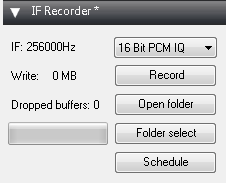
New SDR# Plugin: IF Recorder

On rtl-sdr.ru, the author of several SDR# plugins has uploaded a new one called “IF Recorder”. This plugin allows you to easily record an IQ file of just the intermediate frequency (IF). In SDR#, the IF is the shaded area with the red line which you use to tune with.

This plugin looks to be great for recording example IQ samples of signals because the output file will be significantly smaller and more manageable compared to recording the entire bandwidth. It is also useful for recording IQ files for use in decoding METEOR M2 weather satellite images, as the decoding software requires an IQ file of the LRPT signal. The plugin also has a schedule option which could be used to start and stop recording the METEOR M2 weather satellite signals automatically.

IF (Intermediate Frequency) Recorder SDR# Plugin

New Airspy Review from Radio User Magazine

Update: Note that we also now have our own comprehensive review available here which compares the Airspy, SDRplay RSP and HackRF.

A new review of the Airspy (store) software defined radio has been published by Mike Richards in the March 2015 edition of the Radio User magazine. Although the magazine is for sale, the publishers have allowed the Airspy team to release the review for free. The review goes over the Airspy architecture, features, use of the software and presents a favourable tone towards the Airspy.

The Airspy is an software defined radio that costs $199 USD and comes with a 24 – 1800 MHz tuning range, 10 MHz of bandwidth and 12-bit ADC.

Previously Mike Richards also reviewed the SDRPlay, a competitor to the Airspy in Radio User and that review is also available for download.

Airspy diagram from the Radio User magzine review.

Highlighting some SDRPlay Reviews

Update: Note that we also now have our own comprehensive review available here which compares the Airspy, SDRplay RSP and HackRF.

The Radio Spectrum Processor (RSP) by SDRplay is a receive only software defined radio with a 100 kHz to 2 GHz range (with a small gap at 380 MHz to 430 MHz), a 12-bit analogue to digital converter (ADC) (~10.4 ENOB), 8 MHz bandwidth and a bank of several switched front end filters. It currently costs $299 USD and with these specs and price range we consider the RSP to be a competitor to the Airpsy and Funcube Dongle software defined radio offerings.

Recently several reviews of the SDRplay RSP have been written online and in magazines. The first review comes from the pages of the UK based Radio User magazine (pdf warning) which goes through the specs, design, install and operation of the device. A more recent review shows an unboxing and there’s also this review submitted to the SDRplay team which demonstrates some FM dxing results. There are also several more reviews collected by the SDRplay team linked on the SDRplay website at http://www.sdrplay.com/reviews.htm.

We also note that we recently posted about some in depth measurements that Leif (programmer of Linrad) recently made to multiple SDR’s, including the SDRplay.

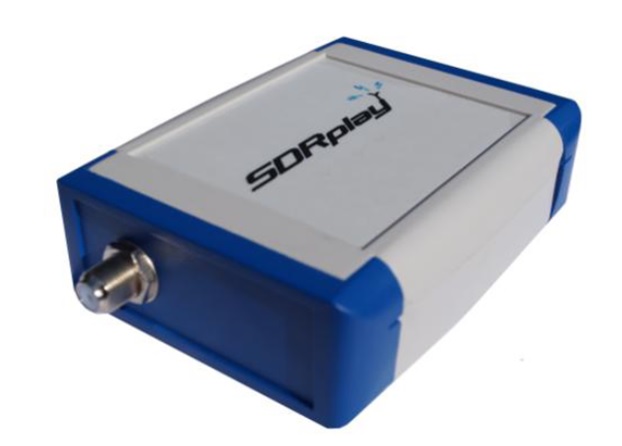
The Radio Spectrum Processor (RSP) by SDRplay.

YouTube Airspy Review and Comparison

Over on YouTube user ranickel (aka W9RAN) has uploaded a video showing his review of the Airpsy software defined radio. Although the Airspy is not yet shipping, several independent reviewers received a unit early.

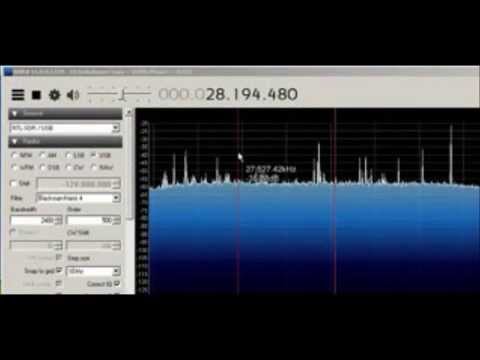
In the video W9RAN compares the Airspy against seven traditional analogue hardware radios and the RTL-SDR using a amateur radio beacon at 28 MHz. He also demonstrates the software decimation feature of the Airspy drivers and shows how it can increase the sensitivity and signal to noise ratio.

Airspy Review and Comparison by W9RAN

Review of the USA TCXO Modified RTL-SDR Dongle

A few days ago we posted about a new US source for TCXO modified RTL-SDR dongles. We received a sample from the company that does the modifications and below we present a review of the product.

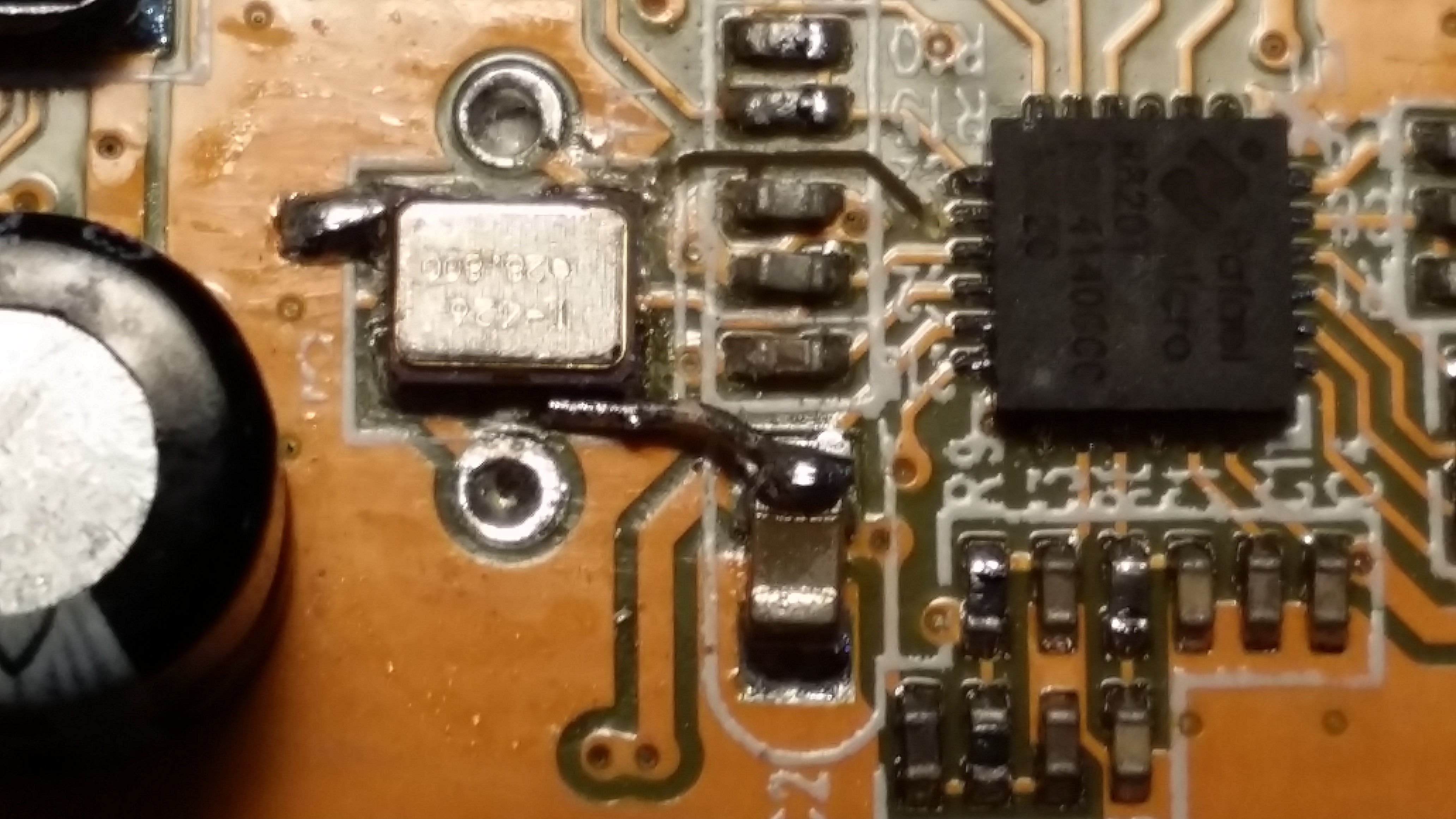
The modified TCXO dongle is based on a standard full sized R820T RTL-SDR PCB board. Inside we can see that the standard 28.8 MHz oscillator has been removed and in its place is a 28.8 MHz TCXO oscillator. The old oscillator has been removed and the new oscillator is carefully soldered in its place. The soldering job appears to be nice and tidy.

TCXO Close up
TCXO close up

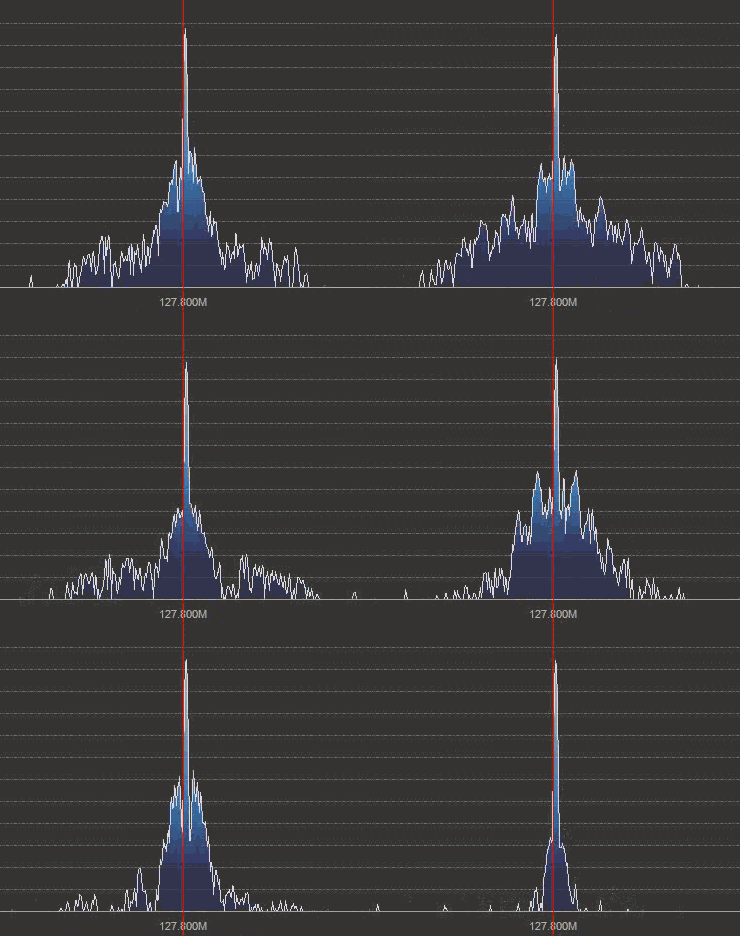
Next we tested the TCXO dongle against a control RTL-SDR which had a standard non-TCXO oscillator. First we measured the PPM offset at room temperature against a known ATIS signal. The TCXO dongle had an offset that was somewhere around 0.5 PPM. The control RTL-SDR had an offset of 60 PPM.

As the dongle heats up from use, the oscillator will experience thermal drift, causing the frequency offset to change. The TCXO should be immune to this problem due to it’s temperature compensation circuitry. To test the TCXOs temperature compensation capabilities we placed both dongles in a freezer for 30 minutes and then took them out and recorded their start and end PPM offsets after 30 minutes of operation. To simulate a warm environment the dongles were also placed under a warm tungsten light during operation.

The control RTL-SDR started with an PPM offset of 58 PPM and ended with an offset of 72 PPM, giving a total drift of 14 PPM. The TCXO RTL-SDR dongle started with a PPM offset of ~0.5 PPM and ended with an offset of ~0.5 PPM, giving a total drift of 0 PPM.

Below we have recorded animated GIFs of the drift observed in both dongles. The first GIF shows the control RTL-SDR. Note how the frequency offset oscillates at first and then slowly drifts away in one direction. The TCXO dongle exhibited no drift whatsoever.

STD_Dongle_Crop_Faster_comp
Control RTL-SDR Drift over 15 Minutes (Sped up)
USTCXO_comp
TCXO Dongle Drift over 15 Minutes (Sped up)

The results show that the US TCXO has a very low overall PPM offset and is very stable over temperature changes. If you want one of these dongles they can be found for sale over on Ebay for $65 USD.

In the previous post some commenter’s raised the concern that this product was overpriced at $65 USD. However, we believe this price is reasonable. The reason the cost is much higher than a standard RTL-SDR is that it is very difficult to obtain TCXO oscillators with 28.8 MHz clocks. The company selling these needed to have the TCXOs custom made from the factory with a large minimum order quantity of 1000 pieces. Then after adding the labour, quality control and selling costs the profit margins become quite small.

HackRF Initial Review

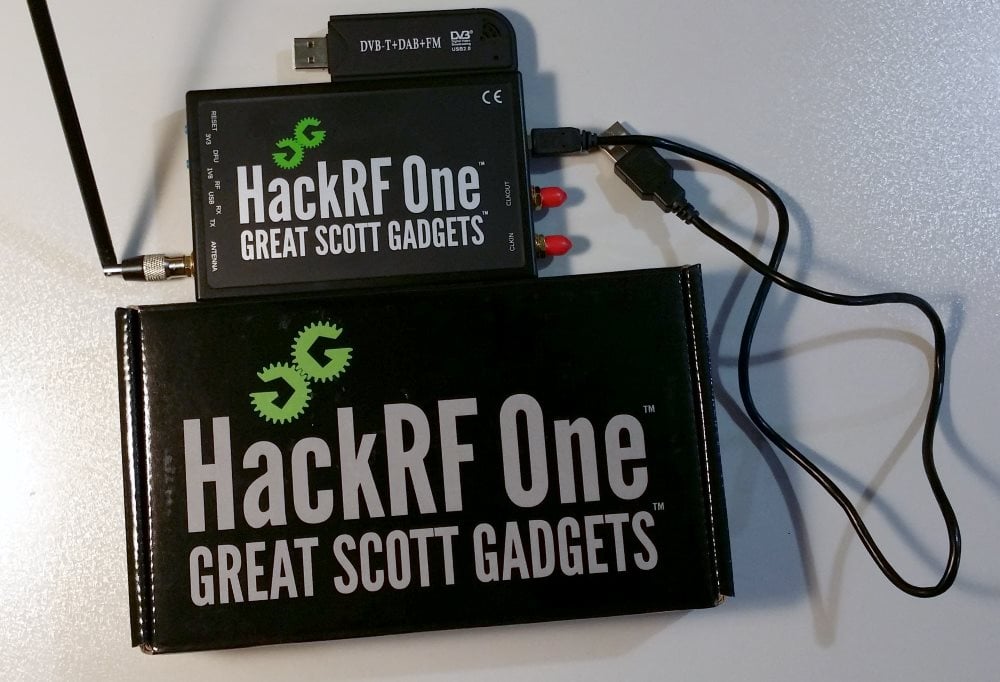
The HackRF One is a new software defined radio that has recently been shipped out to Kickstarter funders. It is a transmit and receive capable SDR with 8-Bit ADC, 10 MHz to 6 GHz operating range and up to 20 MHz of bandwidth. It can now be preordered for $299 USD. We just received ours from backing the Kickstarter and here’s a brief review of the product. We didn’t do any quantitative testing and this is just a first impressions review. So far we’ve only tested receive on Windows SDR#.

Unboxing

Inside the box is the HackRF unit in a quality protective plastic casing, a telescopic antenna and a USB cable. We show an RTL-SDR next to the HackRF for size comparison.

HackRF + Telescopic Antenna + USB Cable + Box (RTL-SDR Dongle Shown for Size Comparison)
Back of the box
Back of the box

Continue reading

YouTube Review of the DX Patrol 100 kHz to 2 GHz SDR Receiver

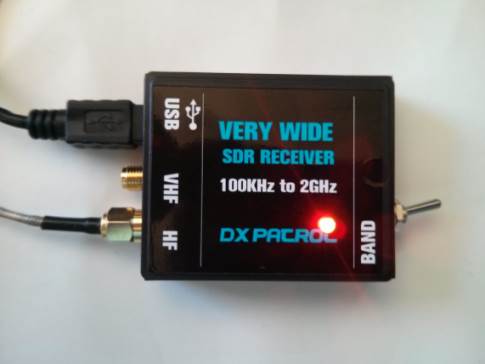
The DX Patrol 100 kHz to 2 GHz SDR receiver appears to be a custom built RTL-SDR with upconverter built in. It is made by CT1FFU who is also known to be a good manufacturer of upconverters for the RTL-SDR. The DX Patrol SDR can be bought for 79 Euros at CT1FFU’s website. It’s features are as follows:

  • Ultra Wide-band Coverage SDR Receiver
  • Full coverage reception form 100KHz to 2GHz SDR
  • Independent antenna inputs for Shortwave and VHF
  • USB computer connection ( mini usb)
  • Very High dynamic range receiver
  • Low noise pin-diode band switch
  • Accurate and efficient band filters
  • Very clean audio reception
  • SMA golden antenna connectors
  • LED power and band indication
  • 40MHz local oscillator for HF conversion
  • DBM balance diode ring mixer
  • Small size board
  • Freeware software
  • Up to 3.2 M Sample rate.
Ultra Wide band SDR Receiver 100KHz to 2GHz
Ultra Wide band DX Patrol SDR Receiver 100KHz to 2GHz

We aren’t sure how this compares to a standard RTL-SDR with conventional upconverter, or direct sampling mode and we also aren’t sure about the truthfulness to their very high dynamic range claims as the RTL-SDR is known to have dynamic range that isn’t what could be called very high (8 bits ~ 50 dB).

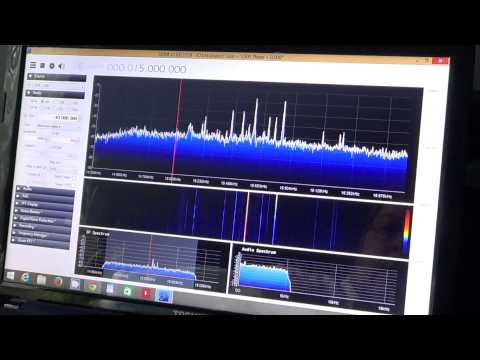
Over on YouTube user OfficialSWLchannel has uploaded a video review. OfficialSWLchannel gives a generally positive review of the hardware.

DX Patrol SDR Receiver Review and Observations