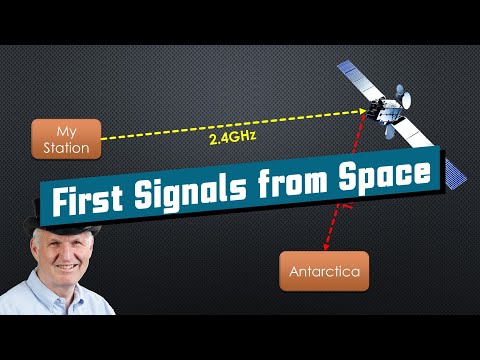
Over on YouTube Andreas Speiss has uploaded a video that explains what the geostationary QO-100 satellite is, and explains about the parts needed to receive and transmit to it. In particular Andreas goes into depth explaining the low noise block (LNB), and the PLL inside it. A PLL or phase locked loop is a common design used in RF electronics as it allows us to increase the frequency of crystal oscillators.
This PLL explanation ties into the fact that most commercial LNBs available do not have a stable enough crystal oscillator to properly receive or transmit the narrowband amateur radio signals used on QO-100. A PLL can increase the frequency of a crystal, but it will also increase the frequency drift and jitter/phase noise of the crystal. He notes that in later videos he'll show how to modify the LNB to improve these factors. We note that a commercially available stable LNB is the Bullseye LNB which we have posted about previously.
#331 QO-100 Satellite Receiving Technology. And Explanation of a PLL
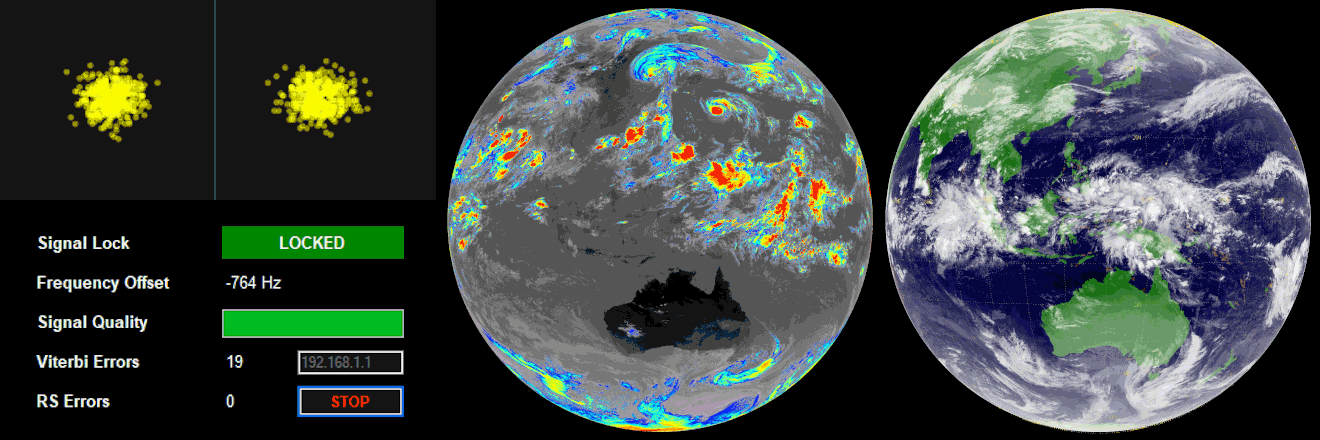
Over on his website VKSDR has recently released a tutorial about his Linux based xirt-rx software which allows RTL-SDR and other SDR owners receive weather images from the geostationary satellite known as GEO-KOMPSAT-2A (GK-2A). GK-2A is a Korean satellite, hence it is positioned over the Asia-Pacific region, covering Asia, Eastern Russia, Australia and New Zealand.
To receive images from GK-2A you'll need an RTL-SDR, 2.4 GHz WiFi grid antenna and an L-band LNA. We have an earlier tutorial about receiving GK-2A and GOES geostationary L-band satellites that goes into more detail about the hardware required.
VKSDR's xrit-rx software decodes the Low Rate Information Transmission (LRIT) signal from GK-2A which provides a 64kbps data stream and full disk images of the earth every 10 minutes. His tutorial explains the various image types that are transmitted, shows a few example images, and shows that some smooth animations can be created with the 144 images received over a day. The rest of the tutorial goes into the software setup, and explains the installation and configuration procedure.
We note that the latest version of xrit-rx now also comes with a nice web based dashboard that allows you to view the latest image, as well as the upcoming image schedule.
Thank you to Apostolos for submitting information about his new open source program called "CygnusRFI". CygnusRFI is a tool designed for analyzing radio frequency interference (RFI) with a focus on how it affects satellite ground stations and radio telescopes. We note that in the past we've posted several times about Apostolos' other project called PICTOR, which is an open source radio telescope platform that makes use of RTL-SDR dongles.
Apostolos explains CygnusRFI in the following:
CygnusRFI is an easy-to-use open-source Radio Frequency Interference (RFI) analysis tool, based on Python and GNU Radio Companion (GRC) that is conveniently applicable to any ground station/radio telescope working with a GRC-supported software-defined radio (SDR). In addition to data acquisition, CygnusRFI also carries out automated analysis of the recorded data, producing a series of averaged spectra covering a wide range of frequencies of interest. CygnusRFI is built for ground station operators, radio astronomers, amateur radio operators and anyone who wishes to get an idea of how "radio-quiet" their environment is, using inexpensive instruments like SDRs.
In addition, he's also noted how the default config files provided by goestools do not download EMWIN (Emergency Managers Weather Information Network) images. EMWIN images are not photos, but rather weather forecast and data visualizations that may be useful for people needing to predict or respond to weather. Over on his Github he's uploaded a modified version of goestools which has config files for EMWIN and other image products that might be of interest to some.
If you're interested, Carl Reinemann also has various bits of information about building APT/Meteor satellite RTL-SDR receivers on his main site too. Of interest in particular is his notes on creating wide area composites of NOAA APT images with WXtoIMG which we have posted about in the past.
Examples of some EMWIN Images Received by Carl Reinemann's GOES receiver.
Paul (microp11) is the programmer behind the Scytale-C Inmarsat decoder which has become very popular with RTL-SDR owners. With Scytale-C, and RTL-SDR and an appropriate L-band antenna and amplifier it is possible to receive STD-C NCS data from Inmarsat satellites. This is a public broadcast which contains information like search and rescue (SAR) and coast guard messages as well as news, weather, pirate activity and other incident reports. If you're interested, we have a tutorial available here which uses different software.
Paul has recently created a 6-part video series explaining Scytale-C and all it's features. As well as showing how to setup a Scytale-C decoder with the SDR# plugin in order to receive the STD-C text data via the UI, Paul's series goes into more depth showing how to review and inspect the raw data packets, how to monitor multiple Inmarsat channels at once using SDR# Spyservers and how to use the map feature for plotting coordinate and region data.
SMOG-P is a Hungarian nano satellite developed by BME University. It's payload consists of an on board spectrum analyzer that is designed to measure electromagnetic pollution (electrosmog) from space, and to also monitor the DVB-T spectrum. It currently holds the title of the world's smallest satellite in operation. ATL-1 is another Hungarian satellite this time developed by ATL Ltd. Its mission is to test a new thermal isolation material in space and to monitor the DVB-T spectrum.
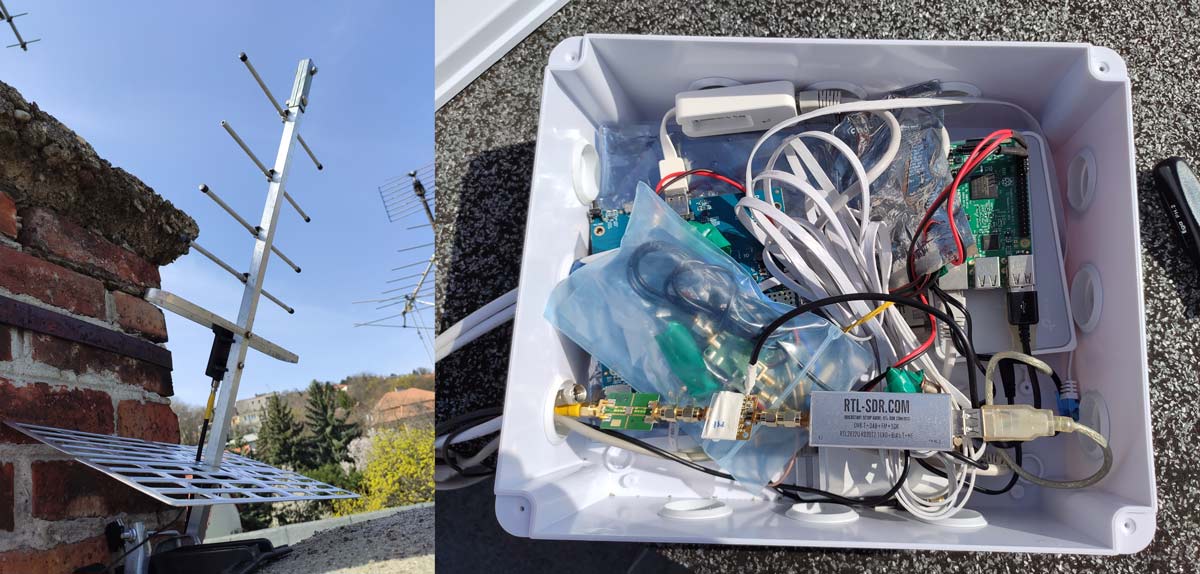
To receive telemetry from these satellites you can use a Raspberry Pi, RTL-SDR, Yagi, and optionally an LNA and filter. In his post Zoltan shows how to install the SMOG-P decoder, and provides a script that automatically decodes, uploads packets to the BME University server, and archives old IQ files and packets.
We note that if you wish to receive these satellites, now is the time to do so as these nano satellites are in a very low orbit and only have an orbital lifespan of only 6-8 months total.
SMOG-P and ATL-1 Satellite Ground Station Receiver Setup
Over on YouTube William IU2EFA has been uploading multiple short "meteor scatter" videos. This involves using an RTL-SDR to briefly receive distant radio stations via the RF signal reflecting off the ionized trail left by meteors entering the atmosphere. However, in a similar fashion satellites orbiting the earth can also reflect distant radio stations.
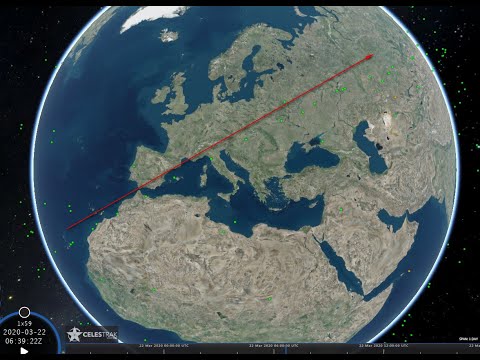
In one of his latest videos William caught a train of Starlink satellites reflecting the signal from the Graves radar in France. To do this he uses a 10 element VHF Yagi, and an RTL-SDR running with HDSDR and SpectrumLab. In the video you can see and hear the change in frequency caused by the doppler shift.
Starlink is a SpaceX project aiming to bring ubiquitous satellite internet to the entire world. Currently 358 Starlink satellites are in orbit, and the end goal is to have 12000.
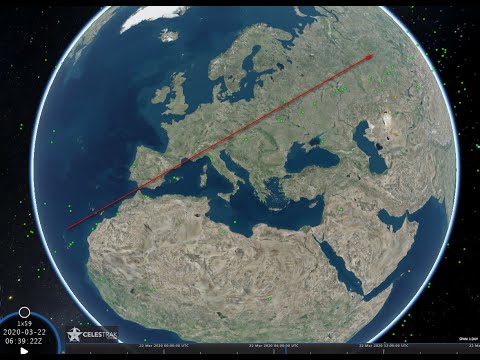
The LNB is designed for receiving QO-100 which is a popular geostationary amateur radio satellite positioned at 25.5°E which covers Africa, Europe, the Middle East, India, eastern Brazil and the west half of Russia/Asia. In the past we've seen several posts about people using RTL-SDRs to set up ground station monitors for this satellite, as well as special WebSDR software designed for QO-100 monitoring.
Typically an LNB with small satellite dish is used to receive QO-100 which downlinks at 10.489550 GHz. These LNB's have a built in LNA, and downconvert the signal into a frequency range receivable by an RTL-SDR. One problem is that most commercial LNBs were intended for satellite TV reception, and hence they do not need to use a very stable local oscillator. So reception of the narrowband signals on QO-100 can become a challenge if they are continuously drifting in frequency as temperature changes.
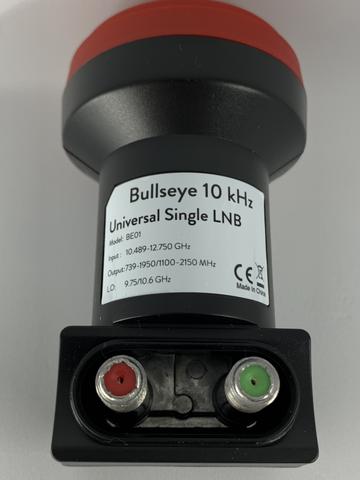
Othernet's new Bullsye LNB uses a 2PPM TCXO as the local oscillator which gives it high stability in the face of changing temperatures. To power it you'll need a bias tee or LNB power source capable of injecting 13 - 18v onto the coax line. The product description reads:
The Bullseye LNB is the world's most precise and stable Ku-band down converter. Even a VSAT LNBF costing hundreds of dollars more is no match for the performance of the Bullseye 10K LNB. Each unit is calibrated at the factory to within 1 kHz of absolute precision against a GPS-locked spectrum analyzer. As a bonus feature, the Bullseye 10K provides access to its internal 25 MHz TCXO through the secondary F-connector. This reference output can be used to directly monitor the performance of the TCXO over time.
Bullseye 10 kHz BE01
Phase locked loop with 2 PPM TCXO
Factory calibration within 1 kHz utilizing GPS-locked spectrum analyzers
Ultra high precision PLL employing proprietary frequency control system (patent pending)
Digitally controlled carrier offset with optional programmer
25 MHz output reference available on secondary F-connector (red)
Return loss of 8 dB (739 - 1950 MHz) and 10 dB (1100 - 2150 MHz)
Noise figure: 0.5 dB
Over on his blog @F4DAV has uploaded a comprehensive review of the Othernet LNB which goes over the specs, construction and testing of the LNB. The review is an excellent read and he concludes with the statement:
As far as I know the BE01 is the first affordable mass-produced Ku-band TCXO LNB. Specifications are not entirely clear but these early tests suggest that it can be a game changer for amateur radio and other narrowband applications in the 10 GHz band. The stability and ability to recalibrate should allow even unsophisticated analog stations to tune to a 5 kHz channel and remain there for hours at a time. For SDR stations with beacon-based frequency correction, the absolute accuracy removes the need to oversample by several hundred kHz or to scan for the initial frequency offset.