Not too long ago we posted about Jacek Lipkowski (SQ5BPF)'s project called "Etherify" which seeks to use unintentional RF radiation from Ethernet hardware/cables to transmit arbitrary signals such as morse code and FSK. During his earlier experiments he noted how he felt that the Raspberry Pi 4 had an unusually strong radiated Ethernet signal. In his recent post Jacek investigates this further.
Indeed his new tests seem to confirm that the Pi 4 has excessive RF leakage from the Ethernet hardware. His latest results have shown that he was able to receive the Ethernet leakage strongly from 50 meters away without any cable connected to the Ethernet port to act as a radiator. Jacek's post contains a number of demonstration videos such as the one below.
He admits that his particular Pi 4 unit might be unique in this regard. If anyone else tests this and can confirm excessive leakage, please let us know in the comments.
Ethernet RF leakage received strongly from 50m away without any antenna on the Pi 4
Over on his blog SQ5BPF has been documenting a TEMPEST experiment where he's been able to transmit data via RF being leaked from a Raspberry Pi's Ethernet connection. The idea was born when he found that his Raspberry Pi 4 was leaking a strong RF signal at 125 MHz from the Ethernet cable. He went on to find that it was easy to turn a tone on and off simply changing the Ethernet link speed with the "ethtool" command line tool. Once this was known it is a simple matter of creating a bash script to generate some morse code.
Quite amazingly the Ethernet RF leakage is very strong. With the Raspberry Pi 10 meters away, and a steel reinforced concrete wall in between, SQ5BPF was able to receive the generated morse code via an RTL-SDR connected to a PC. Further experiments show that with a Yagi antenna he was able to receive the signal from 100 meters away.
His post explains some further experiments with data bursting, and provides links to the scripts he created, so you can try this at home.
Update - SQ5BPF also notes the following:
The leakage differs a lot with the hardware used. The Raspberry Pi 4 is exceptional and also allows to switch the link speed quickly, so was a nice candidate for a demo, but other hardware works as well.
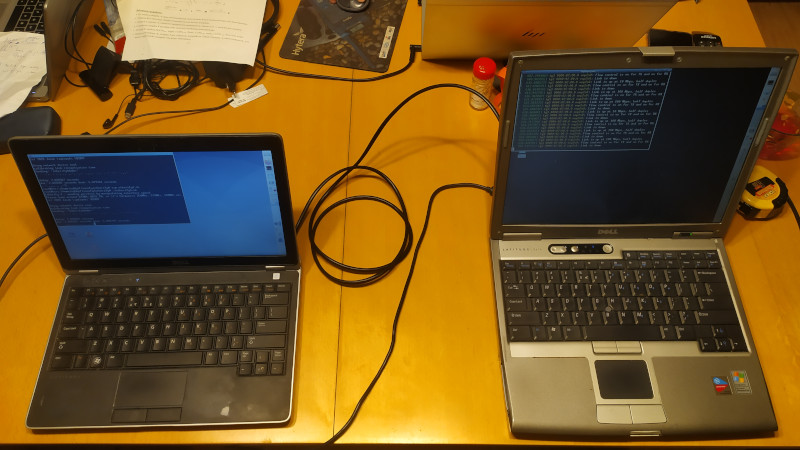
The first tests were done on some old laptops I had laying around, and they leak as well. Maybe someday I will publish this, but everyone of them behaves differently.
Etherify 1 demo receiving via SDR and decoding via fldigi
At this years ICNP 2020 IEEE conference a paper titled "Real-World ADS-B signal recognition based on Radio Frequency Fingerprinting" (pdf file) was presented by researchers from Harbin Engineering University in China. The idea presented in the paper is to use RF "fingerprinting" techniques to uniquely identify and confirm that the ADS-B signal originates from the correct aircraft source.
RF fingerprinting works on the premise that every transmitter has small manufacturing variances that result in slightly different signals be transmitted, resulting in a unique "fingerprint" that can be traced to a particular transmitter. The idea here is to use these fingerprints to ensure that a known aircraft is indeed transmitting an ADS-B signal and the signal is not being transmitted from a fake spoofer. ADS-B is completely unencrypted and not authenticated, so spoofing of ADS-B signals may be a real security threat.
In the teams research they use an RTL-SDR to collect ADS-B signals from five different aircraft. They then use that data to create "Contour Stellar Images" and train a deep learning neural network which after training accurately identifies which aircraft a signal comes from.
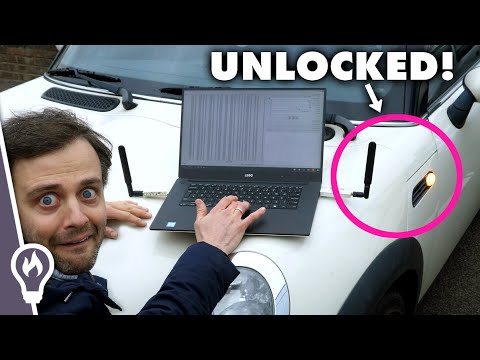
Over on his YouTube channel Kalle Hallden has uploaded a video demonstrating how to perform a replay and "rolljam" attack on a wireless car key with an RTL-SDR and Yardstick One. His first experiment is a simple replay attack which involves recording the unlock signal from the car key with the Yardstick One in a place far away from the car so that it is not received, then replaying it close by.
This works well, but Kalle then explains rolling code security and how this would easily thwart any replay attack in the real world. However, he then goes on to explain and demonstrate the "rolljam" technique, which is one known way to get around rolling code security. The demonstrations are obviously not full tutorials, but are just high level overviews of how wireless security can be defeated.
A few weeks ago we posted about the recently uploaded talks listed on the Defcon YouTube channel. However, there is a second YouTube channel dedicated to talks presented as part of the Defcon Aerospace Village which was also held virtually. A number of these talks involve software defined radios and RTL-SDRs and so may be of interest to readers. We have listed a few interesting talks below, but the full list can be found on their YouTube channel.
A Deeper Dive into ILS and ADS-B Spoofing - Harshad Sathaye discusses weaknesses in the security of the Instrument Landing System and ADS-B and how these can be spoofed.
Introduction to ACARS - Alex Lomas explains aircraft ACARS text messages in detail and discusses receiving them with an RTL-SDR
Low-Cost VHF Receiver - Alan Tart, Fabian Landis show how to build a low cost VHF airband receiver from an RTL-SDR, Raspberry Pi and the RTLSDR-Airband software.
The Organized Crime and Corruption Reporting Project (OCCRP) have recently run a story about how they have used ADS-B aircraft data to uncover the role that US civilian aircraft contractors are playing in the East African "kill chain". The investigation began over concerns that while civilian contractors do not pull the trigger, they may be becoming too involved in the process of determining exactly who will be killed in combat via data collection and analysis through their high tech surveillance aircraft. In the article they also note how many of these civilian contractors hide their true owners behind a chain of multiple LLC companies, thus reducing any accountability for their actions.
OCCRP also supports the Dictator Alert project which we have posted about in the past. In a related article titled "Mapping the Secret Skies: Lessons Learned From Flight Data" Emmanuel Freudenthal who helped setup the Dictator Alert project discusses how censorship free ADS-B tracking is helping journalists uncover new stories. In the article he notes how he uses uncensored ADS-B data together with the leaked Paradise Papers to reveal the true owners of aircraft hidden behind multiple LLC and shell companies. Regarding the "kill chain" article Emmanuel's post also explains how the story came to be:
An upcoming OCCRP story focuses on U.S. surveillance flights over Somalia. The U.S. military operates out of a small air base at Manda Bay just over the border in Kenya. We had a tip that it would be worth checking on planes in the area, so we set up an antenna nearby, which fed us information about planes taking off and landing from the base.
We eventually had to take down the antenna due to security concerns. But we managed to collect data on a number of planes that had been purchased by obscure shell companies and modified with advanced surveillance equipment before being sent to Kenya.
Why is this article posted on this blog? ADS-B data from aircraft is most often received these days via RTL-SDR dongles due to their low cost, so it is interesting to see to what extent cheap SDRs may be affecting the world via this type of reporting.
We note that ADS-B Exchange is the only censorship free ADS-B data aggregator available. All other online flight trackers censor flights from the government as well as from some private jets that may be owned by high profile company directors or in some cases dictators. The argument for censorship is that ADS-B data collection may be made illegal otherwise.
In a previous post we also discussed how censorship free ADS-B data from ADS-B Exchange revealed how military Blackhawk helicopters and Predator drones were used for surveillance during the early Black Lives Matter protests.
At the BSides OK 2020 virtual conference Cameron Mac Millan recently presented a talk titled "It’s 2020, so why am I still able to read your pager traffic?". On this blog we have posted numerous times about privacy breaches stemming from insecure wireless pager traffic. Anyone with a radio or SDR can receive and decode pager messages, and this has been known and done since the 1980's. Cameron's talk explains how paging systems work, who are the modern users of pagers, how to capture and decode pager messages and how to best log and filter through messages. He goes on to describe a number of major pager security breaches that he's personally seen. The talk preview reads:
This talk explores why pagers remain a potential threat vector in many environments despite the technology being 40 years old. This is not a the-sky-is-falling presentation: everything from paging history to how simple it is to decode pager traffic (and the associated risks) is covered without FUD.
I enjoy poking things with sticks and turn over rocks to see what crawls out from under them. One of my interests is seeing how technologies believed to be obsolete can still pose a problem for security today, and do that from the perspective of a 20-year career in infosec. When not creating tomorrow’s problems with yesterday’s technology, I can usually be found wrenching on unusual cars.
It’s 2020, so why am I still able to read your pager traffic? - Cameron Mac Millan - BSidesOK 2020
Ars Technica recently ran a story about how University researchers have been able to eavesdrop on LTE mobile phone calls using a USRP B210 software defined radio which runs the Airscope software. The technique exploits a flaw in how some LTE carriers are implementing their keystream. A keystream is a stream of random data combined with the actual voice data, resulting in encrypted data.
It turns out that many LTE carriers reuse the same keystream when two calls are made within a single radio connection. An attacker can then record an encrypted conversation, then immediately call the victim after that conversation. The attacker can now access the encrypted keystream, and as the keystream is identical to the first conversation, the first conversation can now be decoded.
The ReVoLTE attacks exploit the reuse of the same keystream for two subsequent calls within one radio connection. This weakness is caused by an implementation flaw of the base station (eNodeB). In order to determine how widespread the security gap was, we tested a number of randomly selected radio cells mainly across Germany but also other countries. The security gap affected 12 out of 15 base stations.
The ReVoLTE attack aims to eavesdrop the call between Alice and Bob. We will name this call the target or first call. To perform the attack, the attacker sniffs the encrypted radio traffic of Alice within the cell of a vulnerable base station. Shortly after the first call ends, the attacker calls Alice and engages her in a conversation. We name this second call, or keystream call. For this call, the attacker sniffs the encrypted radio traffic of Alice and records the unencrypted sound (known plaintext).
For decrypting the target call, the attacker must now compute the following: First, the attacker xors the known plaintext (recorded at the attacker's phone) with the ciphertext of the keystream call. Thus, the attacker computes the keystream of the keystream call. Due to the vulnerable base station, this keystream is the same as for the target (first) call. In a second step, the attacker decrypts the first call by xoring the keystream with the first call's ciphertext. It is important to note that the attacker has to engage the victim in a longer conversation. The longer he/she talked to the victim, the more content of the previous communication he/she can decrypt. For example, if the attacker and victim spoke for five minutes, the attacker could later decode five minutes of the previous conversation.
The ReVoLTE Attack
Demonstration of the ReVoLTE attack in a commerical LTE network.