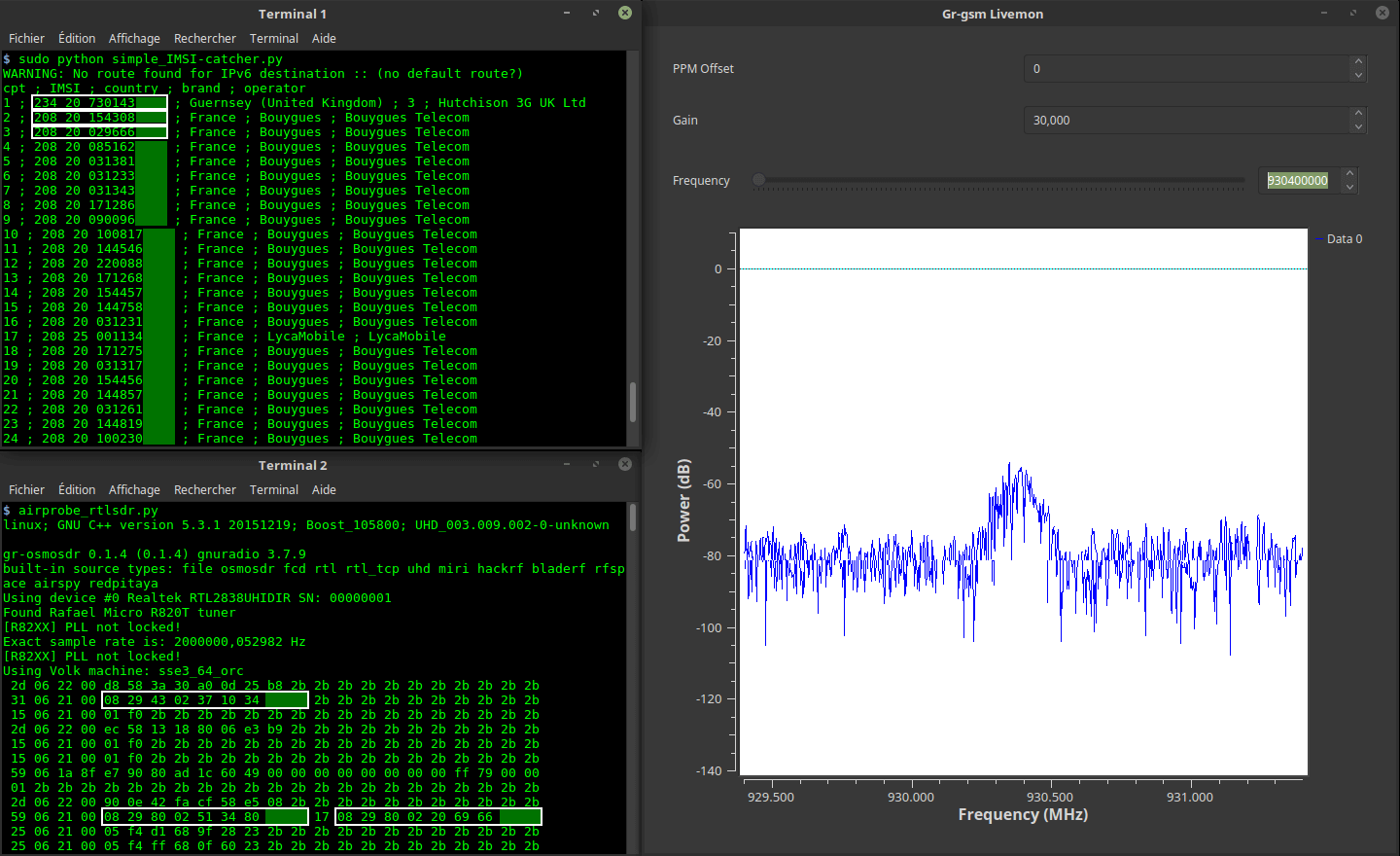
Over on YouTube user Keld Norman has uploaded a video showing how he uses an RTL-SDR with gr-gsm and a Python script to create a simple IMSI catcher. IMSI stands for International mobile subscriber identity and is a unique number that identifies a cell phone SIM card in GSM (2G) mobile phone systems. For security IMSI numbers are usually only transmitted when a connection to a new cell tower is made. More advanced IMSI-catchers used by governmental agencies use a fake cell tower signal to force the IMSI to always be revealed. This way they can track the location of mobile phones as well as other data like who or when you are calling.
In the video Keld uses a Python script called IMSI-Catcher. This script displays the detected IMSI numbers, country, and mobile carrier on a text display. The video description shows how to install GR-GSM and the IMSI-Catcher script on Ubuntu.
UPDATE: Version 2 of RPiTX renders this tutorial obsolete, as it is now very easy to copy and replay signals using the RPiTX GUI (or the "sendiq" command) and an RTL-SDR. This tutorial is still valid for the overall concept.
With an RTL-SDR dongle, Raspberry Pi, piece of wire and literally no other hardware it is possible to perform replay attacks on simple digital signals like those used in 433 MHz ISM band devices. This can be used for example to control wireless home automation devices like alarms and switches.
In this tutorial we will show you how to perform a simple capture and replay using an RTL-SDR and RPiTX. With this method there is no need to analyze the signal, extract the data and replay using a 433 MHz transmitter. RPiTX can replay the recorded signal directly without further reverse engineering just like if you were using a TX capable SDR like a HackRF to record and TX an IQ file.
Note that we've only tested this replay attack with simple OOK 433 MHz devices. Devices with more complex modulation schemes may not work with this method. But the vast majority of 433 MHz ISM band devices are using simple modulation schemes that will work. Also replay attacks will not work on things like car keys, and most garage door openers as those have rolling code security.
A video demo is shown below:
Replay Attacks at 433 MHz with RTL-SDR and a Raspberry Pi running RPiTX
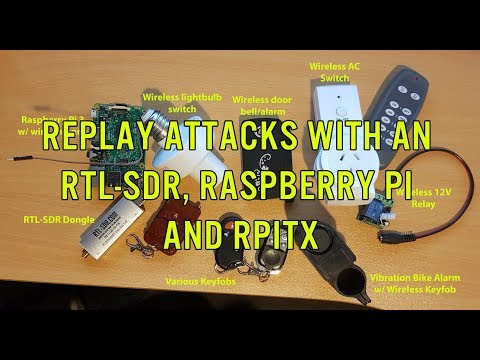
Hardware used and wireless ISM band devices tested with RPiTX
RpiTX
RPiTX is open source software which allows you to turn your Raspberry Pi into a general purpose transmitter for any frequency between 5 kHz to 500 MHz. It works by using square waves to modulate a signal on the GPIO pins of the Pi. If controlled in just the right way, FM/AM/SSB or other modulations can be created. By attaching a simple wire antenna to the GPIO pin these signals become RF signals transmitted into the air.
Of course this creates an extremely noisy output which has a significant number of harmonics. So to be legal and safe you must always use bandpass filtering. Harmonics could interfere with important life critical systems (e.g. police/EMS radio, aircraft transponders etc).
For testing, a short wire antenna shouldn't radiate much further than a few meters past the room you're in, so in this case you should be fine without a filter. But if you ever connect up to an outdoor antenna or amplify the signal then you absolutely must use adequate filtering, or you could find yourself in huge trouble with the law. Currently there are no commercially made 433 MHz filters for RPiTX available that we know of, so you would need to make your own. Also remember that you are still only allowed to transmit in bands that you are licensed to which for most people will be the ISM bands.
Back in May of this year the DailyMail ran an article discussing how the HackRF by Great Scott Gadgets could be used to break into cars. The DailyMail is a British tabloid magazine well known for its low credibility and alarmist articles. This week they ran a new article about Great Scott Gadgets other product, the Yard Stick One. In the article they discuss how the £109 Yard Stick One tool can be used to disable wireless burglar alarms. The YARD Stick One is not an SDR, but rather a computer controlled radio which can be used to transmit and receive wireless digital signals below 1 GHz. It is useful for wireless security research and reverse engineering digital signals in a way that is a bit easier than with using an SDR like the HackRF.
In the experiment performed in the article they use the YARD Stick one to jam a wireless home alarm for a few seconds allowing entry to the property without setting off the alarm. All in all the article is a good advert for the YARD Stick One, and does do a decent job at drawing attention to the lack of security provided by many wireless security devices.
DailyMail shows how a YS1 can be used to jam a wireless burglar alarm.
These days it’s quite easy to share your ADS-B reception on the internet with giant worldwide aggregation sites like flightaware.com and flightradar24.com. These sites aggregate received ADS-B plane location data received by RTL-SDR users from all around the world and display it all together on a web based map.
However, what if you don’t want to share your data on these sites but still want to share it over the internet with friends or others without directly revealing your IP address? Some of the team at beame.io have uploaded a post that shows how to use their beame.io service to securely share your ADS-B reception over the internet. Beame.io appears to be a service that can be used to expose local network applications to the internet via secure HTTPS tunneling. Essentially this can allow someone to connect to a service on your PC (e.g. ADS-B mapping), without you revealing your public IP address and therefore exposing your PC to hacking.
On their post they show how to set up the RTL-SDR compatible dump1090 ADS-B decoder on a Raspberry Pi, and then connect it to their beame-instal-ssl service.
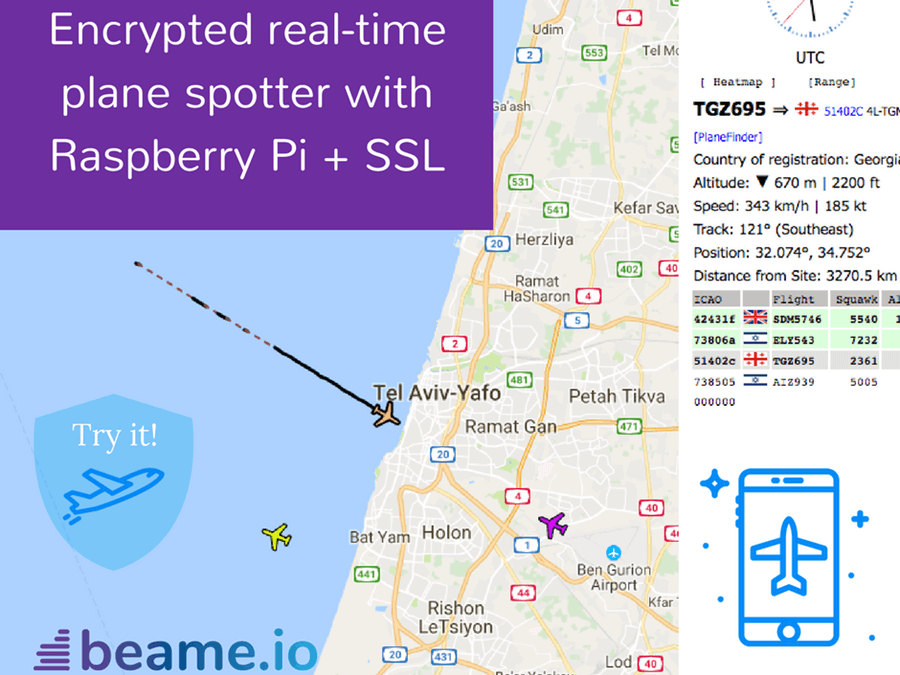
Encrypted ADS-B Sharing with the beame.io service.
It’s been known for a while now that it is possible to break into cars using simple wireless attacks that involve jamming of the car keyfob frequency. Sammy Kamkars “rolljam” is one such example that can be built with a cheap Arduino and RF transceiver chip. One way to secure yourself against wireless attacks like this is to run a jammer detector.
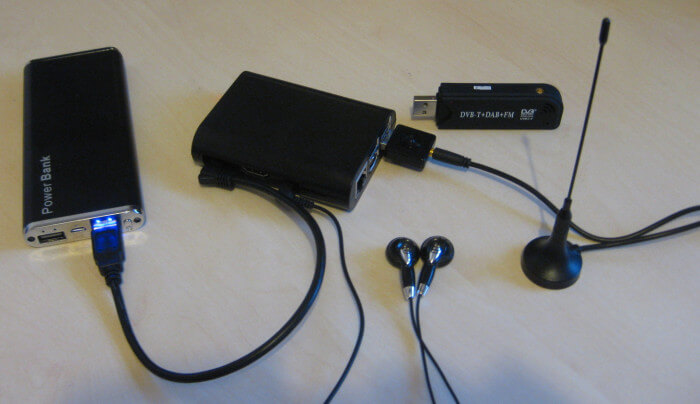
A jammer detector is quite simple in theory – just continuously measure the signal strength at the car keyfob frequency and notify the user if a strong continuous signal is detected. Over on his blog author mikeh69 has posted about his work in creating a wireless jammer detector out of a Raspberry Pi and RTL-SDR dongle. He uses a Python script and some C code that he developed to create a tool that displays the signal strength on an onscreen bar graph and also conveys signal strength information via audio tones. He writes that with a pair of earphones and battery pack you can use the system while walking around searching for the source of a jammer.
Mikeh69’s post goes into further detail about installing the software and required dependencies. He also writes that in the future he wants to experiment with creating large area surveys by logging signal strength data against GPS locations to generate a heatmap. If you are interested in that idea, then it is similar to Tim Haven’s driveby noise detector system which also used RTL-SDR dongles, or the heatmap feature in RTLSDR Scanner.
Over on his YouTube channel Linux Psycho has uploaded a video showing how he was able to listen in on wireless phone calls and recover the dialed phone numbers from within the conversation.
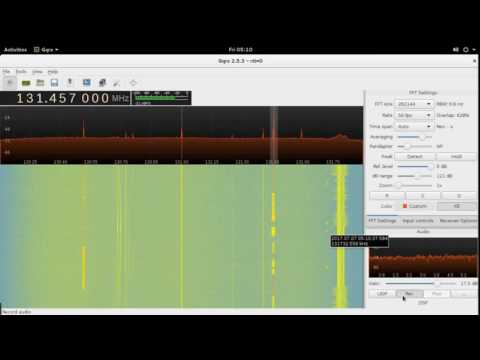
The intercepted signal appears to be unencrypted in the clear NFM at 130 MHz and appears to originate from some sort of wireless telephone service. Heard in the phone call are DTMF dial tones. Later in the video Linux Psycho shows how to retrieve the dialed phone number by recording the DTMF tones and submitting the .wav file to an online DTMF tone detection website. DTMF tones are simply the tones that you hear when you dial a number on a landline phone. Each tone is a different frequency and so it is fairly trivial to recover the dialed numbers.
We’re not sure exactly what the signal that Linux Psycho is listening to actually is as it seems to be a cordless phone, but in the wrong frequency range. Potentially it is a long range wireless phone extension commonly used in the third world or rural areas where actual landline connections are rare.
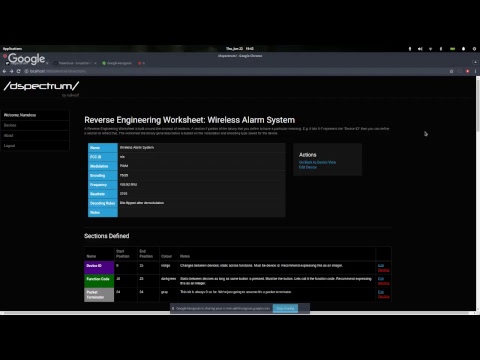
Over on YouTube a talk from the author of DSpectrum has been uploaded from his talk during the 13th Cyberspectrum Melbourne meetup. In his talk he goes through the full process of reverse engineering a wireless alarm system in DSpectrumGUI. DSpectrum is a reverse engineering tool that aims to make it trivial to demodulate digital RF transmissions using data captured from SDRs like an RTL-SDR or HackRF.
In the video he shows how to create a project, import a capture and create an overlay on Inspectrum and bring the waveform back into DSpectrum. DSpectrum was then able to automatically detect that the encoding used was PWM and convert it into a bit string. Then by importing multiple captures from various buttons on the alarm he shows how easy it is to see the differences in the bit strings from within DSpectrum. From these differences he uses DSpectrum to help identify what the function of each byte of the bitstring is. Finally he shows how to perform a replay attack with RFcat or similar hardware using the data gathered.
This is a really good talk to watch if you’re interested in getting started with reverse engineering simple digital signals, like those from ISM band devices.
Cyberspectrum Melbourne #13: Introduction to DSpectrum for reverse engineering signals
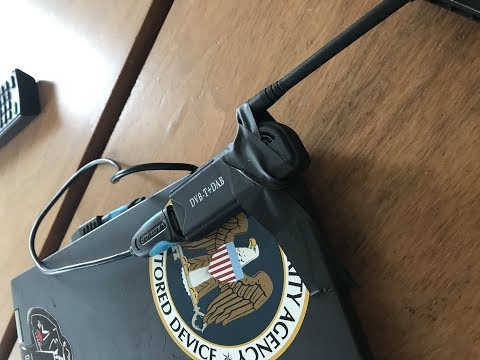
All electronic devices emit some sort of unintentional RF signals which can be received by an eavesdropping radio. These unintentional signals are sometimes referred to as TEMPEST, after the NSA and NATO specification which aims to ensure that electronic devices containing sensitive information cannot be spied upon through unintentional radio emissions, sounds or vibrations. TEMPEST can also refers to the opposite, which is spying on unsecured electronic devices by these means.
In their experiments they set up an AES implementation on an FPGA, and used a simple wire loop antenna and RTL-SDR to measure and record the RF emissions. By then doing some analysis on the recorded signal they are able to fairly easily extract the AES encryption key, thus defeating the encryption.
Further testing in an anechoic chamber showed that with a discone antenna they were able to recover the keys from up to a meter away. A directional antenna could probably reach even further distances.
In the past we’ve seen a similar attack using a Funcube dongle, which is an SDR similar to the RTL-SDR. In that attack they were able to remotely recover encryption keys from a laptop running GnuPC. Also, somewhat related is Disney’s EM Sense which uses an RTL-SDR to identify electronic devices by their RF emissions.