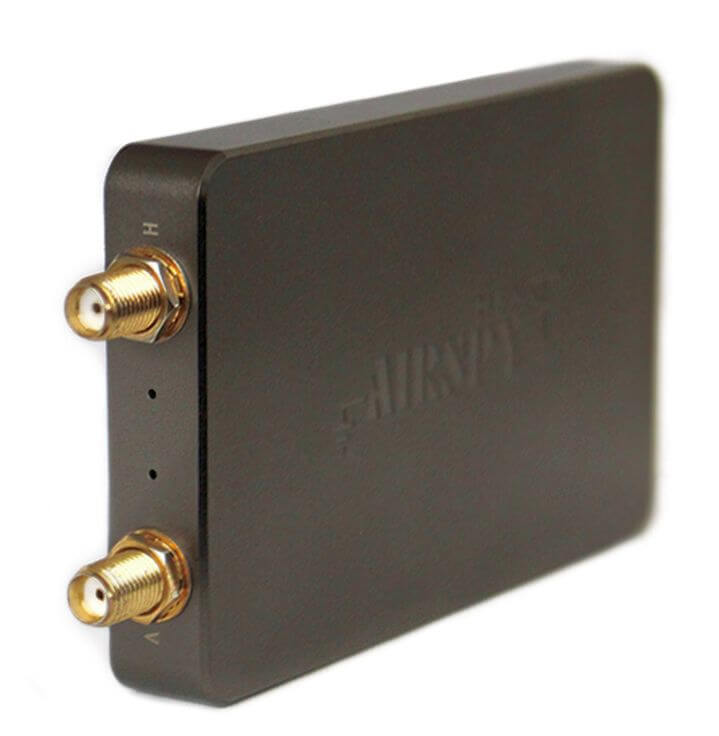
Airspy HF+ Real World Performance Examples by the Author of GQRX up on YouTube & Twitter

Alexander Csete (OZ9AEC) is the programmer behind the popular GQRX software. Recently Alexander has received a review sample of the upcoming Airspy HF+ and has been uploading videos showing it in action to his YouTube channel.

The Airspy HF+ is a soon to be released low cost (expected price $149 USD) yet high performance HF/VHF receiver designed for DXing with exceptional performance in the presence of strong overloading signals. If you are interested we also have our own review of the HF+ available here.

In the video below Alexander demonstrates the HF+ on SSB and CW modes in his GQRX software. See his YouTube channel for the rest of the videos. Currently there are about 7 videos demonstrating the HF+ on his channel.

Over on his Twitter account @csete Alex has also been uploading several images of the HF+ in action as well as some screenshots of it being compared against the RFSpace Cloud-IQ which is a $629 USD SDR. So far his impressions of the HF+ seem very high.
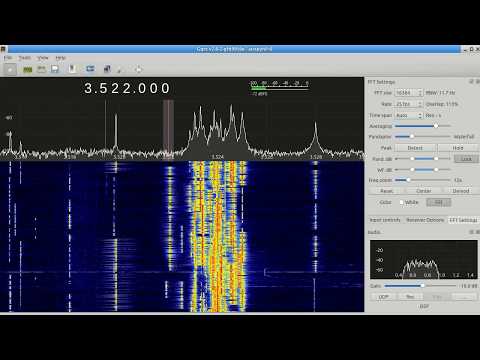
Testing the Airspy HF+ with Gqrx, then a pirate comes by...

RadioForEveryone New Posts: Antenna Weatherproofing, NooElec Nano 3 Review, ADS-B Antenna Shootout

Over on his blog 'Radio for Everyone' author Akos has uploaded three new posts. The first shows how to cheaply weatherproof antenna connections by wrapping electrical/plumbing tape around the connection. He shows and example with the FlightAware ADS-B antenna.

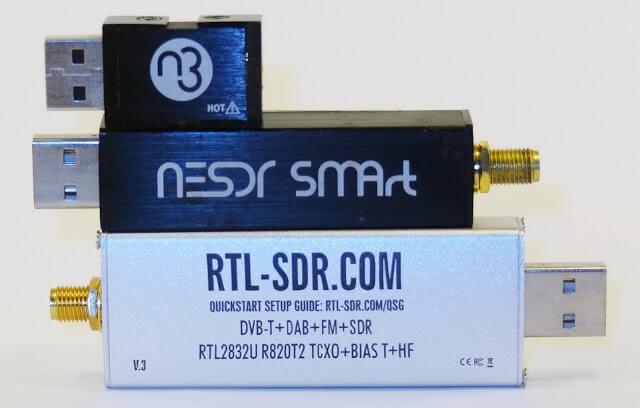
The second post is a review of the relatively new NooElec Nano 3, which is a small form factor RTL-SDR that comes with a TCXO and metal case. Akos shows how the form factor is good for using it with Mobile phones. Akos opens the unit up and shows us how the unit is sandwiched inside the metal case with two thermal pads for improved heat dissipation. Later in the review he also discusses the MCX connector, TCXO and heat.

The third post compares three commercially sold antennas at ADS-B reception. The compared antennas are the FlightAware ($45) and Jetvision ($90) ADS-B antennas as well as our RTL-SDR Blog general purpose dipole ($10). The results show that the Jetvision antenna performs the best followed by the FlightAware and then the dipole. However we note that Akos has incorrectly used the dipole as he did not orient it as a vertical dipole.

Radio For Everyone: Nano 3 Size Comparison

LimeSDR Mini Updates: Demonstrations with Universal Radio Hacker, LattePanda, PothosSDR and GNU Radio

Over on their CrowdSupply crowdfunding site LimeSDR have been releasing several short tutorials and demonstrations showing their new LimeSDR Mini in action. The latest update shows a short tutorial on using the LimeSDR Mini together with Universal Radio Hacker (URH) to reverse engineer a 433 MHz remote control

Other previous updates include showing how to use the LimeSDR Mini and Wireshark to analyze WiFi signals, using it with a LattePanda mini computer, creating an FM demodulator in PothosSDR and decoding a 433 MHz keyfob in GNU Radio.

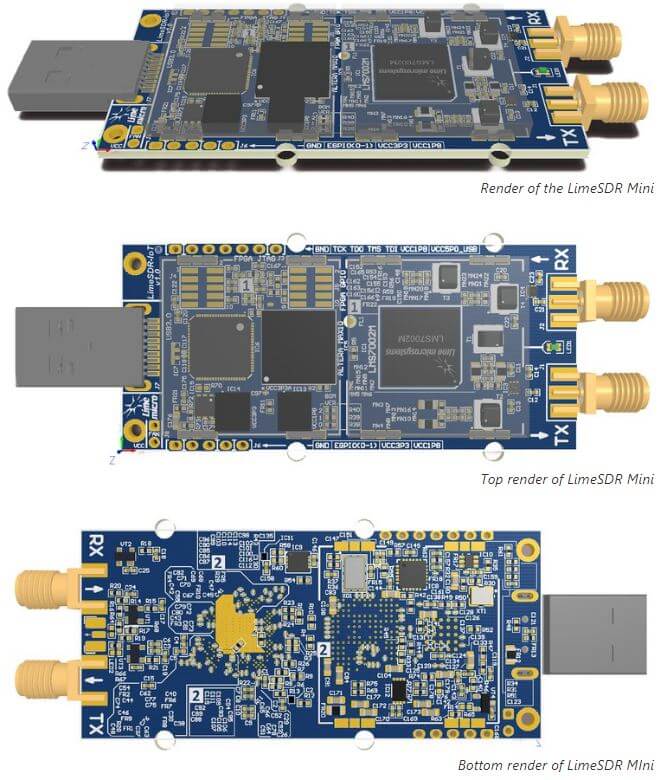
The LimeSDR Mini is a smaller and cheaper version of their LimeSDR which has slightly reduced specifications. The main changes are the slightly restricted frequency range of 10 MHz – 3.5 GHz, and half the maximum bandwidth at 30.72 MHz. The mini also only has 1×1 TX/RX channels. 

Recently the LimeSDR was released for crowdfunding on crowdsupply.com and already has raised $165,000 of it’s $100,000 threshold with 12 days remaining. Currently you can back the project for $139 with shipping expected on Dec 31.

LimeSDR Mini Renderings

RSP1 Metal Enclosure Price Reduced to $29.95

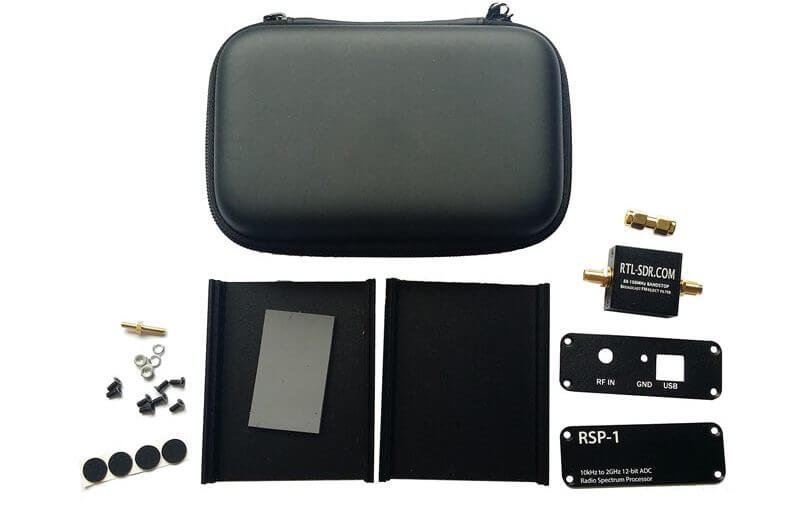
Recently we’ve reduced the price of our RSP1 Metal Enclosure upgrade kit from $39.95 down to $29.95 USD. You can purchase the kit from our store. The kit comes with:

  • 1x Metal Enclosure
  • 1x Carry case
  • 1x BCFM Filter with SMA Male to Male Adapter
  • 1x Accessory set including rubber feet, screws, grounding post.

On Amazon USA there are less than 16 units left, and shipped from China from our store there is less than 85. We won’t be restocking this item for a few months so please get in quick if you are interested.

We brought out this kit back in March and instructions for using the kit can be found on this post.

The RSP1 metal case kit

Meteor Logger: A Tool for Counting Meteor Detections with an RTL-SDR

Thanks to Wolfgang Kaufmann for submitting news about his new software called ‘Meteor Logger’. This tool can be used to count the number of meteors entering the atmosphere which have been detected by a meteor scatter setup using an RTL-SDR or similar SDR.

Wolfgang writes about his software:

I have developed a new piece of software “Meteor Logger” to detect and log radio meteors from the digital audio stream of a PC-soundcard. It is based on Python 3. It is addressed to those meteor enthusiasts who want get the most information out of forward scattering of radio waves off meteor trails. “Meteor Logger” do not display spectrograms, it delivers an instantaneous and continuous numerical output of the detected signal with a high time resolution of about 11 ms. Thereby a radio meteor signal is not detected on the basis of an amplitude threshold but on its signature in the frequency domain. “Meteor Logger” has a built in auto notch function that may be helpful in case of a persistent strong interference line. From these data not only hourly count rates can be derived but it is also possible to easily study power profiles of meteors as well as Doppler shifts of head echoes.

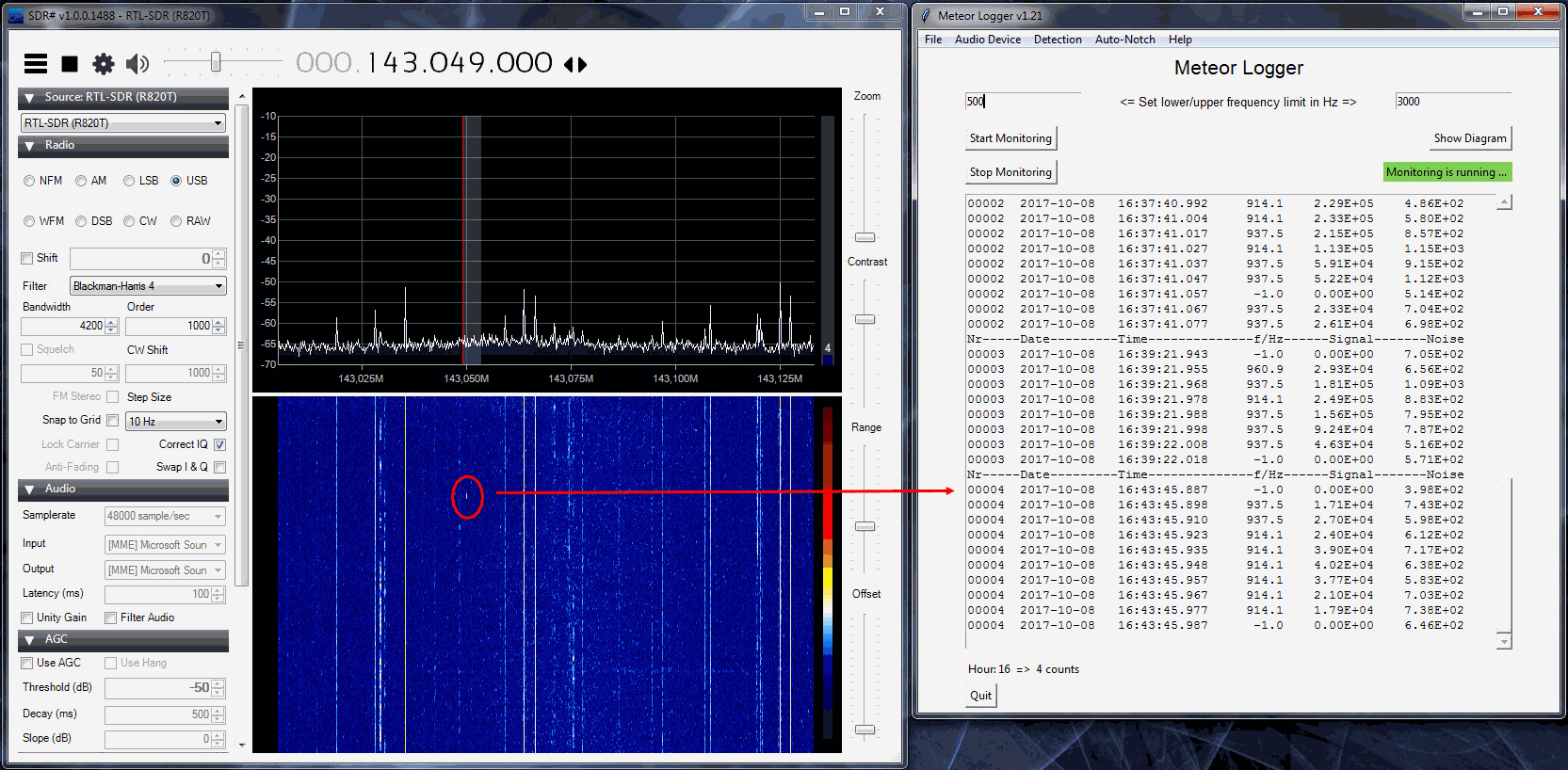
As receiving front end a RTL-SDR is fine, if you strive after a very high signal resolution you may use a Funcube Dongle Pro. I employed SDR# to run the RTL-SDR. GRAVES-radar is used as transmitter. The added screenshot shows this setup together with “Meteor Logger”.

Additionally I wrote an also Python 3 based post processing software “Process Data” that allows for clearing the raw data, viewing and analysing them and exporting them in different ways (e.g. as RMOB-file for opening with “Cologramme Lab” of Pierre Terrier, see added screenshot).

Everything else you may find on my website http://www.ars-electromagnetica.de/robs/download.html

Meteor Logger
Meteor Logger

Meteor scatter works by receiving a distant but powerful transmitter via reflections off the trails of ionized air that meteors leave behind when they enter the atmosphere. Normally the transmitter would be too far away to receive, but if its able to bounce off the ionized trail in the sky it can reach far over the horizon to your receiver. Typically powerful broadcast FM radio stations, analog TV, and radar signals at around 140 MHz are used. Some amateur radio enthusiasts also use this phenomena as a long range VHF communications tool with their own transmitted signals. See the website www.livemeteors.com for a livestream of a permanently set up RTL-SDR meteor detector.

Simon Brown Compares the Airspy HF+ against the RFSpace NetSDR on SDR-Console V3

Simon Brown who is the author of the popular SDR-Console V2/V3 software has received an early review version of the Airspy HF+ and has uploaded some screenshots comparing it with the RFSpace NetSDR. The NetSDR is a high performance 16-bit DDC SDR with frequency range of 10 KHz – 32 MHz, and a bandwidth of up to 1.6 MHz. The base price of the NetSDR is US $1449.

The Airspy HF+ on the other hand is based on a polyphase harmonic rejection mixer design with 18-bit DDC and has a frequency range of DC – 31 MHz and 60 – 260 MHz, with a maximum bandwidth of up to 660 kHZ. It is not yet released, but is expected to be about US $149 shipped from China.

Simon’s screenshots show that despite its low cost the HF+ seems to perform just as well as the more expensive NetSDR.

If you’re interested in the HF+ we also have our own review available here.

New HF+ photo, with black metal enclosure.

Testing the Prototype Outernet Patch Antenna with Built in RTL-SDR

A few months ago satellite data broadcasting company Outernet created a limited number of prototype receivers that combined an L-band satellite patch antenna, LNA and RTL-SDR into a signal unit. This was never produced in bulk as they found it to be too noisy having the RTL-SDR so close to the antenna, but nevertheless it still worked fairly well.

Over on YouTube max30max31 bought one of these prototype units and made a video about using it for receiving and decoding various L-band satellite signals. In the video he first shows an overview of the product and then shows it receiving and/or decoding some signals like Inmarsat STD-C, AERO and Inmarsat MFSK.

IZ5RZR - Inmarsat - outernet Rtl-Sdr patch antenna

Tom’s Radio Room Show Tests the RTL-SDR Blog Broadcast AM Filter

Over on YouTube Tom from Tom’s Radio Radio Room Show (TRRS) has uploaded a video showing the effectiveness of our broadcast AM (BCAM) filters for cleaning up HF reception. In the video he uses an RSP1 to receive the WWV time signal at 5 MHz and shows that there is some AM signals mixing into the audio. After connecting the BCAM filter the AM signal is gone and WWV comes in clearer.

TRRS #1305 - RTL-SDR.COM MW Filter for Shortwave - Works!