LNA4HF Now for Sale Plus Review

Back in November last year we posted about the possibility of an “LNA4HF” low noise amplifier (LNA) for the HF bands being made available for sale. The LNA4HF is now available for purchase.

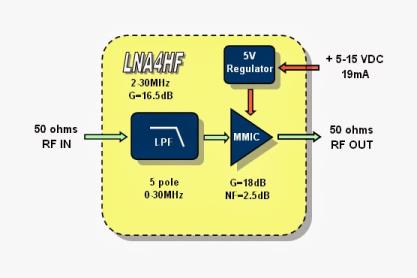
The LNA4HF is a low noise amplifier with built in low pass filter that runs on a 6-12 V power supply and covers a frequency range of 150khz to 30MHz, with a 18-20 dB gain and 1-2 dB noise figure. It costs 20 Euros. The low pass filter can also be disabled with a small board modification which will allow the amplifier to be useful at up to 2 GHz.
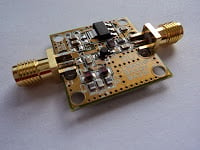
LNA4HF
LNA4HF
LNA4HF Block Diagram

Akos from the SDR for Mariners blog has reviewed the LNA4HF on his latest post. His results show that the low pass filter significantly reduces broadcast FM interference and that the amplifier also increases signal strength by around 20 dB as advertised.
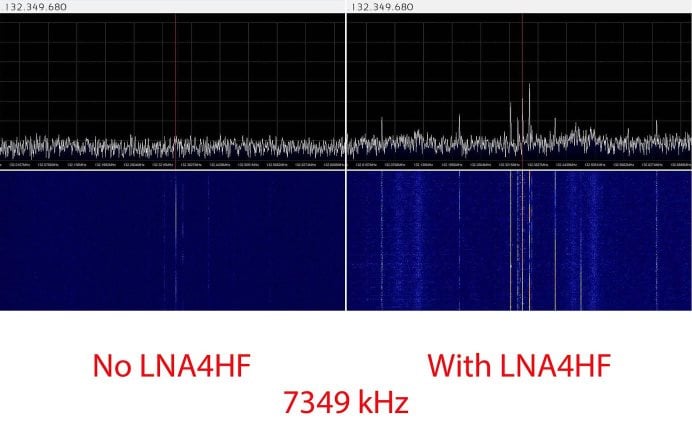
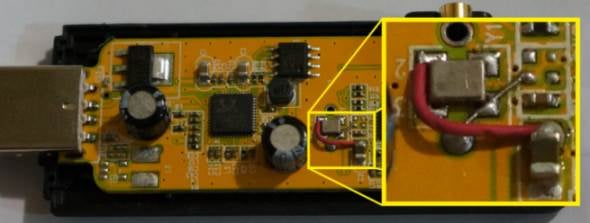
LNA4HF Comparison
SDR for Mariners LNA4HF Comparison

TCXO RTL-SDR Now Available for International Sale

Andy programmer of the RTL1090 ADS-B decoder software, and owner of the 1090Mhz webstore has notified us that the modified TCXO RTL-SDR we reviewed in December is now available for sale to international customers via their webstore.

Previously in December we gave a brief review of the modified temperature controlled oscillator (TCXO) RTL-SDR created by Japanese RTL-SDR modifier Nobu Saitou. In the review the TCXO showed good temperature stability and a very low PPM offset, which may be useful for some applications.

TCXO Photo
TCXO Photo

RTL_ACARS Updated

The rtl_acars console based ACARS decoder which is based on rtl_fm has been updated by a new author, gat3way on Reddit. The new updates include decoder sensitivity improvements and the following:

  • Multiple frequencies scanning is now supported (by providing multiple -f arguments at command line and -l ). Since there is no audio output and it’s hard to determine right squelch level, a squelch debug option (-r) is implemented. Use it to experiment with squelch value, it’s simple: good squelch values flood stdout with “hopping freq!” messages yet avoid too high squelch levels. In general, values between 20-30 work good with my setup (big city, lots of radio interference, NOAA turnstile which gives -3db due to rhcp polarization).
  • Aircraft and airline databases now supported (using the acarsdec builtin ones). DBs are text files using simple format, so you may easily update them. I would very much appreciate your help to keep that up-to-date.
  • Certain improvements in frequency hopping code as compared to rtl_fm, but don’t expect wonders, it takes time to retune so data loss is not avoidable especially if you provide lots of frequencies to scan or huge ranges.
  • A simple Makefile to make it simpler 🙂

In the future gat3way hopes to support the decoding of multiple ACARS channels as well. The updated rtl_acars software can be downloaded from github here.

Linrad Installation Tutorial Videos

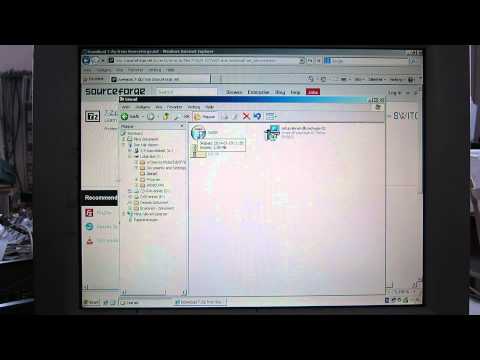
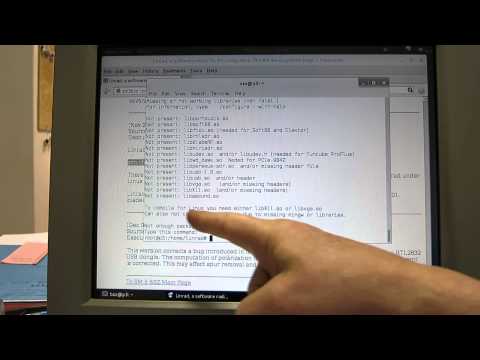
Linrad is an advanced SDR software program which supports the RTL-SDR. It is not as easy to use as the more popular SDR#, but some people prefer to use it as it has a very high information density GUI. The author of Linrad has uploaded two videos to YouTube that show how to install Linrad on Windows XP and Linux, which may be useful to those wishing to try Linrad out.

linrad-install-windows-xp

linrad-install-linux-x11

Sniffing and Decoding NRF24L01+ and Bluetooth LE Packets with the RTL-SDR

Omri Iluz wrote in to us to let us know about his recent project which involves sniffing and decoding wireless packets at 2.4 GHz from NRF24L01+ and Bluetooth Low Energy (BTLE) transceivers. The NRF24L01+ is a popular wireless transceiver which is used in many common devices such as keyboards, mice, remote controls, toys and appliances.

Since 2.4 GHz is out of any of the RTL-SDR’s receivable range, Omri used a cheap downconverter which he was able to buy from China using Aliexpress. The downconverter converts the 2.4 GHz signal into a lower frequency at around 400 MHz which is in the receivable range of the RTL-SDR.

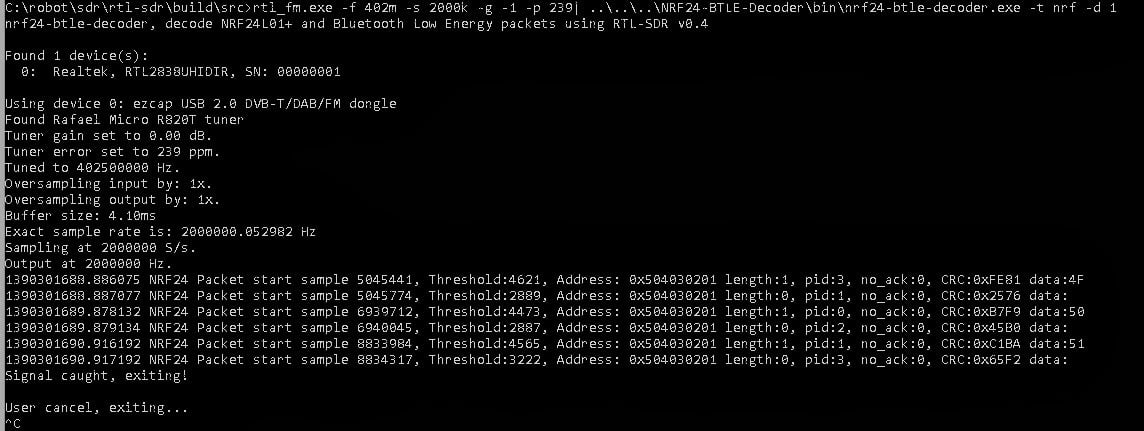
He was then able to use his NRF24-BTLE-Decoder software that he developed to convert the received data from the NRF24L01+ transceiver into a decoded packet by simply piping the output of RTL_FM into his program.

Since the NRF24L01+ uses hardware similar to the Bluetooth Low Energy (BTLE) protocol, Omri was able to modify his code to be able to also decode BTLE packets.

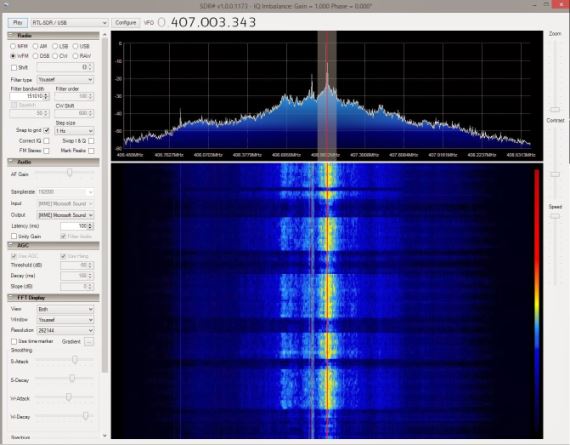
2.4GHz NRF24 packet received on the RTL-SDR from a Logitech mouse using a downconverter
2.4GHz packet received on the RTL-SDR + downconverter from a Logitech mouse
decodednrf
Decoded NRF24 Packets

Radio Astronomy with a 0.2dB Noise Figure LNA

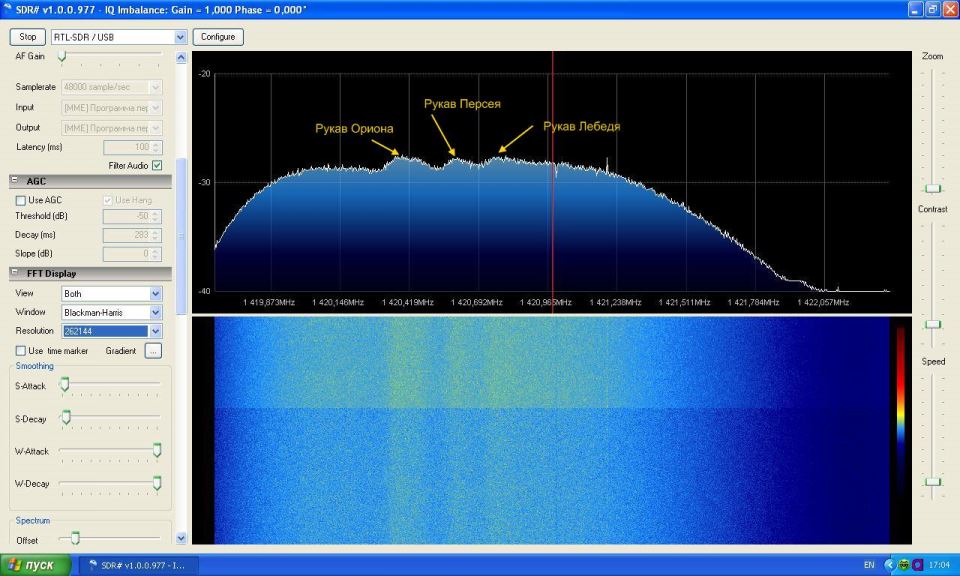
Over on our Facebook page member Александр has let us know about a Russian amateur astronomer, Alex who has been using the RTL-SDR for radio astronomy. Alex uses an Elonics E4000 RTL-SDR combined with a 3.7m mesh parabola dish with 1420 MHz waveguide.

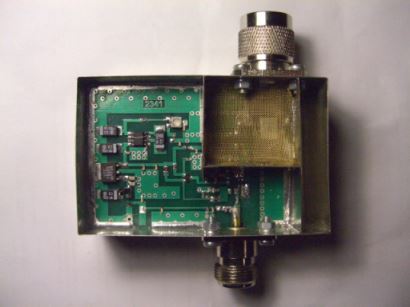
At the center of his system is an LNA with 40dB gain and a very low noise figure of 0.2dB. This LNA appears to be based on G4DDK’s VLNA, but modified to work with the 1420 MHz frequency used for radio astronomy. It seems the LNA can be ordered for 140 USD from the above link.

Note: The above Russian links are machine translated with Google to English.

0.2dB Noise Figure Low Noise Amplifier
Radio Astronomy Results

Using the RTL-SDR to help Program a TI Chronos RF Watch

Over on our Facebook page, member Александр has posted about a project he found by Georg Campana which involves using an RTL-SDR to capture signals from his TI Chronos watch which has a programmable 433 MHz RF transmitter built into it.

Georg used his TI Chronos watch to transmit a signal copied from remote controls which are used to open his house gate, garage door, light switches and set his house alarm. When he discovered that the watch signal was not transmitting properly, he used his RTL-SDR to compare the signal coming from the watch to the original signals from the remote controls to help him with debugging. In order to detect the bit stream from the RF signal, he used a GNURadio program for decoding wireless temperature sensors, which he modified slightly to work with his watch.

Tools used to program the TI Chronos watch