Harvey Mudd College Learn SDR Course with RTL-SDR, PlutoSDR and GNU Radio on YouTube

Professor Jason from Harvery Mudd College in California has recently uploaded a 23 lesson video series on software defined radio digital signal processing (DSP) concepts that can be learned with an RTL-SDR, PlutoSDR and GNU Radio.

If you're looking for a University level introduction to DSP this looks like a good hand on approach to learning. It covers concepts from a simple FM radio receove in GNU Radio, to doppler radar with PlutoSDR, to digital modulation, pulse shaping, GPS reception and more.

All the GNU Radio flowgraphs are available on their class GitHub as well.

Playlist: Learn SDR with Prof Jason

The NOAA-15 Weather Satellite may be Failing (Again)

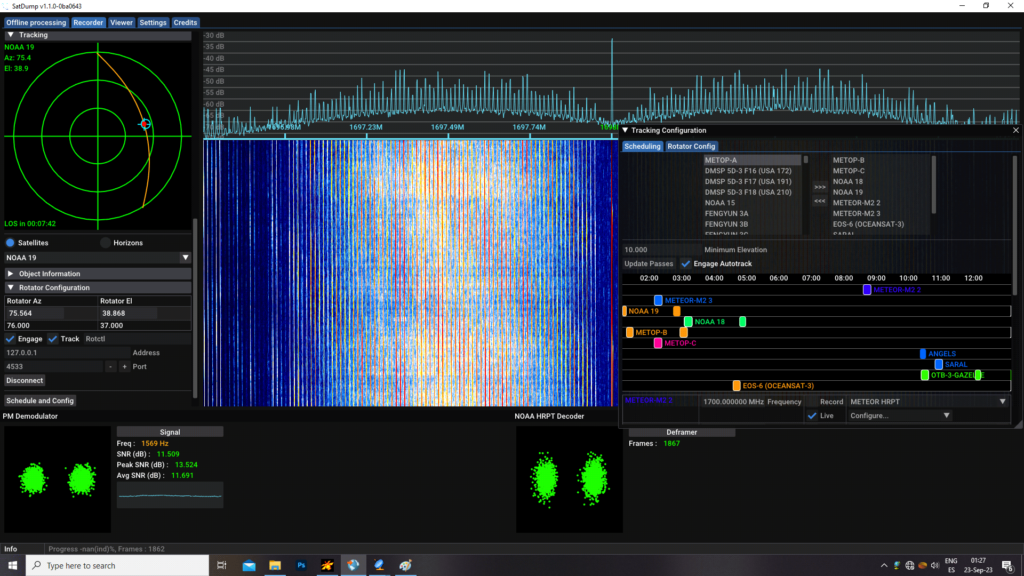
The NOAA APT weather satellites are popular because they fly over most places on earth frequently, and they are easy to receive images directly from with modest hardware such as an RTL-SDR and v-dipole antenna.

Three NOAA APT satellites currently operational include NOAA-15, NOAA-18 and NOAA-19. The satellites are however long past their rated mission age, with NOAA-15 being almost 25 years old now.

Unfortunately NOAA-15 appears to be having trouble with it's image scanning motor at the moment, and it is producing corrupted images. This problem has occurred in the past in 2018 and 2019, before fixing itself, so the hope is that it will fix itself again this time.

NOAA does not appear to have released any information about the outage yet on their General Satellite Messages page.

We also wanted to note the recent news that NOAA will be transitioning NOAA-15, 18 and 19 to a private company for on-orbit operations.

niliBOX: Software for Managing RTL-SDRs and other Radios Locally and Remotely

niliBOX is a multiplatform software package in beta release that can be used to manage radio devices such as Icom radio scanners and RTL-SDRs remotely or locally. It is the evolution of the older 'PCR Anywhere' software which was specifically designed for controlling Icom Radio scanners.

Over on YouTube user Danny Shortwave And Radio DX has uploaded a video demonstrating the RTL-SDR module being used in niliBOX with his RTL-SDR Blog V3 SDR. He writes:

niliBOX developed a software for various models of computer controlled radios and also for the RTL-SDR software defined radio. I will demonstrate this by running the software while tuning the mediumwave stations. The antenna I'm using is the MLA-30 active loop antenna. This is their first initial release of this software. I will make a series of videos showing this program working. Stay Tuned. This is Version 1.0.0

They currently have Windows 64 Bit. Tested on Windows 7, 10 and 11. They also have Linux version, tested on Ubuntu and Centos 64 Bit. And also a Apple Mac version, tested with MacOS 10.14, 10.15, 11 and 12. They are also coming soon with Android and IOS versions.

Brief Demonstration of new niliBOX software for the RTL-SDR V.3 SDR USB Dongle

ADS-B Radar Android App Updated with Open Street Maps

Thank you to James Mainwaring for letting us know about the latest update to his "ADS-B Radar (RTL-SDR)" Android App. The update brings an Open Street Map (OSM) display, allowing for aircraft to be directly plotted on the map.

As before the app works with an RTL-SDR directly connected to the Android device, and also has a radar like display.

James also has other apps on the Google Play store for FM Radio, Airband and Ham Radio listening.

ADS-B Radar App for Android

Internet Archive Seeks Donations of Materials to Build a Digital Library of Amateur Radio and Communications

In Internet Archive is a non-profit project with the main goal of maintaining a historical archive of the world wide web. Its goal is to preserve human knowledge and culture by creating an Internet library for researchers, historians, and scholars. Readers may be most familiar with their 'wayback machine', that allows users to view websites as they appeared in the past.

As part of this project, the Internet Archive is currently seeking donations of materials including printed medium relating to amateur radio and communications to add to their archives. Their press release and contact details read:

Internet Archive has begun gathering content for the Digital Library of Amateur Radio and Communications (DLARC), which will be a massive online library of materials and collections related to amateur radio and early digital communications. The DLARC is funded by a significant grant from the Amateur Radio Digital Communications (ARDC), a private foundation, to create a digital library that documents, preserves, and provides open access to the history of this community.

The library will be a free online resource that combines archived digitized print materials, born-digital content, websites, oral histories, personal collections, and other related records and publications. The goals of the DLARC are to document the history of amateur radio and to provide freely available educational resources for researchers, students, and the general public. This innovative project includes:

  • A program to digitize print materials, such as newsletters, journals, books, pamphlets, physical ephemera, and other records from both institutions, groups, and individuals.
  • A digital archiving program to archive, curate, and provide access to “born-digital” materials, such as digital photos, websites, videos, and podcasts.
  • A personal archiving campaign to ensure the preservation and future access of both print and digital archives of notable individuals and stakeholders in the amateur radio community.
  • Conducting oral history interviews with key members of the community. 
  • Preservation of all physical and print collections donated to the Internet Archive.

The DLARC project is looking for partners and contributors with troves of ham radio, amateur radio, and early digital communications related books, magazines, documents, catalogs, manuals, videos, software, personal archives, and other historical records collections, no matter how big or small. In addition to physical material to digitize, we are looking for podcasts, newsletters, video channels, and other digital content that can enrich the DLARC collections. Internet Archive will work directly with groups, publishers, clubs, individuals, and others to ensure the archiving and perpetual access of contributed collections, their physical preservation, their digitization, and their online availability and promotion for use in research, education, and historical documentation. All collections in this digital library will be universally accessible to any user and there will be a customized access and discovery portal with special features for research and educational uses.

We are extremely grateful to ARDC for funding this project and are very excited to work with this community to explore a multi-format digital library that documents and ensures access to the history of a specific, noteworthy community. Anyone with material to contribute to the DLARC library, questions about the project, or interest in similar digital library building projects for other professional communities, please contact:

Kay Savetz, K6KJN
Program Manager, Special Collections
[email protected]
Twitter: @KaySavetz 

TechMinds: A Look at the TRX DUO Red Pitaya Clone

The Red Pitaya is advertised as an open source electronics laboratory instrument, but as it's essentially a software defined radio with built in computing hardware, custom software can be installed allowing it to function as an HPSDR compatible RX/TX capable SDR.

The TRX DUO is a "Red Pitaya compatible" device that comes at a price significantly lower that the Red Pitaya. Its specifications are comparable to the Red Pitaya SDRlab 122-16 which in the official website goes for 625,00€ / US$622. In comparison the TRX DUO can be found on marketplace sites like Aliexpress for almost half price at US$320.

The TRX-DUO has a tuning range from 10 kHz to 60 MHz, 16-bit ADC and 2-RX and 2-TX channels. It also has a built in ARM Cortex A9 processor, and Xilinx Zynq 7010 FPGA SOC. The built in computing means that decoding software can be run directly on the device if desired.

Matt from the TechMinds YouTube channel has recently tested and reviewed the TRX-DUO in his latest video. His video goes over the specifications, software installation, and a demonstration of it receiving HF signals. He goes on to show how it can be used as an 8-band WSPR monitor, and how you can enable WiFi on it and download various Red Pitaya apps.

Matt also notes that the transmit power of the TRX-DUO is very small at 2.5 mW, but of course an external amplifier can be used to boost this.  However, it is important to note that band filtering would be required for the emissions to be safe to transmit.

TRX DUO APPLICATION BASED HF SDR TRANSCEIVER (RED PIYATA)

HackRF Opera Cake Released: A Rapid RF Switching Board

Back in 2016 Michael Ossmann, founder of Great Scott Gadgets and creator of the HackRF released schematics for 'Opera Cake', a rapid RF switching add on board for the HackRF. We also saw back in a January 2018 post how Opera Cake was capable of being used as the switching hardware for Pseudo-Doppler direction finding. Up until now Opera Cake has only been available as a schematic, for advanced hackers who could produce and build the board themselves.

Earlier this week Opera Cake was released for sale via various resellers in the US, UK and EU. The pricing from the US reseller is US$190.

Opera Cake is an antenna switching add-on board for HackRF One that is configured with command-line software either manually, or for automated port switching based on frequency or time. It has two primary ports, each connected to any of eight secondary ports, and is optimized for use as a pair of 1x4 switches or as a single 1x8 switch. Its recommended frequency range is 1 MHz to 4 GHz.

When HackRF One is used to transmit, Opera Cake can automatically route its output to the appropriate transmit antennas, as well as any external filters, amplifiers, etc. No changes are needed to the existing SDR software, but full control from the host is available.

Opera Cake also enhances the HackRF One’s use as a spectrum analyzer. Antenna switching works with the existing hackrf_sweep feature, which can sweep the whole tuning range in less than a second. Automatic switching mid-sweep enables the use of multiple antennas when sweeping a wide frequency range.

Opera Cake connected to multiple antennas

Quick Demo of our KrakenSDR Network Mapping Direction Finding Software (Alpha)

The KrakenSDR is our 5-channel coherent radio based on RTL-SDRs, and it can be used for applications like radio direction finding and passive radar. We successfully crowd funded the device on Crowd Supply back in November 2021.

Over the past year we've been working on a networked mapping system for KrakenSDRs that will allow distributed units to contribute radio direction finding bearing data to a central server. This allows for multiple fixed KrakenSDR sites to combine live bearings, allowing for near instantaneous localization of transmission sources.

We are close to releasing an alpha version of this software for KrakenSDR and KerberosSDR customers to test, and will have news about signups within the next few weeks. For now it will be restricted to three networked units per user.

In the future we plan to add (reasonably priced) advanced features like support for more units, history rewind, multi-channel layering, remote KrakenSDR management, object tracking, ID differentiation, and recording and playback of mp3 sound bites based on tracked location. 

Below is a simple timelapse demo of the system tracking a weather balloon from a single station. Because it's only a single station, the red estimation dot can be ignored. The yellow dot indicates the actual GPS location of the weather balloon. Once the weather improves we'll be setting up a distributed two-station test.

One interesting thing to note is how the KrakenSDR tracks the balloon accurately, until the elevation angle between the antenna and balloon goes above 45 degrees which happens when the balloon rises higher and comes too close to the station. At this angle the antenna array can no longer track the balloon correctly. Once the balloon falls to a lower altitude and the elevation from the antenna is less than 45 degrees accurate tracking resumes.