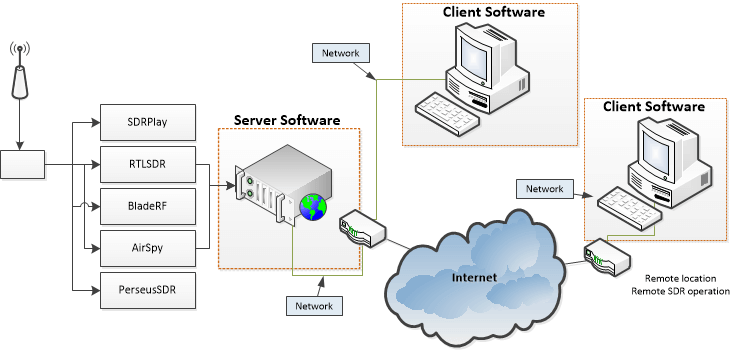
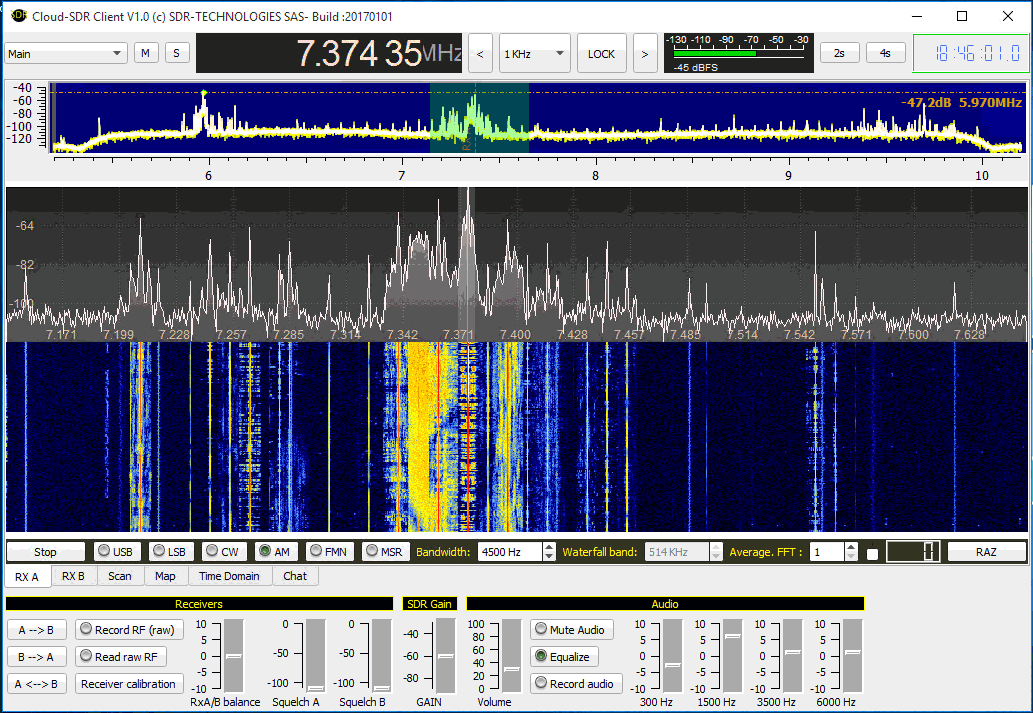
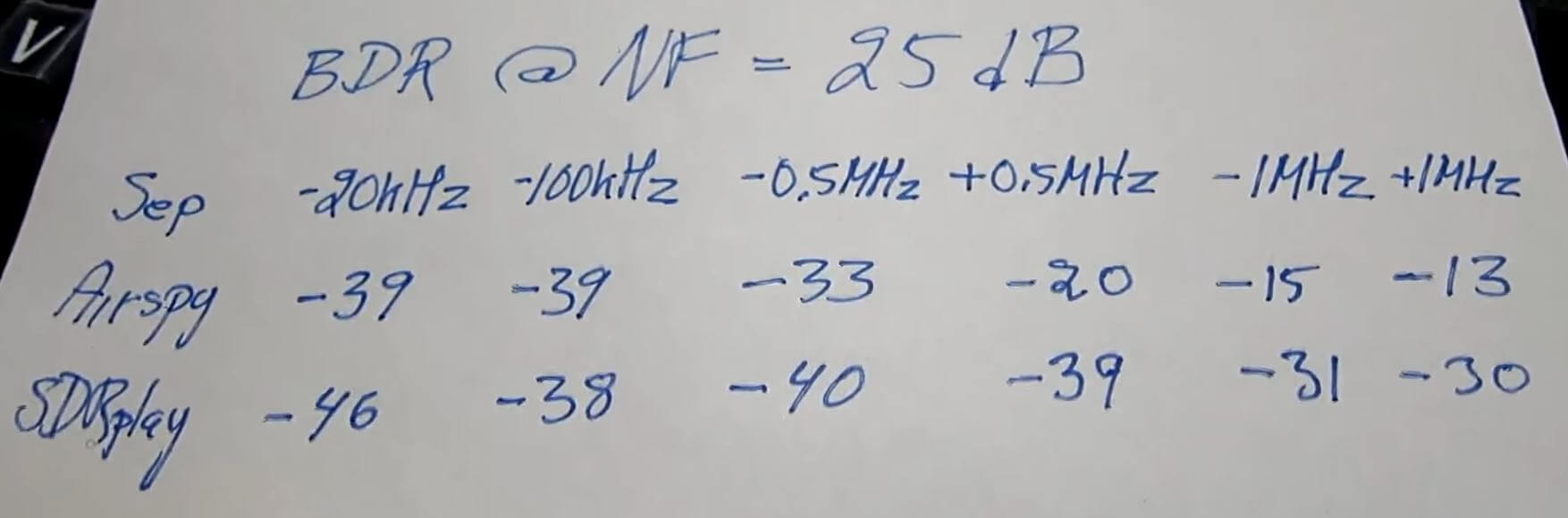
In a previous post we posted about how SDR# had been updated to vastly improve on the CPU usage. The author has been hard at work once again, and has now released a new update which significantly improves the dynamic range with the Airspy SDR. The new update gives a boost of up to 12dB in dynamic range when using decimation. This means that the gains can be turned up further without overloading occurring, and that weaker signals can come in much stronger without strong signals overloading and drowning them out.
The example images show some examples of the dynamic range improvements.
An example of the improved dynamic range for the Airspy on the latest SDR#.Using decimation removes overload.
Recently the popular SDR# (SDRSharp) software has had several improvements made to it (changelog). One of the most noticeable improvements is a decent reduction in the amount of CPU usage required by the software. We tested the new version on an i7 CPU and compared it against an older version using an Airspy. We saw 12% CPU usage on the older version and 7% on the newer version. With the RTL-SDR the older version showed 5% CPU usage which reduced to 3% on the newer version. Using an older i5 PC resulted in even larger improvements, going from about 35% CPU on the older version down to 25% or lower usage on the new version with the Airspy. The improvements are especially noticeable when decimation is used with the Airspy. These performance updates may help users on older PC’s and tablets run the software, or help users who run many programs at one time. The SDR# author is also testing out a 64 bit version of SDR#, which may be released in the future.
Recent versions over the past few months have also made improvements to the included noise blanker plugins and they have also added a default band plan plugin which shows the various frequency bands visually on the FFT spectrum.
Showing the very low CPU usage obtainable with the latest SDR# versions.
The Geostationary Operational Environmental Satellite (GOES) is a weather satellite placed in geosynchronous orbit (same position in the sky all the time) which is used for weather forecasting, severe storm tracking and meteorology research. It transmits full disk images of the earth on its Low Rate Information Transmission (LRIT) signal, and weather data images and text on its Emergency Managers Weather Information Network (EMWIN) signal. EMWIN is a service for emergency managers that provides weather forecasts, warnings, graphics and other information in real time.
In his post devnulling writes about receiving GOES:
GOES LRIT runs at 1691.0 MHz , EMWIN is at 1692.7 MHz and is broadcasted from GOES-13 and GOES-15. GOES-14 is currently in a backup position to take over in either fails.
For the hardware side, it is recommended to use roughly a 1.2m or larger dish, depending upon how far north you are, you may need a 1.8m dish (larger the better). Repurposed FTA or C-band dishes are easy to come by and work well.
I made a 5 turn helical feed with some 12ga copper wire and a piece of copper plate, and used this calculator to design it – https://jcoppens.com/ant/helix/calc.en.php
I have a short run of coax into the LNA/Filter box. The first LNA is a TriQuint TQP3M9037 which has a very low noise figure (0.3 dB NF and 22 dB gain at 1.7 GHz).
That is ran into a Lorch 1675 MHz filter (150 MHz pass band), then a LNA4ALL and another Lorch before going over a 30ft run of RG-6 to the SDR.
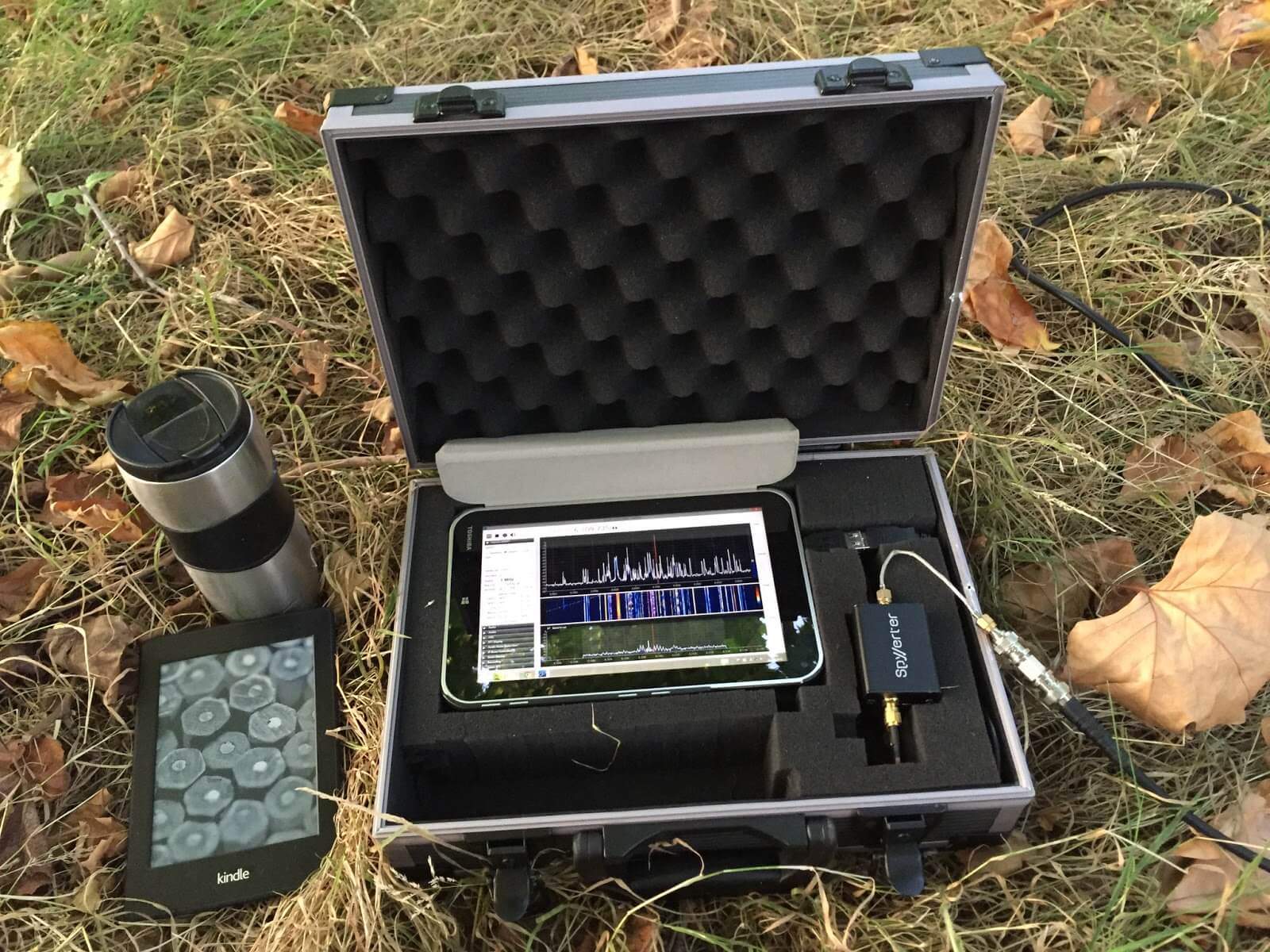
I am using @usa_satcom (twitter.com/usa_satcom, usa-satcom.com)’s LRIT Decoder and that feeds into XRIT2PIC to produce the images and other data streams. By default the decoder only works with the Airspy, but with a custom GNU Radio UDP block, it can be fed with other SDRs like the BladeRF/USRP/SDR Play. A regular R820T(2) RTL probably won’t work because of the higher frequency (rtls tend to not work above 1.5 GHz) and 8 bit ADC. I’m going to try and use the Outernet e4k to see if I can pickup the EMWIN signal in the near future.
EMWIN is broadcasted on 1692.7 MHz, along with being encoded in the LRIT stream at 1691 MHz. The 1692.7 MHz signal is stronger and narrower, so it is easier to pickup. For decoding EMWIN I used @usa_satcom’s EMWIN decoder that piped data into WxEmwin/MessageClient/Weather Message Server from http://weathermessage.com.
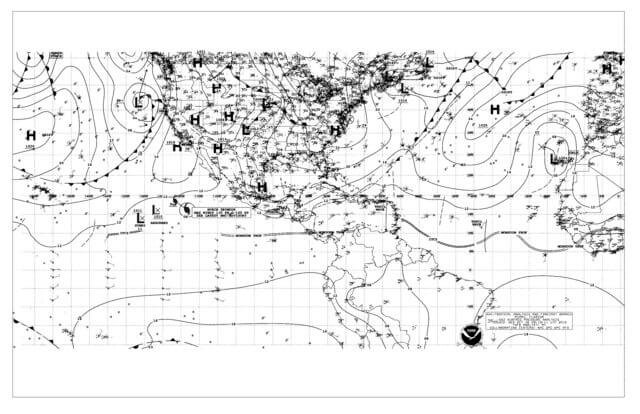
LRIT will contain the full disk images from GOES-15, and relayed images from GOES-13 and Himawari-8. It will also included zoomed in pictures of the USA, and northern/southern hemispheres. The images will be visible light, water vapor and infrared. The full disk images are transmitted every 3 hours, with the other images more often. EMWIN will contain other weather data, text, charts, and reports.
It seems as though it may be possible to receive LRIT and EMWIN signals with an RTL-SDR since the signals are at 1690 MHz, which should be covered by cooled R820T2 and E4000 dongles. The only hardware requirements would be a 1m+ dish, 1690 MHz L-band feed, and an LNA + filter.
In 2017 these satellites are due to be replaced by new ones that will use a HRIT signal, which will be about 1 MHz. New software to decode this signal will be required then, but we assume the same hardware could still be used as the frequency is not due to change significantly.
Please note that the decoding software is only available by directly contacting usa-satcom, and devnulling writes that you must have the proper equipment and be able to show that you can receive the signal first before attempting to contact him.
GOES Full Disk ImageOne of several received EMWIN images
rtl_fm / rx_fm: Allows you to decode and listen to FM/AM/SSB radio. rtl_sdr / rx_sdr: Allows you to record raw samples for future processing. rtl_power / rx_power: Allows you to do wideband scans over arbitrarily wide swaths of bandwidth by hopping over and recording signal power levels over multiple chunks of spectrum.
rx_tools is based on SoapySDR which is an SDR abstraction layer. If software is developed with SoapySDR, then the software can be more easily used with any SDR, assuming a Soapy plugin for that particular SDR is written. This stops the need for software to be re-written many times for different SDR’s as instead the plugin only needs to be written once.
rx_power scan with the HackRF at 5 GHz over 9 hours.
Over on YouTube user Mile Kokotov has uploaded a very nice tutorial video that shows how the Airspy can be used as a low cost scalar network analzyer from between 0.1 – 1800 MHz. A network analyser allows you to characterize the performance of antennas, by determining the antenna SWR curve. A low point on an SWR graph indicates the frequency at which an antenna is resonant/tuned, so a network analyzer is very useful for tuning homemade or adjustable antennas.
In this video I am showing how Airspy SDR can be used for measuring Return Loss, Antenna SWR and Antenna Bandwidth of several commercial and homemade antennas.
The impedance of the Radio Station (transmitter or receiver) must be well matched to the antenna’s impedance if we want maximum available power to be delivered to antenna.
The return loss and SWR measurements show us the match of the system.
A poorly matched antenna will reflect costly RF energy which will not be available for transmission and will instead end up in the transmitter. This extra energy returned to the transmitter will not only distort the signal but it will also affect the efficiency of the transmitted power and the corresponding coverage area.
Return Loss and SWR both display the match of the system, but they show it in different ways. The return loss displays the ratio of reflected power to reference power in dB.
The return loss view is usually preferred over the SWR linear scale, because is easier to compare a small and large number on a logarithmic scale.
More than 20 dB system return loss is considered very efficient as only less than 1% of the power is returned and more than 99% of the power is transmitted. In that case the SWR is around 1.2
For radio amateur usage, Return loss more than 14 dB is acceptable. This is adequate to SWR of 1.5 which means that 4% of the power is returned and 96% of the power is transmitted.
0 dB Return loss represent an open or a short antenna terminal, while 45 or more dB Return loss would be close to a perfect match.
Many different methods can be used to measure standing wave ratio. Professionals usually use a vector network analyzer or frequency analyzer with sweep signal generator and directional coupler.
In this video I will show you very cheap and very good method for antenna characterizing which means measuring the Return loss versus frequency and usable antenna bandwidth like measuring with much, much more expensive, state of the art Network Analyzers and similar measuring equipment.
Airspy SDR as a Network Analyzer using for Antenna Characterization
EDIT: It has been pointed out that we incorrectly used the term vector network analyzer in the previous title, when we should have instead used scalar network analyzer. A scalar network analyzer can measure amplitude, but a vector network analyzer can measure amplitude and phase and is a more complex device. Apologies for any confusion.
To celebrate the fourth of July, the US distributor of Airspy is throwing a sale. The prices are the lowest we’ve ever seen for any Airspy product before. Currently the sale price for an Airspy R2 is $149 (vs $199), $99 for Airspy Mini (vs $114) and $39 for the Spyverter. Unfortunately the sale only appears to be occurring with the USA distributor, and is not available for international customers.
If you’re interested in these products see our previous review on the Airspy R2 vs HackRF vs SDRplay, review of the Airspy Mini, and our review of the SpyVerter. In short the consensus from our reviews is that the Airspy is an excellent product. The Spyverter is also the best upconverter we’ve tried, and is an excellent choice for an upconverter for any other non Airspy SDR, such as an RTL-SDR. And at this price it is even cheaper than most of the alternative options like the ham-it-up.
Over on YouTube user Mile Kokotov has uploaded a video showing his reception of the SAQ very low frequency (VLF) signal. The SAQ transmitter is based in Grimeton, Sweden and transmits at 17.2 kHz, which is well below the frequency of most radio communications. SAQ only transmits its beacon on certain days, and last Sunday July 3rd 2016 the SAQ beacon activated to celebrate Alexanderson day, which is named after Swedish radio pioneer Ernst Frederick Werner Alexanderson.
In the video both the Airspy + Spyverter and the SDRplay RSP appear to receive the SAQ VLF signal equally well. In the video description Mile writes:
“SAQ”- Radio Station at Grimeton is a VLF transmission facility at Grimeton, Sweden. It has the only working Alexanderson alternator rotating armature radio transmitter in the world and is classified as a World Heritage Site.
The transmitter was built in 1922 to 1924 to operate at 17.2 kHz. The antenna is a 1.9 km wire aerial consisting of eight horizontal wires suspended on six 127-metre high freestanding steel pylons in a line, that function as a capacitive top-load to feed energy to six grounded vertical wire radiating elements.
Until the 1950s, the Grimeton VLF transmitter was used for transatlantic radio telegraphy to Radio Central in Long Island, New York, USA. From the 1960s until 1996 it transmitted orders to submarines in the Swedish Navy.
The Alexanderson transmitter became obsolete in 1996 and went out of service. However, because it was still in good condition it was declared a national monument and can be visited during the summer.
On July 2, 2004, the Grimeton VLF transmitter was declared a World Cultural Heritage site by UNESCO. It continues to be used on special occasions such as Alexanderson Day to transmit Morse messages on 17.2 kHz. Its call sign is SAQ.
Recent transmissions from SAQ on 17.2 kHz with Alexaderson 200 kW alternator, was on Alexanderson day (Sunday, July 3rd 2016) at 09:00 UTC.
Distance between SAQ transmitter in Grimeton, Sweeden and Macedonia where the signal was received is about 1850 km.
Receiving with: 1. AIRSPY R2 – SDR + Spyverter and SDRsharp software. 2. SDRplay RSP1 and SDRuno software.
Both SDR receivers settings were previously set for maximum S/N ratio.
Antenna is Mini-Whip 10cm homemade active antenna on 6.5 meter plastic pole.
The LPF filter (fc=535 kHz) is used also.
SAQ VLF Receiving with Airspy+Spyverter and SDRplay
The Airspy Mini is a recently released $99 USD software defined radio with a tuning range of 24 MHz to 1800 MHz, 12-bit ADC and up to 6 MHz of bandwidth. The Mini is the younger brother of the $199 USD Airspy R2, but despite the $100 USD price difference, both units are very similar, which makes the Mini a very attractive option. The idea is that the Mini is the cheaper version for those who do not need the more advanced features of the R2.
In a previous review we compared the Airspy R2 with the SDRplay RSP and the HackRF. In those tests we found that the Airspy had the best overall RX performance out of the three as it experienced the least amount of overload and had the most dynamic range. The SDRplay RSP was the main competitor in performance to the Airspy R2, and was found to be more sensitive due to its built in LNA. But the RSP experienced overloading and imaging problems much easier. With an external LNA powered by its bias tee, the Airspy gained a similar sensitivity and still had very good dynamic range. The main downside to the Airspy R2 was its higher cost compared to the $149 USD SDRplay RSP, and needing to fork even more for the $50 USD SpyVerter if you want to listen to HF signals.
In this review we'll compare the difference between the R2 and Mini, and also see if the cheaper Airspy Mini ($99 USD), or Airspy Mini + SpyVerter combo ($149 USD) can compete in this lower price range.
Difference Between the Mini and R2
Airspy Mini
Airspy R2
Price
$99 USD
$199 USD
Tuning Range
24 - 1800 MHz
24 - 1800 MHz
ADC Bits
12
12
Maximum Bandwidth (Alias Free Usable)
6 MHz (5 MHz)
10 MHz (9 MHz)
Extras
Bias Tee
Bias Tee, External clock input, Multiple expansion headers
Dimensions (Including USB and SMA ports)
7.7 x 2.6 x 1 cm
6.4 x 2.5 x 3.9 cm
Weight
21 g
65 g
Right now the "early bird" price of the Mini is $99 USD. We are unsure if this price will go up in the future.
The external design between the two units is different. The Mini comes in a USB dongle form factor which is very similar to a standard RTL-SDR, whilst the R2 comes in a larger box with a female Micro USB input. In our tests this metal enclosure appears to provide good shielding from strong signals. One thing that was missing on the unit was a nut and washer on the SMA connector. Adding a nut helps the PCB ground make good contact with the aluminum enclosure. The Airspy team have said that future units will come with this nut provided.
Airspy R2 (top), Airspy Mini (Middle), RTL-SDR (bottom) for size comparison.
Apart from the price and enclosure, the most noticeable feature difference between the two is the smaller bandwidth of the Airspy Mini. Unlike the Airspy R2, the Airspy Mini does not use a Si5351 clock generator chip. The lack of this chip limits the Mini's maximum bandwidth to 6 MHz and eliminates any ability to use an external clock. The main applications that you miss out on from the lack of an external clock input include: coherent clock, passive radar and direction finding experiments.
From the circuit photos below we can see that the Mini consists of mostly the same parts used in the Airspy R2. Missing is the Si5351 clock controller, expansion headers and the external clock input.
The Airspy Mini Circuit BoardThe Airspy R2 Circuit Board