Tagged: airspy

Running the Airspy ADSB decoder at full speed on a Raspberry Pi 2

Bob W9RAN recently wrote in to let us know about some developments he and Youssef have had with getting the Airspy to function at full speed on a Raspberry Pi 2 with ADS-B decoding. Bob and Youssef created the SpyVerter upconverter, and Youssef is the programmer of SDR#. Bob writes the following:

Airspy is a high-performance SDR that streams 12 bit samples at 20 MSPS (real, not IQ) to a PC where the real processing is done. But 20 million samples per second uses a significant fraction of the bandwidth available with USB 2.0, and has made apparent the weaknesses in USB subsytems on a number of PCs. So of course the natural assumption by "experts" has been that the Raspberry Pi 2 isn't up to the task.

As we Pi fans know, the Pi 2 has a 900 Mhz 4-core ARM Cortex A7 CPU, and the key to performance is properly implemented code that can take full advantage of the processor architecture.

Youssef Touil, author of SDR# and creator of Airspy has done that, proving first that an optimized multithreaded version of his ADSB decoder would run on a 4-core Odroid that has more CPU power than the Pi 2. But today we have proven that not only can the Raspberry Pi 2 run the optimized ADSB decoder at full speed (20 million samples per second via USB), but that it even has enough horsepower left to run the Virtual Radar Server Google map display in the Pi's Epiphany web browser!

For those not familiar, the map display is created by a program called Virtual Radar Server that runs on a PC and receives samples from the Pi over ethernet, and includes a web server that allows other computers (in my case, the Pi 2) to view the composite map display. (For more information about ADSB, see my article in QST for January 2014).

I'm really thrilled to be able to demonstrate that the Pi 2 has this
impressive capability! This makes it feasible to create inexpensive high performance ADSB receiving systems, and who knows what else?

[tweet https://twitter.com/w9ran/status/682327092441268224 align="center"]

Review of the SpyVerter Upconverter

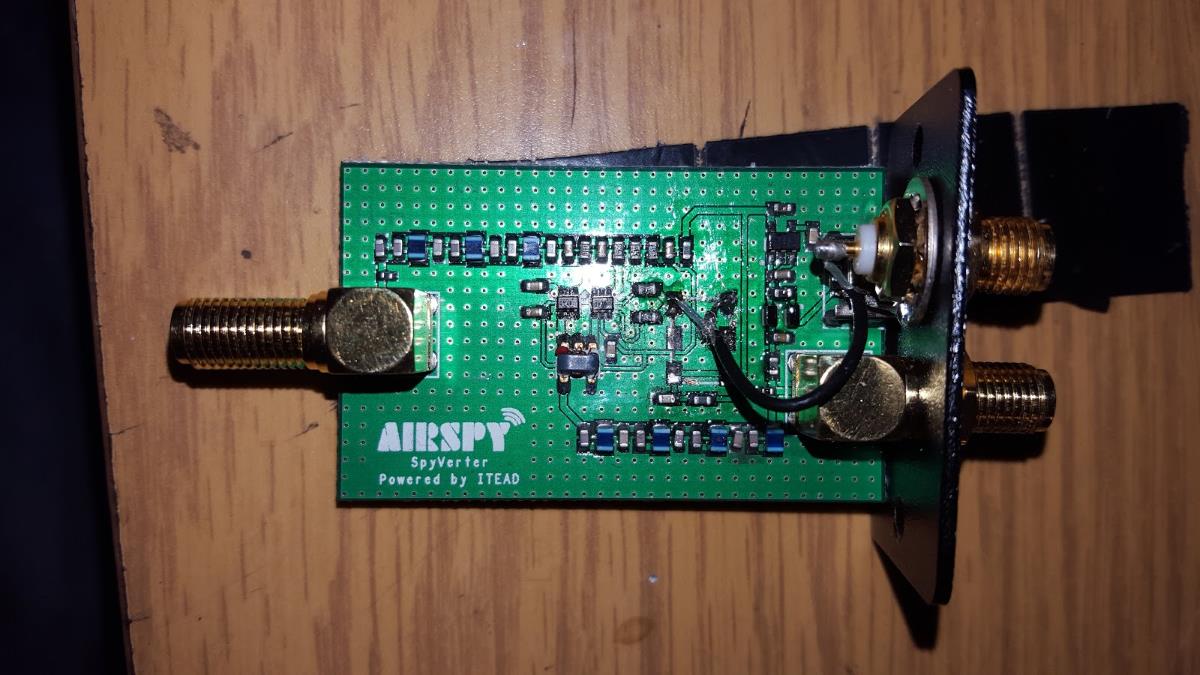
The SpyVerter is a new upconverter that has recently gone on sale. It is created by Youssef (he programmed SDR# and worked on the development of the Airspy SDR) and Bob W9RAN (of rantechnology.com and youtube.com/user/ranickel). In this post we'll review the SpyVerter and compare it against some other up converters that we have used in the past.

Background

Radio transmissions between 0 - 30 MHz can travel all the way around the world. At these frequencies many interesting signals such as international shortwave radio, ham radio communications and several military transmissions exist.

The RTL-SDR's lowest tunable frequency is 24 MHz, and so it can only receive a small portion of the interesting transmissions that occur between 0 - 30 MHz. In order to listen to frequencies below 24 MHz an upconverter is required (either that or perform the direct sampling mod). An upconverter works simply by shifting these lower frequencies up to a higher frequency that the RTL-SDR can receive. For example, a 5 MHz signal might be upconverted to 105 MHz.

To date, most decent upconverters (such as the popular ham-it-up upconverter) have been based on the double balanced mixer architecture implemented by the ADE-1 mixer chip from Minicircuits. The SpyVerter on the other hand is based on a different type of architecture which is inspired by the H-mode mixer design that was used in the unreleased HF7070 communications receiver. The expected major advantage that this design has over a ADE-1 based design is better IIP3 performance. This essentially means that strong signals will not cause overloading issues in the SpyVerter, meaning less noise and spurious images. 

Another advantage of the SpyVerter is its use of a 120 MHz low phase noise/low jitter clock, meaning less reciprocal mixing and thus greater SNR and a lower noise floor. A low phase noise clock is essential for getting good performance when receiving the very narrowband signals that are typically found between 0 - 30 MHz. The other upconverters do not specify their phase noise performance as far as we can tell.

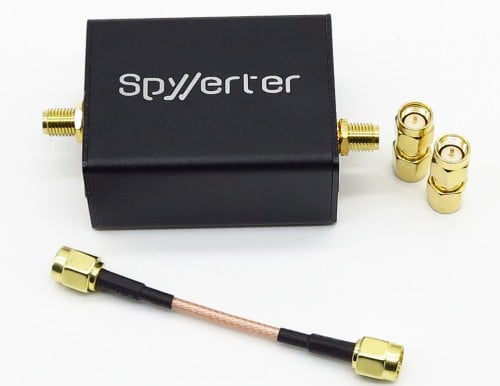
The SpyVerter comes in a metal box, with three SMA adapters. A metal box is great because it helps keep strong interfering signals from entering the signal path, as well as stabilizing the internal temperature, keeping frequency drift to a minimum. Most upconverters only come with a metal box as a paid add on, but the SpyVerter comes in one by default.

Although the SpyVerter is designed to be used with the Airspy, it is fully compatible with the RTL-SDR as well. The SpyVerter can be powered via a USB cable, or via 5V bias tee (and this is compatible with the bias tee used on the RTL-SDR Blog units sold by us).

The SpyVerter in enclosure with bundled adapters.

Continue reading

SpyVerter Upconverter now for sale

The team behind the Airspy software defined radio (as well has the popular SDR# software package) have just released the SpyVerter upconverter for sale. Upconverters shift HF frequencies (0 – 30 MHz) “up” by a fixed amount, giving receivers that can’t tune that low like the RTL-SDR and the Airspy the ability to receive HF signals.

The SpyVerter extends reception all the way down to DC and has a 60 MHz low pass filter. Its main selling point is its H-Mode architecture which provides excellent IIP3 performance. This basically means that strong HF signals are unlikely to cause overloading in the up-conversion stage. The good IIP3 performance should improve HF reception when compared to other upconverters even with lower end SDR’s like the RTL-SDR. The reason is that when hit by strong HF signals many other upconverters will overload in the upconversion mixing stage, before even reaching the SDR, thus requiring the need for attenuators or antennas with less gain.

Another selling point is its good performance down to DC, making it ideal for VLF reception.

SpyVerter is designed for optimal performance with the Airspy and can be powered directly by the Airspy’s bias tee. However, RTL-SDR users can also use the SpyVerter by powering it through the micro USB connector, or by using it with one of our RTL-SDR Blog units with the activatable bias tee. 

The SpyVerter sells for $59 USD and comes in a metal enclosure with three bonus SMA adapters. There is a $9 USD discount for Airspy owners.

At these prices combined with its claimed performance and metal enclosure we now generally recommend the SpyVerter over any other upconverter. The designers of the SpyVerter have sent us a sample unit and we will review it after testing it out over the next few weeks, but our initial tests already show good performance.

The SpyVerter upconverter.

SDR-J Now Compatible with the Raspberry Pi 2

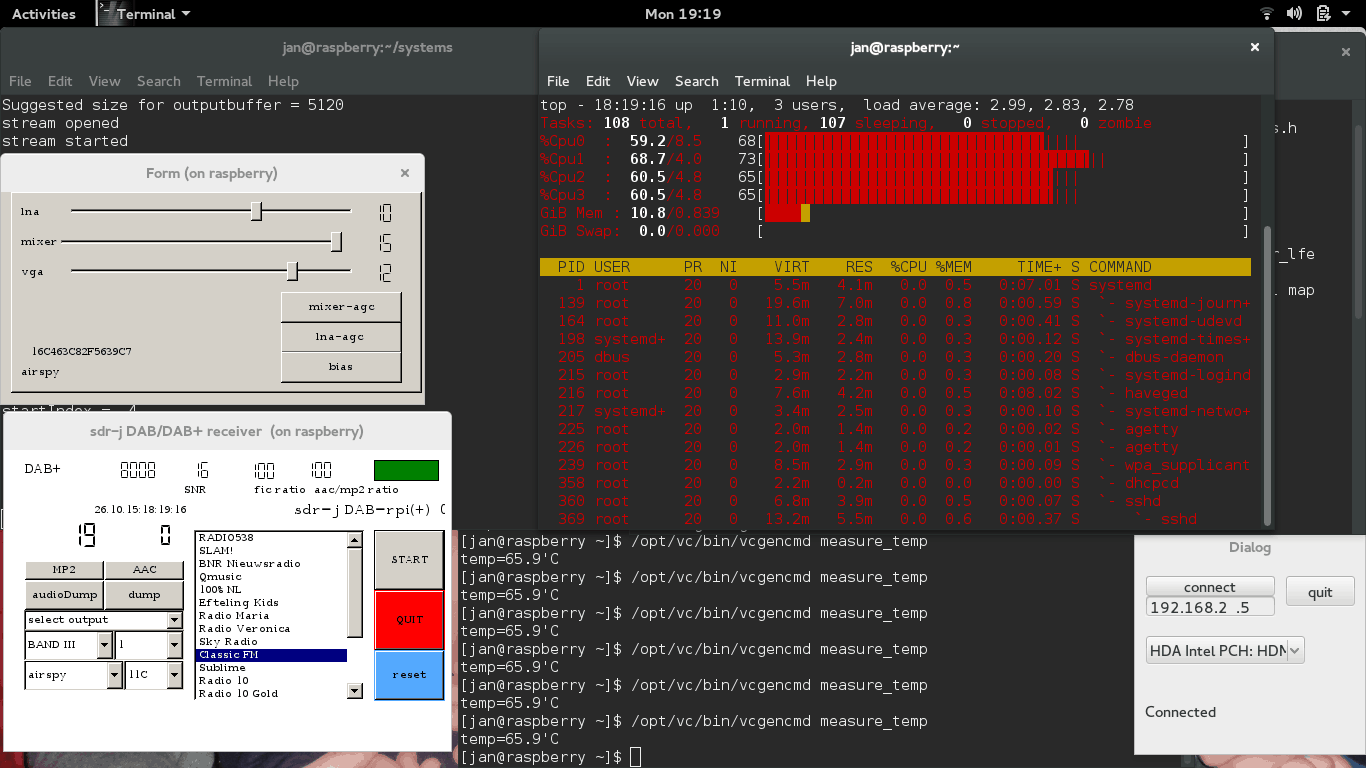
The popular software DAB (Digital Audio Broadcast) decoder SDR-J has recently been updated and can now run on the Raspberry Pi 2. In addition the author has also added experimental DRM decoding capabilities to his shortwave receiving software. The author writes about the Raspberry Pi 2:

The Raspberry PI 2 has a processor chip with 4 computing cores. By carefully spreading the computational load of the handling of DAB over these cores it is possible to run the DAB software on the Raspberry PI 2.

In my home situation the – headless – Raspberry PI 2 is located on the attic and remotely controlled through an SSH connection using the home WiFi on my laptop in my “lazy chair”. To accomodate listening remotely, the DAB software on the Raspberry PI 2 sends – if so configured – the generated PCI samples (rate 48000) also to an internet port (port 100240). On the laptop then runs a very simple piece of program reading the stream and sending it to the soundcard

DAB is a digital audio protocol that is used in some countries as a digital alternative to broadcast FM (music stations). SDR-J is a suite of programs that includes the ability to decode DAB, FM, and several shortwave modes such as AM, USB, LSB, PSK, RTTY, WeatherFax, SSTV, BPSK, QPSK, CW, NavTex (Amtor-B), MFSK, Domino, Olivia, Hell, Throb and now DRM. It can directly connect to RTL-SDR receivers as well as other hardware such as the Airspy and SDRplay.

Screenshot of SDR-J running on the Raspberry Pi 2.

Airspy Revision 2 Released

The Airspy is a $200 USD software defined radio that has a frequency range between 24 – 1700 MHz, bandwidth of up to 10 MHz and a 12-bit ADC. We consider it to be a good upgrade from those who have gotten into SDR via the low cost RTL-SDR.

Recently the Airspy hardware was updated to revision two. The new revision improves upon the first design by reducing noise, improving the USB connector, improving the ESD protection and improving compatibility with the soon to be released Spyverter upconverter. The full release is pasted below:

We have sensitive ears! The demand for ever cheaper, higher performance and ruggedized SDR receivers is driving the professional market. Due to the large demand from our professional customers, we upgraded recently our original Airspy One design to Revision 2. This new revision improves the following points:

  • Better USB noise immunity
  • Better ESD protection on the RF input
  • Added ESD protection on the dual High Speed ADC inputs
  • Better RF Shielding
  • Better RF Filtering
  • Replaced the USB connector with a custom designed, more robust, 4 through hole points model
  • Better thermal stability
  • Better compatibility with the SpyVerter

The old revision is no longer produced, and all new shipments will be based on the R2. We are eager to get your feedback about these improvements!

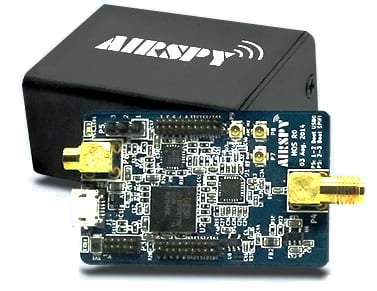
The Airspy software defined radio


New Demo of the Upcoming Spyverter Upconverter

The Spyverter is a new high performance upconverter that is being developed by the team behind the Airspy software defined radio and the SDR# software. It is designed to be used together with the Airspy, but it should also be compatible with other SDRs as well. The main claimed advantages over other upconverters will be it’s low loss and high IIP3 performance, which means that the Spyverter will not saturate in the presence of strong signals as easily as other upconverters.

Recently W9RAN, who is involved in the design and testing of the Spyverter uploaded some demo videos of the Spyverter + Airspy combo in action. The first video shows how the Spyverter when used together with the Airspy and SDR# allows for seamless tuning between VLF, HF through to VHF/UHF (no need to set any offsets).

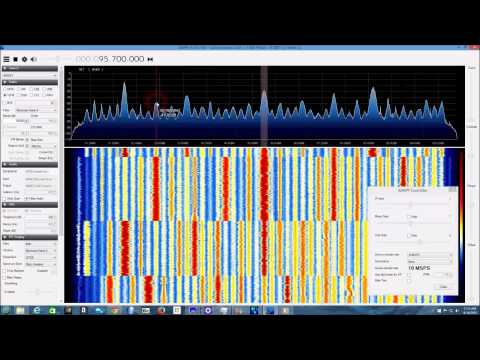
Seamless tuning of SDR# with AIrspy & Spyverter

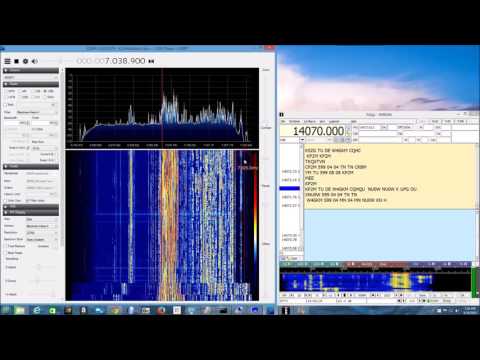
The next video shows the Spyverter + Airspy combo working during a RTTY contest on 40M with very densely packed signals, some of which were very strong.

W9RAN demo of Spyverter in 40 meter RTTY contest

W9RAN (ranickel on YouTube) also has additional Spyverter + Airspy videos on YouTube for viewing if you are interested.

HAMSPIRIT.DE’s Review on Airspy vs SDRPlay

Over on the hamspirit.de blog author January has just uploaded his latest review comparing the Airspy with the SDRPlay (article in German, so use Google Translate if necessary). These are two mid price range RX only software defined radio receivers that many people see as a first upgrade from an RTL-SDR dongle. Currently, the Airspy sells for $199 USD and the SDRPlay sells for $149 USD.

In his review January uses the SDR# to compare both devices on a wide range of signals include a beacon in the 10M band, broadcast FM stations, another beacon in the 2M band, TETRA signals and trunked radio in the 70cm band. He ran the SDRPlay at a bandwidth of 1.536 MHz and the Airspy at a bandwidth of 2.5 MHz, with decimation set to 2 in order to get comparable bandwidths.

From the results it appears that overall the two SDR’s are quite comparable to one another. But the SDRPlay has the advantage that it’s frequency range covers shortwave frequencies and his results show that the SDRPlay had better SNR in the FM broadcast band (although these results may be incorrect as it appears that his gain settings were not set properly, as the Airspy guide recommends that Airspy gains be adjusted to keep the noise floor near -80 dBFS). On the other hand the Airspy was much better when strong FM overload was present as shown in his TETRA results. In his conclusion he writes (translated from German to English):

If one value to a SDR, which covers with the short wave, it is running out on the SDRplay.

If one is interested in the field below the 70cm amateur radio bands, is in my view the Airspy front.

The Airspy software defined radio    The SDRPlay software defined radio

Using a direct sampling enabled Airspy as a Panadapter for a Yaesu FTDX-5000

Tim Havens is an avid CW operator on the ham bands and primarily uses his Yaesu FTDX-5000 transceiver for this purpose. At the same time he also uses a software defined radio coupled with an upconverter as a panadapter by connecting the SDR to the 9 MHz IF output of the Yaesu.

However a problem Tim encountered was that the frequency drift of any SDR he tried was too large, even with a TCXO based software defined radio (like a modded RTL-SDR or the Airspy), and that it was a constant hassle to recalibrate. Furthermore, he noticed that the upconverters he used introduced their own drift which just added to the overall frequency drift.

To get around this Tim decided to use the Airspy in a special configuration. First he used the external clock input of the Airspy to connect to his Jackson Labs “Fury” GPSDO. This device uses GPS satellites to generate a very accurate 10 MHz clock, with almost zero drift. Secondly, to get around the need for an upconverter with it’s own frequency drift he used the ADC1 direct sampling input ports on the Airspy to connect to the 9MHz IF output of his FTDX-5000 through an extra band pass filter and LNA.

Tim writes that he will soon update his post with more images and a video.

Airspy with external GPS clock and ADC1 output connected.