Tagged: PAL

uAVD: Analog Video Decoder Windows Software for SDRs

Thank yoy to Viol Tailer for submitting news about the release of his new software called "uAVD - Analog Video Decoder". uAVD is capable of demodulating the following:

  • AM (broadcast analog television - NTSC, PAL, SECAM)
  • FM (FPV drone video links)
  • RAW (composite output from VHS, camcorders, game consoles)

The software uses the uSDR software as a host, and it passes the IQ passband stream to the uAVD via a uSDR-TCP link. uSDR is a lightweight general purpose multimode software defined radio receiver Windows application that we have posted about on the blog in the past. Currently, it supports RTL-SDR, AirSpy, BladeRF, HackRF, FobosSDR, and LimeSDR devices.

The software supports full color and grayscale modes. With a wideband receiver, it will be possible to receive full-color video. With the reduced bandwidth available with an RTL-SDR, only grayscale will be available.

The code is not open-source, but the software is freely available from SourceForge.

The image below shows it being used to receive video from a camcorder composite video output. A FobosSDR used in direct sampling mode is used to receive the signal.
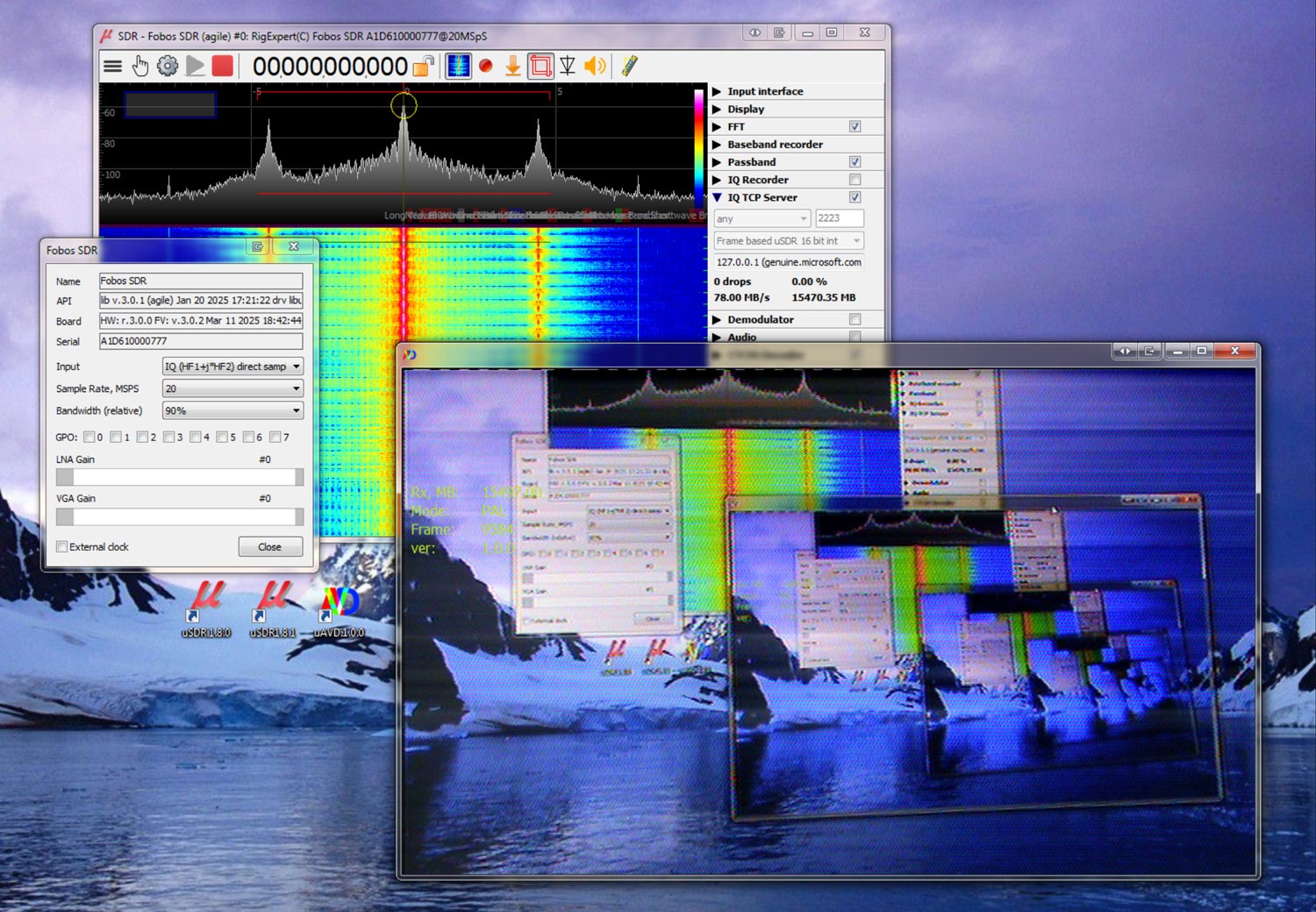
uAVD Receiving Camcorder Composite Video via the Direct Sampling Input in FobosSDR

Below is a video from a user of the software demonstrating it in action.

uSDR and uAVD analog video decoder

SignalsEverywhere: Using HackTV to Transmit Analog Television with a HackRF

Over on her YouTube channel SignalsEverywhere, Sarah has uploaded a new video showing how to use a program called 'hacktv-gui' to transmit analog TV signals using a HackRF software defined radio. Analog TV standards such as PAL and NTSC have been phased out in most of the world in favor of digital TV standards instead. However, transmitting these yourself can be a fun experiment that may help breathe life into old television sets.

In the video Sarah explains how to use the hacktv-gui and hacktv software, and how to create a video transmission. She mentions how hacktv also supports the use of a FL2K device, which is a cheap VGA adapter that can be used to transmit signals.

HackTV | Analog Television Transmission with a HackRF SDR

Decoding the RF Output of a VCR with an RTL-SDR

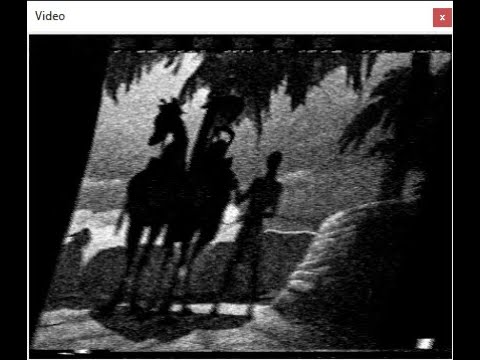
Over on YouTube use Scelly has uploaded a video showing how he has used an RTL-SDR dongle and the TVSharp SDR# plugin to decode video from the RF output of an old VCR (videocassette recorder). VCR players were designed to output the same PAL or NTSC signal that old analog TV transmissions used, and the RF output of the VCR was connected directly to the TV's antenna input.

The TVSharp plugin for SDR# can be used to decode these signals, however as the bandwidth of PAL/NTSC signals is much larger than the 2.4 MHz provided by the RTL-SDR, only a black and white image can be received. Scelly writes:

RF Output from VCR connected directly to input of my RTL-SDR. The RF output is tuned to channel 22 (487.25 MHz), and as the signal is so wide, my RTL-SDR can only display the luminance data (black and white video) and audio, although not at the same time. If I had two RTL-SDRs or an SDR with a larger bandwidth, I could have both audio and video playing at the same time.

The video playing is "The Prince of Egypt" on VHS Video Cassette.

Decoding RF Output of a VCR with RTL-SDR Dongle

Decoding PAL Video from a Nintendo with An Airspy SDR Part 2

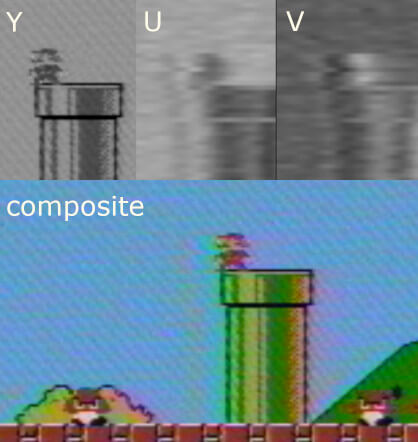
Oona combines composite output for color images.

Last week we posted about Oona Räisänen's ([Windytan] and @windyoona) project to capture live video from her 1985 Nintendo Entertainment System (NES) using an Airspy SDR. In order to avoid expensive Video Capture cards which didn't work on her Mac, she used an Airspy SDR to decode the PAL composite video output of the NES. Last week she had black and white video working.

This week she has full color working, and has on her blog posted a write up about her project with the Airspy and her experiences with trying to find a suitable capture solution. She also goes into some detail about the CPU performance considerations of this solution, noting that there are some performance bottlenecks. She's also uploaded a video showing the results in action.

MacBook decodes PAL video via SDR

Decoding PAL Video from a Nintendo with an Airspy SDR

Oona (also known as [Windytan] and @windyoona) was recently looking for a way to capture PAL composite video from her old 1980’s Nintendo Entertainment System (NES) without spending a bunch of money on what are often poor video capture cards. As she already owned an Airspy SDR she decided to receive the PAL signal with the Airspy and modify some software to act as a PAL decoder.

PAL decoding was handled via some modifications to her private Tempest software. Normally Tempest type programs like TempestSDR that we covered in a [previous article] are used to spy on computer/TV monitors from signals that are unintentionally emitted in the surrounding area.

Oona has made the connection from the composite output directly to the SDR antenna input so it’s not unexpected that you’d have a strong signal. However, I have to admit that’s an incredibly clear image for a video being demodulated via a software radio.

What makes this an even more amazing feat is that the latency is low enough that it’s nearly playable using a computer and SDR in place of a television set.

We note that we’ve also seen SDRs used to decode standard PAL TV broadcasts before with an SDR# plugin called TVSharp.

Transmitting Analog TV Broadcasts with a HackRF

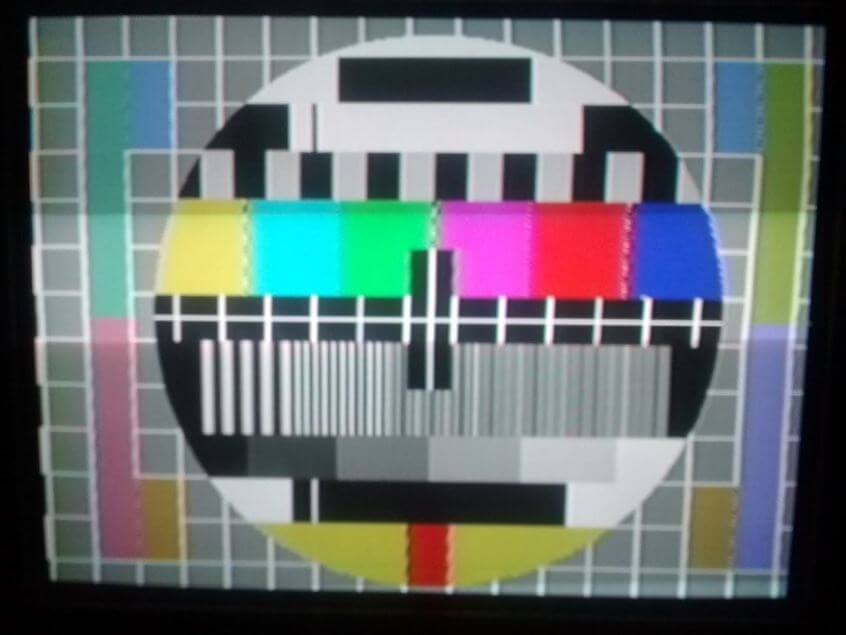
Over on the user submitted hackaday.io community, user marble has shared his work about using a HackRF to transmit PAL analog colored TV images with his rad1o (the rad1o is a slight variation of the HackRF One) using a GNU Radio flowgraph.

In his submission he shares a tutorial that explains the theory behind the PAL analog video standard. He explains the different components of the PAL signal, including the luma (black and white part), frame rates, and modulation. He then goes on to explain how color is encoded onto the PAL by using Quadrature Amplitude Modulation (QAM).

Finally in the files section marble also supplies us with the GNU Radio flowgraph which can be used to transmit PAL video with a HackRF.

PAL test signal transmitted with a HackRF.

New SDR# Plugin: PAL / SECAM TV

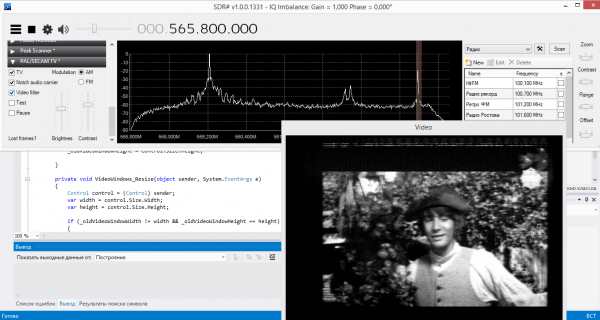
The SDR# plugins programmer over at rtl-sdr.ru has recently released a new plugin which allows the decoding of PAL / SECAM TV images from within SDR# (note link in Russian, use Google translate or see the download link at the bottom of the page). The author also writes that if you are using a newer software defined radio like an Airspy, you can also receive the audio channel using the SDR# multiple VFO plugin.

We note that there is also the TVSharp software by the same author which is a standalone program that can decode PAL and NTSC.

PAL / SECAM TV SDR# Plugin

TVSharp Updated to Version 1.2

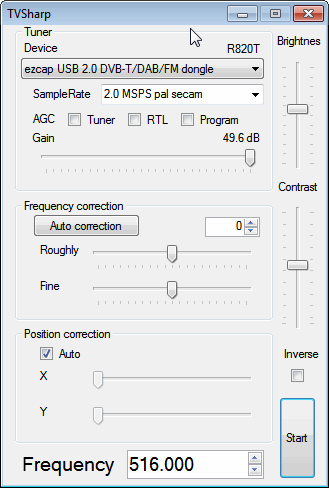
The PAL/NTSC analogue TV viewer TVSharp has recently been updated to version 1.2. This new version features an updated GUI as well as automatic frequency correction and automatic position correction. This may correct some of the scrolling and slanting problems seen in previous versions.

The latest TVSharp can be downloaded from here.

Word of warning: Chrome recognizes the download as malicious, however I have downloaded the file using FireFox and scanned it with Microsoft Security Essentials which found it to be clean.

TVSharp v1.2
TVSharp v1.2