Tagged: sdr#

Using SDR For QO-100 Satellite Operation

Es’hailsat, otherwise known as QO-100 is the first geostationary satellite with an amateur radio payload on-board. The satellite contains both a Wide Band transponder for experimental modes and DVB-S Digital Television and a Narrow Band transponder used mostly for SSB voice and some digital mode contacts with other amateur operators. If you’re unfamiliar with this satellite we’ve covered it in previous articles, like in [Es’hail Transponder Now Active]

While many choose to use a transverter connected to a traditional amateur transceiver, others have turned to use Software Defined Radios to complete their satellite ground stations.

[Radio Innovation] posted a video back in March showing his contact on QO-100 using a LimeSDR Mini as the 2.4 GHz transmitter and a 10 GHz LNB for the downlink.

The PlutoSDR has been frequently seen used for QO-100 satellite operation on the Wide Band transponder due to its ease of DVB-S transmission utilizing software such as [DATV Express] but more recently there have been more and more operators turning to SDR for their day to day satellite operation.

It will be interesting to see how these stations evolve, perhaps by the time North America has access to a similar satellite, we’ll be prepared to operate it.
YouTube Video: Information Packed Introduction to SDR

Over on YouTube Nick Black has uploaded a video where he does a good introduction to software defined radio (SDR), SDR history, how SDR works, various SDR concepts like sampling and bandwidth, different SDR hardware, the SDR Linux stack and reverse engineering wireless signals.

The information is presented fast and densely, so it may be a bit hard to follow for newbies, but if you already have some experience with SDR it may be a good video that helps tie everything together and fill in some gaps. Nick also has a Wiki where he's documented some of what is said in the video.

DANKTECH 001: Software-defined Radios


GR-Oscilloscope: Using an Oscilloscope as a Software Defined Radio

A modern digital oscilloscope uses an analogue to digital converter (ADC) and digital signal processing (DSP), just like a software defined radio does, so it stands to reason that with some software hacks an oscilloscope could be turned into an SDR.

To facilitate this, jmfriedt has just released his new software called "gr-oscillioscope" over on GitHub. GR-Oscilloscope allows you to use a digital oscilloscope as a software defined radio source in the latest GNU Radio 3.8. It has been tested with a Rohde & Schwarz RTO2034 and RTE1054, and should work on any RT series oscilloscope. The software works by using the VXI11 RPC protocol which is a protocol designed for connecting instruments like oscilloscopes to computers.

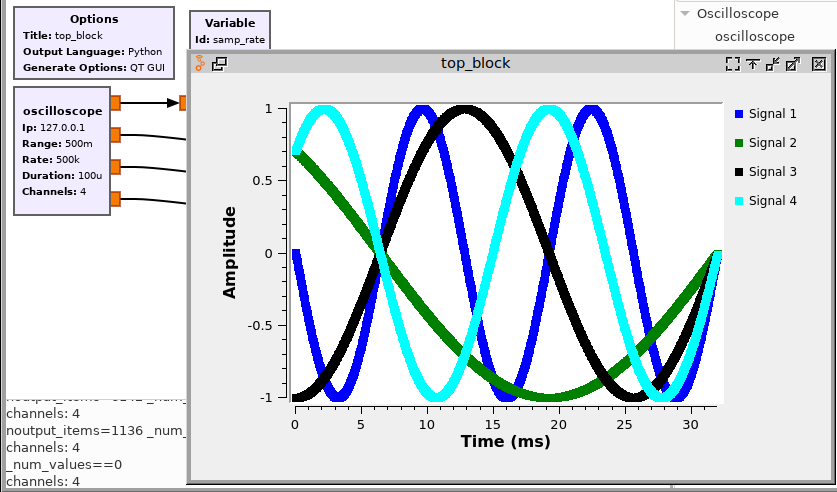
GR-Oscilloscope Screenshot from GNU Radio.

Signals and Bits A New SDR Podcast by the President of the GNU Radio Project

[Ben Hilburn] the president of the [GNU Radio Project] has recently started a new podcast called [Signals and Bits]. If you were unaware, GNU Radio is the defacto open source framework for implementing digital signal processing code. Without it, many SDR programs that we take for granted may have never been developed as it is responsible for a lot of community DSP knowledge and algorithm development.

This podcast is scheduled for a new release every Wednesday and will be composed in an interview style focusing on a multitude of topics from Software Defined Radio to Spectrum Enforcement, Radio Astronomy and so much more.

In the first episode Ben interviews Harold Giddings AKA Corrosive of [Signals Everywhere] where they discuss the state of Software-Defined radio and how he got started with radio communications having come from an IT/Computer Networking background.

Ben has already pre-recorded several episodes which will ensure great content is always just around the corner. Ben would love it if you could also send feedback his way over on the [Signals and Bits Twitter] page.

Ben Hilburn President of GNU Radio (Left), Harold Giddings AKA Corrosive of Signals Everywhere (Right)

SignalsEverywhere: Common Modulations Tutorial Video

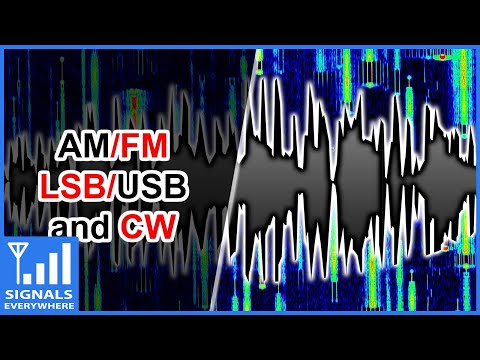
This week on the SignalsEverywhere YouTube channel, host Corrosive gives us a tutorial on common modulations that you'll see on your software defined radio. His tutorial covers Amplitude Modulation (AM), Frequency Modulation (FM), Single Side Band (SSB) and Conintuous Wave (CW) modulations. In the video he shows what they look like and how to select the correct mode and bandwidth settings in SDR#. Corrosive uses an Airspy in the video, but the same concepts are valid for any SDR, like the RTL-SDR.

If you're new to SDR then this is a great introductory video to watch and learn from.

AM FM SSB and CW | Common Modulation You'll See on SDR

Using a LimeSDR Mini in SDR#

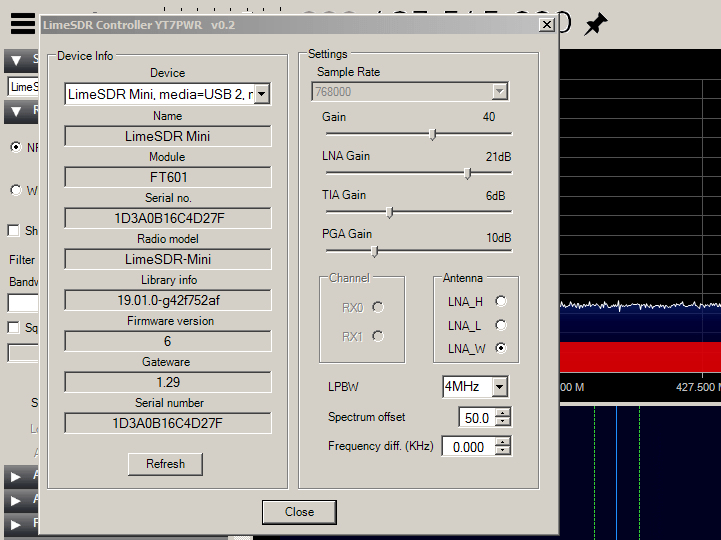
Thank you to Steve Bossert who wrote in and wanted to share his notes about getting a LimeSDR Mini SDR to run in SDR#. The LimeSDR Mini is a $159 RX and TX capable SDR with 12-bit ADC, 10 MHz to 3.5 GHz tuning range and up to 30.72 MHz of live bandwidth. We have a short review of it available here.

Steve notes that to get the Limesdr Mini to run in SDR# he simply had to download and extract into the SDR# folder a front end plugin developed by Goran Radivojevic (YT7PWR). After adding the front end plugin XML definition, it can now be found in the SDR# device selection menu. This plugin should work for the standard LimeSDR as well.

We note that this is the same procedure for other SDRs too, such as the PlutoSDR. If you have an SDR not supported by default in SDR#, search for "[your_sdr] + SDR# front end plugin" on Google, and if you are lucky you might find something already exisiting.

LimeSDR Mini Control Interface in SDR#

Elektor SDR Hands-on Book + Arduino Shield HF SDR

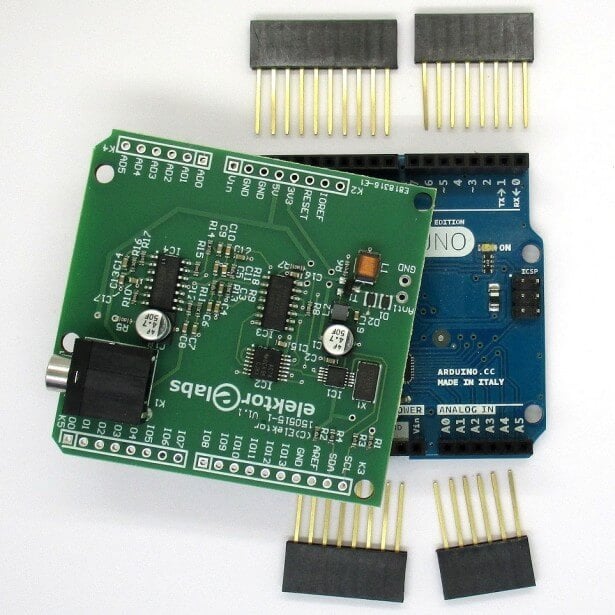
Elektor is a popular electronics magazine and hobbyist kit store. Recently they have published a book titled "SDR Hands-on Book" written by Burkhard Kainka. The book is intended as a companion to their Arduino SDR shield kit, which is a low cost module that allows you to turn an Arduino into a 150 kHz to 30 MHz capable SDR. It is based on the G8JCFSDR, which is an RF front end downconverter that allows a PC soundcard to be used as an SDR analog to digital converter.

Kainka's book goes over introductory topics such as shortwave reception, explains signal to noise ratio and interference, different types of antennas, software, digital modes, SDR measurements, receiving and finally WSPR and QRP transmission. If you're interested Jan Buiting also recently reviewed the book on the Elektor website.

Elektor are currently running a promotion and are selling the book + Arduino shield for a reduced price of €49.90.

The Elektor Arduino Shield HF SDR Kit.

The 2019 New England Workshop for SDR

The New England Workshop on Software Defined Radio (NEWSDR) is a yearly conference that hosts multiple SDR related talks. Previously we posted a selection of our favorite 2018 talks which involved topics such as remote sensing of space with SDR, wireless deep learning and multi-objective SDR optimization.

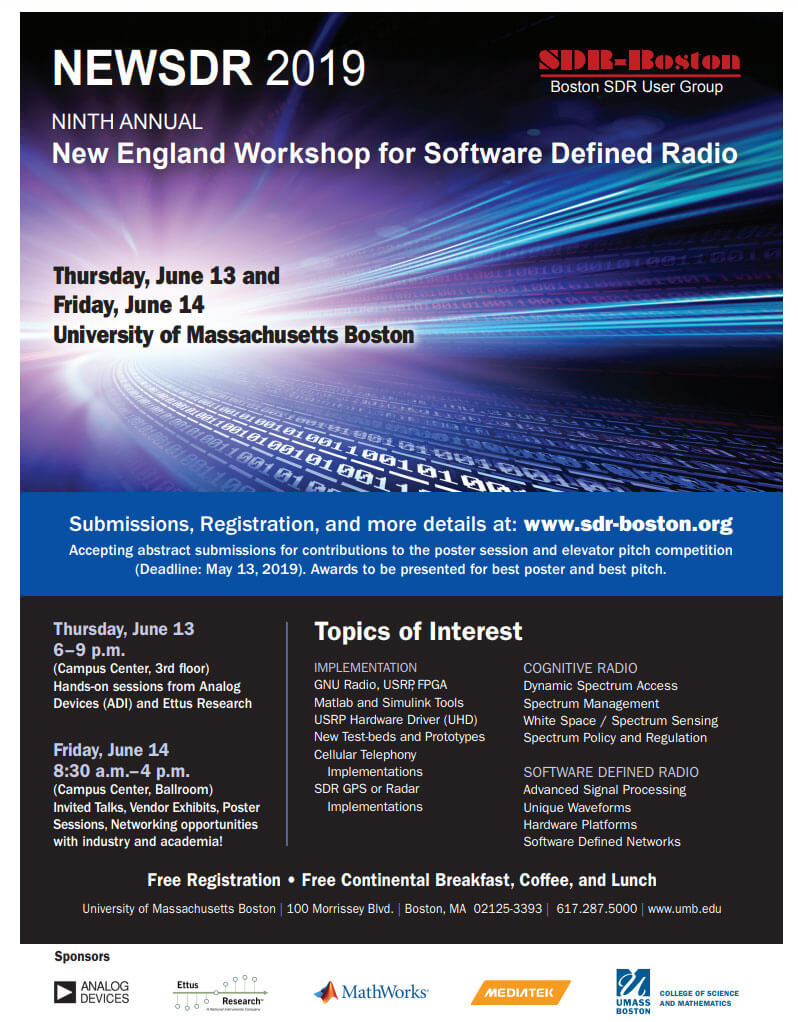
This years NEWSDR event will been held on Jun 13 and 14 at the University of Massachusetts in Boston. They are currently offering pre-registration for free, and are looking for poster presentations.

This year is the 9th iteration of NEWSDR and it will be held at the University of Massachusetts Boston campus on June 13 and 14. Registration is free and we are also accepting submissions for poster presentations and elevator pitches. The event is an excellent networking opportunity and includes technical presentations as well as demonstrations from industry sponsors (Ettus/NI, MathWorks, Analog Devices, and MediaTek).

NEWSDR 2019 Poster
NEWSDR 2019 Poster