The GRAVES radar at 143.05 MHz is often used by amateur radio astronomers as a way to detect the echos of meteors entering the atmosphere. The basic idea is that meteors leave behind a trail of ionized air which is reflective to RF energy. This RF reflective air can reflect the signal from the powerful GRAVES space radar in France, allowing the radar signal to be briefly received from far away. Detecting the angle of arrival from these reflections could help determine where the meteor entered the atmosphere.
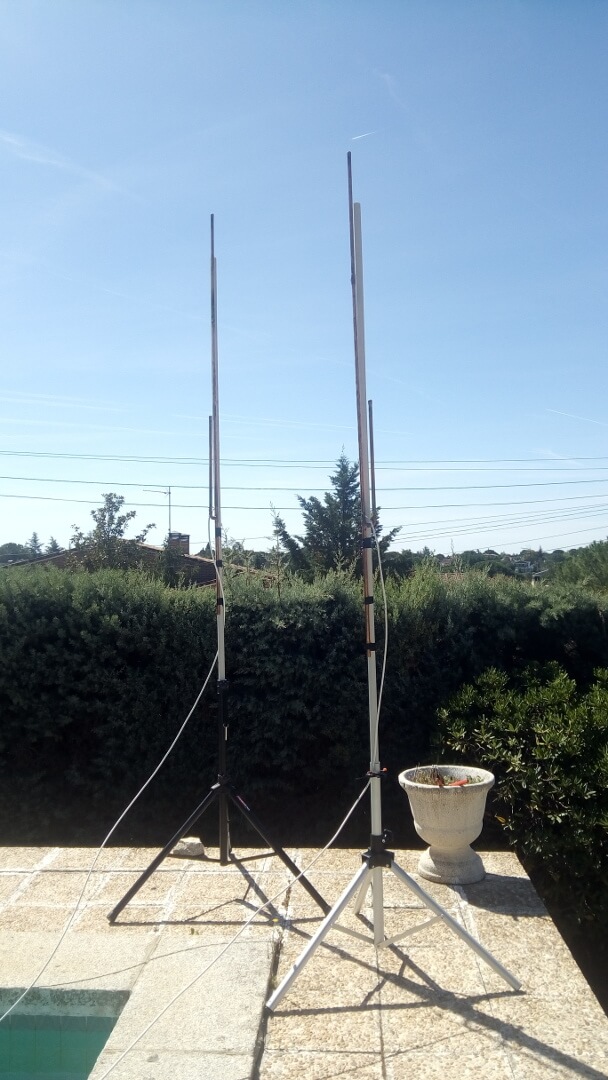
Their experiments used a pair of J-Pole antennas and a LimeSDR receiver. The LimeSDR has two channels and can receive the signal coherently from both channels. The phase difference in the received signals from the two antennas can then be measured, and the angle of arrival calculated.
In their testing the first tested with 145 MHz amateur radio satellites. Unfortunately due to the low elevation of the antennas and multipath from terrain obstructions an angle could not be calculated. In a second experiment they tried receiving terrestrial APRS signals. With APRS they were successful and were able to determine the angle of arrival from multiple stations. Unfortunately for GRAVES meteor echoes they were not entirely successful, citing multipath issues due to houses, and the need for a clear view of the horizon.
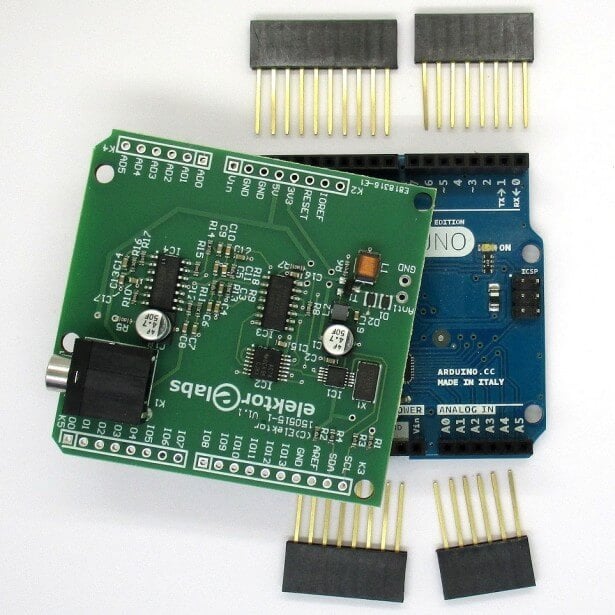
Elektor is a popular electronics magazine and hobbyist kit store. Recently they have published a book titled "SDR Hands-on Book" written by Burkhard Kainka. The book is intended as a companion to their Arduino SDR shield kit, which is a low cost module that allows you to turn an Arduino into a 150 kHz to 30 MHz capable SDR. It is based on the G8JCFSDR, which is an RF front end downconverter that allows a PC soundcard to be used as an SDR analog to digital converter.
Kainka's book goes over introductory topics such as shortwave reception, explains signal to noise ratio and interference, different types of antennas, software, digital modes, SDR measurements, receiving and finally WSPR and QRP transmission. If you're interested Jan Buiting also recently reviewed the book on the Elektor website.
Elektor are currently running a promotion and are selling the book + Arduino shield for a reduced price of €49.90.
Yesterday we posted about a real time Windows demodulator for receiving amateur TV DVB-S/S2 on Es'Hail-2/QO-100. Recently another YouTube user "M Khanfar" also submitted a video tutorial showing how to decode Es'Hail-2 DVB-S2 on Ubuntu with an RTL-SDR and the LeanDVB decoder.
Khanfar notes that although the LeanDVB decoding method is not real time, his tests show that the LeanDVB method is able to work with a much lower SNR signal compared to the Windows demodulator. The process is to simply capture an IQ file with GQRX, then run LeanDVB on the command line with the recorded IQ file. It will create a TS file that can be played in any media player.
His receiving setup consists of an RTL-SDR, 100cm dish, modified LNB and a home made bias tee that can switch his LNB between horizontal and vertical polarization.
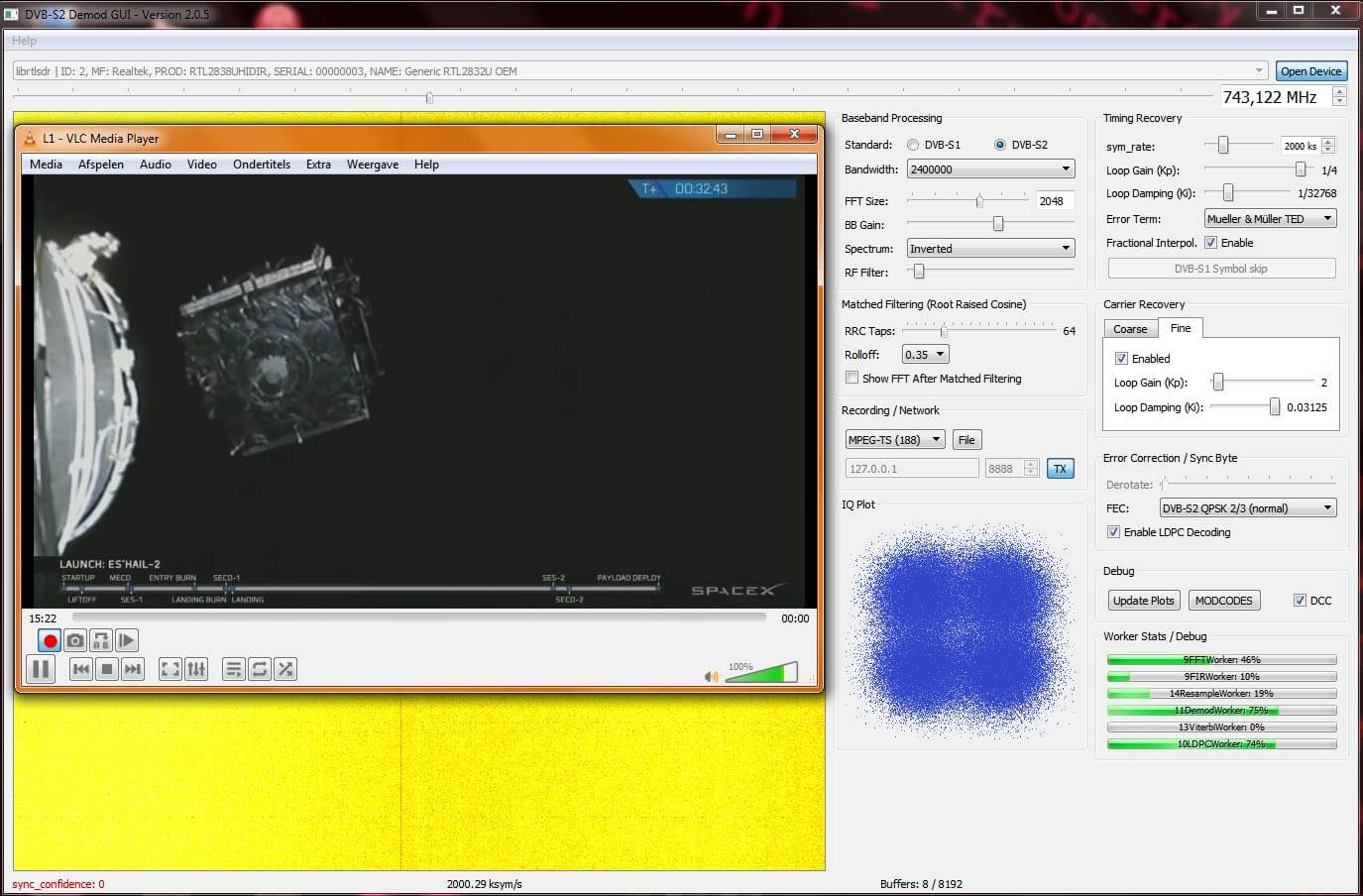
Thank you to Happysat for writing in and noting that over on the Amsat-DL forums user Markro92 has uploaded a realtime Windows DVB-S demodulator with GUI. The demodulator works with the RTL-SDR, HackRF, SDRplay and PlutoSDR support is due to be added soon. Happysat notes the following:
It can demodulate DVB-S and S2 signals with very low symbolrate on Es Hail-2 geosat on 25,9 East from the Wideband Transponder. So you do not need a modified lnb or modified satelitte stb :) Of course you can also see the amateur tv streams which people uplink theirself.
To see if there is any stream active one can visit the wideband WebSDR and above the stream the info is displayed which parameters in use (symbol rate and mode dvbs(2)) so you can adjust in the Demodulator program. Stream + Chat: https://eshail.batc.org.uk/wb/ .
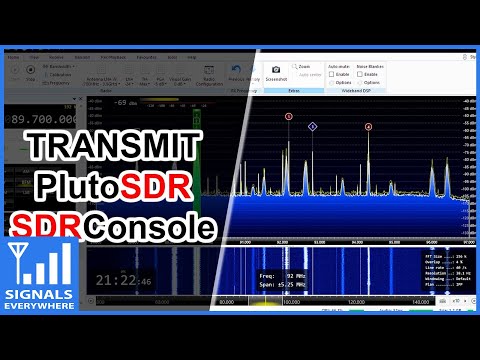
Over on YouTube Corrosive from the SignalsEverywhere YouTube channel has uploaded a video showing us how to use SDR-Console V3 and a PlutoSDR to transmit ham radio voice. In the video he sets his PlutoSDR to transmit from his microphone at 445.5 MHz, and to receive at 434 MHz. He is then able to talk to a friend using a handheld who is receiving at 445.5 MHz and transmitting at 434 MHz.
Thank you to Alex Happysat for writing in and letting us know about the next upcoming ISS SSTV event which will begin on 11 April at about 18:00 UTC and end on 14 April 2019 18:00 UTC. If you were unaware, the International Space Station (ISS) transmits SSTV images several times a year to commemorate special space related events. SSTV or Slow Scan Television is an amateur radio mode which is used to transmit small images over radio signals.
The images will be transmitted constantly at 145.8 MHz over the active period and they are expected to be in the PD-120 SSTV format. To receive the images you can use a simple RTL-SDR dongle and the MMSSTV software. A tuned satellite antenna like a QFH, turnstile, or tracking Yagi would be preferred, but many people have had good success before using simpler antennas like a V-Dipole. Software like Orbitron, GPredict, various Android apps or NASA's Spot the Station website can be used to determine where the ISS is and predict when it will be over your location.
The next big event will be the ARISS SSTV event that starts Thursday, April 11 about 18:00 UTC and will be operational until about 18:00 UTC on Sunday, April 14. Since this event will run continuously for 72 hours, folks in the higher latitudes should have a pretty good chance to receive all 12 of the images. Operators in the mid latitudes should be able to get most of them depending on location. Good Luck and Enjoy!
Alex also mentions that for this and other ISS events AMSAT Argentina is handing out ARISS-SSTV Diplomas to amateur radio operators who receive, record and upload at least 15 images received from the ISS, in at least two different radio operation with a month or more in between then.
If you cannot set up a receiver, it is possible to use R4UAB's WebSDR which will be available directly at websdr.r4uab.ru. However, note that internet reception is not valid for the AMSAT Diploma. An example of WebSDR SSTV reception and decoding from a smaller ISS SSTV event held a few days ago is shown below.
The famous HAARP (High Frequency Active Auroral Research Program) antenna array will be transmitting again from March 25 - March 28, 2019. HAARP is an antenna array which is used to perform experiments on the Earth's ionosphere and thermosphere by transmitting HF RF energy into it. With an HF capable receiver like the RTL-SDR V3 it is often possible to receive these transmissions from some distance away. As HAARP only rarely transmits, it is an interesting signal to catch when it is transmitting.
HAARP (High Frequency Active Auroral Research Program)
Ghosts in the Air Glow is an ionospheric transmission art project using the HAARP Ionospheric Research Instrument to play with the liminal boundaries of outer space.
Pairing air glow experiments in the ionosphere—false auroras creating soft, glowing spots in the sky—with SSTV images, audio and image signals articulated by artist Amanda Dawn Christie will be received and decoded via SDR (Software Defined Radio) equipment by amateur radio operators around the world, and streamed live online for audiences who do not have the equipment or expertise for reception.
“The facility, which was used by the military, has an air of mystery about it and has been the subject of many conspiracy theories over the years — that’s something I reflected upon when creating the piece.”
Ghosts in the Air Glow will consist of an hour-long transmission containing eight movements, each created for a specific frequency and intended to explore different concepts related to radio science and the HAARP site itself.
From Arctic wolves meeting the aurora to poetic texts written in Morse code and the NATO phonetic alphabet, the motifs covered by this transmission art work address issues related to military research, surveillance, political territories, ionospheric science, and conspiracy theories.
The first art transmission was sent earlier today, and if you missed it Amanda live streamed the signals being received on YouTube and the recording is available here. Future live streams will be available here. DK8OK has also posted about his reception on his blog.
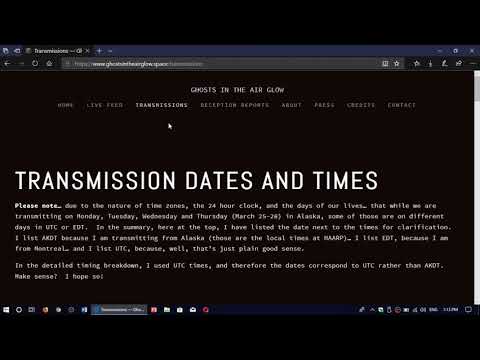
Further transmissions are scheduled every day until March 28, and the transmissions schedule is available here. Each transmission consists of several 'movements', which consist of differing antenna array arrangements, frequencies being used, and signals being transmitted. If the text formatting of the movements is a bit difficult to read, Reddit user
grink has formatted it into a nice table in his post. To follow the transmissions it would be also wise to follow Amanda on Twitter, where she is posting the most up to date transmission frequencies.
The idea for the project came about when Christie met Christopher Fallen, the chief scientist at HAARP, at a hackers conference earlier this year. Fallen, who is an amateur radio operator, was intrigued by Christie’s proposition to use the IRI to create site-specific transmission art.
He agreed to open the facility to her, and when she gained backing from the Canada Council for the Arts, Ghosts in the Air Glow officially became the first Canadian-funded project to take place at HAARP.
“Art and science are often seen as separate efforts but they actually share many of the same inspirations and techniques. I’m excited to see HAARP, a unique scientific instrument, used for a comparably unique artistic performance,” says Fallen.
“Amanda’s project will be a valuable contribution to the 50-year collection of scientific work in the field of ionosphere radio modification, and also to the brand new collection of artistic work using powerful high-frequency radio transmitters and the upper atmosphere — it’s art directed from the ground but created in space!”
Interdisciplinary artist Amanda Dawn Christie. Photo by Concordia University
If you prefer a video explanation of the project, YouTube user OfficialSWLchannel has prepared a video which is shown below.
HAARP tests and Ghost in the Air Glow from Amanda Dawn Christie
Over on YouTube user ElPaso TubeAmps has uploaded a video showing his transit/receiver relay system that allows a "boat anchor" (old radio) ham radio transmitter and SDRplay SDR receiver to coexist. In order to protect the SDRplay's front end from being destroyed by a ham radio transmitting on the same antenna, a relay should be used to ground the SDRplay during a ham radio transmission. He writes:
How to build a small chassis and relay system to switch the antenna from the SDR input to ground and open the speaker connection from the PC to the speakers during transmit. I use "boat anchor", i.e. separate VFO for transmitter and receiver equipment and this video is about that type of connection and is not for transceivers.
SDRPlay, RTL-SDR, Transmit-Receive , PC Speaker, T/R Switch