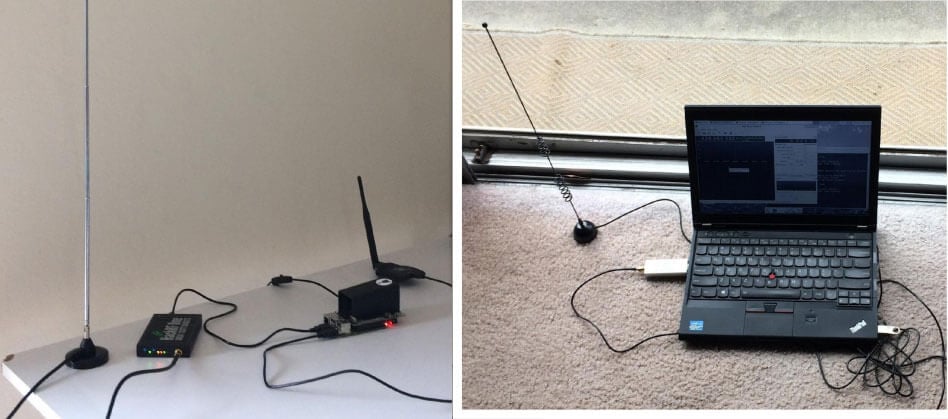
Over on YouTube user radio innovation has uploaded a brief screen capture showing his Raspberry Pi 3 and RTL-SDR dongle being used as an always-on monitor for low transmit power based signals such as FT8, JT65 and JT9. These signals are transmitted by ham radio enthusiasts for the purpose of making contacts, and determining propagation conditions. This is a good application for an RTL-SDR and Raspberry Pi 3 as it enables cheap monitoring of these signals without the need to tie up a full sized ham radio.
To do this "radio innovation" runs Linrad on the Raspberry Pi, which is a program like GQRX that interfaces with the RTL-SDR dongle. Then the WSJTx software is used to decode the signals. He writes:
Remote Desktop screencapture of my Raspberry Pi3 monitor receiver on 40m amateurradio band with WSJTx and decoding FT8,JT65 and JT9. Receiver hardware is RTL-SDR(tcxo) + simple converter and homemade bandpass filter.
SDR software is LINRAD by SM5BSZ.
RasperryPi3 OS is Ubuntu Mate 16.04.
Update:We now have a tutorial on creating a similar set up available on a new post.
Over on YouTube FairlawnARC.org have uploaded a talk about SDRs and ham radio by Ria Jairam (N2RJ0). The talk is a good overview of the current state of SDRs for ham radio use, and she discusses the various hardware and software options as well as giving many tips for improving your ham station. The blurb reads:
Our speaker was Ria Jairam (N2RJ), a world class contest operator and member of the Frankford Radio Club. Ria discussed the latest technology and offerings from Flex Radio, the HPSDR project (Ananradios), RTL SDR and others, as well as practical tips for contesting, DXing and rag chewing using your SDR. This presentation was held on Friday, October 20, 2017, 1900 hours at the Fair Lawn Senior Center, 11-05 Gardiner Road, Fair Lawn, NJ. The event was open to the public & refreshments were served.
Ria Jairam, N2RJ YLs, SDR & Setting Up A World Class Station
Part 2 - Ria Jairam, N2RJ YLs, SDR & Setting Up A World Class Station
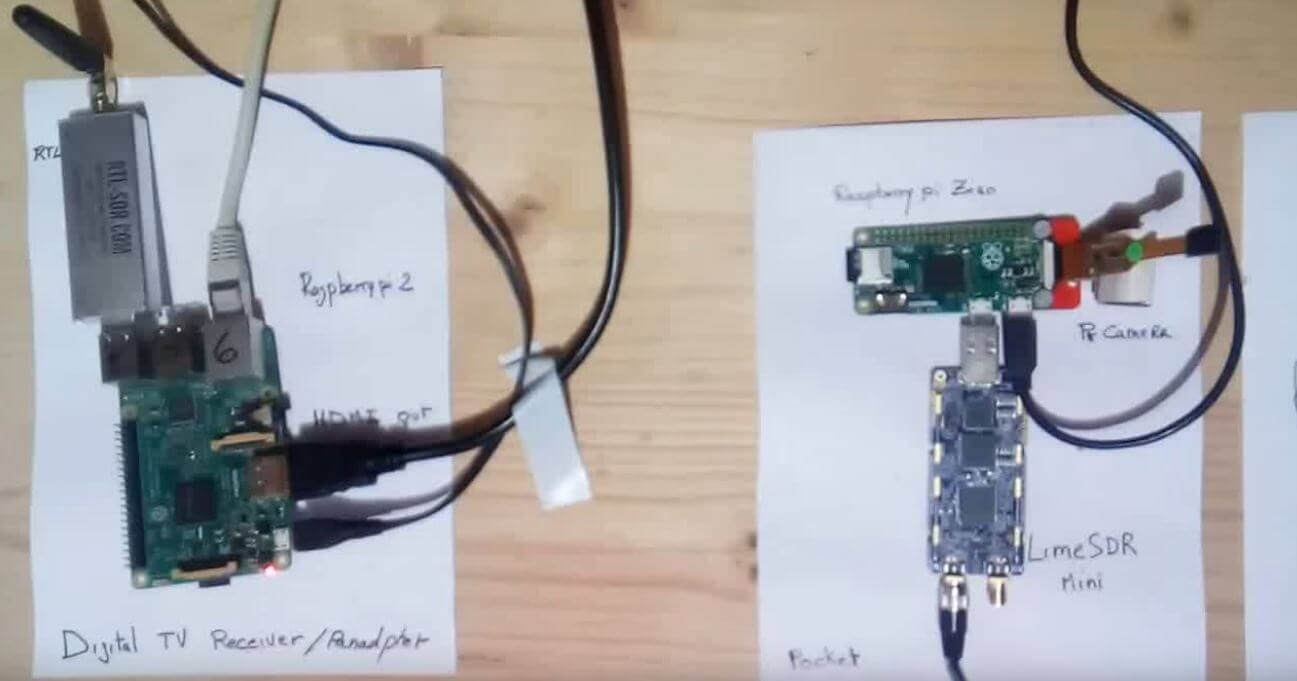
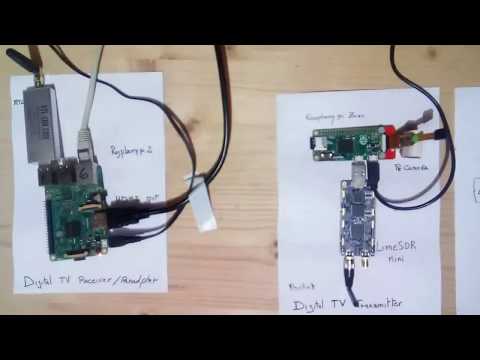
Over on YouTube user Evariste Okcestbon has uploaded a video showing his simple pocket DATV system that consists of a LimeSDR running on a Raspberry Pi Zero transmitting live camera images via DATV which is received by an RTL-SDR running on a Raspberry Pi 3.
If you didn't already know, DATV stands for Digital Amateur Television and is a digital mode somewhat similar to digital over the air TV signals that can be used by hams for transmitting their own TV signals on the ham bands. The LimeSDR Mini is a $139 US transmit and receive capable SDR that is currently crowdfunding and available for pre-order on Crowdsupply. It is expected to ship at the end of February 2018.
Evariste uses a range of software packages on each Raspberry Pi. He writes the following in the video description:
Description of a minimal Digital Tv chain : Transmitter and Receiver.
Hardware used on Tx : PiZero,Picam,LimeSDR Mini
Hardware used on Rx : Raspberry Pi 2, RTL-SDR,Monitor
Software used on Tx : avc2ts,dvb2iq,limetx
Software used on Rx : rtl_sdr,leandvb,kisspectrum,ts2es,hello_video
Evariste is also the author of Rpidatv which allows you to transmit DATV directly from the GPIO pins of a Raspberry Pi without the need for any transmit capable SDR.
If you didn't know already Bitcoin is the top cryptocurrency which in 2017 has begun gaining traction with the general public and skyrocketing to a value of over $19,000 US per coin at one point. In addition to providing secure digital transactions, cryptocurrencies like Bitcoin are intended to help fight and avoid censorship. But despite this there is no real protection from the Bitcoin internet protocol being simply blocked and censored by governments with firewalls or by large ISP/telecoms companies.
One idea recently discussed by Nick Szabo and Elaine Ou at the "Scaling Bitcoin 2017" conference held at Stanford University is to use the something similar to WSPR (Weak Signal Propagation Reporting Network) to broadcast the Bitcoin network, thus helping to avoid internet censorship regimes. To test their ideas they set up a HackRF One as a transmitter and RTL-SDR and used GNU Radio to create a test system.
QRSS is a ham communications mode that is essentially just very slow CW (morse code), with each dash/dot being broadcast for a number of seconds. With QRSS instead of audibly decoding the morse code signal, it is decoded visually via a spectrum display (or automatically by software). It is designed to be a QRP mode, which means that hams transmitting QRSS can be heard all over the world even though very low transmit power is used.
QrssPiG is a QRSS grabber program that runs headless on a Raspberry Pi and can interface with an RTL-SDR. It automatically generates the waterfall graphs of received QRSS images, and supports uploading them via SCP or FTP. The software can also run with a HackRF, or via audio piping from another SDR or standard hardware radio.
Recently on Twitter @ON4CDJ has been trying QrssPiG with an RTL-SDR V3 and has been having good results.
Back in September we posted [1, 2] about the QRadioLink software which is an RTL-SDR compatible digital amateur radio voice decoder and encoder program for Linux and Android (with chroot). It supports modern digital voice codecs like Codec2 and Opus. It is capable of being used with multiple SDRs, and can be used for transmitting digital voice too if you have a transmit capable SDR.
Andrian the developer recently wrote in to let us know that QRadioLink now has a website at qradiolink.org that you can follow for updates about its development. The website also explains some of the features of the software, and lists possible performance values of digital voice. The features include:
Receives and transmits analog voice, digital voice, low resolution video, text, IP protocol.
Narrow band modem with Codec2 or wideband modem and Opus.
Digital Modems: BPSKQPSK2FSK4FSK
Modes: narrow FM, SSB, digital voice, digital video, digital data
Typical Receiver performance is given in the following table, with all values being measured on an R820T RTL-SDR.
Mode
Condition
Sensitivity (dBm)
Codec2 700B
20 db SINAD
-115
Codec2 1400
20 db SINAD
-112
Opus
20 db SINAD
-102
Narrow FM
12 db SINAD
-118
In the future Adrian hopes to expand the software to include features like VOIP integration, SSB transceiver, DTMF & CTCSS encoder/decoders, multi-channel RX, HD video, remote control and a GUI improvement.
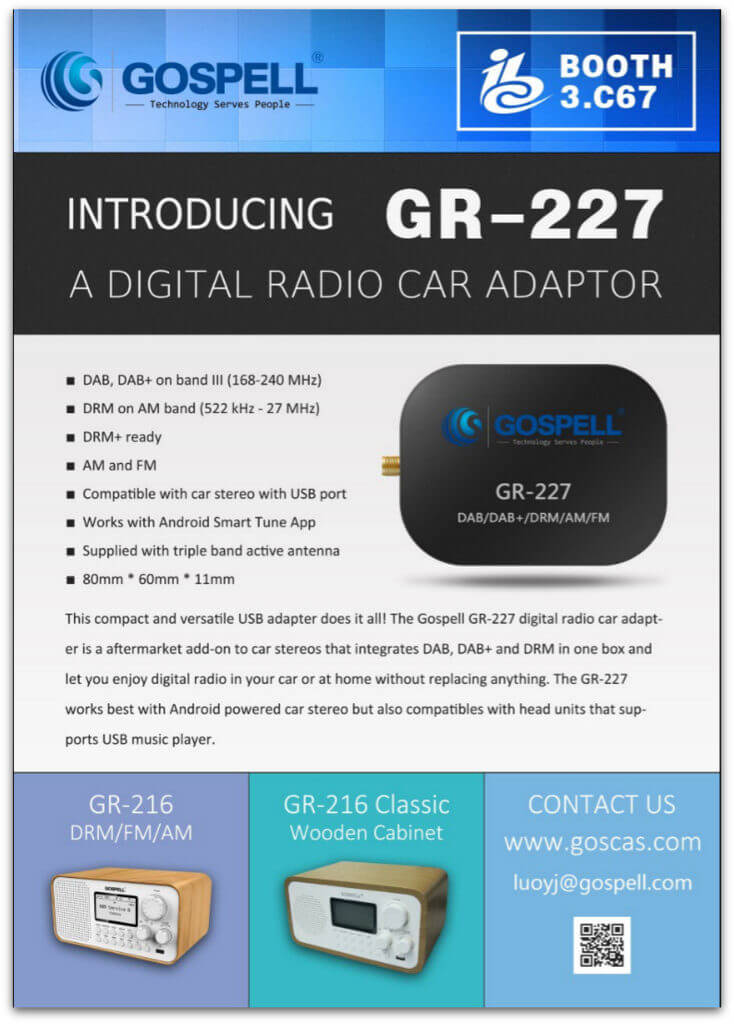
Over on the SWLing Post blog we’ve seen news of this new SDR based car radio called the Gospell GR-227. Gospell is a Chinese manufacturer of various broadcast consumer radio products including DRM receivers. It is intended to be an adapter for your car that lets you listen to digital broadcast stations such as DAB/DAB+ on VHF and DRM on UHF, but it can also be used for standard AM and FM reception. From the product sheet it looks like it will simply plug into you car USB port, and output audio through that port into your cars head unit. Control of the unit is through an Android app.
There doesn’t seem to be anything stopping someone from using this outside of a car though, so perhaps depending on the price and software hackability available it might make a good PC or Raspberry Pi based HF receiver for all modulation types too.
Over on the Gospell Facebook page are images showing the Gospell running at IBC 2017 and next to other upcoming SDR based digital broadcast receivers like the Titus II.
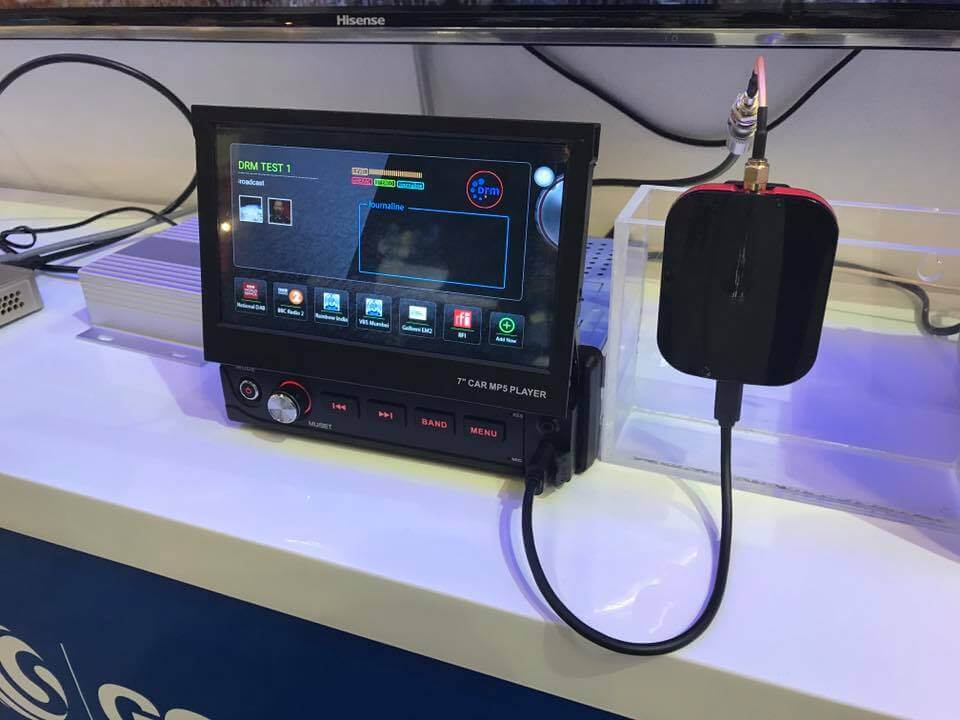
Gospell SDR Connected to a Car Radio Head Unit
No word yet on a release date or pricing. The press release reads:
Chengdu, China, September 04, 2017 – A new adaptor specifically designed for in-car use that simplifies digital radio on the road will be introduced at IBC by Gospell.
GR-227 is a small, low-cost adaptor that acts as an aftermarket add-on to car stereos receiving high-quality digital broadcast programs and data application, and serving it to the car audio system over a USB cable. Based on software defined radio technology, GR-227 is compatible with DAB, DAB+, DRM and is DRM+ ready. It is also powerful enough to support digital audio decoding such as extended HE-AAC (xHE-AAC).
GR-227 literally works with any kind of car stereos with a USB port. Our patent pending technology allows the adaptor to behave like a thumb drive when plug into a USB port and makes it compatible with most of the music players not only in car but also for home use.
To make the most of GR-227, the Gospell Smart Tune App for Android has been included to add more features. When partnered with an Android powered car stereo, the App not only allows for playback of the broadcast audio program but data application which brings much fun to car entertainment.
By connecting the supplied triple band active antenna which can be attached to the windscreen through the SMA antenna connector, the reception in DRM, FM and DAB bands can be significantly improved, offering maximum flexibility between different broadcasting standards.
Installing the plug-and-play GR-227 adaptor to your car is easy and doesn’t require changing your car stereo. It is one of the easiest ways to upgrade your car radio to digital without replacing anything.
The Gospell’s aftermarket car adaptor range starts with USB model but more will follow to support more car stereo types.
Haochun Liu, DRM director, Gospell, said: “By leveraging SDR, we can now combine multiple broadcasting standards together to offer flexibility and cost advantages, coupled with easy installation without the necessity of buying a new car stereo as in traditional solutions.”
For additional information, please visit www.goscas.com or contact Gospell sales at [email protected].
About Gospell
Founded in 1993, Gospell Digital Technology Co Ltd (GOSPELL). is a private hi-tech enterprise with R&D, manufacturing, business consultancy and planning, trade, delivery, project implementation and after sales service, acting as a complete DTV and triple-play solution provider for Digital TV/OTT related projects. Headquartered in GOSPELL INDUSTRIAL PARK at Chenzhou, Hunan Province for CPE related production manufacturing, GOSPELL also has its office in Shenzhen for business/marketing management and administration, in Chengdu for R&D and headend/transmitter system production/debugging and Customer Service Center, and in 12 cities in China as well as international offices in India, Africa and Mexico.
Earlier in the month we posted about Adrian M’s video that showed his QRadioLink software running on Android with an RTL-SDR. QRadioLink is a digital amateur radio voice decoder and encoder, that currently supports modern digital voice codecs like Codec2 and Opus. It’s compatible with a wide range of SDRs including the RTL-SDR, as well as TX capable SDRs for transmitting.
Over on YouTube Adrian M has recently uploaded a new video showing a comparison of QRadioLink receiving SSB, NFM, Codec2 and Opus voice signals at the same initial power levels. The results show that the digital modes are generally much clearer and static free even at low TX levels. He writes:
The Linux SDR transceiver application QRadioLink uses here an RTL-SDR dongle for reception. The QRadioLink transmit chain is using an USRP B200 with output power set at about half the maximum. The Codec2 digital mode works down to a low CNR (6 dB) where even SSB is hard to copy. The Opus mode provides good voice quality at a level where analog narrow FM is noisy. The code for QRadioLink is fully open-source, licensed under GPLv3, and can be found on Github, where it’s undergoing development. Bug reports, patches and suggestions are welcome.