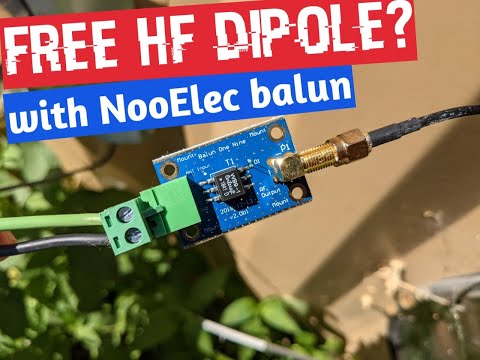
In this weeks video Rob from his Frugal Radio YouTube channel shows us how he's turned an old piece of scrap electrical extension cord into an effective HF antenna for his Airspy HF+ SDR. The scrap wire is combined with a US$15 NooElec 9:1 balun which helps improve the impedance match of the antenna. He then stretches the dipole out through his backyard and then hooks it up to his Airspy HF+.
The results show good reception across the 20m, 80m, 40m amateur radio bands, as well as on HF ATC aircraft communications, US coast guard weather information broadcasts and the AM broadcast band.
I made an HF Dipole for free! Reception was good on my AirSpy HF+ Discovery SDR!
In the latest episode of his YouTube series on Aviation monitoring Rob explores how to decode L-band satellite ACARS (Aircraft Communication Addressing and Reporting System) and CPDLC (Controller Pilot Data Link Communications) messages using JAERO, an SDR like an RTL-SDR, and a appropriate L-band antenna such as our RTL-SDR Blog Active L-Band Patch (currently out of stock).
In the video Rob shows examples of what you might receive such as CPDLC ATC instructions, digital ATIS information, arrival information and suggested landing data configuration instructions. He goes on to show satellite coverage maps, what hardware is required to receive these signals, and finally how to setup the receiving and decoding software.
How To Decode L band Satellite ACARS and CPDLC messages with JAERO and your SDR
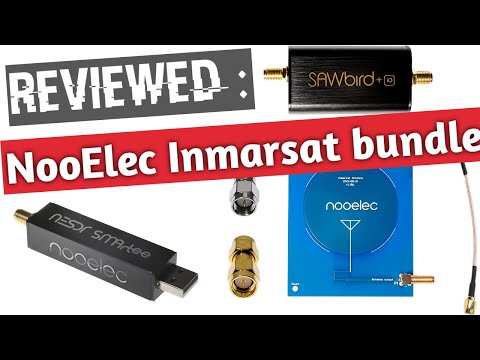
In his latest video Rob from Frugal Radio has reviewed the NooElec Inmarsat Patch Antenna Bundle. The US$79.95 bundle includes a PCB patch antenna, Inmarsat SAWBird LNA, SMA DC Block, SMA Barrel adapter and SMA pigtail. In the video Rob tests the bundle out on various AERO signals using the JAERO software, before moving on to compare the bundle with our own RTL-SDR Blog Active L-Band Patch antenna. The comparison results show that our $49.95 L-band antenna is better by about 5-6dB in SNR.
Our RTL-SDR Blog Active L-Band Patch antenna set is available on our store. However, please note that this antenna is currently in short supply due to the global electronics supply chain shortage. We expect to be sold out within a few days but we are aiming to be able to restock within 1-2 months from now.
Review : NooElec L Band Inmarsat Patch Antenna Bundle
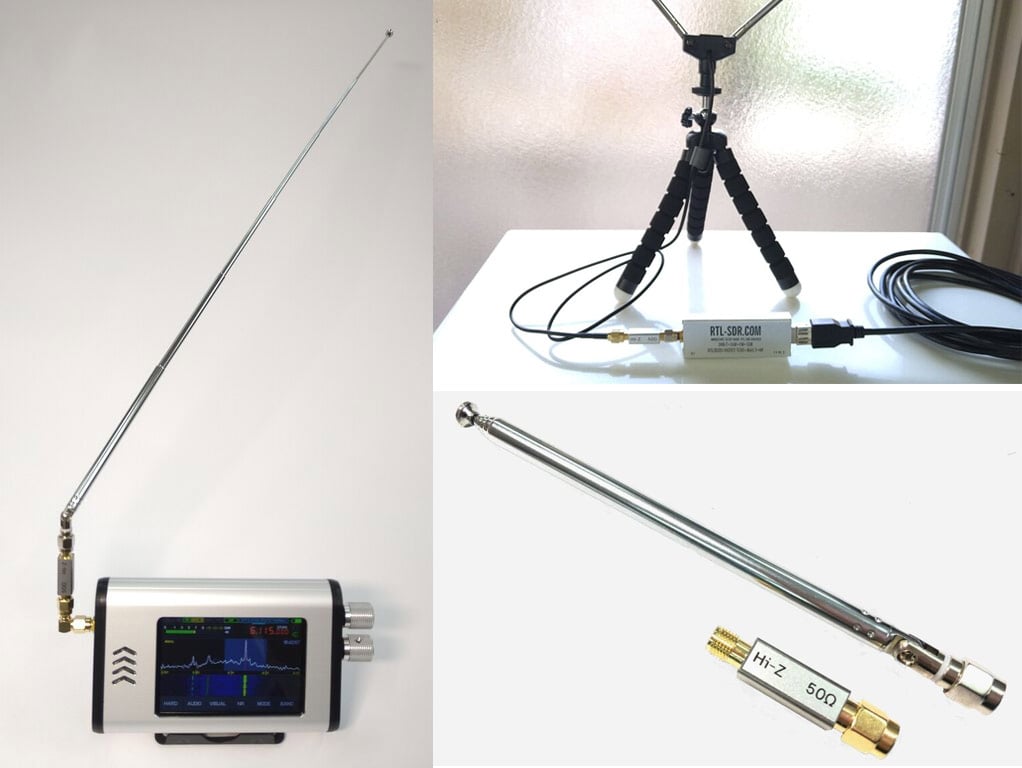
Thank you to Mitsunobu for writing in and sharing news about the release of his new product which is a Hi-Z (high impedance) to 50 Ohm matching transformer. This transformer allows you to use small antennas such as short telescopic whips for HF/SW reception on software defined radios.
Generally for HF reception you would want to use a full sized antenna, which can be many meters long and certainly not portable. However, by using an high impedance transformer it becomes possible to use smaller portable antennas. Reception with a small antenna and transformer will still be suboptimal compared to a full sized HF antenna, however, if the signals are strong enough the transformer will allow you to receive them decently.
In the tests shown on his blog (in Japanese, use Google Translate) he shows how the transformer adapter can be connected to a small telescopic whip and Malachite DSP SDR for portable use. Later he also shows how the adapter can make our Dipole Kit antenna work well for HF on a RTL-SDR Blog V3 with direct sampling.
Over on his YouTube channel saveitforparts has uploaded a video showing how he has built an automated weather satellite image collector for the NOAA APT and Meteor M2 LRPT satellites. The video shows a time lapse of him building a QFH antenna, and how he's mounted a Raspberry Pi and RTL-SDR inside a waterproof enclosure attached to the antenna mast. He goes on to show how he's automating the system with the Raspberry-NOAA V2 software.
Automated Home Weather Station (Satellite Image Collector)
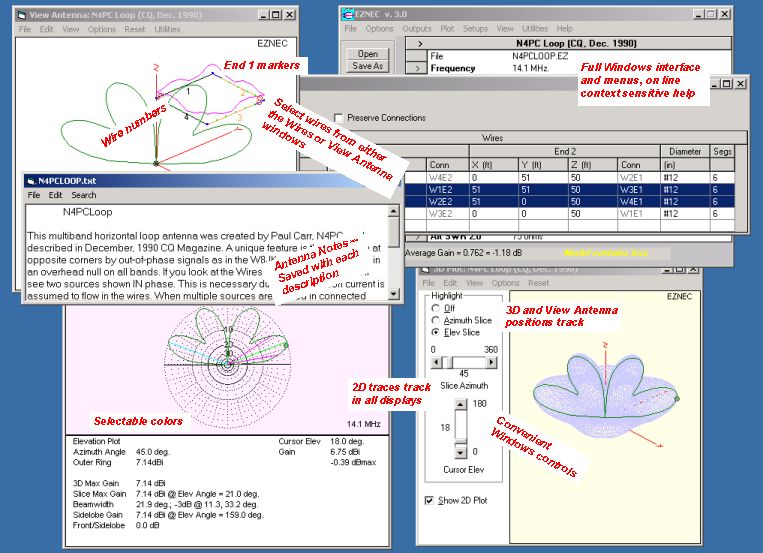
Over the past few months we have posted a few times about the beta of CENOS, a new antenna modelling and simulation design package. Recently CENOS has exited it's beta testing phase, and they have put out a press release about the first release.
Of most importance is that the software is affordable for hobbyist's, with a 10-day free trial and subscription price of €20 (US$25) per month for hobbyist use (no live engineering support).
Electromagnetics simulation software company CENOS (Riga, Latvia) continues on its mission to democratize simulation software by releasing its newest application designed for radio frequency and antenna design engineers. CENOS released its first electromagnetics simulation software focused on the induction heating applications in 2017 and it proved to be a success - mainly because of the simple and straightforward user experience and the specialization and focus on a single industry. After a year of development and testing in close cooperation with its avid beta-tester community, the Antenna Design simulation software was finally released for public use at the end of April, 2021.
CENOS Antenna Design is an intuitive FEM-based software that helps engineers to speed up RF antenna design, it solves Maxwell’s equations directly with no simplifications or limitations. Therefore, the results provided by CENOS are accurate for wide ranges of geometries and antennas, including very complex geometries. For instance, the software is good for high Q, multi-port simulations with arbitrary 3D structures. It is specialized for the simulation of microstrip- and wire-type antennas that include various geometries (fractal, helix, horn, loop, slot, patch, spiral, and others), as well as dipole and monopole antennas.
CENOS co-founder Dr. phys. Mihails Scepanskis: “Two years ago we launched a specialized induction heating simulation software to cover the growing demand in the SME sector - smaller equipment manufacturers, tooling shops, and production plants. Following the success in the low-frequency applications, we decided to move to the microwaves with the same mission - to democratize the simulation software, make it accessible for every engineer. I believe, it is an awkward situation in the market - engineers have to choose either to pay tons of money for enterprise-type generic simulation packages to utilize just a fraction of their functionality or to use over-simplified 1D approximations with the hobbyist-level software. With CENOS we have leveraged the power of open-source algorithms to break the status quo - to deliver a full-functionality FEM software for price-sensitive business users and individuals.”
CENOS Antenna Design is free to try for 10 days, after which the users can choose from the two subscription plans - for an individual or business use, starting from 20 euros per month ($25). The business version includes the features that help to automate and speed up simulation processes and has more integrations with the existing software and, most importantly, it has a live customer support through the chat and video calls. More features are planned to be added in 2021 and thus the prices may be increased over time, so now it is a good moment to subscribe and get all the future updates for a lower price.
The company name CENOS stands for “Connecting ENgineering Open Source” highlighting the new software approach they invented. It is a platform that connects the best of community-driven open-source algorithms into one seamless user experience and since it is a desktop software - the data do not leave the owner’s computer. CENOS was founded in 2017 by 3 PhDs in physics and mathematics who committed themselves to the democratization of the simulation software by making it easy, affordable, and secure for every engineer. CENOS is a startup, funded by the leading San Francisco early-stage investor ‘500 Startups’, the leading B2B European accelerator Startup Wise Guys, and the cohort of the Baltic business angels.
Last month we released our new L-band active patch antenna for sale, and not too long after we had a review from Frugal Radio praising it. We now have two more YouTube reviews available to share.
The first is from Tech Minds who does a teardown and demonstrates it receiving and decoding the Inmarsat STD-C NCS channel, receiving and decoding GPS and receiving Iridium signals. The second is from Mike Ladd from SDRplay, who tests it with an SDRplay RSP1A software defined radio. He shows that the patch works perfectly with an RSP1A, and demonstrates it receiving and decoding STD-C while mounted on the dash of his vehicle.
L-Band Patch Stock Availability Note: We note that we are already close to selling out of the first batch of these units as they sold much faster than expected! New sales of this patch are currently backordered but we expect to have a few more units from this first batch available by the end of next week. Also the freighter with Amazon USA stock should be arriving any day now, but it could still take a few weeks to get through the port and reach the warehouse due to the current port delays.
The second production batch of this antenna might still be a while away due to the electronic component shortage crisis occurring now, so if you were thinking about picking one up, please order ASAP.
RTL-SDR BLOG L-BAND Patch Antenna Version 2 - Inmarsat - Iridium - GPS
Back in early and mid March we posted about how several amateur radio hobbyists worked together to receive and figure out how to decode text telemetry as well as live video from SpaceX Falcon 9 rockets using low cost antennas and SDRs.
Unfortunately the fun has abruptly come to an end, with listeners discovering that the latest launch is now fully encrypted. Given the fact that the data stream was undiscovered and likely unencrypted for the last decade, it seems reasonable to assume that SpaceX added encryption in response to media publicity from the decoding discovery. There is also speculation that it may be due to NOAA space camera laws which caused livestream censorship back in 2018.
Over on Reddit u/derekcz has posted about the encryption, and has left us with some final still images reminding us of the fun that was had.
We also wanted to note that if you're disappointed because you ran out and bought antennas and gear specifically to receive Falcon 9 video, you could sill make use of the gear to receive GOES weather satellites, or to detect the Hydrogen line in the galactic plane.