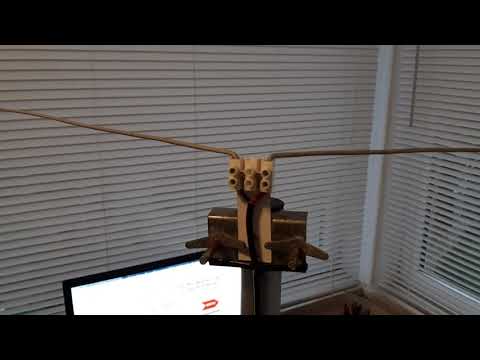
Back in 2017 we posted about Adam 9A4QV's simple V-Dipole antenna design which works very well for receiving NOAA and Meteor weather satellites at 137 MHz. This type of antenna is a lot easier to build compared to a QFH or turnstile, and it results in good performance if built and set up correctly. Over the years he notes that he's received a number of questions asking to clarify the design and so he's uploaded a YouTube video which explains the built and dimensions of the antenna clearly.
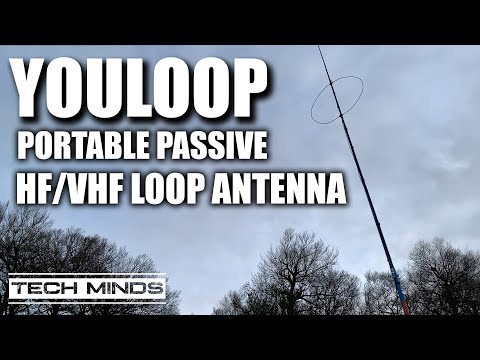
Over on YouTube Tech Minds has uploaded a new video where he unboxes and tests a YouLoop HF Passive Loop Antenna with his Airspy. The YouLoop design is also known as a Möbius loop, or noise cancelling passive loop "NCPL". The passive nature of the antenna means that highly sensitive radios will work best with it, however limited results may still be obtained with other radios. The advantages are extremely low levels of interference pickup and high portability.
In the video Tech Minds explains the specifications of the antenna before demonstrating the antenna receiving the HF bands with an Airspy + SpyVerter. He also tests the loop on VHF, demonstrating its ability to receive a distant 2M beacon.
We note that we sell official YouLoop antennas on our store for $34.95 including free shipping to most countries.
Back in October we first posted about the release of DF-Aggregator, a program by Corey (ckoval7) which can be used to receive and plot data from multiple KerberosSDR direction finding units.
If you weren't already aware KerberosSDR is our 4-channel phase coherent capable RTL-SDR unit that we previously crowdfunded back in 2018. With a 4-channel phase coherent RTL-SDR interesting applications like radio direction finding (RDF), passive radar and beam forming become possible. It can also be used as four separate RTL-SDRs for multichannel monitoring.
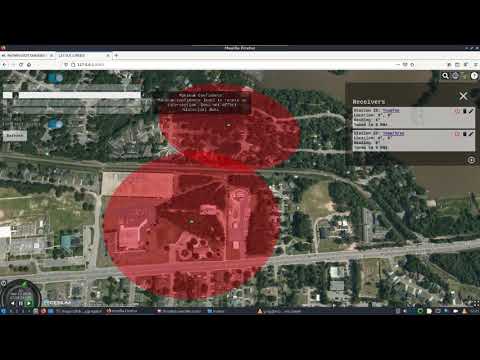
In one of his latest DragonOS videos, Aaron has been testing out DF-Aggregator. In his test he had two vehicles driving around each with a KerberosSDR and antenna array, with both using a mobile data connection to send data to a remote PC running DF-Aggregator. The results were successful, with the team being able to determine the location of a broadcast FM transmitter to within a few meters after a short drive.
DragonOS Focal KerberosSDR x2 Mobile w/ DF-Aggregator Direction Finding Attempt 2 (Better Results)
Gorizont-RTLSDR is an RTL-SDR focussed Linux distribution based on Xubuntu 20.04 LTS. Recently it was updated to V2.0.3. The creator Steve Cox writes:
New release and upgrade of gorizont linux, v 2.0.3. uploaded to sourceforge. The new AMSynch option in gqrx 2.14.2 works rather well for broadcast stations in direct sampling mode.
gqrx 2.14.2 - now with AMSynch mode!
SigDigger 0.1.0
Universal Radio Hacker 2.9.0
gqrx-scan
Welle.io 2.2 for all your DAB and DAB+ needs.
Baudline
fldigi
fmsg
Due to multiple issues with linux versions of Dream DRM, Dream DRM is now installed as a Win 32 .exe running under wine. It works!
w-scan for creating DVB-T/ATSC/etc. scan files for TV viewing using VLC
The Arecibo Radio Telescope has collapsed. Once the largest single dish radio telescope in the world at 305m, Arecibo was mostly used for radio astronomy research. However, the dish was made famous in 1974 for deliberating beaming a message into space as part of a search for extraterrestrial intelligence (SETI) experiment. It also played a part in popular culture, being a part of several famous films such as Golden Eye and Contact.
As part of it's goodbye we thought we'd highlight a few old posts where Arecibo was used together with SDRs for some interesting applications.
The project required finding and researching the original spacecraft documentation, and implementing the modulators and demodulators in GNU Radio. Whilst being successful in communicating with the satellite, ultimately the project failed due to the satellite's nitrogen tanks which had long leaked empty. But the fact that they were even able to find and communicate with the spacecraft using Arecibo was a major achievement. If you're interested in that project, Balint's 2015 talk on YouTube is an interesting watch.
Later in 2017 we saw how Arecibo was used for an Ionospheric heating experiment which involved transmitting 600kW of net power into the Ionosphere. This resulted in SDR users around the world being able to receive the signal. Other posts involve u/moslers Reddit post where he toured Arecibo and showed how they used a familiar program, HDSDR, as part of their monitoring suite.
So goodbye to Arecibo. However, we can look forward to the 500 meter Chinese FAST (Five-hundred-meter Aperture Spherical Radio Telescope) giving us new opportunities for single dish radio observations in the future.
We've posted about Job Geheniau's RTL-SDR radio telescope a few times in the past [1] [2] [3], and every time his results improve. This time is no exception as he's created his highest resolution radio image of the Milky Way to date. We have uploaded his PDF file explaining the project here.
Job used the same hardware as his previous measurements, a 1.5 meter dish, with 2x LNA's, a band pass filter and an RTL-SDR. Over 72 days he used the drift scan technique to collect data in 5 degree increments. The result is a map of our Milky Way galaxy at the neutral Hydrogen frequency of 1420.405 MHz.
JRT - Northern sky Hydrogen Line Survey with RTL-SDR
This image is quite comparable to an image shown in a previous post which was created by Marcus Leech from CCERA who used a 1.8m dish and Airspy.
If you're interested in exploring our Galaxy with an RTL-SDR via Hydrogen Line reception, we have a simple tutorial available here. The ideas presented in the tutorial could be adapted to create an image similar to the above, although with lower resolution.
John from JR Magnetics has written in and wanted to share his Kickstarter for a US$50 ultra wide band antenna that he has designed. The size is a just little bit bigger than two credit cards and the advertised coverage is from 750 MHz up to 6 GHz with a VSWR of less than 2.0.
John's Kickstarter text reads below:
Flat Ultra Wide Band Antenna Suitable for SDR
About
I was never satisfied with the commercially available wide band antennas. They were all too large or did not have suitable VSWR over the frequency range generally required by SDRs. I read many research papers and ultimately made a omni-directional ultra wide band antenna, but it was too expensive for most people. Details regarding that antenna can be found at https://www.rtl-sdr.com/constructing-a-3d-printed-wideband-900-mhz-to-11-ghz-antenna/
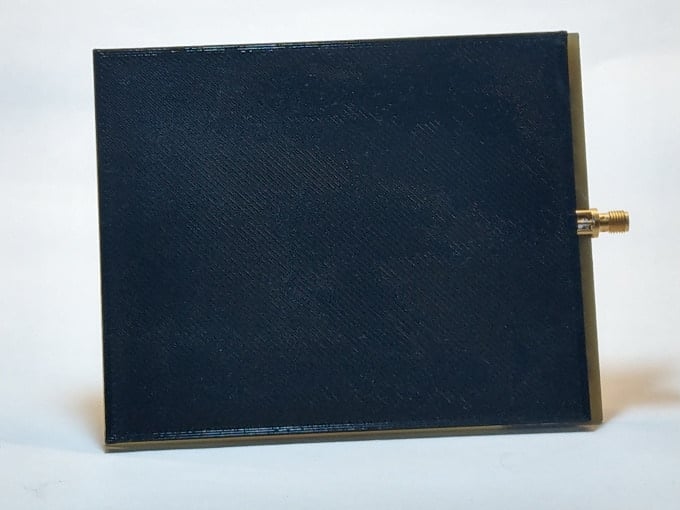
However, a bi-directional antenna was good enough for most people, so I have made a flat one. The antenna I ended up with is 5 inches by 4 inches and about 3 mm thick with an SMA connector. It is quite definitely not a square patch antenna, which usually has a narrow bandwidth.
This antenna has a VSWR measured to be under 2.00 from around 750 MHz to over 3 GHz. It simulates to have a VSWR under 2.00 out to over 6 Ghz. This is enough for most of the available SDRs. It works very well with WiFi, Bluetooth, Zigbee and other systems within the bandwidth.
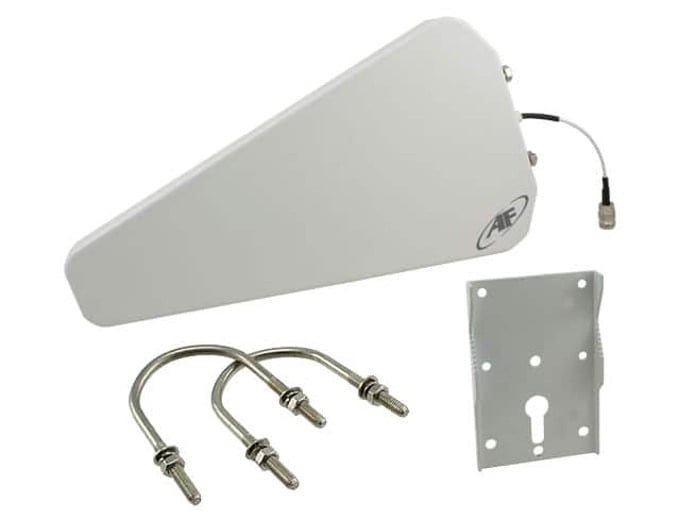
Typical Directional Log Antenna
Existing Antennas
The log antenna, Figure 2, has a wide bandwidth, but it is specified as having ranges, because the VSWR rises over 2.00 several times over that range. The antenna measure sover 40 centimeters long, which is problem for me in a laboratory setting. It is too large to fit anywhere and wants to be permanently fixed to a pole or something like that.
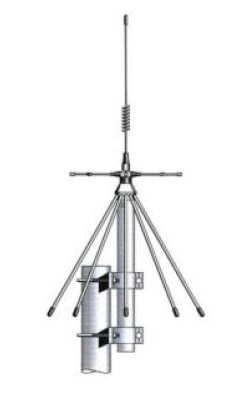
The other antenna I have is a discone type device, Figure 3. It is huge. There is not practical for it to fit on a lab bench around various RF devices. It is measures around 28 centimeters at its base. It needs to be elevated above any ground planes, which complicates a laboratory environment with metal bench tops. I have it sitting on a shelf above the computer monitors on the opposite side of the room away from the lab bench. This does not work well when I am trying to deal with wireless devices connected to USB hubs on the bench with short range features.
Discone Type Wide Band Antenna
Figure 4 shows the Flat Antenna next to the Log Antenna for a size comparison that illustrates just how much space saving there is with this new device. This is no small feat. This Flat Antenna is useful around all manner of RF devices on the bench without causing space issues, getting in the way of instruments and couples well with all of the wireless devices I am using. It is small enough with a convenient shape for moving it around and keeping it above a metal bench top. It only needs to be a few centimeters above any ground planes when perpendicular, not horizonal.
Due to its size and shape, near field problems have not been a problem, as with the other antennas. The antenna is quite directional, which is not much of a problem, since the RF bounces around all over the place. A Faraday shield is the only way to keep this device from picking out everything in the vicinity. The neighbors IoT devices create mountains of RF clutter. This antenna picks up all of it. If you only want restricted bandwidths, band pass and reject filters can be used. The load impedance is 50 Ohms across the band making an excellent match for all of the filters I have here.
Our Flat Antenna Size Comparison with the Log Antenna
Specifications
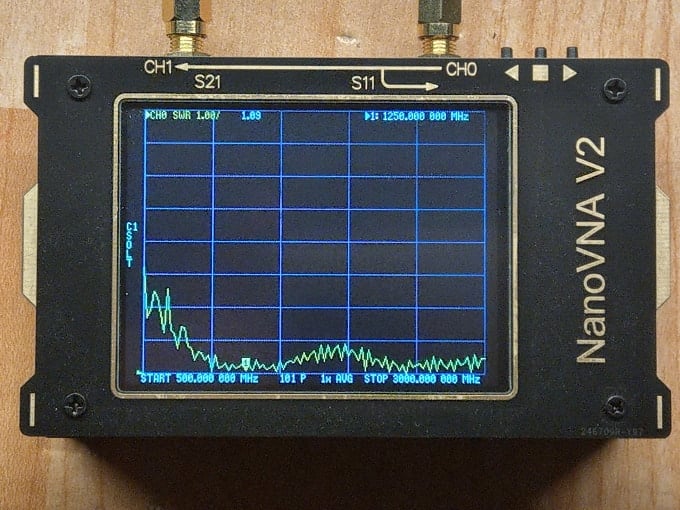
Figure 5 shows the VSWR as measured by the NanoVNA Version 2. It only goes out to 3 Ghz. The device must be calibrated before use, or you will get extraneous results. I am told the VSWR never goes above 2.00 until after 6 GHz. This is a remarkable antenna. I never found anything comparable to it on the Internet.
It can be used for all wireless and SDR applications normally within the 750 MHz to 6 GHz bandwidth. This is not guess work or speculation. The network analyzer shows the response clearly.
The antenna is 5 inches long by 4 inches wide by roughly 3 mm thick, not counting the SMA connector.
VSWR of Our Flat Antenna
What You Get
You get one (1) antenna, as shown in Figure 1, for each US$50. You cannot do this yourself for that price. Your time alone is worth more than that after you do the calculations, simulations and prototyping. You also would have to deal with fab shops to get this done correctly, which is not always convenient for many people.
In other words, this is a remarkable Ultra Wide Band Antenna at a remarkable price.
Engineering
This has already been done. I have a Masters Degree in RF Engineering. I also have all of the simulation tools that are not available to most people, with the exception of some university students.
Manufacturing
I have sources that I use all the time. I just put this one into the queue. We also have a minimum order, which is why we Crowd Fund this operation.
Timeline
Once in the queue, it takes about two (2) weeks. After that, we are only concerned with delivery time. We intend to use ordinaty Postal Service mail, to keep the cost down, so time of delivery may vary depending upon the destination.
Risks and challenges
We already have laboratory results, so there is nothing to risk in performance. The only other thing that could be troublesome is the lead time by the vendor that manufactures the main component or any delays caused by the Postal Service.
UPDATE 16 Dec 2020:John has provided us with this document that addresses a few questions people had about the antenna.
AirNav is the company behind RadarBox24.com, a flight data aggregation service similar to sites like FlightAware.com and FlightRadar24.com. RTL-SDR hardware is typically used to receive ADS-B, and like other providers AirNav have their own custom ADS-B optimized RTL-SDR unit. In addition they sell RTL-SDR's optimized for UAT 978 MHz and the VHF Airband. They also have a range of ADS-B/UAT/VHF airband outdoor antennas as well as filters.
Currently their products are discounted by 20% for Black Friday/Cyber Monday sales. The discount is available on Amazon, as well as directly from their store with coupon GET20.