Category: Antennas

Using our RTL-SDR Blog Dipole as a V-Dipole for Receiving Weather Satellites

With our RTL-SDR Blog dipole antenna set, it is possible to use it in a "V-dipole" configuration to receive polar-orbiting weather satellites such as NOAA and Meteor at 137 MHz. More information on this can be found on our page at www.rtl-sdr.com/DIPOLE.

If you are after more visual instruction, "Baltic Lab" has uploaded a clear video on YouTube showing how to set the dipole leg lengths and angles correctly for weather satellite reception. 

We want to add that it is also important to remember to mount the antenna outdoors horizontally and in a north-south orientation with a clear view of the sky for the best results.

How To Build A V Dipole For Receiving Weather Satellites

IEEE Spectrum Article on Discovery Dish

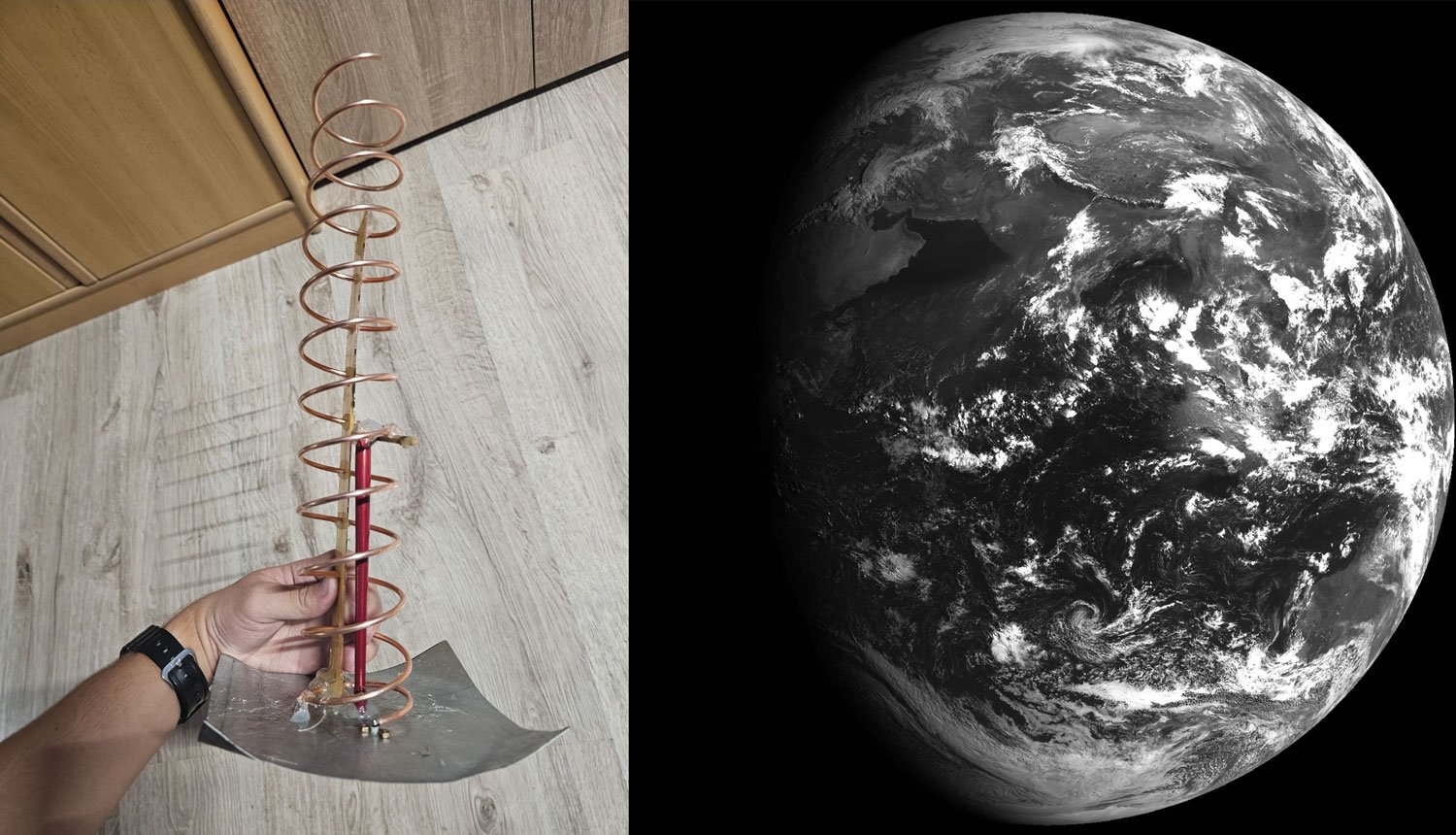
Electrical engineering magazine IEEE Spectrum has recently posted an article about our Discovery Dish product, which was successfully crowd-funded on CrowdSupply and delivered to initial backers early this year. Discovery Dish is a 70-cm aluminum satellite dish with an active filtered feed. It is designed for receiving real-time weather data from GOES HRIT, GK-2A LRIT, FengYun LRIT, NOAA HRPT, Metop HRPT, Meteor M2 HRPT, and other weather satellites that operate around 1.69 GHz. There are also feeds for Inmarsat satellites, Hydroden Line observation, and S-band satellites.

In the article, Stephen Cass introduces the Discovery Dish, highlighting its practical uses and the convenience of disassembling it for easy packing in a suitcase during travel. He also shares his experience using the Discovery Dish to successfully receive images from the GOES-East satellite from the rooftop of his New York City apartment.

Finally, he mentions how he tested the hydrogen line feed as well, successfully seeing a hydrogen line peak when pointing at the galaxy.

Image from the IEEE Spectrum Article on Discovery Dish

A 3D Printed V-Dipole Guide for the RTL-SDR Blog Dipole Kit

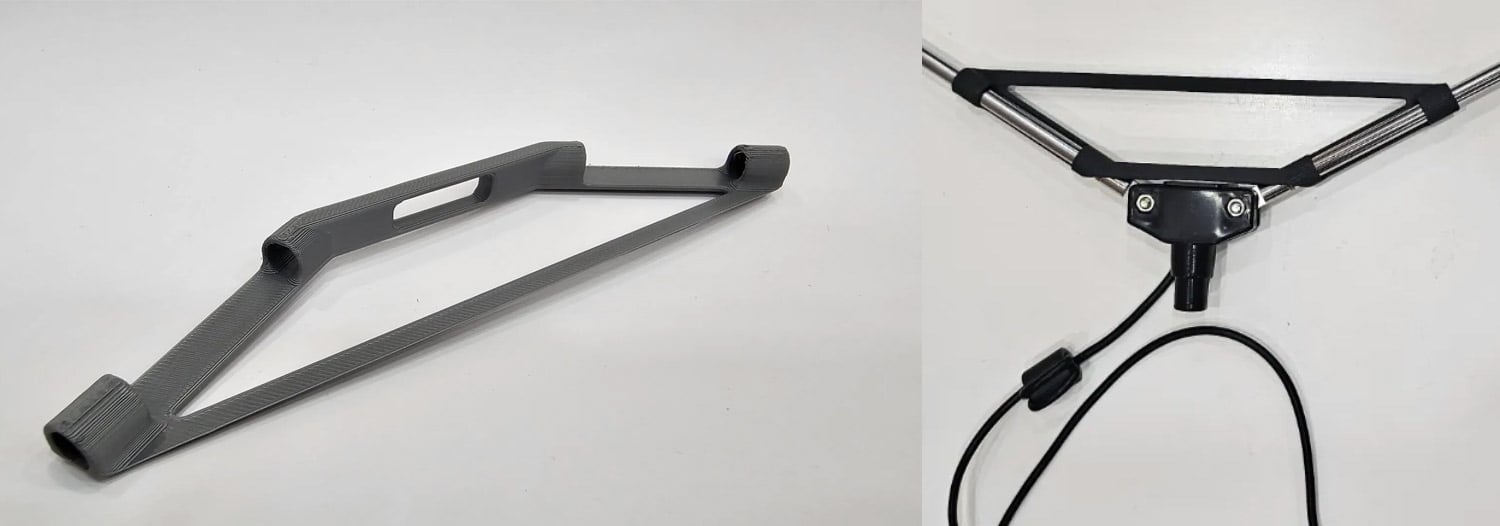
Thank you to Denis for submitting his 3D printable V-dipole guide for our RTL-SDR Blog Dipole Antenna set. The guide holes the dipole at a 120-degree V-shape angle, which is ideal for receiving polar-orbiting satellites such as NOAA and Meteor at 137 MHz. 

Back in 2017, Adam 9A4QV wrote about how a V-Dipole could be used as a very simple yet effective antenna for receiving weather satellites. Since then, it has become a popular beginner's choice for receiving weather satellites.

In the past, we've also seen other 3D-printed V-dipole holders, such as this one by f16v1per. However, f16v1per relies on cable ties to hold the elements in place, whereas the design by Denis simply slides in place.

If you don't have an RTL-SDR Blog Dipole Antenna, you can also build a V-dipole out of an electrical terminal block and a different 3D-printed part, as shown in this previous post.

3D Printed V-Dipole Holder

Saveitforparts: Receiving Military DMSP Satellite Data with a Hacked TV Dish

Over on the saveitforparts YouTube channel, Gabe has uploaded a video showing how he uses a hacked TV satellite dish to receive satellite weather data from Defense Meteoroloogical Satellite Program (DMSP) satellites.

These satellites were initially developed during the Cold War and featured an encrypted downlink of meteorological data. However, recently, the DMSP downlink has encryption turned off when passing over the northern half of the USA (40°-41° latitude and up to 60° North), allowing hobbyists in some parts of the USA to decode images. 

In his video, Gabe uses a HackRF SDR with an old DirectTV dish with a modified S-band helical feed mounted on a hacked Wineguard motorized platform that was originally intended for automatically pointing TV dishes on RVs. Despite some initial problems with the SatDump software crashing, he is eventually able to receive some nice, clean images.

Interestingly, Gabe also shows what the signal looks like while encrypted and how it transitions to the unencrypted signal after the satellite passes over the threshold. 

We note that it is not documented by the military why encryption is being turned off only over the northern half of the USA. Still, it is speculated that the military doesn't consider images over this part of the USA to be sensitive, and disabling encryption could help save power and help other organizations with scientific research. However, as Gabe mentions in the video, being a Cold War-era satellite, the image quality from DMSP isn't great, and more modern satellites like the NOAA series give much better images over the entire earth unencrypted. 

Grabbing Military Satellite Data With Hacked TV Dish

Saveitforparts Checks out the Discovery Dish

Over on his YouTube channel 'saveitforparts,' Gabe has uploaded a video checking out and reviewing our Discovery Dish product that we successfully crowd-funded on CrowdSupply back in December 2023.

Discovery Dish is designed as a low-cost way to dive straight into backyard satellite experiments, including receiving L-band and S-Band weather satellites as well as Inmarsat satellites. It also offers an easy entry into making galactic Hydrogen line observations.

The dish is a 70cm prime focus dish, that can easily be broken down into three parts for easy storage and transport. The feeds are fully integrated, meaning that the feed antenna, LNA, and filtering are all in one unit and built into a waterproof enclosure. This means there is no need to purchase individual components and figure out waterproofing.

In his video, Gabe unboxes the Discovery Dish, builds it, and uses the L-band feed to receive a few images from GOES 16, Meteor M3, Meteor M4, and METOP weather satellites. He goes on to successfully test reception with the S-band feeds on NOAA weather satellites, before testing out the Inmarsat feed and successfully receiving signals. Finally, Gave notes that he hopes to test out the Hydrogen Line feed in a future video.

Checking Out The Discovery Dish - A Simple & Easy-To-Use Satellite Antenna For Everyone!

CCC Conference Talk: Investigating the Iridium Satellite Network

Over the years, we've posted numerous times about the work of “Sec” and “Schneider,” two information security researchers who have been investigating the Iridium satellite phone network using SDRs. Iridium is a constellation of 66 satellites in low Earth orbit that supports global voice, data, and messaging services.

In a talk at the Chaos Computer Club (CCC) 2024 conference, they provided updates on their work. The recorded video of their talk has recently been uploaded to YouTube.

The Iridium satellite (phone) network is evolving and so is our understanding of it. Hardware and software tools have improved massively since our last update at 32C3. New services have been discovered and analyzed. Let's dive into the technical details of having a lot of fun with listening to satellites.

We'll cover a whole range of topics related to listening to Iridium satellites and making sense of the (meta) data that can be collected that way:

  • Overview of new antenna options for reception. From commercial offerings (thanks to Iridium Time and Location) to home grown active antennas.
  • How we made it possible to run the data extraction from an SDR on just a Raspberry Pi.
  • Running experiments on the Allen Telescope Array.
  • Analyzing the beam patterns of Iridium satellites.
  • Lessons learned in trying to accurately timestamp Iridium transmissions for future TDOA analysis.
  • What ACARS and Iridium have in common and how a community made use of this.
  • Experiments in using Iridium as a GPS alternative.
  • Discoveries in how the network handles handset location updates and the consequences for privacy.
  • Frame format and demodulation of the Iridium Time and Location service.
38C3 - Investigating the Iridium Satellite Network

Saveitforparts: Hacking an Motorized RV Satellite Dish for Tracking LEO Satellites

Over on the saveitforparts YouTube channel, Gabe has uploaded a new video showing how he's hacking an old motorized Wineguard RV satellite dish for tracking low earth orbit satellites, such as the NOAA and Meteor weather satellites as well as the US Military's DMSP system.

The motorized RV satellite dish was originally intended for tracking TV satellites, but by connecting to the serial port on the control unit, Gabe is able to control the satellite dish through his own code.

In this video I'm creating a motorized satellite tracker for S-Band signals. S-Band includes NOAA weather satellites and the US Military's DMSP system (it's also the radio band for WiFi, which I might look at later).

I'm using a Winegard brand "Trav'ler" antenna designed for use on campers and recreational vehicles. It has a built-in three-axis motor system for pointing at TV satellites, but I wanted to use it for tracking satellites closer to earth. Since a low-orbit satellite like NOAA 18 or DMSP passes overhead in about 10 minutes, I need to move the dish faster and more precisely then it was intended for.

This project is still ongoing, and I don't yet have the code up on Github. When I do, it will be available at https://github.com/saveitforparts/ alongside the code for some similar antennas I've hacked in the past.

The serial cable I'm using is described here: https://saveitforparts.wordpress.com/2023/12/29/another-portable-radio-telescope/

Modifying RV Satellite Dish To Track Low-Earth-Orbit Satellites

Setting up a Dual RX System with an SDR and Ham Radio Rig via an SDRSwitch

There are two common options when using an SDR together with a ham radio rig. You can either create an IF tap within your ham radio and connect the SDR to that, or connect the SDR directly to the antenna via a switch that switches the SDR out when transmitting.

Over on YouTube, Ham Radio DX has uploaded a video discussing the latter option and revealing its advantages. In the video, he mentions results by HB9VQQ that show that connecting an Airspy HF+ directly to an antenna via an SDR switch from SDRSwitch.com results in 60% more spots on WSPR, compared to using an IF tap from an FT450D ham radio rig.

He goes on to explain and demonstrate his setup and the recommended switch that he is using, which is the SDRSwitch by N2EME, available at SDRSwitch.com. He notes that this switch is recommended due to its very low insertion loss and high isolation specifications and compares it against an MFJ switch, which has some rather terrible specifications.

Add a SDR Receiver to ANY Ham Radio Rig!