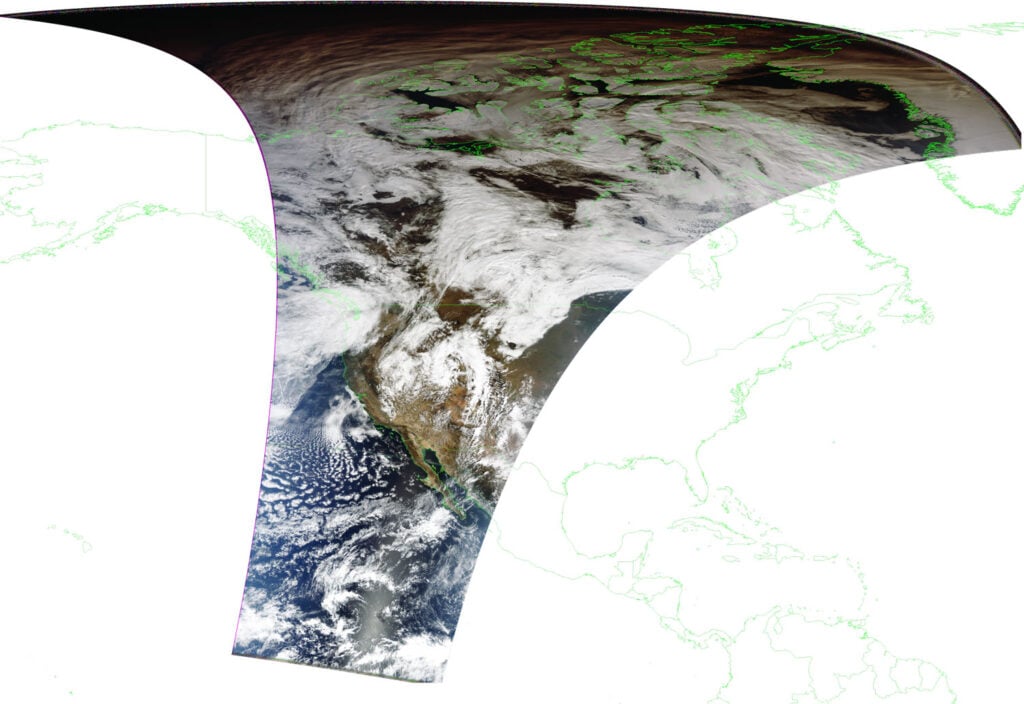
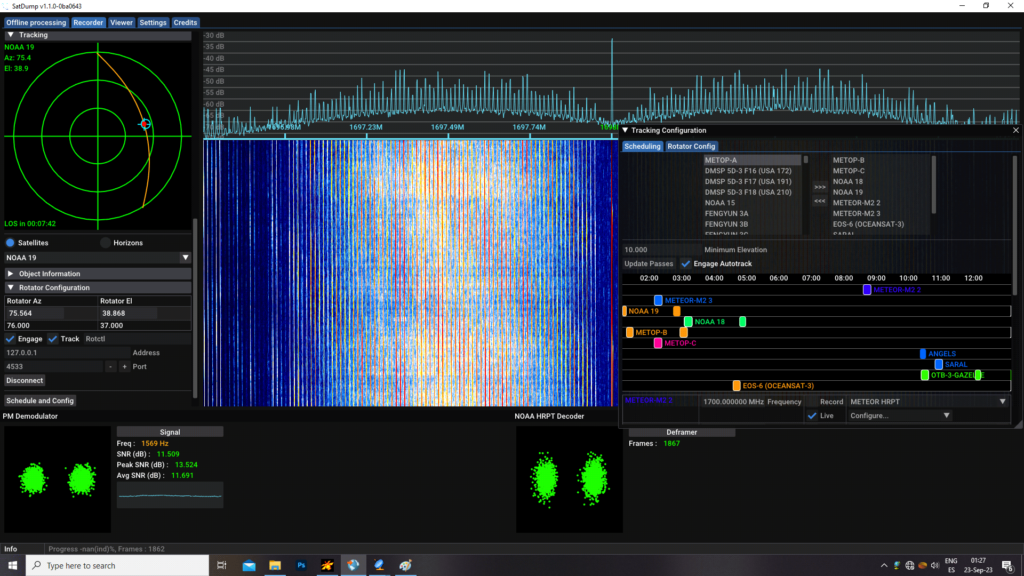
SatDump is a popular program that is used with RTL-SDRs and other SDRs for decoding transmissions from a wide array of weather satellites and their various imagers and sensors. Recently SatDump's author @aang254 has been working on improving the way projections work. Projections are essentially when the weather satellite image is stretched and skewed to fit correctly over the curved earth.
This means now that city markings and border lines should show up in the correct placed in any images received from SatDump.
If you're interested @aang254 has uploaded blog post on the SatDump website explaining the math, algorithms and problems he found when trying to get projections done right.
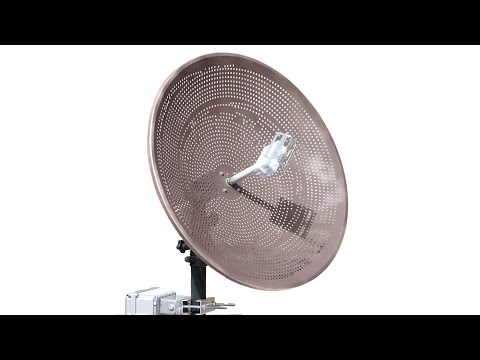
Over on his YouTube channel, "saveitforparts" has uploaded a video showing how he's modified an old wireless networking dish for L-band HRPT satellite reception. L-band satellites that transmit HRPT are polar orbiting, meaning that some sort of tracking solution is required to point the satellite dish at the sky as the satellite passes over. However, lacking any sort of motorized solution, saveitforparts simply removes the dish mount so that the dish can be manually held and tracked.
He notes that he uses the paid version of the Stellarium app for augmented reality tracking of the satellite. In the past there was a great app called "Satellite AR" which did this for free, however within the past few years it has unfortunately been removed from the Google Play store.
The modifications to the dish involve removing the feed from the satellite and installing a custom built helical feed. He also uses a small handheld PC with RTL-SDR on the rear. However in the end the handheld PC turns out to be problematic so he switches to a laptop.
The dish used in saveitforpart's project is quite similar to our upcoming Discovery Dish crowd funding project, so please check that out if you are interested.
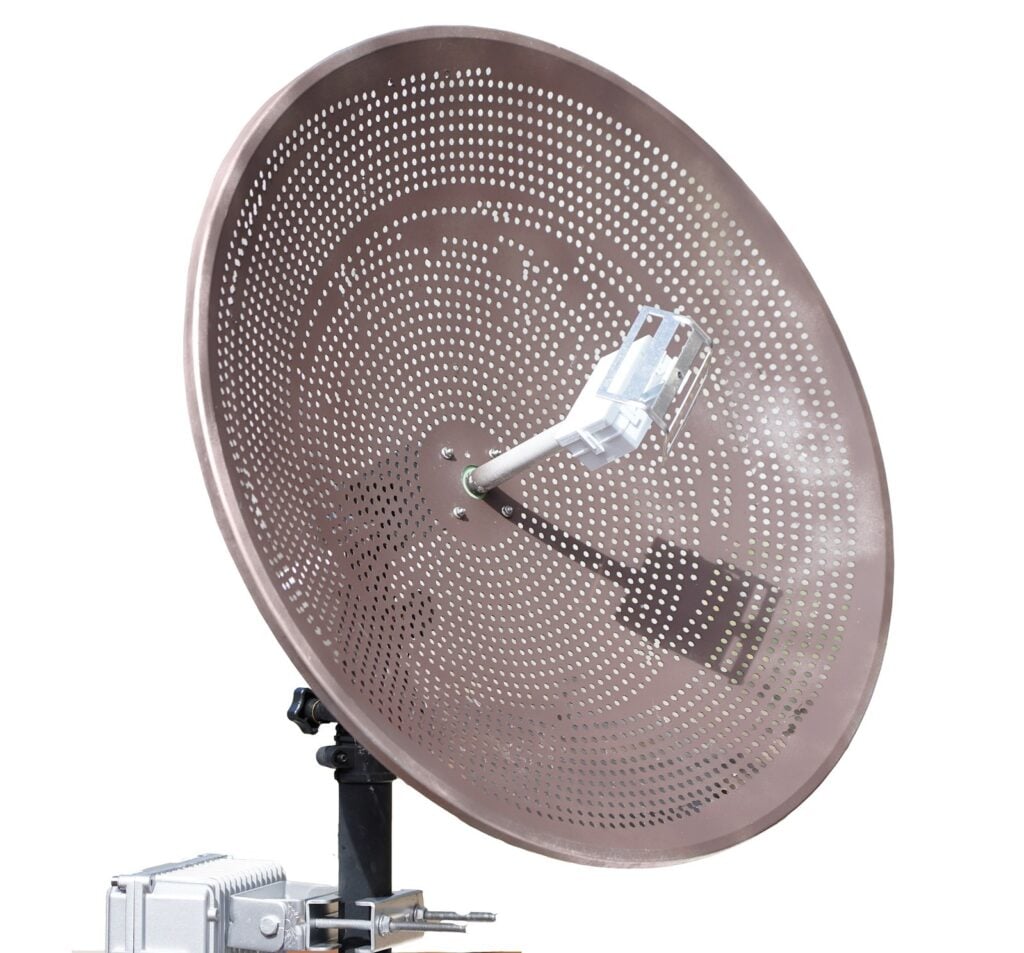
For the past few years we have been working on finding the best way to help beginners get started with L-band weather satellite reception and basic radio astronomy. We have now come up with a solution that we're calling the 'Discovery Dish' - a lightweight 65 cm diameter dish and active filtered feed set.
Discovery Dish: Simplified system for weather satellite reception and hydrogen line radio astronomy
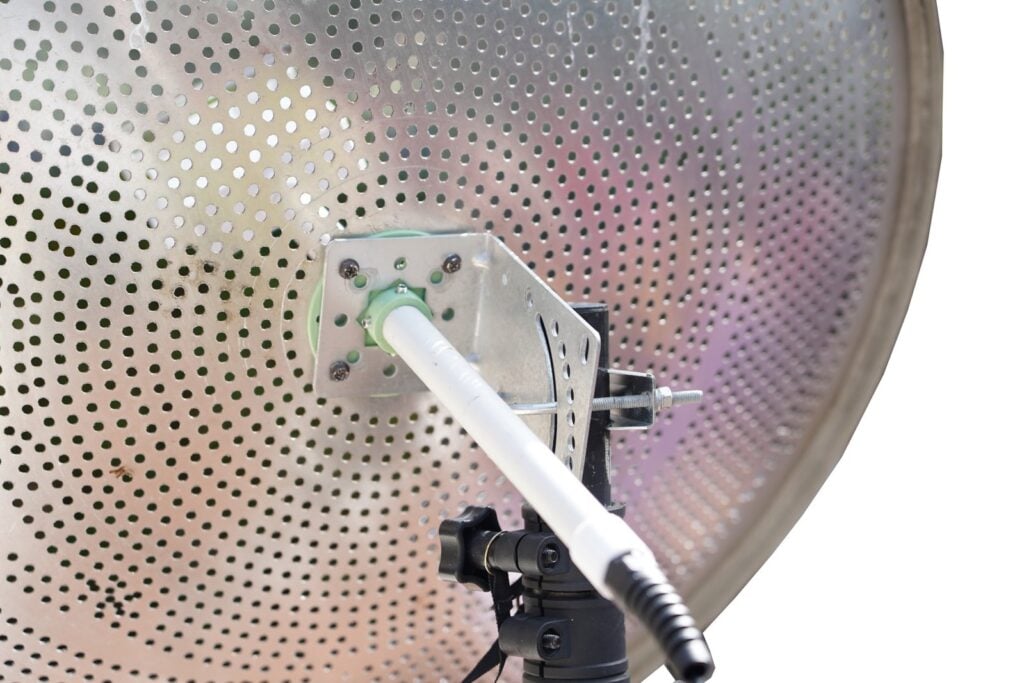
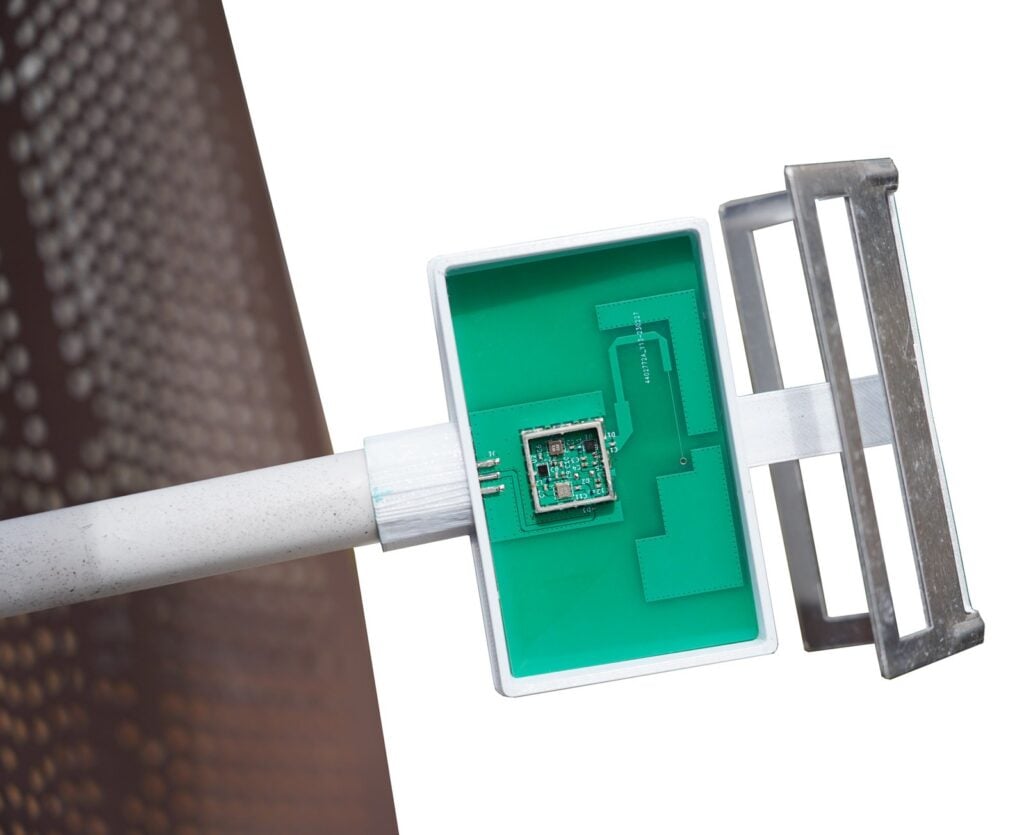
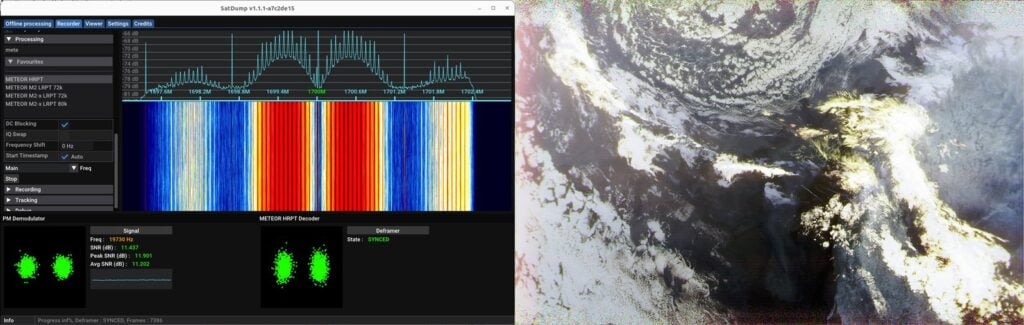
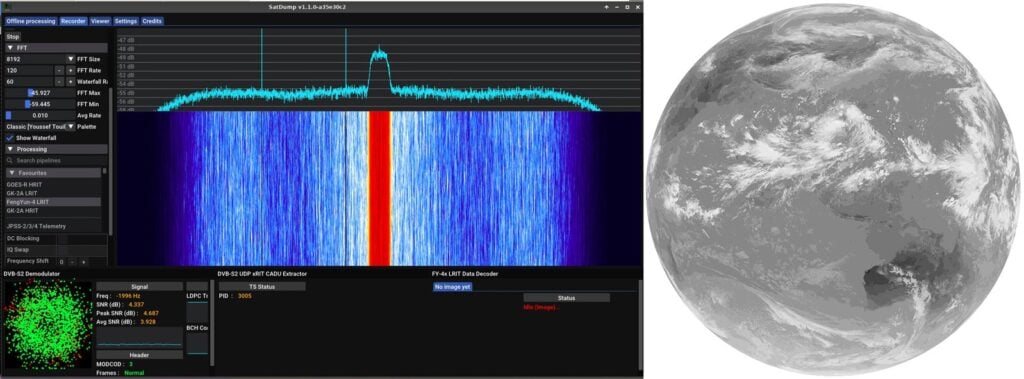
Discovery Dish is a 65-cm diameter aluminum satellite dish and active filtered feed designed for receiving GOES HRIT, GK-2A LRIT, FengYun LRIT, NOAA HRPT, Metop HRPT, Meteor M2 HRPT and other weather satellites that operate around 1.69 GHz. The dish is designed to weigh under one kilogram, and it splits into three petals, making it easier to ship worldwide. The 1.69 GHz feed contains a built-in LNA right at the feed point, as well as filtering, which means that there is almost no noise figure loss from cables or connectors.
Note that the prototype images show an early non-petalized prototype with rough laser cut wind holes. The production version will obviously be a lot neater looking!
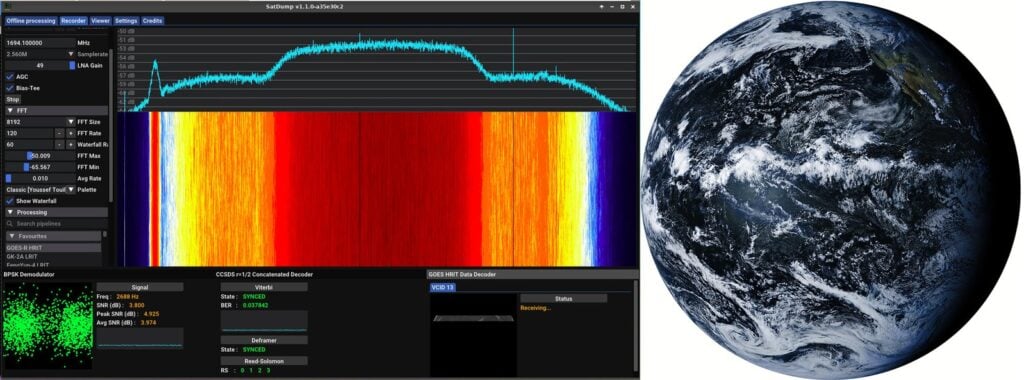
In testing the 65 cm diameter Discovery Dish with it's highly optimized feed has proven effective at receiving the GOES HRIT satellite signal with SatDump. We typically achieve SNR values of 3-4 dB to GOES-18 at 24 deg elevation, and with SatDump an SNR of 1 dB is about the minimum required to receive images so there is plenty of margin. It can also easily receive LRIT from GK-2A and Fengyun, and also when combined with an antenna rotator (or manual hand rotating) can receive HRPT weather satellites too.
The feed on the Discovery Dish consists of a tuned dipole feed with two 5V bias tee powered low noise figure LNAs, and two SAW filters (centered at 1680 MHz with 69 MHz Bandwidth). The feeds are also easily swapped out, and we will also be selling a 1.42 GHz Hydrogen Line feed for those who want to use the dish to get started with radio astronomy. Because the LNA's are right by the feed there is are no losses from feed to LNA, so we can use thinner and easier to handle cabling like RG58 without any loss issues.
In the past we've recommended and relied on 60 x 100 cm WiFi dish antennas for L-Band geosynchronous satellites and Hydrogen Line reception, but at 1.6kg these are too heavy, wide and exert too much torque for light duty antenna rotators to handle. At about half the weight of an equivalent WiFi Dish, the Discovery Dish is much easier to handle.
In the future we hope to be able to provide a low cost light duty antenna rotator that compliments the Discovery Dish. Currently we have tested the Discovery Dish with the AntRunner antenna rotator and found it to be light enough for that rotator to handle, versus a WiFi dish which is far too heavy for it.
Also when compared to a WiFi dish, the Discovery Dish is much easier to optimally set the offset skew as you can simply rotate the feed, versus having to rotate the entire dish at 45 degree increments.
We will also be offering an outdoor electronics enclosure that can be used to house a Raspberry Pi, RTL-SDR and other components like POE splitters. In our tests we have been running an RTL-SDR Blog V4, Orange Pi 5 and POE splitter in the enclosure, and running the SatDump GUI directly on the Orange Pi 5. This results in a neat contained system where only one Ethernet cable needs to be run out to the enclosure.
As we are in pre-launch, pricing is not yet confirmed, but we expect the Discovery Dish to sell for less than US$200 with reasonable worldwide shipping costs. It will be a similar cost to what you would pay if you purchased a WiFi dish, filtered LNA and cabling yourself. Obviously please check what satellites can be seen in your region.
SatDump is a popular program that can be used with RTL-SDRs and other software defined radios for decoding images from a wide array of weather imaging (and other) satellites including GOES, GK-2A, NOAA APT, NOAA HRPT, FengYun, Electro-L and Meteor M2 LRPT + HRPT, and many many others. It is multiplatform, running on Windows, MacOS, Linux and even Android. Because of it's good decoding performance, wide satellite and OS compatibility, it is the most recommended software for satellite decoding.
Recently SatDump was updated to version 1.1.0 and the new version brings many enhancements and new features. In summary, Lua scripting support has been added, calibrated products are now possible, composites can be made via Lua scripting, nightly builds are now available on GitHub, Mac .dmg builds are now available, decimation has been added, an SDR Server is available, and a Windows installer was added.
Support for various satellites and their instruments have also been added for NOAA APT, CCSDS LDPC decoding for Orion, LandSat-9, TUBIN X-Band, FengYun-3G/3F, Meteor M2-3, Geonetcast (soon), GOES RAW X-Band, STEREO-A, DSCOVR EPIC, ELEKTRO-L N°4, Inmarsat STD-C, UmKA-1 (soon), PROBA-V GPS .
SatDump also now includes rotor tracking control which works together with it's satellite pass predictor and scheduler. There is no more need to use programs like Orbitron or Gpredict as everything can be handled by SatDump.
An insane amount of work has gone into SatDump, so if you like the software please remember to support the developer @aang23 by donating on Ko-Fi.
Thank you to Carl Reinemann for writing in and sharing with us that the Meteor M2 LRPT decoder by Oleg (Robonuka) was recently updated. The Russian Meteor M2-3 weather satellite was launched in June of this year and is currently the only operational Meteor M2 satellite in the sky. It transmits images at 137 MHz in the digital LRPT format.
To receive it a simple V-Dipole antenna and RTL-SDR is usually sufficient. And to decode it software like SatDump or M2_LRPT_DECODER combined with the Meteor Demodulation Plugin for SDR# can be used. Instructions for the latter are available on HappySats instructional page.
Regarding the update Carl writes:
Thanks to Oleg (Robonuka), Happysat and Usradioguy have been testing the new decoder for about 6 weeks now, and it is ready to go!
The stability of the processing has been improved: The decoder is now more likely to produce stable results, even when there are errors in the input data.
The procedure for generating RGB and calculating GEO in the error-handling block has been improved. Now, the decoder's processing is considered unfinished until the GEO calculation is completed.: This means that the decoder will now wait until the GEO calculation is finished before generating the RGB values. This helps to prevent errors and produce more accurate results.
Exception errors fixed: Some errors that were previously causing the decoder to crash have been fixed.
AutoClose=yes by default: This means that the decoder will now automatically close when it is finished decoding. This can be helpful for saving resources and preventing memory leaks.
80K is much more stable: The decoder is now more stable than before. This means that it is less likely to crash or produce unexpected results.
Overall, these changes make the decoder more reliable and easier to use.
Over on the saveitforparts YouTube channel the creator has uploaded a video showing how he was able to image geosynchronous satellites with his modified motorized RV satellite dish. The idea is to scan the sky using the motorized dish, taking Ku-band RF power readings at each point in the sky. The result forms a heatmap image of satellite transmissions in the sky. For the most part, the satellites detected are TV satellites and they are at known positions in the sky.
However, in one of his recent scans saveitforparts appears to have detected an unknown satellite just outside of the geostationary plane. He goes on to discuss what it could have been, noting that it is most likely to be the AMSC 1 telecommunications satellite.
Recently I spotted a strange "UFO" with my homemade radio telescope / microwave imager. I've used this imager before to spot television satellites in geostationary orbit, but this unknown object was something new to me.
Spoiler Alert: I was able to determine that I'm probably seeing a geosynchronous (but not geostationary) satellite in an inclined / elliptical orbit. Specifically, I think this is the AMSC-1 telecom satellite, which is in a type of orbit designed to cover high latitudes like Northern Canada.
These types of satellites don't seem to show up too often on my telescope / imager setup, since they're not as common and aren't usually aimed directly at my location. This is the first time I've managed to spot one (if that's what I'm seeing), so it seems kind of rare to catch it with this particular equipment!
Folks might also ask if this "UFO" could be the sun or moon producing microwave signals, but those were both off to the left of the scan, not where the mystery signal showed up. It's also probably not a reflection / side lobe / "lens flare", I do get those, but they show up as rings around the main signals, and in fact this mystery signal has its own faint ring around it. Since my dish takes 3-4hrs to do a full scan, this also isn't something fast like a plane or low-orbit satellite as those don't show up on my imager (I'm essentially taking a very long time exposure).
I'm still planning to upgrade / rebuild this mini radiotelescope device in the future, hopefully with more flexibility to pick up different frequencies. That should let me see even more satellites (and maybe other space stuff!).
Mysterious Space Object Detected With DIY Radio Telescope
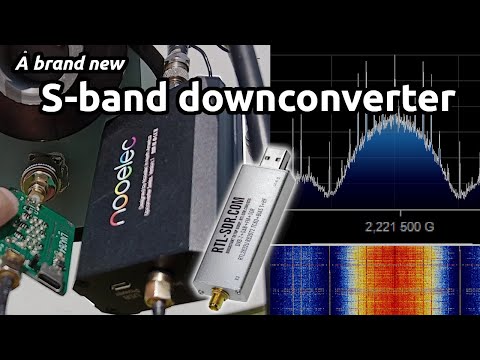
Over on his YouTube channel dereksgc has uploaded a new video where he tests out a new yet to be released downconverter product from NooElec. A downconverter works by shifting high frequencies down into a range that can be received by the RTL-SDR. This makes it useful for receiving 2.2 GHz S-band satellite downlinks which is out of the tuning range of RTL-SDR dongles.
In his video dereksgc shows the new 'Ham-it-down' downconverter, and tests it with an LNA and S-band helix feed and dish. He shows that he is able to easily receive S-band telecommunications satellites without a dish, and with a dish he is able to receive the Coriolis and Chandrayaan-3 satellites.
The ham-it-down is expected to cost US$90 when released. We note that a much lower cost solution might be a commercial 2.2 GHz MMDS downconverter which also comes built in with an LNA and filtering and can be obtained from Aliexpress for less than US$20. Alternatively, the $90 might be better put towards a HackRF clone which is almost the same price and can receive S-band natively without the need for external downconverter.
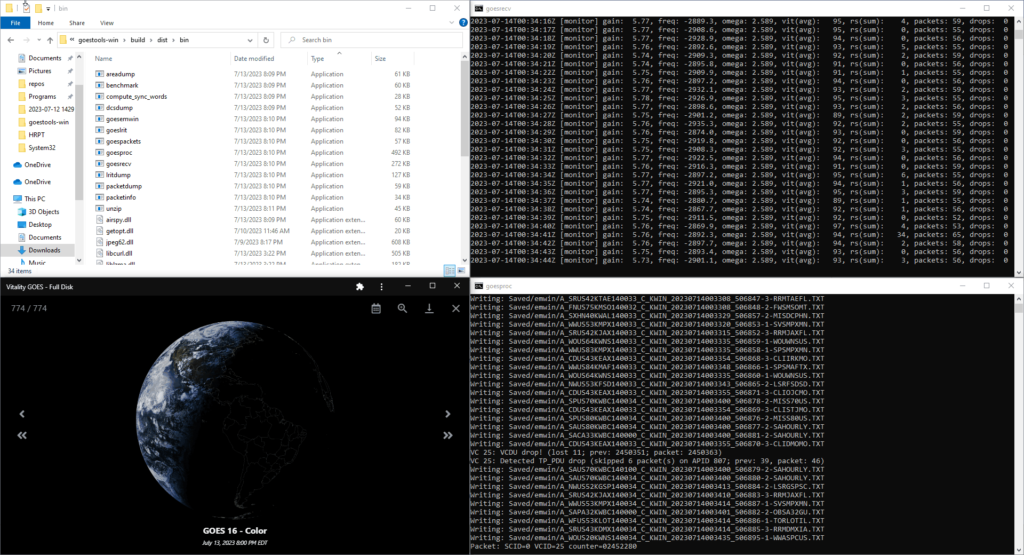
Thank you to Carl Reinemann (aka USRadioGuy) for letting us know through his blog post that goestools has recently been ported to Windows. Goestools is a software package that is used to receive and decode images from GOES weather satellites. In the past it was only available for Linux systems, however recently thanks to the work of Jamie Vital, goestools has now been ported and can run on Windows. Carl Reinemann has confirmed that the software runs perfectly on Windows. Our GOES tutorial should also be easily modified to work with the Windows port.
The Windows port can be downloaded from goestools-win on GitHub. If you are interested, Jamie Vital is also the author of Vitality GOES, which is a program that can display the received weather images in a nice GUI.
Alternatively we note that another cross platform GOES decoder is SatDump which is currently the most popular choice for GOES.