A Car Based SDR Station for ADS-B, ATCS, P25, DMR, POCSAG and more

Over on YouTube user Corrosive has uploaded a video where he takes us on a tour or his very nicely set up mobile SDR station that is built into his car. His setup includes several antennas on his car's roof which cover multiple bands, a BCD780XLT scanner, an RTL-SDR, an Android head unit that is capable of running multiple SDR apps and also a Windows tablet that is used to run more CPU heavy SDR apps.

Later in the video he shows himself running SDR Trunk on the tablet and receiving and decoding the local P25 police department signal, and then running dump1090 for monitoring aircraft ADS-B, and Gpredict for tracking satellites.

RTL SDR Mobile Car Station | Receive ADS-B ATCS P25 DMR POCSAG and More on the Go!

RadCom Review of the RSPduo Now Available Online

In the July 2018 edition of the UK based amateur radio magazine 'RadCom' Mike Richards wrote up a review of the RSPduo. This review is now available for free to download from SDRplay (pdf). The RSPduo is the latest product from SDRplay. Unlike previous models the RSPduo has two tuners on board which can be used to tune to two independent 2 MHz wide areas of the spectrum simultaneously. It currently retails for US $279.95 + shipping.

Mike's review goes over the design of the RSPduo and discusses it's dual tuning capabilities. He mentions that the most exciting prospect of the RSPduo is going to be the phase-coherent applications, such as active noise cancelling. At the moment no software for these applications is available, however SDRplay is working on it. In addition to this, Mike also discusses the new API, changes to the filtering and connections, and well as some notes on sample rates and decimation.

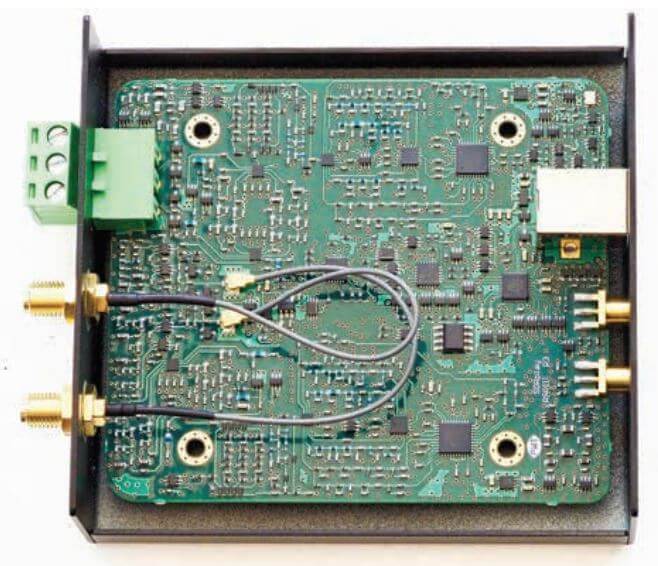
Inside the RSPduo
Inside the RSPduo

Tutorial on using RS to Decode and Plot Radiosondes

A radiosonde is a small weather sensor package that is typically attached to a weather balloon. As it rises into the atmosphere it measures parameters such as temperature, humidity, pressure, GPS location etc, and transmits this data back down to a receiver base station using a radio signal.

Zilog's RS is a free open source radiosonde decoder for Linux and it supports a wide range of radiosonde protocols. Together with an RTL-SDR it is possible to receive radiosonde signals, and decode them using RS.

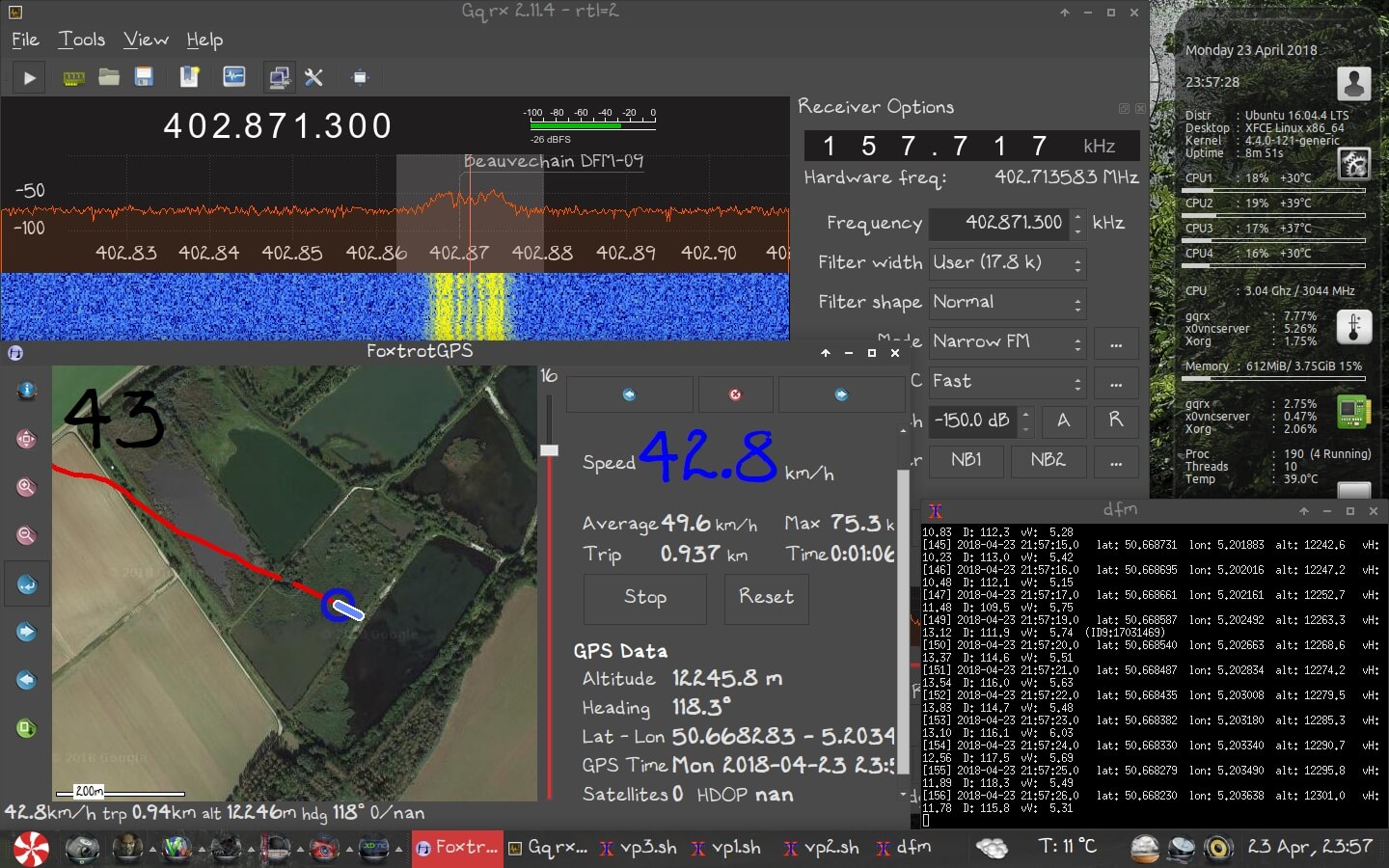
Over on his website, happysat has recently uploaded a tutorial that shows how to use RS with an RTL-SDR, CubicSDR or GQRX, and FoxtrotGPS, a GPS plotting program for visualizing the location of the radiosonde. The tutorial covers some tricky points like setting up audio piping in Linux, and getting the GPS data into a virtual COM port to use with FoxtrotGPS.

Alternatively, there are also Windows GUI based sonde decoders that can be used with the RTL-SDR such as SondeMonitor which costs 25 Euros, but also covers a wide range of sonde protocols, and RS41 Decoder which is a GUI for the RS41 sonde protocol only. If you are interested we have a tutorial on setting up radiosonde decoding in Windows with SondeMonitor available here.

Plotting the Sonde Location with an RTL-SDR, GQRX, RS and FoxtrotGPS.

Understanding Direction Finding on the KiwiSDR

Earlier this month we posted about the KiwiSDR direction finding update, which now allows anyone with internet access to utilize public KiwiSDR's for the purpose of pinpointing the physical location of a transmitter that transmits at a frequency below 30 MHz.

A few people have had trouble understanding how to use the direction finding feature, so KiwiSDR fan Nils Schiffhauer (DK8OK) has written up a KiwiSDR direction finding usage guide. Nils' guide explains the basic technical ideas behind the TDoA (Time Difference of Arrival) direction finding technique used, and highlights some important considerations to take into account in order to get the best results. For example he discusses best practices on how to choose receiver locations, how many receivers to choose, and how to properly take into account the time delaying effects of ionospheric propagation with HF signals.

Finally at the end of the document he shows multiple case studies on HF signals that he's managed to locate using the discussed best practices. Looking through these examples should help make it clear on how receiver locations should be chosen.

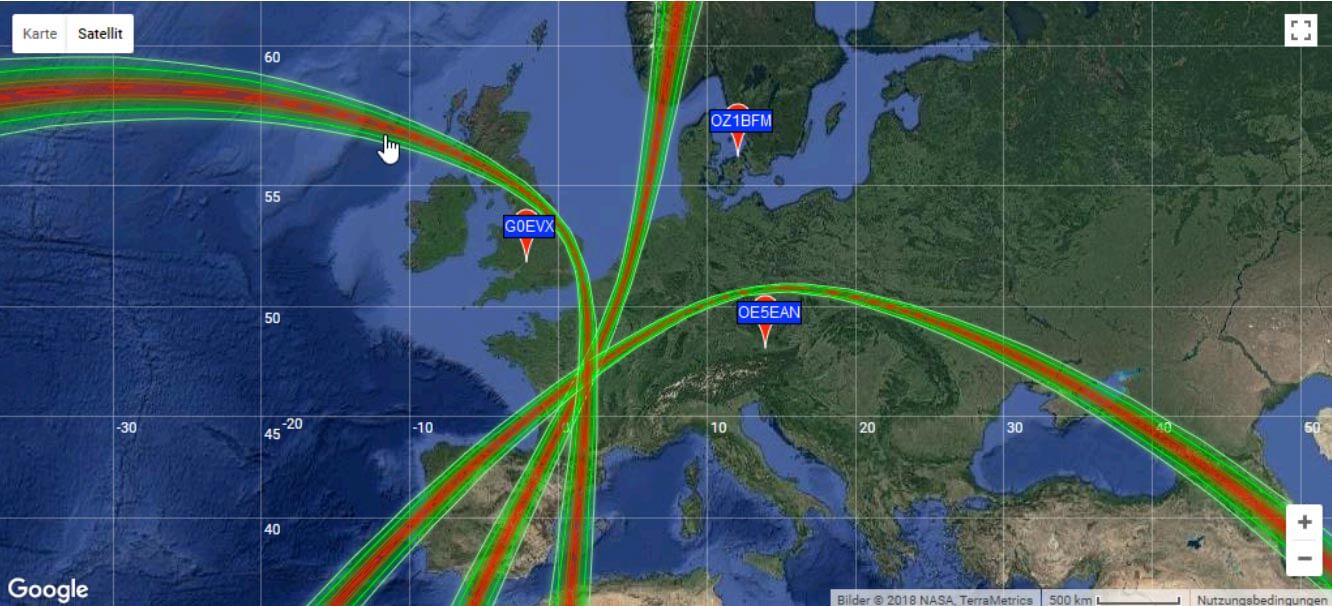
DK8OK Locates Radio France at 15320 kHz

PlutoWeb: Custom firmware for the PlutoSDR that enables you to Run OpenWebRX, dump1090 etc directly on the device

GitHub user unixpunk has been working on a custom firmware image for the PlutoSDR called 'PlutoWeb' (more info available on their website as well). The firmware allows you to run a web interface on the PlutoSDR and this allows you to run server programs such as OpenWebRX, Dump1090 and streaming servers like SoapyRemote. Because the PlutoSDR has a built in processor, this firmware can turn the SDR into a fully standalone device.

The PlutoSDR is an Analog Devices $99 RX/TX capable SDR with 20 MHz of bandwidth and a 325 MHz to 3.8 GHz frequency range that is software hackable to 56 Mhz of bandwidth and a 70 MHz to 6000 MHz frequency. It has an on board Xilinx Zynq Z-7010 FPGA, which has a built in dual core ARM Cortex-A9 processor as well. It has been out of stock for a while, but was recently restocked and can be purchased directly from Analog Devices, or via Arrow, DigiKey or Mouser.

If you're interested we previously did a review on the PlutoSDR, and have notes on enabling the software hack and setup available on this blog.

PlutoWeb Web Interface Running on the PlutoSDR.

Archiving Shortwave History with Software Defined Radio

Broadcast shortwave radio is not always archived for long at the station, so finding sound bites from interesting historical events can be difficult. We know that songs are of course recorded, but talk back radio, discussions in between music, news readings, weather updates, ads and pirate radio are all lost over time. Although these things may seem mundane now, future historians may be interested in listening in on this little slice of life.

At this years HOPE XIII conference, Thomas Witherspoon, owner of the popular SWLing Blog gave a talk titled "Creating a Radio Time Machine: Software-Defined Radios and Time-Shifted Recordings". Currently the talk is available as a full recording of all talks at the conference over on Livestream. Thomas' talk begins at about 9h03m45s (thanks to Aaron Kuhn from the comments for finding the talk. Hackaday also recently ran an article on the content of his talk.

Thomas' idea is to create a database of shortwave radio IQ recordings so that they can be archived for historical purposes. The project is called "The Radio Spectrum Archive" and has a website set up at spectrumarchive.org. To do this modern software defined radios like the RTL-SDR can be used to record a large bandwidth, however the problem is with data storage as IQ recordings can take up extremely large amounts of disk space. 

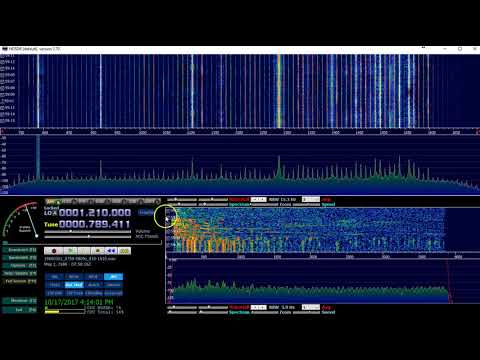
Interestingly, it turns out that people have actually been making IQ recordings since the 1980's by connecting their shortwave radios to VCR tape recorders. In the modern day these VCR recordings can be digitized into an IQ file, and played back in software like HDSDR. In the video below Thomas demonstrates the playback of a digitized VCR radio recording from May 1 1986. You can hear some interesting news tidbits on the soviet cover-up of Chernobyl, the Challenger disaster and the launch of a new hurricane tracking satellite. If recording was more popular it would have been interesting to hear soviet radio during this time too.

In addition to archiving IQ files, Thomas has been releasing a podcast of curated historical audio recordings from VCR tapes, as well as modern recordings that may be of interest over at shortwavearchive.com.

We envision a future where one day these recordings could be automatically turned into text logs via advanced speech to text software, so they could easily be searched through.

[Also seen on Hackaday]
Radio Spectrum Recordings: A short demonstration

An Opensource Mini-Whip Antenna and Upconverter Design for RTL-SDRs

Thank you to Igor Yatsevich for submitting news about an open source Mini-Whip and Upconverter design that he's created and released for free on GitHub. An upconverter converts HF frequencies into VHF frequencies so that they can be received by RTL-SDRs in their quadrature mode, and a Mini-Whip is a small active antenna for receiving HF signals.

The designs include the PCB Gerber files for manufacturing, the components list and assembly and usage guides. Also both through-hole and SMD designs are provided.

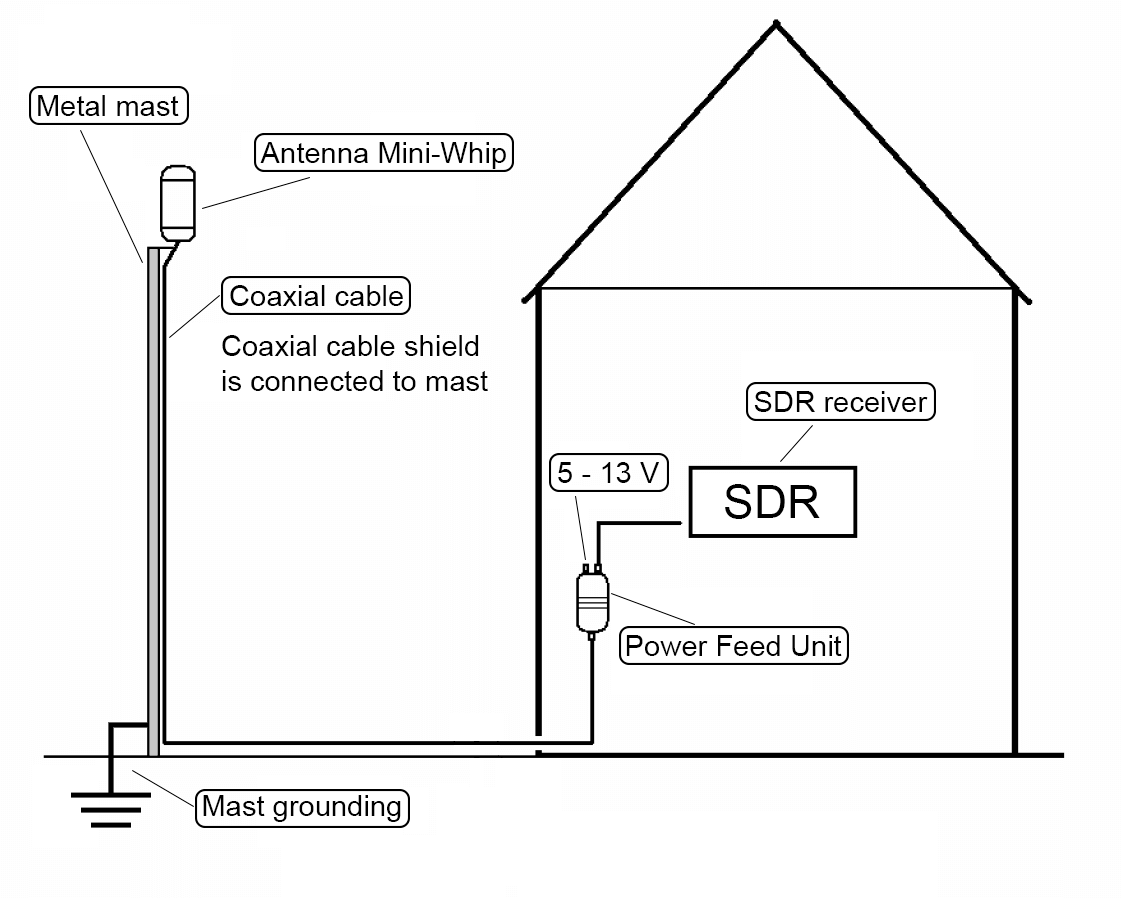
The Mini-Whip design has a frequency range of 10 kHz - 30 MHz and to power it you'll need a 5 - 13V bias tee. You will need to install it up high and preferably away from the house as Mini-Whips are quite susceptible to local noise pickup. Another very important point is that Mini-Whips need to have a good ground connection. The upconverter is based on the ADE-1 mixer, and uses a 125 MHz local oscillator.

Igor's documentation on the project is excellent, and is a good read for getting more information about upconverters and Mini-Whips. He has noted that he is sending us some samples of units that he's built, so when we receive them we'll post again with test results. It looks as if he's put a lot of research into these designs so we're looking forward to seeing how well they work. 

Diagram on how to ground a miniwhip connected to a metal mast.
Diagram from Igor's documentation about how to properly ground a Mini-Whip connected to a metal mast.

NEWSDR 2018 Software Defined Radio Presentations

The New England Workshop on Software Defined Radio (NEWSDR) was held in May this year, and there have been several talks now uploaded to YouTube. These are typically fairly technical in nature, and discuss cutting edge research being performed with software defined radios. Below we post a few selected talks, and the rest can be viewed in this WPI playlist.

Remote Sensing of the Space Environment Using Software Defined Radio

From studies of the ionosphere to astronomical measurements with arrays of radio telescopes the manipulation and analysis of RF signals has been key to new instrumentation and many resulting discoveries. Software radio technology has been a core component of remote sensing of the space environment for several decades now. The flexibility of combining computing and radio was adopted very early on in scientific applications. This enabled new classes of scientific experiments which would otherwise have been impossible. The capability and adaptability of software radio instrumentation and systems has been growing consistently with the exponential increase in available computing power. The recent surge of low cost software radio hardware technology has enabled a new generation of instrumentation. These instruments are increasingly blurring the line between traditionally separate scientific disciplines as well as practical applications. I will discuss the science and the instrumentation enabled by software radio with highlights from studies of the ionosphere and radio astronomy. My overview will focus on the relationship to work underway at MIT Haystack Observatory. I will highlight the core architectural patterns of scientific software radio and discuss the evolution of our systems over several decades of rapid technological change. I will also look forward to the possibilities for discovery offered by the next generation of software radio and radar instrumentation.

NEWSDR 2018: Invited Presentation by Frank Lind (MIT Haystack)

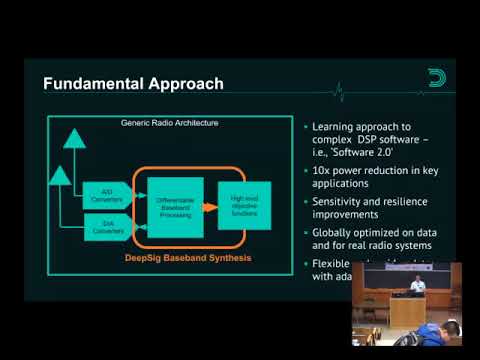
Reinventing Wireless with Deep Learning

While wireless communications technology has advanced considerably since its invention in the 1890s, the fundamental design methodology has remained unchanged throughout its history – expert engineers hand-designing radio systems for specific applications. Deep learning enables a new, radically different approach, where systems are learned from wireless channel data. This talk will provide a high-level overview of deep learning applied to wireless communications, discuss the current state of the technology and research, and present a vision for the future of wireless engineering using a data-centric approach.

NEWSDR 2018: Invited Presentation by Nathan West (DeepSig)

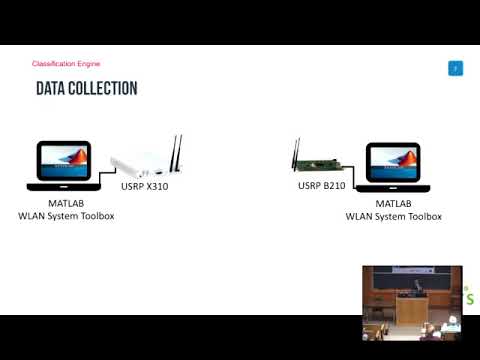
Multi-objective SDR Optimization for Wireless Access, Actuation and Attacks

Software defined radios (SDRs) have become the foundational block of agile wireless communications. The first part of the talk presents an overview of how the same SDR can alternate between multiple different and non-traditional actuation functions, such as aerial distributed beamforming and wireless energy transfer. Furthermore, as SDR technology becomes more pervasive assuming roles beyond communication, there is a growing risk of security concerns of ID spoofing and malicious hardware attacks. The second part of this talk describes our efforts of fingerprinting individual SDRs using machine learning, where we only analyze the I/Q samples collected at the receiver. We demonstrate the feasibility of achieving 90-95% classification accuracy through experiments conducted with 12 radios, at separation distances of beyond 50 feet. The talk concludes with a summary of the challenges ahead and identifies other emerging application areas of SDRs that will impact the next decade.

NEWSDR 2018: Invited Presentation by Kaushik Chowdhury (Northeastern University)