Airspy vs SDRPlay: Two New Comparison Videos

Over on YouTube two new videos comparing the reception on the SDRplay and Airspy have been uploaded. The first is by Mile Kokotov and he compares the reception on a very weak broadcast FM station, with several strong signals surrounding it. He writes:

In this video I am presenting Airspy+SDR# vs SDRplay+SDRuno in the real world, receiving very weak FM broadcast station in the terrible conditions, with very strong signals around.
The Weak signal was in the lower edge of the FM broadcast spectrum, with very strong local signals close to the weak one, in the upper frequencies of the FM broadcast spectrum.
The antenna for the both SDR receivers was the same – Vertical Dipole for FM BC band.

Both SDR receivers were tuned to maximum possible signal to noise ratio (SNR) of the weak FM broadcast signal.

In SDRuno RSP control panel (for SDRplay receiver) ZERO IF and 0.3/0.6 bandwidth were chosen, and the weak signal of interest was placed on the right edge of IF filter, so that the strong signals from other FM broadcast radio stations were placed right from the weak one in order to minimized the negative influence to the our weak signal.
LNA was switched off. When the LNA was on, there where high distortion level because LNA was overloaded from the strong signals, and SNR was deteriorated regardless of gain reduction.
The best results were achieved with gain reduction set to “0”, without LNA.

In SDR# software (for Airspy SDR receiver) 10 MSPS and Decimation was used.
From the version 1480, in SDR#, when decimation is choosed, there is tracking filter which allow better selectivity, so you can use more gain, increasing the SNR to maximum possible level depending of concrete situation.

The overall receiving conditions was extremely bad. The signals from local FM radio stations were too strong so the weak signal from this video can not be received at all, with many expensive FM tuners which I tried: Pioneer VSX 527, Denon AVR-1802, Marantz SR6300. I was tried RTL-SDR just for fun, but it can not receive weak signal too :-), not because SDR-RTL is not sensitive enough, but because its dynamic range is not so high and it is overloaded by too strong local signals.

The very sensitive receiver is not problem to design and produce. Much more difficult is to design a high dynamic range receiver. which will be able to receive very weak and very strong signals at the same time without overloading.

Overloaded receiver front end means that it is not linear any more, and produces many signals by itself, increasing its noise level.
Very strong signals at the receiver front end makes Desensitization of the receiver, so it could not receive weak signals any more.
We should not forget that the receiver front end “looks” all signals from the wide frequency range even if we want to receive only one signal at the time. The more wideband the receiver is, the higher dynamic range it has to be, for not been overloaded…
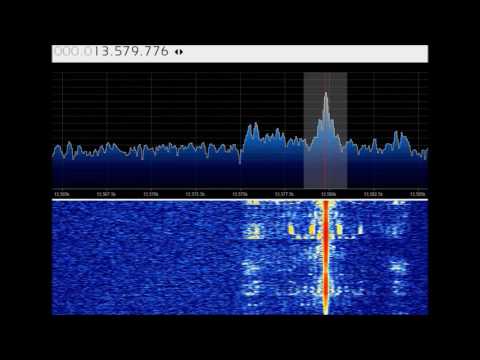
SDRplay and Airspy receiving Very WEAK FM broadcast signal

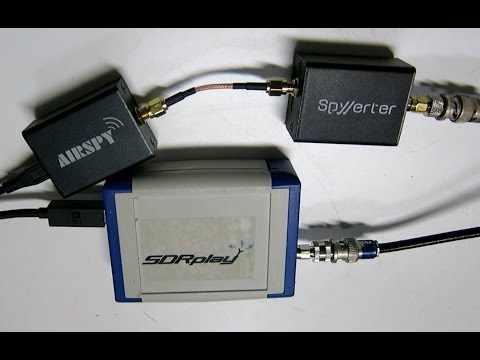
In the second video Leif sm5bsz compares the Airspy+SpyVerter with the SDRplay RSP on HF reception. He concludes that the difference between the two radios on HF is small. However, Youssef from Airspy has contested the result, noticing that Leif ran the Airspy at 2.5 MSPS, resulting is significantly less decimation being used. In response Leif updated his video adding an A/B comparison on HF with the Airspy correctly running at 10 MSPS in the last 8 minutes of the video. The results seem to show that the SDRPlay and Airspy+Spyverter have similar HF performance, but when comparing maximum decimation on the Airspy and the smallest bandwidth the SDRplay to obtain similar bandwidth’s, the results seem to show that the Airspy+SpyVerter is about 5 dB more sensitive at receiving weak signals.
SDRUno Updated to Version 1.03

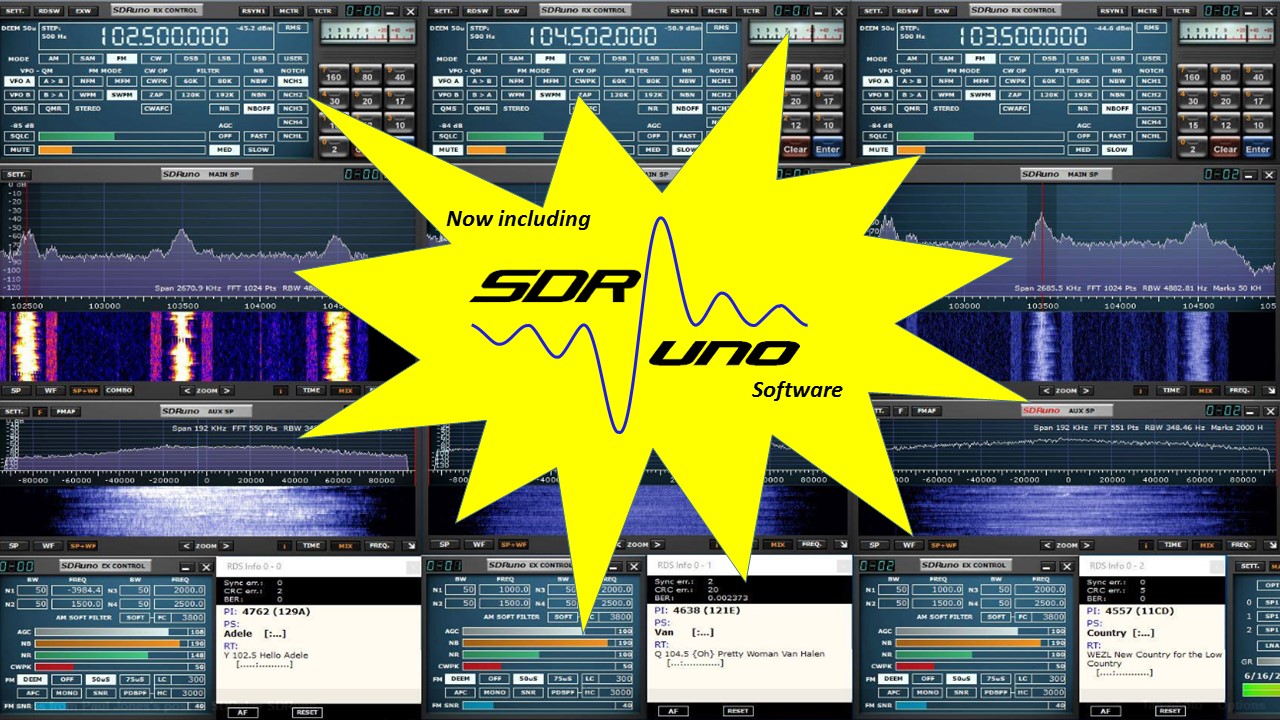
SDRUno, the official software for the SDRplay has recently been updated to version 1.03. SDRUno is the free SDRplay specific version of Studio1, and also supports other SDR’s like the RTL-SDR, with an artificial 1MHz bandwidth limit. The change log is shown below:

Bug Fixes

  • High DPI resolution issue.
  • Various minor bug fixes and typos

Updates

  • Reworked filter cutoffs
  • Separate out EXTIO functionality
  • RSP Ready indicator in Main Window/SETT/Input
  • Rename FM Stereo Noise Reduction button and slider to FMS-NR to avoid confusion with SNR (Signal Noise Ratio)
  • Improvements to tuner AGC scheme
  • Improvements to DC offset scheme
  • Removed unused buttons in SP1/SP2 windows
  • LO display in RSP advanced window and the SP1 window
  • Change defaults (LNA OFF / AGC ON)
  • Added RDS PTY support

sdruno_announcement

New Posts From RTLSDR4Everyone: Avoiding RTL-SDR Ripoffs, ADS-B Antenna Reviews, Travel Kits and Direct Sampling vs Upconverter vs SDRPlay

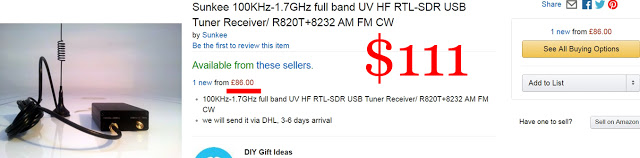
Akos from the rtlsdr4everyone blog has been busy uploading new posts over the past few days. His first post is part three in a series that discusses how to avoid ripoffs when buying RTL-SDR dongles. The RTL-SDR market has recently become quite saturated, and it is now easy to purchase something that most experienced users would consider a ripoff. His post shows some examples of what he considers to be poor value choices available on eBay.

An example of a ripoff price.

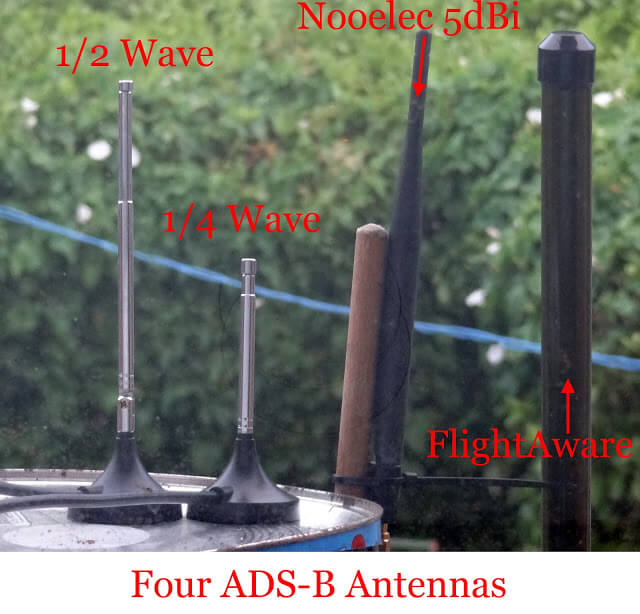
His second post discusses his methodology for testing dongles on their ADS-B performance. The second post then leads into the third post in which he compares four antennas on ADS-B reception. He compares two telescopic whip antennas, one set to 1/2 wave length, and the other set to 1/4 wave, a NooElec 5dBi whip antenna, and the FlightAware ADS-B antenna. His results show that the FlightAware antenna was the best performer, followed by the 1/2 wave telescopic whip, then the NooElec 5dBi whip and finally the 1/4 wave telescopic whip. The fourth post continues the ADS-B topic, and he reviews the NooElec 5dBi ADS-B antenna. Although the performance is not as good as the FlightAware antenna he mentions that it is much smaller and great for portable use. If  you are interested, we have also a review of the FlightAware antenna, and we also found its performance to be excellent.

The four ADS-B antennas tested in Akos' review.
The four ADS-B antennas tested in Akos’ review.

In his fifth post Akos shows what his RTL-SDR travel kit consists of. In this post he recommends both our RTL-SDR V3 dongle as well as the NooElec SMArt. For a portable computer, he takes along a Raspberry Pi 3 and a 20,000 mAh battery bank with solar charger. (Though we’d be interested to hear from Akos how long it takes for that small solar panel to charge the battery bank, probably takes days to charge?) For antennas he prefers to take along our large 1.5m telescopic antenna, the NooElec 5dBi ADS-B antenna, a medium telescopic antenna and a Nagoya knock-off telescopic antenna.

Akos' Mobile ADS-B Station.
Akos’ Mobile ADS-B Station.

Finally in the sixth post he shows a video that compares the differences between a generic dongle modded with direct sampling (without any impedance matching circuitry), an RTL-SDR dongle with ham-it-up upconverter and an SDRplay. Unsurprisingly the upconverter and SDRplay performs best.

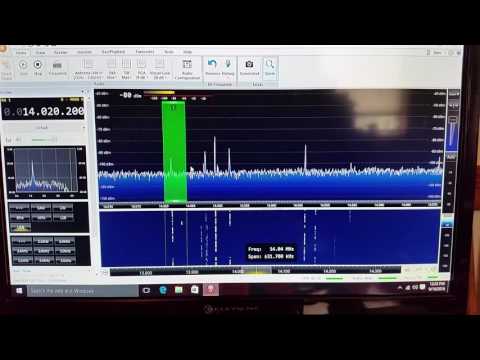
Direct sampling vs upconverter vs SDRPlay on shortwave broadcast stations - 16 mins

As a bonus, Akos also has done an interesting stress test on the metal case of our RTL-SDR dongles, where he runs it over with a bus to see if it will survive. The case is mangled afterwards, but the dongle and functionality survives!

Dotcom dongle meets a bus

Two Videos Showing the LimeSDR on HF in SDR-Console V3

The LimeSDR is a RX/TX capable SDR with a 100 kHz – 3.8 GHz frequency range, 12-bit ADC and 61.44 MHz bandwidth. It costs $299 USD and we think it is going to be an excellent next generation upgrade to SDR’s with similar price and functionality like the HackRF and bladeRF. Back in August we posted how they had added HF functionality to their drivers, and posted some videos from LimeSDR beta tester Marty Wittrock who had gotten HF working well  in GQRX.

Now that SDR-Console has added support for the LimeSDR and HF reception, Marty has uploaded two new videos showing it in action. The first video shows some SSB reception on 40M and the second shows some CW reception on 20M. Marty runs SDR-Console on a MSI Core i5 Cube PC. Marty also writes:

Even with the ‘older’ LimeSDRs that I have that don’t have the proposed modified matching networks on them the performance at 20m and 40m was actually REALLY good for voice and CW. Obviously if the band conditions for 15m and 10m were better the days that I tested the LimeSDR it would have been even better since ‘as-designed’ matching networks seem to do better at 30 MHz and up. Checking the performance at 162.475 MHz (my local Cedar Rapids, Iowa NOAA Weather Station) the performance is excellent on a VHF antenna.

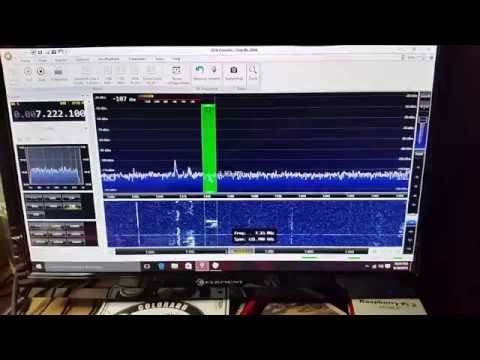
The LimeSDR on 40m Phone using SDRConsole V3.0

LimeSDR Operating on the HF 20m Band with SDRConsole V3.0


Performing a Replay Attack on a Wireless Doorbell with a USRP SDR

A replay attack consists of recording a signal, and then simply replaying it back at the same frequency at a later time. To do this a receive and transmit capable software defined radio like a USRP/HackRF/bladeRF can be used.

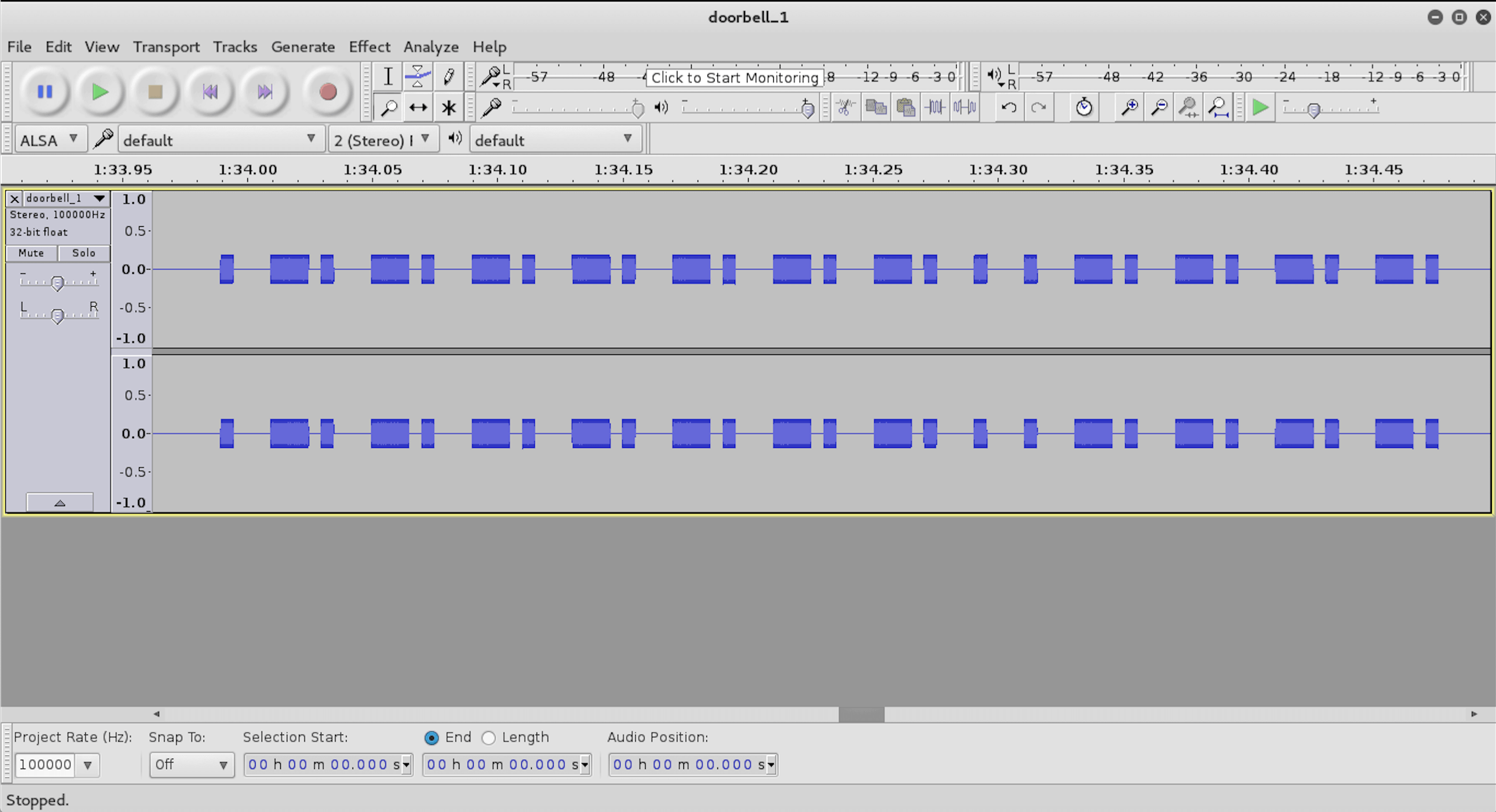
Over on his blog, the admin of the dxwxr group has posted a tutorial showing how he performs a replay attack on a simple wireless doorbell using a USRP, GNURadio and the audio editor Audacity. This is a very simple process and is a great tutorial for those looking to get started in reverse engineering signals. First he determines the frequency of the doorbell which turned out be be around 315 MHz. Then using GNURadio he records the signal emitted by the doorbell remote and opens up the audio file in Audacity. He then isolates a section of the signal and saves it as a raw aiff file. Finally, he uses GNURadio to transmit the isolated signal via the USRP.

Captured wireless doorbell signal.

Replay Attack - DoorBell

Working towards an FPGA DSP Implementation with LabVIEW for the RTL-SDR

Back in August we posted how Albert Lederer had created a RTL-SDR interface for the LabVIEW visual programming language which could be run on a host PC. LabVIEW is a visual programming language which is used commonly by engineers and scientists to quickly build applications for things like product testing, system monitoring, instrument control etc.

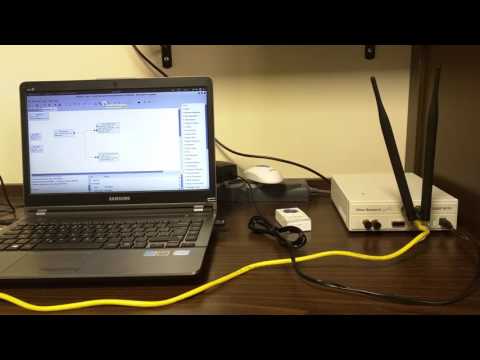
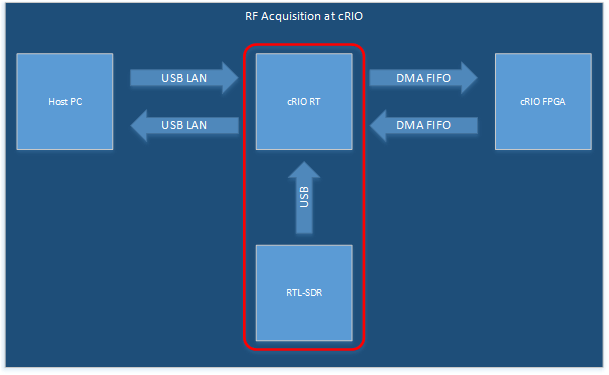
In his latest post/tutorial uploaded a few days ago he shows how to run the RTL-SDR RF acquisition on a myRIO, which is a development processing board that can run Linux and has an on board FPGA. LabVIEW can then be used to control the RTL-SDR from the host PC.

The whole point of running the RTL-SDR on the myRIO is to eventually make use of the on board FPGA. In future posts he hopes to show us how to use the on board FPGA to offload digital signal processing (DSP) tasks,  which would significantly speed up applications.

Data flow for offloading RTL-SDR DSP tasks onto the FPGA

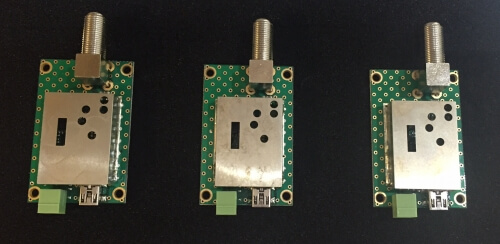
New ThumbNet RTL-SDR Receiver Released: F-Connector, TCXO, External DC Power, No Switch-Mode Power

ThumbSat is a company that aims to help experimenters design and launch experiments on their mini satellites (10x smaller than a regular cubesat with most of the same functionality) into orbit. They write that for about $20k they will fully design a satellite based experiment and launch it into orbit – all you need to do is provide the orbital experiment that you would like done.

To aide with the reception, they also have the ThumbNet project which aims to setup a network of satellite receivers around the world. They do this by providing school students around the world with low cost satellite receivers. The satellite receivers consist of modified/upgraded RTL-SDR dongles and satellite antennas. 

Today the ThumbNet project announced the latest iteration of their RTL-SDR dongle, called the ThumbNet N3 SDR Receiver. This receiver has some interesting design changes when compared to any other dongle that we’ve seen so far. The biggest change appears to be that this dongle uses an external power port for power. They also replaced the 1.2V switching regulator with a 1.2V linear regulator for lower noise operation. This is useful because switching regulators can cause noise, whilst linear regulators are much cleaner. However, using a linear regulator increases the power consumption significantly, and the new dongle draws 450mA of current (vs 250-280 mA on standard or our V3 dongles), meaning that some USB ports may be unable to power the device unless the external power supply port is used.

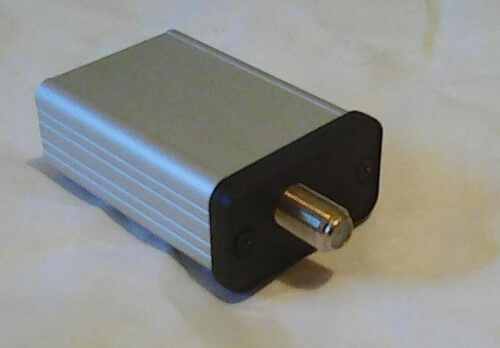
The other interesting change is that they have changed the PCB form factor, and it can now fit into a common 1455 aluminum case. Also, similarly to our V3 RTL-SDR dongles, they have decided to add a common mode choke to the USB lines, which significantly reduces USB noise. To add ESD protection they also added a static bleed resistor. Finally, like their previous receivers they continue to use a F-type RF connector and a TCXO for frequency stability.  

The price is $25.75 each plus flat rate global shipping of $4.50 and the receivers are expected to ship in mid-October. While we have not yet tested this model, it looks to be like a good receiver for those who need very low noise, or external power options.

They write:

The next Generation, ThumbNet N3 is designed from the ground up to be as simple to use as older generation dongles, but with powerful hardware features for advanced hobbyists and experimenters.

We removed all of the excess components that were sources of noise or interference in other dongles, and optimized the circuit for simplicity, sensitivity and selectability. Then we added a port to use a cable with the extremely common mini-USB connection so that the N3 is less prone to noise from the host computer than a traditional dongle. Finally, the use of standard Surface Mount 0603 or larger components makes it simple for testing or modification.

We built them for our own use, then decided to offer them to everyone.

A quick list of the features of the N3:

– Full backward compatibility with existing RTL-SDR dongles and software
– High stability TCXO (+/-0.5ppm) (ensuring rock-solid stability from start-up and over a wide range of temperatures)
– Standard R820T2 + RTL2832U (plus 24C02 EEPROM) chipset
– Improved/enhanced decoupling. (Common-mode choke on USB port)
– Low-noise, linear only power regulation (separate 1.2v and 3.3v regulators)
– External DC (+5v, 450mA) supply connector
– Mini-USB connection (allows easy separation of the RF unit from the noisy PC)
– F type RF connector (very common and compatible with existing ThumbNet tracking stations)
– Large (6x4cm) contiguous ground-plane (for better thermal dissipation)
– Static drain-away resistor on the RF input (1K to ground)
– All unnecessary parts (IR receiver, high-current LED etc.) eliminated to reduce parts count and noise
– Circuit board can be mounted into a common 1455 case

Ideal for experimentation:

– Can be connected to an external power supply for very clean power
– All of the important tracks are visible on the top side of the board for easy access
– All of the RF parts are on the top of the board (only regulators and decouplers on the back)
– Logical, simple layout using 0603 (or larger) SMT parts
– IF port break in connector (between front end and IF/USB chip) provided

While not required for operation, the N3 receiver is designed to be able to utilize a clean source of power from an external 5v power supply, instead of using the noisy power line coming from the computer’s USB port. This gives a tremendous advantage to the purist or experimenter who wants to utilize power from the N3 to power any external experiments. (When the external power supply is active, no power is drawn from the USB port to power the N3.)

PLEASE NOTE: The N3 draws approximately 450mA of current and care should be taken, even when using a powered USB hub, as it could possibly exceed the current limit of the USB port.

The ThumbNet N3
The ThumbNet N3
The ThumbNet N3 inside its optional 1455 aluminum enclosure.

Airspy Dynamic Range Improved in the Latest SDRSharp

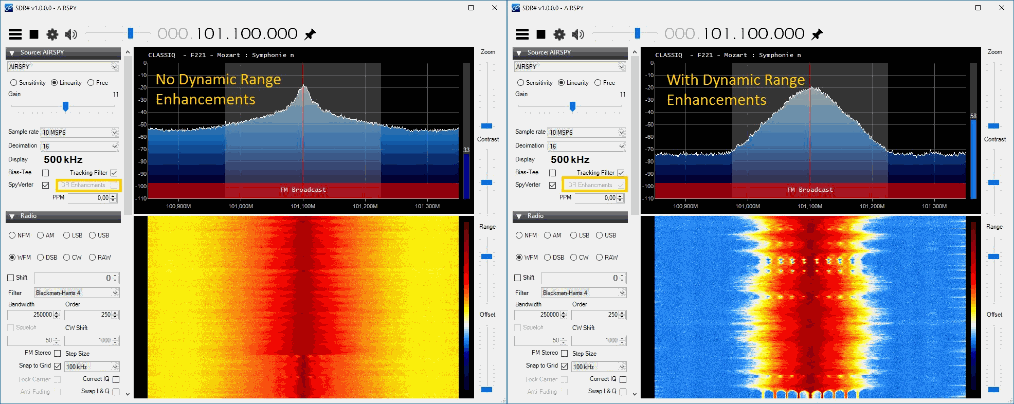
In a previous post we posted about how SDR# had been updated to vastly improve on the CPU usage. The author has been hard at work once again, and has now released a new update which significantly improves the dynamic range with the Airspy SDR. The new update gives a boost of up to 12dB in dynamic range when using decimation. This means that the gains can be turned up further without overloading occurring, and that weaker signals can come in much stronger without strong signals overloading and drowning them out.

The example images show some examples of the dynamic range improvements.

An example of the improved dynamic range for the Airspy on the latest SDR#.
Using decimation removes overload.