Monitoring Drone FPV Frequency Usage with a USRP Software Defined Radio

Over on YouTube balint256 (Balint), a researcher at Ettus (creators of the USRP line of software defined radios) has uploaded a video showing how he is using his USRP to help with frequency management at FPV time trial racing events. FPV a.k.a First Person View is a term used to describe the act of flying a remote controlled aircraft such as a quadcopter with an onboard camera that transmits live video down to the pilot. FPV racing is a new sport where pilots race FPV controlled drones around a track.

One important technical challenge at these events is frequency management. FPV drones use many frequencies at around 2.4 GHz for control and 5.8/2.4/1.3 GHz for video. With many drones in the air it is important that frequencies are managed appropriately so as to not jam each others signals.

To try and solve this problem Balint has been using GNU Radio coupled with a USRP X310 software defined radio to get very wide band RF spectrum waterfall views of the 2.4 and 5.8 GHz bands. In the waterfalls he is able to see when control signals and video signals are transmitted and at what frequency, and is able to tell if any are overlapping and jamming each other.
SDR Wideband Spectrum Monitoring for Drone FPV Frequency Management

In addition to this, Balint has also been working on his custom software defined radio based digital video downlink. Back in March we posted about his earlier work on this concept. In the video Balint demonstrates his drone with an on board USRP E310 which is used to send a custom 4.2 Mbps video downlink.
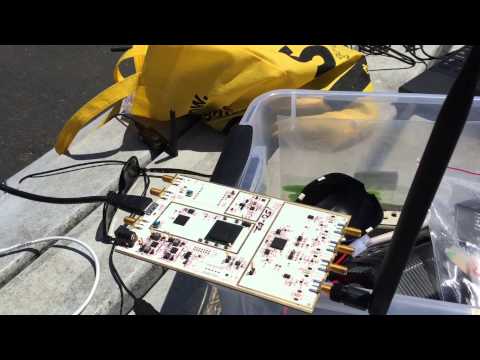
SDR digital video downlink (custom drone FPV) with E310 + webcam

New method for generating wideband spectograph’s with Radio-Sky and an RTL-SDR

Radio-Sky Spectrograph is a software application that is designed to produce waterfall displays similar to other software, but with a focus on observing radio astronomy phenomena. 

Radio-Sky Spectrograph displays a waterfall spectrum. It is not so different from other programs that produce these displays except that it saves the spectra at a manageable data rate and provides channel widths that are consistent with many natural radio signal bandwidths. For terrestrial, solar flare, Jupiter decametric, or emission/absorption observations you might want to use RSS [Radio-Sky Spectrograph].

Last year, we posted about the release of RTL_Bridge, which is a program designed to interface an RTL-SDR dongle with Radio-Sky Spectrograph. One limitation with RTL_Bridge was that it was limited to the dongles maximum bandwidth of about 2.4 MHz. Now Raydel Abreu Espinet (CM2ESP) has written a new application called RTL-WideSpectrum which allows for wideband spectral sweeps in Radio-Sky Spectrograph by using the RTL-SDR to quickly switch between frequencies and combine the outputs. It is similar to how rtl_power works.

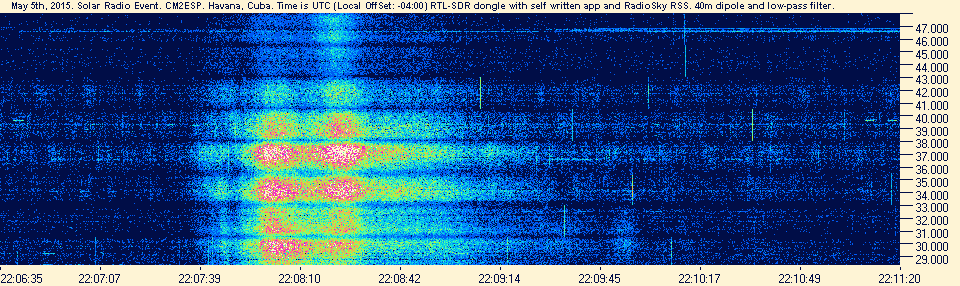
With RTL-WideSpectrum and Radio-Sky Spectrograph, Raydel was able to capture this solar burst shown below which occurred between 28-48 MHz.

A solar burst between 28 - 48 MHz captured with an RTL-SDR dongle, RTL-WideSpectrum and Radio-Sky Spectrograph.
A solar burst between 28 – 48 MHz captured with an RTL-SDR dongle, RTL-WideSpectrum and Radio-Sky Spectrograph.

How coax cable loss affects ADS-B reception

Over on YouTube user Adam Alicajic has uploaded a video showing how coax cable loss affects the frame rate when receiving ADS-B. To do this test Adam uses a precision attenuator in between his ADS-B antenna and RTL-SDR dongle to simulate attenuation from coax cable loss. His results show that for every 1 dB of attenuation the frame rate drops by about 10%.

Coax cable loss for common type of cable can be estimated with calculators available at http://www.net-comber.com/cable-loss.html and http://www.arrg.us/pages/Loss-Calc.htm. RG-6 cable has a low loss at 1090 MHz of about 0.23 – 0.32 dB per meter, whereas RG58 has a loss of about 0.5 – 0.6 dB per meter and RG174 (stock antenna cable on most RTL-SDR units) has a greater loss of about 1.2 dB per meter.

Coax length loss contribution to the bad ADS-B reception

LightSail now active and transmitting data

The LightSail is a solar sailing spacecraft that has been launched by the planetary society. It is based on the “solar sail” concept, which uses a large reflective foil to harness the suns energy as a means of propulsion. The planetary society write about solar sails:

Solar sails use the sun’s energy as a method of propulsion—flight by light. Light is made of packets of energy called photons. While photons have no mass, a photon traveling as a packet of light has energy and momentum.

Solar sail spacecraft capture light momentum with large, lightweight mirrored surfaces—sails. As light reflects off a sail, most of its momentum is transferred, pushing on the sail. The resulting acceleration is small, but continuous. Unlike chemical rockets that provide short bursts of thrust, solar sails thrust continuously and can reach higher speeds over time.

The LightSail Concept

Currently a test mission of the LightSail concept is under way. The LightSail is in orbit and expected stay in orbit for about 1-2 months. Initially the mission had trouble with communications, but after an automatic reboot of the on board computers they have now confirmed that the LightSail is transmitting properly.

With an RTL-SDR and appropriate satellite antenna, it should be possible to monitor the LightSail. The LightSail transmits at a frequency of 437.435 MHz with the AX.25 protocol, FSK encoding at 9600bps and with a call sign of KK6HIT. The LightSail can be tracked at http://sail.planetary.org/missioncontrol and the planetary society are also requesting that amateur radio tracking enthusiasts email over any data they capture. Over on twitter some users have confirmed LightSail downlink hits:

A Review of the TitanSDR Pro

Over on the swling.com blog, Thomas has uploaded a review of the TitanSDR Pro that was published in the May 2015 version of The Spectrum Monitor online magazine. Although the TitanSDR pro software defined radio is an expensive (1,380 EUR for the basic / 1,970 EUR for the PRO), it may be of interest to those looking to go further into the short wave listening hobby. The TitanSDR is a high performance 9 kHz to 32 MHz receiver with 16 built in preselectors and a bandwidth up to 2.1875 MHz. It’s main markets appear to be government intelligence and military, but it also finds good use in general short wave listening.

Thomas reviews the TitanSDR positively, liking its easy to use software and its superb sensitivity, but noting that it’s high price may be a bit off putting.

Also, in the current June version of The Spectrum Monitor magazine Thomas also reviews the SDRPlay, a $149 USD HF capable radio, also giving it a favourable review.

The TitanSDR Pro
The TitanSDR Pro

Review of Nobu’s HF Upconverter, Galvanic Isolator and 14 MHz Low Pass Filter

Back in April we posted about some new products made by Japanese RTL-SDR experimenter and product manufacturer Nobu. Nobu’s new products were a 1:1 galvanic isolator and a low pass filter. The galvanic isolator isolates the antenna from the RTL-SDR and PC, significantly reducing noise. The low pass filter is useful when used with direct sampling modified RTL-SDRs to filter out any strong interfering signals that are above 14 MHz.

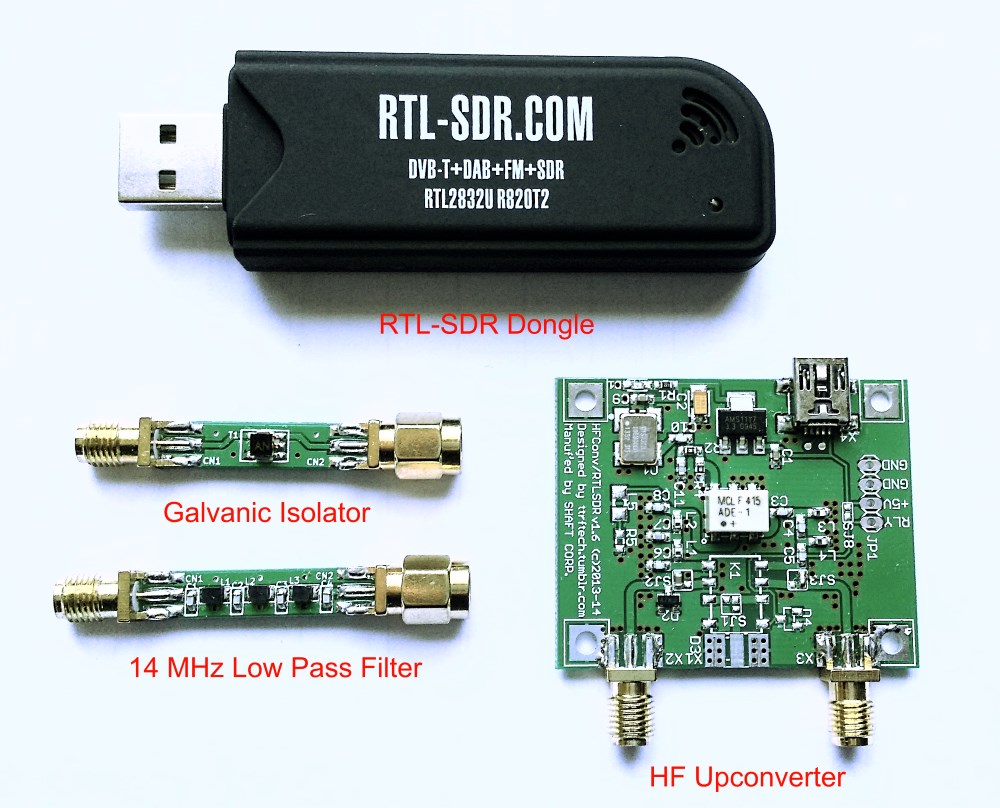
Recently Nobu sent us at RTL-SDR.com some samples of his products. He sent us one of his HF upconverters, a galvanic isolator and a low pass filter.

NobuProducts
Nobu’s RTL-SDR Products: HF Upconverter, Galvanic Isolator, Low Pass Filter. Placed next to an RTL-SDR for size comparison.

Continue reading

New EAS SAME Weather Alert Decoder

Over on Reddit and GitHub user cuppa-joe has released a Python based EAS SAME Alert message decoder called dsame which is compatible with the RTL-SDR. EAS is an acronym for Emergency Alert System and is a system that is most commonly used to alert the public to local weather emergencies such as tornadoes, flash floods and severe thunderstorms.

Local EAS weather alerts are encoded with the SAME (Specific Area Message Encoding) protocol. They are transmitted on the local weather radio frequency in the USA and Canada and some weather radio’s are capable of decoding the EAS SAME data. Cuppa-joe’s dsame EAS decoder outputs full EAS weather messages such as:

The National Weather Service in Pleasant Hill, Missouri has issued a Required Weekly Test valid until 12:30 PM for the following counties in Kansas: Leavenworth, Wyandotte, Johnson, Miami, and for the following counties in Missouri: Clay, Platte, Jackson, Cass. (KEAX/NWS)

To use the software you will still need to use a EAS demodulator such as multimon-ng which is available for Windows and Linux, and you will also need Python 2.7+ installed.

An example EAS SAME alert can be heard in the player below:

HackRF Blue Shipped and HackRF One Updates

Back in December of last year we posted about the Indiegogo campaign for the HackRF Blue, a lower cost clone of the HackRF One software defined radio. They were able to achieve a lower cost by better component sourcing and manufacturing choices, thus reducing the cost from $299 to $200. The HackRF Blue Indiegogo campaign was successful and most of the HackRF Blue’s have now been shipped and delivered to backers. If you need help getting started with the HackRF Blue see http://hackrfblue.com/getting-started/. To get started on Windows, simply use Zadig like with the RTL-SDR, and use SDR# which has built in HackRF support.

The specs of the official HackRF One (and by extension the HackRF Blue) have also recently been changed. They now officially acknowledge that the HackRF One is capable of operating at a frequency down to about 1 MHz. They write:

Now that we’ve seen consistent low frequency performance across multiple manufacturing runs, we’re comfortable changing the official specification: HackRF One operates from 1 MHz to 6 GHz. Try attaching a long wire antenna to listen to shortwave radio!

Recently some people have been considering which mid priced SDR to upgrade to from their RTL-SDR. Our opinion is this: The HackRF has pretty poor RX performance, probably the same as, or even worse than the RTL-SDR, so we suggest you buy it only if you want TX capabilities or need operation above 1.7 – 2 GHz. If you only need RX then we suggest you choose the Airspy or SDRPlay as they have much better RX performance. See our list of SDRs for more possible options. 

The HackRF Blue.
The HackRF Blue.