Tagged: HF

Airspy vs SDRPlay: Two New Comparison Videos

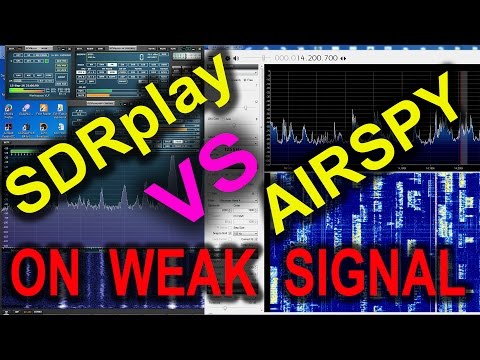
Over on YouTube two new videos comparing the reception on the SDRplay and Airspy have been uploaded. The first is by Mile Kokotov and he compares the reception on a very weak broadcast FM station, with several strong signals surrounding it. He writes:

In this video I am presenting Airspy+SDR# vs SDRplay+SDRuno in the real world, receiving very weak FM broadcast station in the terrible conditions, with very strong signals around.
The Weak signal was in the lower edge of the FM broadcast spectrum, with very strong local signals close to the weak one, in the upper frequencies of the FM broadcast spectrum.
The antenna for the both SDR receivers was the same – Vertical Dipole for FM BC band.

Both SDR receivers were tuned to maximum possible signal to noise ratio (SNR) of the weak FM broadcast signal.

In SDRuno RSP control panel (for SDRplay receiver) ZERO IF and 0.3/0.6 bandwidth were chosen, and the weak signal of interest was placed on the right edge of IF filter, so that the strong signals from other FM broadcast radio stations were placed right from the weak one in order to minimized the negative influence to the our weak signal.
LNA was switched off. When the LNA was on, there where high distortion level because LNA was overloaded from the strong signals, and SNR was deteriorated regardless of gain reduction.
The best results were achieved with gain reduction set to “0”, without LNA.

In SDR# software (for Airspy SDR receiver) 10 MSPS and Decimation was used.
From the version 1480, in SDR#, when decimation is choosed, there is tracking filter which allow better selectivity, so you can use more gain, increasing the SNR to maximum possible level depending of concrete situation.

The overall receiving conditions was extremely bad. The signals from local FM radio stations were too strong so the weak signal from this video can not be received at all, with many expensive FM tuners which I tried: Pioneer VSX 527, Denon AVR-1802, Marantz SR6300. I was tried RTL-SDR just for fun, but it can not receive weak signal too :-), not because SDR-RTL is not sensitive enough, but because its dynamic range is not so high and it is overloaded by too strong local signals.

The very sensitive receiver is not problem to design and produce. Much more difficult is to design a high dynamic range receiver. which will be able to receive very weak and very strong signals at the same time without overloading.

Overloaded receiver front end means that it is not linear any more, and produces many signals by itself, increasing its noise level.
Very strong signals at the receiver front end makes Desensitization of the receiver, so it could not receive weak signals any more.
We should not forget that the receiver front end “looks” all signals from the wide frequency range even if we want to receive only one signal at the time. The more wideband the receiver is, the higher dynamic range it has to be, for not been overloaded…

SDRplay and Airspy receiving Very WEAK FM broadcast signal

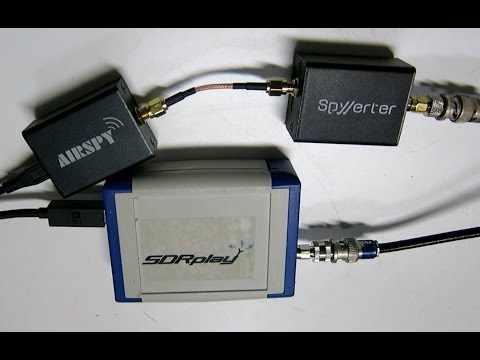
In the second video Leif sm5bsz compares the Airspy+SpyVerter with the SDRplay RSP on HF reception. He concludes that the difference between the two radios on HF is small. However, Youssef from Airspy has contested the result, noticing that Leif ran the Airspy at 2.5 MSPS, resulting is significantly less decimation being used. In response Leif updated his video adding an A/B comparison on HF with the Airspy correctly running at 10 MSPS in the last 8 minutes of the video. The results seem to show that the SDRPlay and Airspy+Spyverter have similar HF performance, but when comparing maximum decimation on the Airspy and the smallest bandwidth the SDRplay to obtain similar bandwidth’s, the results seem to show that the Airspy+SpyVerter is about 5 dB more sensitive at receiving weak signals.

Two Videos Showing the LimeSDR on HF in SDR-Console V3

The LimeSDR is a RX/TX capable SDR with a 100 kHz – 3.8 GHz frequency range, 12-bit ADC and 61.44 MHz bandwidth. It costs $299 USD and we think it is going to be an excellent next generation upgrade to SDR’s with similar price and functionality like the HackRF and bladeRF. Back in August we posted how they had added HF functionality to their drivers, and posted some videos from LimeSDR beta tester Marty Wittrock who had gotten HF working well  in GQRX.

Now that SDR-Console has added support for the LimeSDR and HF reception, Marty has uploaded two new videos showing it in action. The first video shows some SSB reception on 40M and the second shows some CW reception on 20M. Marty runs SDR-Console on a MSI Core i5 Cube PC. Marty also writes:

Even with the ‘older’ LimeSDRs that I have that don’t have the proposed modified matching networks on them the performance at 20m and 40m was actually REALLY good for voice and CW. Obviously if the band conditions for 15m and 10m were better the days that I tested the LimeSDR it would have been even better since ‘as-designed’ matching networks seem to do better at 30 MHz and up. Checking the performance at 162.475 MHz (my local Cedar Rapids, Iowa NOAA Weather Station) the performance is excellent on a VHF antenna.

The LimeSDR on 40m Phone using SDRConsole V3.0

LimeSDR Operating on the HF 20m Band with SDRConsole V3.0


Three New Reviews of our V3 RTL-SDR using the HF Direct Sampling Mode

Recently this week three new reviews of our RTL-SDR V3 came out, all reviewing its operation on HF frequencies.

In the first review Mike (KD2KOG) reviews the dongle and provides a video of it in action in SDR# receiving AM and SSB signals. (Update: Sorry the video has been removed)

In the second review Gary (W4EEY) posts a review to swling.com and provides various screenshots of the dongle in action in HDSDR.

Finally over on YouTube user Johnny shows the dongle running in CubicSDR and listening to various SSB signals. (Video Removed)


More videos showing HF reception on the RTL-SDR V3 Dongle

In this video icholakov from our last post continues his testing, and does some more tests on daytime HF reception.

RTL SDR V3 Dongle vs. SDR Play HF and MW part 2

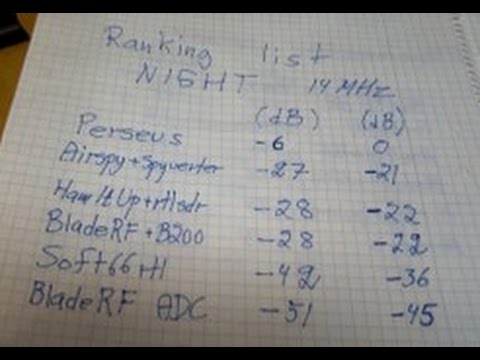
In his third video he tests night time reception against the SDRplay.

RTL SDR Dongle V3 nighttime vs SDRPlay Part 3

In this video YouTube user Michael Jackson tests his RTL-SDR V3 at 8 MHz, with a dipole antenna.

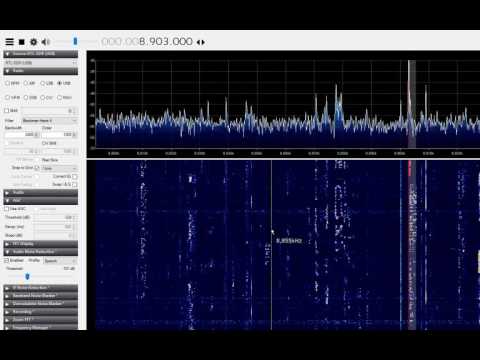
RTL-SDR v3 Dongle on HF

Finally, in this video YouTube user jonny290 tests the V3 dongle on HF reception using CubicSDR.

A Preliminary Review of the HF Mode on Our V3 Dongles

Over on YouTube user icholakov shows a video where he compares our new RTL-SDR V3 dongles with direct sampling against an SDRplay and Icom 7100. The video shows reception at various HF frequencies on AM shortwave, time signals and SSB signals during day time reception. The performance seems to be fairly decent, but of course not as good as the more expensive SDRplay or Icom receivers.

This was originally posted on swling.com.

RTL Dongle V3 vs SDRPlay vs Icom 7100 Part 1

Using a Beam Deflection Tube as a Mixer for an RTL-SDR Upconverter

Over on YouTube user Full spectrum technician has uploaded an interested video where he shows how he used a beam deflection tube to create an upconverter for his RTL-SDR. A beam deflection tube is a type of vacuum tube that can be used as a mixer. If you aren’t aware, a vacuum tube (a.k.a tube or valve) is an electrical component that was used in electrical equipment heavily back in the first half of the 1900’s. They could be used to implement circuits like amplifiers, mixers, switches, oscillators and more. Even today they are still used in some high end audio equipment because many people believe they produce superior audio quality. Full spectrum technician writes on his video:

A simple test using a 6ME8 beam deflection tube as a balanced mixer up converter for an RTL-SDR to enable HF reception.

The only problem I had was too much conversion gain. Even with a relatively short antenna, and literally starving the tube for voltage, the signal output levels were high enough that I had to crank back the gain of the RTL SDR and/or use padding on the input of the RTL-SDR.

The LO was feed to grid 1 for common mode input.
The antenna was feed to the two deflection plates via a transformer as a differential input.
The output was taken from the two anode plates via a transformer as a differential output.

That resulted in the LO balancing it’s self out on the output so that the LO would not overload the front end of the receiver.

Operating voltages at the time were..
20V anode.
5V deflection plates.
20V accelerator grid.
Cathode tied to ground.

Using a beam deflection vacuum tube as a mixer for an RTL-SDR up converter.

Videos showing the LimeSDR in Action on HF with GQRX

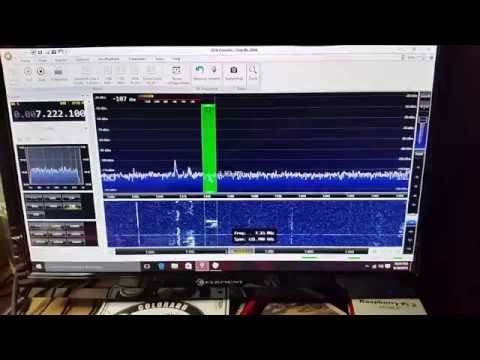
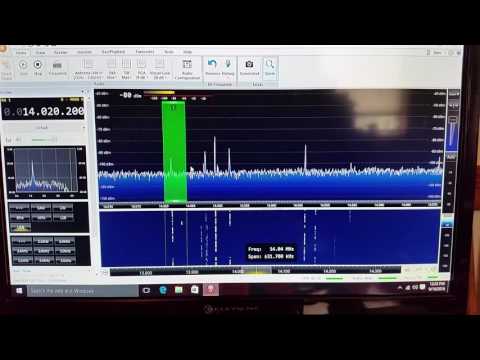
Over on YouTube LimeSDR beta tester Marty Wittrock has uploaded several videos showing the LimeSDR receiving HF frequencies. In the first video Marty shows it receiving the USB voice on the 20m band during the 2016 ARRL field day. The second video shows reception of PSK31 signals. More videos are available on his channel if you are interested.

In the videos he uses GQRX and his own KN0CK HF upconverter. The LimeSDR should be able to receive HF on its own without an upconverter, but at the moment the HF capabilities have not been programmed into the drivers yet, so during this beta testing period an upconverter is required.

Marty also wrote in to us to make some comments on his experiences with the LimeSDR. He believes that the LimeSDR is amazing and writes:

The quality of the receive and audio [of the LimeSDR] is incredible against other SDRs I have in the house (Flex 5000A, RTL-SDR, HackRF, Red Pitaya – and soon SDRPlay).

Marty also writes that he will soon have more videos of the LimeSDR operating in Windows with SDRConsole in the near future, and we will post those videos too when they are ready.

LimeSDR Receiving 20m Voice on USB

LimeSDR Receiving PSK31 on the 20m Band

Monitoring Ionosondes and Creating Ionograms with a USRP and GNU Chirp Sounder

In the HF region between about 0 – 30 MHz it is common to see and hear “chripers” – signals which quickly sweep through the HF frequency band and produce an audible chirp. These chirps are actually signals from Ionosondes which is a type of radar system used to monitor the Ionosphere. The Ionosphere exists about 50km above the surface of the earth and is the atmospheric layer responsible for a large part of long range HF communications. In a previous post by Mario Filippi we also discussed Ionosondes.

Usually it is scientists who transmit and monitor these Ionosondes, however if you have wide band radio that can cover a majority of the HF spectrum then you can also monitor these chirpers yourself. Over on his blog Fabrizio Francione has created a post showing how to use a USRP, together with a GNU Radio Program called GNU Chirp Sounder to create his own amateur Ionogram monitoring station. The USRP is a fairly expensive SDR with a bandwidth of 25 MHz, but we add that we think that next generation of low cost wide band SDRs like the up and coming LimeSDR should also be able to do the same job.

The Ionograms show at what frequencies HF propagation is currently optimal for a specific distance (or number of signal bounces from the Ionosphere). Below is an example Ionogram animation showing the reception of Ionosondes taken over time. Video from the GNU Chirp Sounder page.