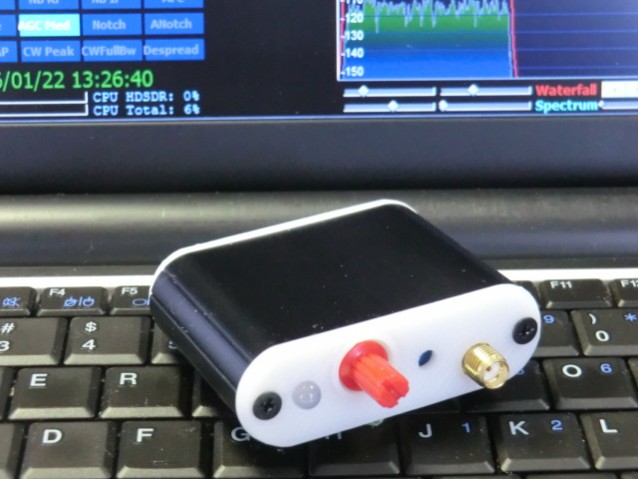
Over on the SWLing Post blog contributor Mike Ladd has posted up a review of the Soft66RTL3 software defined radio. The Soft66RTL3 is a fully enclosed SDR unit that consists of a standard mini RTL-SDR dongle, a selectable upconverter circuit, several switchable bandpass filters for HF and a UPC1688 RF amp which is enabled in HF mode and is controllable through a trimmer pot. The selectable bandpass filters are from 0.4 MHz to 1.2 MHz, 1.2 MHz to 5 MHz, 5 MHz to 15 MHz and 15 MHz to 30 MHz. The unit also comes enclosed in an aluminum box with an SMA input connector and Micro-B USB port.
The Soft66RTL3 is custom produced by Kazunori Miura (JA7TDO) who is based in Japan. The Soft66RTL3 sells for $40 USD shipped, or $46 USD shipped with registered air mail.
In the review Mike shows us the insides of the Soft66RTL3 and discusses its features. Later he also shows an installation and user guide.
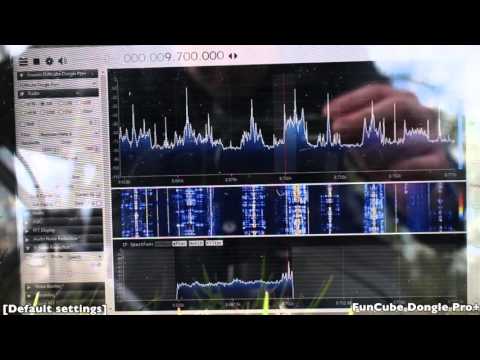
Over on YouTube user London Shortwave has uploaded a video showing a comparison of the FunCube Dongle Pro+, Airspy with SpyVerter upconverter and SDRplay on shortwave reception. The Funcube, Airspy and SDRplay are all $150 – $250 USD software defined radios that have much higher performance compared to the RTL-SDR.
In the video he tests the reception of Radio New Zealand International (RNZI) at 9400 kHz using a 6m copper wire dipole and 9:1 matching balun raised 2m off the ground. He did not use any external antenna preselectors. The RNZI station is weak and appears to be almost blocked by a stronger station so reception of the station is difficult.
In his results it appears that the FunCube and Airspy/SpyVerter are able to clearly receive the RNZI station, but the SDRplay has trouble with images of other stations mixing into the signal.
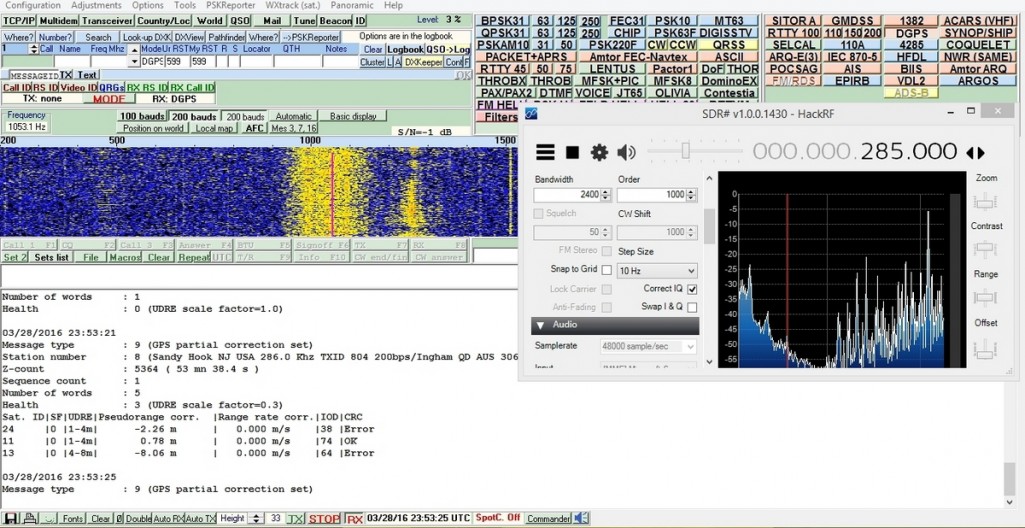
Differential GPS (DGPS) are signals that exist between 285 – 325 kHz and are used to enhance the accuracy of GPS receivers. The system can improve GPS accuracy from 15m down to 10cm in some cases. It works using a network of ground stations at a very accurate known location that continuously measure the GPS error they receive. They then broadcast this error to DGPS capable receivers. The receiver can then use this error knowledge to correct their own readings.
Over on his blog András Retzler has created a post that discusses his research work on creating a fast networked wideband HF receiver. András is the creator of the web based OpenwebRX software, which allows RTL-SDR and some other SDR’s to efficiently broadcast their SDR data over a network and onto the internet. Some live SDR’s can be found at the OpenWebRX directory at sdr.hu.
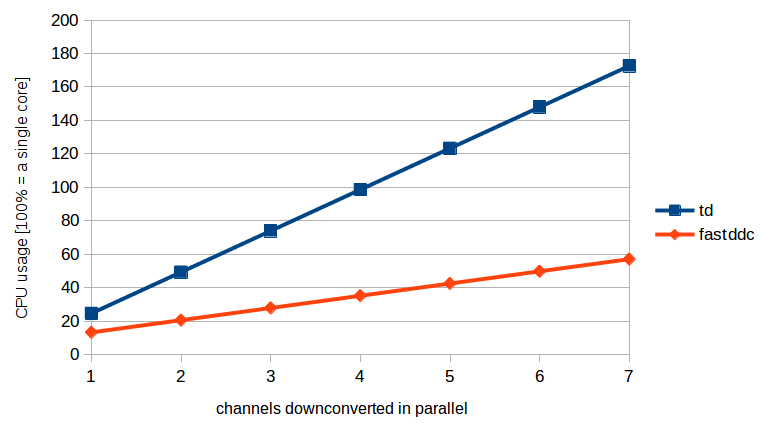
The problem with the current implementation, András writes, is that while OpenWebRX works well with the RTL-SDR’s 2.4 MSPS sampling rate, it can not work so well with very high sampling rates, such as 60MSPS due to excessive computational requirements when several channels need to be monitored. András’ solution is to use his Fast Digital Down Conversion (FastDDC) algorithm which is significantly more CPU efficient. András writes that the FastDDC algorithm improves computation by up to 300% in some cases, can speed up calculations on low powered computers like the Raspberry Pi 2 and can be implemented on a GPGPU for even higher performance. He is still working to implement the algorithm in OpenWebRX.
John Seamons has forked OpenWebRX, and sells his own hardware with it. The web interface is clearly the selling point of the device. After getting a lot of help from me, most of which was inevitable for his success, now John and ValentF(x) are leaving me with nothing, except a ‘Thank you!’. John has told me that OpenWebRX is a large part of his project, and he also claimed that my work has reduced the time-to-market of his product by maybe a year or so.
Why I’m standing up here is that forking open source software (which means changing the code in a way that is incompatible with the original version, and taking development in another direction), and funding it through Kickstarter is a very unusual way of getting things done. I acknowledge that John has very much work in his board and the accompanying software, however, he treated me and my project in an unethical manner.
In the Kickstarter comments section, the KiwiSDR creators reply back with their side. It is hard to say who is in the right in a situation like this. While what KiwiSDR have done is legal according to the licence, the ethics of doing so are questionable. We hope that both parties can successfully come to an agreement in the end.
If you want to directly support András and his work on OpenWebRX and other projects like FastDDC, then please consider donating to him at http://blog.sdr.hu/support. If you are a KiwiSDR backer, donating to Andras may be one way to right the situation if a deal cannot be reached.
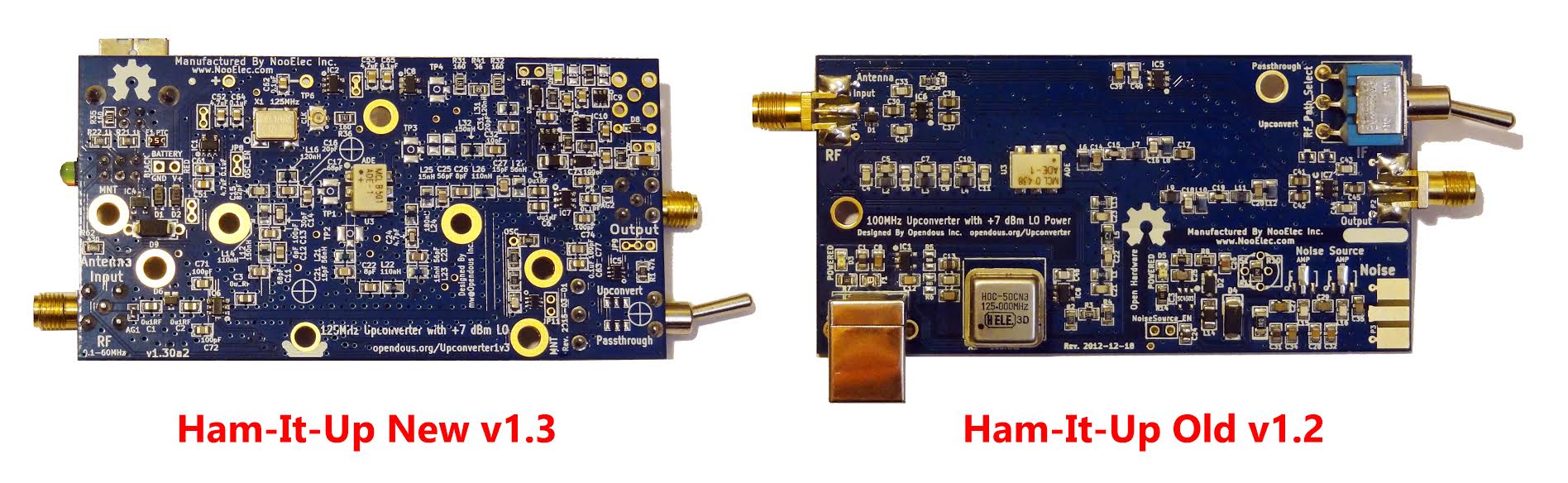
An upconverter allows you to receive HF frequencies (0-30 MHz) with an RTL-SDR which has a lower frequency limit of 24 MHz. The ham-it-up upconverter was one of the first upconverters to go on the market that targeted users of the popular RTL-SDR dongle. Over the years the ham-it-up has slowly been revised and now it is up at version 1.3. The biggest changes in the latest version are a revised design that uses the ADE-1 in reverse (better VLF operation), a presoldered oscillator and it also now includes the previously optional noise source by default.
In his review Akos compares the ham-it-up v1.3 to the older v1.2 model. His results show that the revised design seems to have better immunity to noise and better FM broadcast filtering. He also tests out the new battery power via connection and shows that using battery power is less noisy.
Previously we posted a review comparing the ham-it-up v1.0, SpyVerter and Nobu’s Japanese upconverter. Although the ham-it-up v1.3 is much improved and we have not tested it, we still believe the SpyVerter is the better upconverter choice at the moment due to its better architectural design and included metal case, though Akos does point out that the ham-it-up is currently about $15 USD cheaper and has a passthrough switch.
Ham-it-up v1.3 vs ham-it-up v1.2
In his second post Akos reviews the Balun 1:9 which is a $10 balun that is designed for attaching a long wire antenna to the ham-it-up. The goal of the balun 1:9 is to transform the high impedance long wire antenna down to around 50/75 Ohms for the receiver. In Akos’ results he writes that he mostly see’s identical or better performance with the balun connected.
The Nooelec balun 1:9
To add to Akos’ review, we want to note that we think that there might be some confusion over baluns and ununs. We wonder if a 9:1 unun (instead of a balun) should be used for a long wire antenna, since a long wire is an unbalanced antenna. We think a balun should be used for a balanced antenna such as a dipole. In his review Akos also found that connecting two longwire antennas to the spring terminals improved reception. This may have possibly been because adding two longwires essentially created a balanced dipole antenna. To implement a longwire antenna unun with a balun, we think that the second terminal and coax shield should be connected to a good ground source like a cold water pipe. If you have knowledge on this topic please comment to confirm or expand on our theory.
Radio transmissions between 0 - 30 MHz can travel all the way around the world. At these frequencies many interesting signals such as international shortwave radio, ham radio communications and several military transmissions exist.
The RTL-SDR's lowest tunable frequency is 24 MHz, and so it can only receive a small portion of the interesting transmissions that occur between 0 - 30 MHz. In order to listen to frequencies below 24 MHz an upconverter is required (either that or perform the direct sampling mod). An upconverter works simply by shifting these lower frequencies up to a higher frequency that the RTL-SDR can receive. For example, a 5 MHz signal might be upconverted to 105 MHz.
To date, most decent upconverters (such as the popular ham-it-up upconverter) have been based on the double balanced mixer architecture implemented by the ADE-1 mixer chip from Minicircuits. The SpyVerter on the other hand is based on a different type of architecture which is inspired by the H-mode mixer design that was used in the unreleased HF7070 communications receiver. The expected major advantage that this design has over a ADE-1 based design is better IIP3 performance. This essentially means that strong signals will not cause overloading issues in the SpyVerter, meaning less noise and spurious images.
Another advantage of the SpyVerter is its use of a 120 MHz low phase noise/low jitter clock, meaning less reciprocal mixing and thus greater SNR and a lower noise floor. A low phase noise clock is essential for getting good performance when receiving the very narrowband signals that are typically found between 0 - 30 MHz. The other upconverters do not specify their phase noise performance as far as we can tell.
The SpyVerter comes in a metal box, with three SMA adapters. A metal box is great because it helps keep strong interfering signals from entering the signal path, as well as stabilizing the internal temperature, keeping frequency drift to a minimum. Most upconverters only come with a metal box as a paid add on, but the SpyVerter comes in one by default.
Although the SpyVerter is designed to be used with the Airspy, it is fully compatible with the RTL-SDR as well. The SpyVerter can be powered via a USB cable, or via 5V bias tee (and this is compatible with the bias tee used on the RTL-SDR Blog units sold by us).
Mario Filippi a regular contributor to our blog has recently written in with another article of his. This time he’s submitted an interesting article about ionosondes and how he listens to and watches them with an RTL-SDR dongle and upconverter. We present his article below.
Chirp Sounders and Those Ear-Jarring “Zwoops”
Written by Mario Filippi (N2HUN) – (All photos courtesy of author)
Have you ever experienced a loud disconcerting “zwoop” sound quickly passing through your headphones while listening to the HF or shortwave bands? Surely many of us have, and for years these odd sounding transmissions were a mystery, but the conundrum was unraveled one day when using my RTL-SDR (software defined radio) dongle for some HF (high frequency, 2MHz – 30MHz) listening. The HF band is populated by an array of non-voice (digital) signals from familiar modes such as CW, RTTY, and FAX to more contemporary modes such as ALE, PSK-31, and JT65, to name a few. Many different modes and sounds, both man-made and from Mother Nature, some familiar, some mysterious, inhabit the breadth of the HF band. These frequently heard “zwoops,” on different portions of the band definitely were in the “mysterious” category.
Over the past several years these high-pitched “zwoops” passing through my headset at lightning speed disturbed the calm of a normal evening spent listening to shortwave with my venerable boat anchor-like Yaesu FRG-7 receiver. However, further investigation using a RTL-SDR dongle (from www.rtl-sdr.com), Nooelec HamItUp upconverter, and SDR# software visualized these signals emanating from ionosondes. Their transmissions appear on the waterfall image as pulsed lines traveling up (and sometimes down) different segments of the HF band. Their purpose is helping to assess the ionosphere’s propagation status.
Author’s RTL-SDR dongle, Nooelec upconverter (in plexiglass case), and MJF antenna tuner.
In short, ionosondes, or ionospheric sounders, sometimes referred to as “chirp sounders” are transmitters that send out a radio signal across a specific frequency range, only to be heard by receivers at distant locations that analyze what the propagation characteristics are. Armed with this information, these analyses are an aid in two-way radio communications, such as determining the best frequencies to use at a given time by radio operators around the world. So what do these ionosonde transmissions appear like using the RTL-SDR and SDR# software? See some examples below.
Chirp sounder appears as steeply-sloped line in center of SDR# waterfall. Strong signal at 20 MHz is time signal station WWV, Ft. Collins, CO.Pulse-like chirp sounder moving up the 15 meter (18.900MHz – 19.020MHz) shortwave band.CB (Citizen’s Band, 26.965MHz – 27.405MHz) band exhibiting chirp sounder activity.Weak chirp sounder in the 20 meter (14.000MHz – 14.350MHz) ham band.
Chirp sounder transmissions appear randomly as one navigates the HF bands and in the author’s experience are a hit and miss affair, but with the advent of software defined radios with real-time spectral displays of two megahertz or more in width, one can increase the possibility of hearing and seeing them more regularly. Note that ionosonde tracings on a waterfall can take many different shapes; I have shown only a few examples. The speed at which the ionosonde transmits up or down the band varies with the setup, but it’s an amusing signal to watch as it gracefully and speedily streaks across the band’s waterfall image with its’ meteor-like trail.
If you’d like to submit an article related to SDR, please remember to contact us at rtlsdrblog_AT_gmail.com.
The Spyverter is a new high performance upconverter that is being developed by the team behind the Airspy software defined radio and the SDR# software. It is designed to be used together with the Airspy, but it should also be compatible with other SDRs as well. The main claimed advantages over other upconverters will be it’s low loss and high IIP3 performance, which means that the Spyverter will not saturate in the presence of strong signals as easily as other upconverters.
Recently W9RAN, who is involved in the design and testing of the Spyverter uploaded some demo videos of the Spyverter + Airspy combo in action. The first video shows how the Spyverter when used together with the Airspy and SDR# allows for seamless tuning between VLF, HF through to VHF/UHF (no need to set any offsets).
Seamless tuning of SDR# with AIrspy & Spyverter
The next video shows the Spyverter + Airspy combo working during a RTTY contest on 40M with very densely packed signals, some of which were very strong.
W9RAN demo of Spyverter in 40 meter RTTY contest
W9RAN (ranickel on YouTube) also has additional Spyverter + Airspy videos on YouTube for viewing if you are interested.