Tagged: rtl2832u

Hackaday Supercon 2024: Tracking Down Radio Transmissions

Talks from the Hackaday Supercon 2024 conference have recently been uploaded to YouTube, and one interesting talk by Justin McAllister and Nick Foster is about tracking down radio transmissions.

The talk focuses on using SDR hardware such as the RX888, RTL-SDR, and Airspy devices combined with directional antennas for radio direction finding. Interestingly, they also discuss using ultrasonic microphones to find power line noise from bad transformers or insulators. The talk also focuses on ensuring that your SDRs receive real signals and what noise might look like on the spectrum.

This talk provides a comprehensive guide to identifying and locating radio transmitters. Learn about practical techniques, common tools, and methodologies from decades of combined experience finding, squashing, and mitigating against radio frequency interference.

Supercon 2024: Justin McAllister and Nick Foster - How to Track Down Radio Transmissions

SkyRoof: New Ham Satellite Tracking and SDR Receiver Software

Recently VE3NEA has released a new Windows program called "SkyRoof". SkyRoof is both a satellite tracking and SDR receiver program. It supports the RTL-SDR as well as Airspy and SDRplay devices.

The software is designed for tracking and receiving ham radio satellites, and it can provide detailed information about all ham satellites, tracking them in real time, and provide pass prediction. It also shows a skymap and SDR waterfall display. The receiver software supports demodulation of SSB/CW/FM, and it automatically compensates for doppler. It can also interface with antenna rotators that support hamlib.

SkyRoof Satellite Tracking and SDR Receiver Software Screenshot

Over on YouTube Johnson's Techworld has also recently uploaded a video showing him testing out Skyroof, which may be of interest to some.

Brief review of SkyRoof, the latest satellite tracking software!

AEDA: Crowd Sourced RTL-SDR Spectrum Analysis and TDoA Direction Finding Platform

Recentlywe've seen posts on X about a new service called "AEDA" (Advanced Electromagnetic Detection Application). This crowd-sourced web service utilizes RTL-SDR dongles as the RF reception hardware. The software can use multiple RTL-SDRs distributed around a city area for spectrum analysis and TDoA (Time Difference of Arrival) radio direction finding.

The service uses RTL-SDR dongles connected to Raspberry Pis as RF monitoring hardware. In the web UI, a user can initiate a spectrum scan using any of the distributed RTL-SDR nodes available to them. It can also automatically detect popular modulation types such as WBFM, NBFM, DMR, and P25.

A user can also initiate a TDoA scan to localize the source of a particular signal. This requires at least three RTL-SDR nodes to be distributed with good geometry around the signal source. The service synchronizes time via external wideband noise-like signals such as TV signals, cell towers, and DAB, so one of these signals must be available to be received by all RTL-SDRs used in the TDoA calculation.

For now, the service and features appear to be free. However, it looks like they will monetize the platform in the future by renting the crowdsourced RTL-SDR nodes to companies and persons that need to do band studies, radiolocation, and interference detection. They also hope to pay node owners for any time the nodes are rented.

More information about the AEDA service is available on their documentation page.

AEDA Scan with Modulation Detection
AEDA TDoA Hyberbolas from Three Distributed RTL-SDRs

NOAA18 to Begin Decommissioning Steps Immediately

In April, we posted news that the NOAA satellites would be classed as 'end-of-life' on June 16, 2025. According to the statements, the satellites were expected to remain in orbit and continue transmitting data that radio hobbyists could use, but no attempts would be made to rectify failures.

However, recent news from Carl Reinmann's usaradioguy.com blog has indicated that NOAA 18 will begin decommissioning steps immediately on June 3, 2025. The steps involve disabling batteries and transmitters, depleting remaining propellants, transitioning data and operations, and finally deorbiting, or moving the satellite to a safer orbit.

NOAA-18 may have been chosen to be decommissioned earlier than NOAA-15 and NOAA-19 as the S-band downlink transmitter failed last month, resulting in severe image degradation. The satellite has also been running on backup gyros since 2017, and has suffered various transmitter and sensor failures over the years. 

NOAA-18

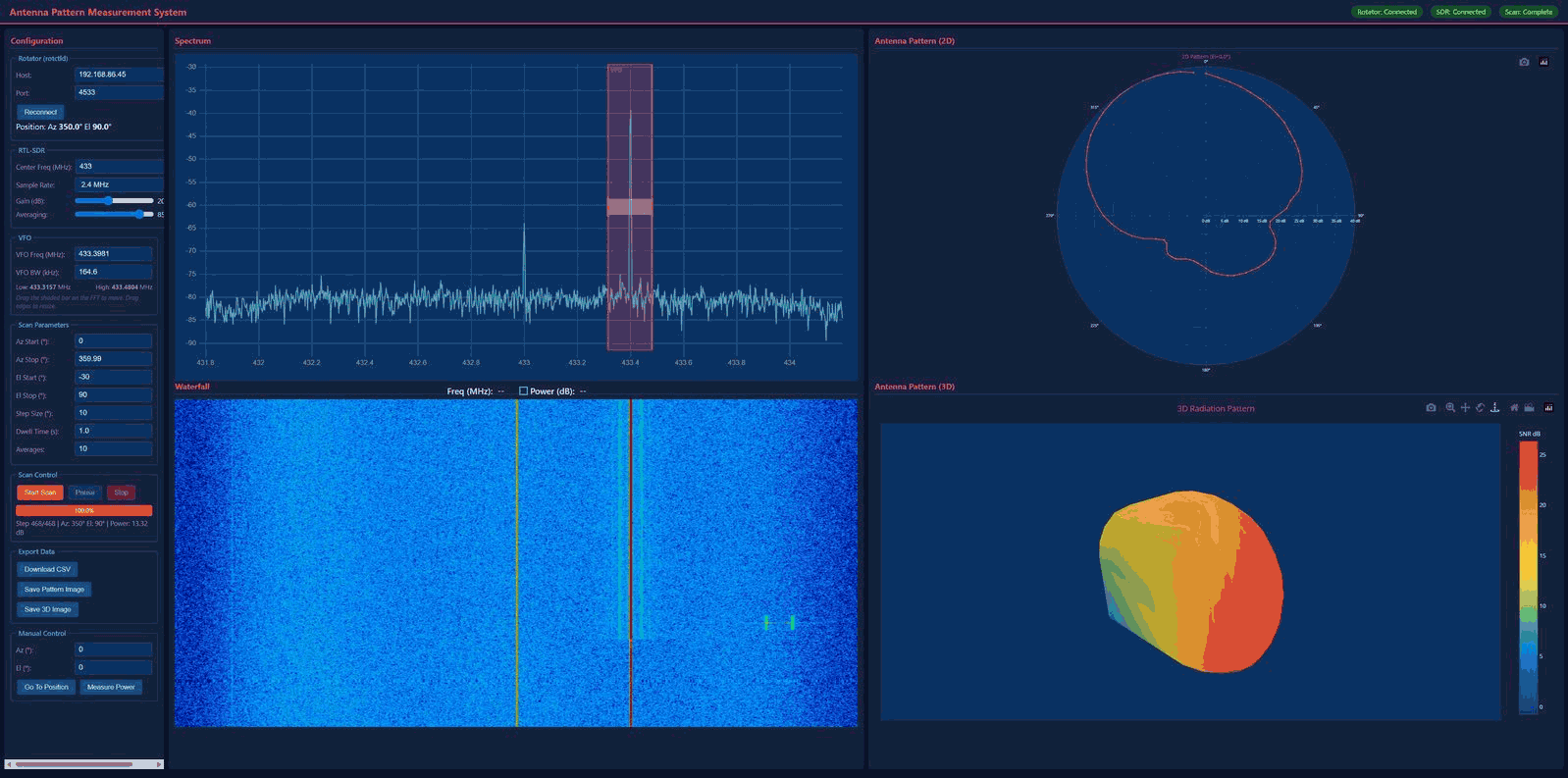
Obtaining an Antenna Radiation Pattern with a Large Field, Android Device and RTL-SDR

An antenna's radiation pattern tells us how it radiates or receives electromagnetic energy in different directions, indicating the strength, directionality, and coverage area of its signals. These days, this is easy to simulate on a PC. However, getting real-world results can still be essential to ensure an antenna is constructed well. For commercial antennas, real-world testing is typically done in an RF anechoic chamber.

Over on Hackaday, Jenny List shows us an alternative method for measuring an antenna's radiation pattern: setting up an antenna in a large field and taking RF measurements at various locations around it using an RTL-SDR.

In the post, List tests an HB9CV two-element 144MHz Yagi antenna. As expected, the resulting polar plot from the measurements indicates that the HB9CV is a directional antenna.

We've seen a similar setup in the past, as shown in this post, where a NanoVNA was used to measure the antenna power.

Antenna Field Test Setup


AI Cloud Detection for GOES Weather Satellite Images on a Raspberry Pi

Over on his blog account at Hackser.io Justin Lutz has uploaded an article describing how he uses AI object detection to automatically detect clouds on weather satellite images that he's downloaded from GOES satellites via an RTL-SDR.

Lutz's blog post first describes and shows his RTL-SDR GOES reception setup. Then, it explains how he used Edge Impulse on his Raspberry Pi 4 to create an AI model that automatically detects the clouds in the image.

The process begins by importing 100 images into Edge Impulse, manually labelling the clouds in each image, training the model, and testing it. The result was an average detection accuracy of 90%.

The Open-Weather Project’s Year Of Weather: June 15 NOAA EOL Nowcast Scheduled

Dr. Sasha Engelmann and Sophie Dyer, the team behind the Open-Weather project have recently announced a NOAA end-of-life nowcast to be recorded on June 15 2025. An open weather nowcast is a collaborative effort with users all around the world sending in weather satellite images that they have received locally with their home SDR setups.

NOAA satellite weather image APT transmissions have long been a staple of RTL-SDR hobbyists as they are among the easiest and cheapest satellite transmissions to receive. A simple V-dipole, RTL-SDR, and a computer are all that is required.

Sadly, it was recently announced that the NOAA satellites will be classified as end-of-life (EOL) on June 16 2025. However, the good news is that APT and HRPT data transmissions are expected to continue as usual. The end-of-life status indicates that NOAA will cease its own collection of data from these satellites and, hence, will no longer be distributing the datasets online. It also means that the satellites should no longer be used for mission-critical or scientific purposes and that no attempt will be made to fix a failing satellite.

These satellites have been operating well past their operational life, and given their advanced age, failure could come at any time. So the Open-Weather nowcast on June 15 2025 remains a nice way to honor their service to humanity.

You can see the last Year of Weather map created by the Open-Weather team and contributors here https://open-weather.community/yow/map/

The recent newsletter from the Open-Weather team explains how to participate in the June 15 nowcast.

OpenWeather Current Screenshot

New Khanfar Software: RTL-SDR CFAR Mask Analyzer

Recently, software developer M. Khanfar has been releasing a lot of new SDR and RTL-SDR compatible software, which you can see by searching for Khanfar on our blog.

Recently M. Khanfar has released a new program called "Khanfar RTL-SDR CFAR - Mask Analyzer" which is software designed for RF signal detection and analysis. Khanfar writes:

This powerful tool combines advanced Constant False Alarm Rate (CFAR) algorithms with innovative  Frequency Mask Trigger (FMT) techniques to provide reliable signal detection even in challenging RF environments.

CFAR (Constant False Alarm Rate) is an advanced adaptive threshold technique developed originally for radar systems but extremely valuable for any signal detection application.

The Frequency Mask Trigger (FMT) functionality allows you to define signal-free areas in the spectrum where you expect no signals or want to ignore existing signals. The software automatically adapts to these masks, preventing false detections in known signal areas while maintaining high sensitivity in areas of interest.

What You'll Learn:
How CFAR adapts to changing noise environments
Impact of different algorithm parameters
Mask creation and application techniques
Optimal settings for different signal types

Perfect For:
Students learning signal processing
Radar enthusiasts and researchers
SDR hobbyists exploring advanced features
Engineers developing detection systems

The Khanfar RTL-SDR CFAR - Mask Analyzer brings many features traditionally found only in expensive commercial spectrum analyzers and radar systems to the affordable RTL-SDR platform and provides an incredible value for education, hobbyists, and even many professional applications.
The software was also soon after updated to support Airspy devices, and add Telegram integration. The Telegram integration allows users to set up remote monitoring, and have alerts and data delivered directly to your mobile device via the Telegram messenger chat software.

As mentioned in previous posts, antivirus software can flag M. Khanfar's software as suspicious. We suspect these are false positive results due to the PyInstaller system used to create the exe, but please take your own precautions just in case.

Khanfar RTL-SDR CFAR - Mask Analyzer