Category: Applications

Using a LimeSDR To Detect Aircraft Reflections from a 2.3 GHz Beacon

Over on his blog author Daniel Estevez has described how he's been listening to aircraft reflections from a 2.3 GHz 2W beacon. The beacon is 10km away from Daniels location and transmits a tone and CW identification at 2320.865 MHz. As aircraft fly nearby to his location Daniel was able to observe aircraft reflections of the beacon, and was able to match them with ADS-B position and velocity reports.

The hardware that he used was a LimeSDR and a 9dBi 2.4GHz planar WiFi antenna patch. By aiming the antenna away from the transmitter, and using his car as a shield to block the transmitter he was able to receive some reflections. Daniel recorded several reflections including one produced by a nearby car.

By combining his results with ADS-B data he was able to superimpose the results, and color aircraft tracks by either a negative or positive doppler shift which was observed from the reflection. By combining the ADS-B data with the time stamps, he was also able to mark the reflections from each aircraft.

Marking Aircraft Reflections at 2.3 GHz against ADS-B Data

Reverse Engineering Wireless Blinds with an RTL-SDR and Controlling them with Amazon Alexa

Amazon Alexa is a smart speaker that can be programmed to control home automation devices via voice commands. For example, Stuart Hinson wanted to be able to control his wirelessly controlled blinds simply by verbally asking Alexa to close or open them. Stuart's blinds could already be controlled via a 433 MHz remote control, so he decided to replicate the control signals on an ESP8266 with 433 MHz transmitter, and interface that with Alexa. The ESP8266 is a cheap and small WiFi capable microchip which many people are using to create IoT devices.

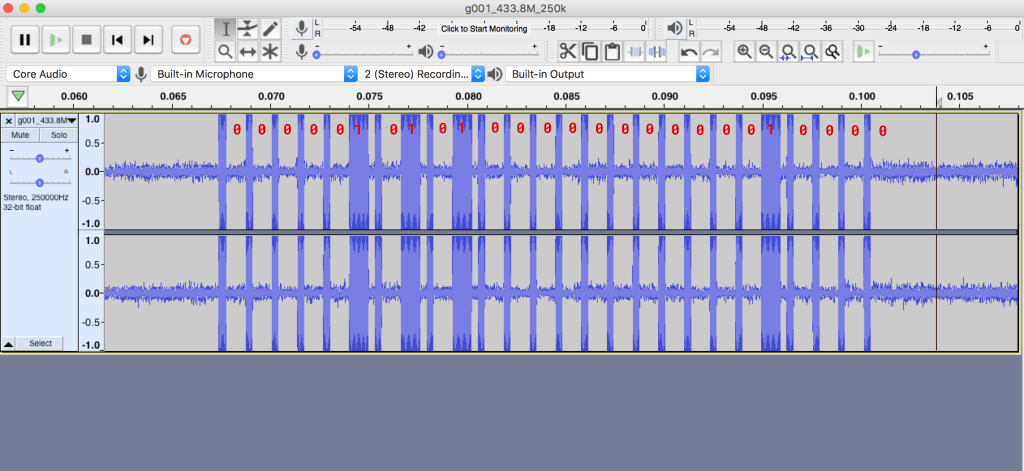
Fortunately replicating the signal was quite easily as all he had to do was record the signal from the remote control with his RTL-SDR, and use the Universal Radio Hacker software to determine the binary bit string and modulation details. Once he had these details, he was able to program the ESP8266 to replicate the signal and transmit it via the 433 MHz transmitter. The remaining steps were all related to setting up an HTTP interface that Alexa could interface with.

If you're interested, we've also previously posted about another Alexa + RTL-SDR mashup which allows Alexa to read out ADS-B information about aircraft flying in your vicinity.

[First seen on Hackaday]

The ESP8266 with 433 MHz Transmitter

More KerberosSDR Passive Radar Demos

KerberosSDR is our upcoming low cost 4-tuner coherent RTL-SDR. With four antenna inputs it can be used as a standard array of four individual RTL-SDRs, or in coherent applications such as direction finding, passive radar and beam forming. More information can be found on the KerberosSDR main postPlease remember to sign up to our KerberosSDR mailing list on the main post or at the end of this post, as subscribers will receive a discount coupon valid for the first 100 pre-order sales. The list also helps us determine interest levels and how many units to produce.

In this post we're showing some more passive radar demos. The first video is a time lapse of aircraft coming in to land at a nearby airport. The setup consists of two DVB-T Yagi antennas, with KerberosSDR tuned to a DVB-T signal at 584 MHz. The reference antenna points towards a TV tower to the west, and the surveillance antenna points south. Two highlighted lines indicate roughly where reflections can be seen from within the beam width (not taking into account blockages from mountains, trees etc).

The second video shows a short time lapse of a circling helicopter captured by the passive radar. The helicopter did not show up on ADS-B. On the left are reflections from cars and in the middle you can see the helicopter's reflection moving around.

We are expecting to receive the final prototype of KerberosSDR within the next few weeks. If all is well we may begin taking pre-orders shortly after confirming the prototype.

Subscribe to our KerberosSDR Announcement

When preorders start subscribers to this list will receive a discount coupon valid for the first 100 pre-order sales. This list also helps us determine interest levels and how many units to produce, so please sign up if you're interested.

Please select all the ways you would like to hear from RTL-SDR Blog:

You can unsubscribe at any time by clicking the link in the footer of our emails. We use MailChimp as our marketing platform. By clicking below to subscribe, you acknowledge that your information will be transferred to MailChimp for processing. Learn more about MailChimp's privacy practices here.

Aerial Landmine Detection using USRP SDR Based Ground Penetrating Radar

Over the last few years researchers at Universidad Javeriana Bogotá, a University in Colombia, have been looking into using SDRs for aerial landmine detection. The research uses a USRP B210 software defined radio mounted on a quadcopter, together with two Vivaldi antennas (one for TX and one for RX). The system is then used as a ground penetrating radar (GPR).  GPR is a method that uses RF pulses in the range of 10 MHz to 2.6 GHz to create images of the subsurface. When a transmitted RF pulse hits a metallic object like a landmine, energy is reflected back resulting in a detection.

Recently they uploaded a demonstration video to their YouTube channel which we show below, and several photos of the work can be found on their Field Robotics website. We have also found their paper available here as part of a book chapter. The abstract reads:

This chapter presents an approach for explosive-landmine detection on-board an autonomous aerial drone. The chapter describes the design, implementation and integration of a ground penetrating radar (GPR) using a software defined radio (SDR) platform into the aerial drone. The chapter’s goal is first to tackle in detail the development of a custom designed lightweight GPR by approaching interplay between hardware and software radio on an SDR platform. The SDR-based GPR system results on a much lighter sensing device compared against the conventional GPR systems found in the literature and with the capability of re-configuration in real-time for different landmines and terrains, with the capability of detecting landmines under terrains with different dielectric characteristics.

Secondly, the chapter introduce the integration of the SDR-based GPR into an autonomous drone by describing the mechanical integration, communication system, the graphical user interface (GUI) together with the landmine detection and geo-mapping. This chapter approach completely the hardware and software implementation topics of the on-board GPR system given first a comprehensive background of the software-defined radar technology and second presenting the main features of the Tx and Rx modules. Additional details are presented related with the mechanical and functional integration of the GPR into the UAV system.

Drone with USRP Ground Penetrating Radar Setup
Aerial landmine detection using SDR-based Ground Penetrating Radar and computing vision

Spektrum SV Mod: RTL-SDR Spectrum Analyzer Software Now with Improved UI

Spektrum is a popular spectrum analyzer program that is used with RTL-SDR dongles. It is based on the command line rtl_power software and is compatible with both Windows and Linux. Thanks to it's easy to use GUI it is an excellent piece of software for scanning and determining where active signals exist, or for measuring filters and antenna SWR with a noise source.

Recently SV8ARJ (George) and SV1SGK (Nick) have been working on extending the original open source Spektrum code. Their improvements focus around the UI and making it more functional and easier to use. Currently the updated branch is in alpha, and they are hoping that any testers could help report bugs, issues and wishes to them. The code is available on their GitHub and the latest Windows test build can be downloaded from their DropBox.

The changelog reads:

  • 2 Cursors for Frequency axis.
  • 2 Cursors for Amplitude axis.
  • Absolute and differential measurements with cursors.
  • Zoom functionality of the cursors's defined area (gain + frequency).
  • Mouse Wheel Gain adjustment on graph (Top area for upper, low area for lower).
  • Mouse Wheel Frequency adjustment on graph (left area for lower frequency, right for upper).
  • Mouse Wheel in the centrer of the graph performs symetric zoom in/out.
  • View/settings store/recall (elementary "back" operation, nice for quick zoomed in graph inspection).
  • Right click positions primary cursors.
  • Right Double Click positions primary cursors and moves secondary out of the way.
  • Left Double Click zooms area defined by cursors (Amplitude + frequency).
  • Left Mouse Click and Drag on a cursor moves the cursor.
  • Middle (mouse wheel) Double Click resets full scale for Amplitude and Frequency.
  • Middle (mouse wheel) Click and Drag, moves the graph recalculating limits accordingly.
  • Reset buttons to Min/Max range next to Start and Stop frequency text boxes.
  • Cursor on/off checkbox now operate on all 4 cursors.
  • ZOOM and BACK buttons.
  • Filled-in graph option (line or area).
  • Display of frequency, Amplitude and differences for all cursors.
  • Modified: Button layout.
  • Fixed: Save/Reload settings on exit/start. IMPORTANT : delete the "data" folder from the installation location if you have it.
  • Filling in graph option (line or area).
Spektrum UI Updates
Spektrum UI Updates

GammaRF: Distributed Radio Signal Collection and Analysis with RTL-SDR and HackRF

Thank you to Josh for submitting news about his project called GammaRF. GammaRF is an client-server program that is used to aggregate signal information via the internet from distributed SDRs. Currently the RTL-SDR and HackRF SDRs are supported.

ΓRF (“GammaRF”, or “GRF”) is a radio signal collection, storage, and analysis system based on inexpensive distributed nodes and a central server. Put another way, it is a distributed system for aggregating information about signals, and a back-end infrastructure for processing this collected information into coherent “products”.

Nodes utilize inexpensive hardware such as RTL-SDR and HackRF radios, and computers as small and inexpensive as Intel NUCs. Each node runs modules which provide various radio monitoring functionality, such as monitoring frequencies for “hits”, watching power levels, keeping track of aircraft (through ADS-B), and more. Nodes are distributed geographically and their data is combined on the server for hybrid analysis.

A web-based system allows users to view information from and about each station in its area. Below shows the server landing page. Markers are placed at each station’s last known location (stations can be mobile or stationary.)

GammaRF Server Landing Page

From the currently implemented modules it appears that you can monitor ADS-B, scan and monitor the power of a set of frequencies, forward the output from trunk-recorder (a P25 call recorder), scan the spectrum and monitor power levels, monitor a single frequency for activity, take a picture of a swath of RF spectrum, and collect 433 MHz ISM data. Some example applications might include:

  • Monitoring ham radio activity on repeaters in a city
  • Creating timelines of emergency services activity in an area
  • Distributed tracking of satellites and other mobile emitters
  • Monitoring power at a frequency, for example as a mobile node traverses an area (e.g. signal source location)
  • Building direction finding networks (e.g. for fox hunts)
  • Spectrum enumeration (finding channels and guessing modulation) [under development]
Monitoring Activity of an Amateur Radio Repeater
Monitoring Activity of an Amateur Radio Repeater via the 'scanner' Module

Listening to the Sound of Molecules via Nuclear Magnetic Resonance and an RTL-SDR

Over on YouTube user aonomus has uploaded a video showing how he's used an RTL-SDR to observe and listen to the radio signal generated via a chemistry lab's nuclear magnetic resonance machine. To do this he simply taps the RF output of the NMR machine which allows the RTL-SDR to listen to the signal and play it as audio. In the video he shows the sound of a sample of chloroform in acetone-d6. The demo has no real scientific purpose other than to hear the sound of the molecule. Normally the RF output goes straight into a spectrum analyzer for visual analysis.

Nuclear magnetic resonance is a technique used in chemistry for the analysis of chemicals, as well as in MRI medical imaging machines. Very basically, it works by applying a chemical sample to a strong magnetic field, exciting it with a strong pulse of RF, and listening to the echo. An echo will only occur when the radio waves are transmitted at the chemicals resonant frequency. The frequencies used are typically between 60 to 800 MHz.

A few years ago I came up with a demonstration for some high school students interested in chemistry. This demo is a modern take on a classic NMR experiment, using a low cost software defined radio to observe the FID signal as audio. In short, this demo allows you to hear the proton FID echo from the liquid sample inside the NMR magnet.

Nuclear Magnetic Resonance Demonstration Using Software Defined Radio

Measuring the SWR of FPV Antennas with an RTL-SDR

FPV stands for 'First Person View', and is a term used to describe the hobby of flying remote controlled aircraft entirely via the view from a wireless camera that transmits live video to the pilots screen or video goggles.

Part of the FPV hobby is to not only enjoy flying, but also to tweak the wireless video equipment for maximum range and reliability. This involves measuring the SWR characteristics of FPV antennas. SWR is a metric that describes how well the impedance of an antenna is matched with the receiver at a certain frequency. Poor SWR results in additional signal loss on top of cable and connector loss. We note that SWR is only one antenna metric, and doesn't take into account radiation pattern and antenna gain which is often more important, but it is the easiest metric to measure and control, and should give you some idea as to if an antenna was designed and tuned properly.

As FPV hobbyists are often not hams or radio professionals, most don't have access to the equipment required to measure SWR. So over on his YouTube channel bonafidepirate shows how he's been using a cheap RTL-SDR, noise source and RF Bridge to measure the SWR of his FPV antennas. The process is similar to the one shown in our tutorial, but he uses the Spektrum software which allows you to measure SWR entirely within the software itself.

In the video bonafidepirate goes over the required hardware, software and the setup, and then demonstrates several SWR scans of different FPV antennas.

DIY VSWR Meter for FPV, Lets test some antennas!