Meteor M-N1 Satellite Wakes up from the Dead
RTL-SDR.com reader Happysat recently wrote in with some news. A few days ago a weather satellite image decoding enthusiast from Argentina was waiting for a pass of the Russian Meteor M-N2 satellite when he discovered a strong LRPT signal at 137.1 MHz, even though the Meteor M-N2 satellite was not in sight yet. It turns out that the signal was coming from the old Meteor M-N1 satellite which was supposed to have been shut down in September 2014 due to several problems it had. The received signal is strong enough to produce a good black and white weather image, but because the satellite is not longer physically stable, sometimes the Earth’s curve can be seen in the images.


The exact reason as to why it is transmitting again is unknown, but it is speculated that it is due to a breakdown of the chemicals in the batteries. Last year we posted about how sometimes satellites which have been decommissioned and shut down can spontaneously begin transmitting again when their batteries undergo a chemical change due to thousands of failed recharge cycles. The chemical change allows the batteries to conduct electricity from the solar panels directly to the electronics, which on Meteor M-N1 could be reactivating the transmitters and imaging sensors. If this is what happened then the satellite will only be able to transmit during the day.
The Meteor M-N2 satellite is the currently official active satellite. It transmits weather satellite images with the LRPT protocol which can be received and decoded with an RTL-SDR dongle. We have a previous post on this showing an offline LRPT decoding tutorial and more recently a tutorial showing how to decode LRPT in real time. The same processes can now be adapted to the resurrected Meteor M-N1 satellite by choosing the 80K symbol rate option in the LRPT decoder.
Happysat who submitted this news originally writes:
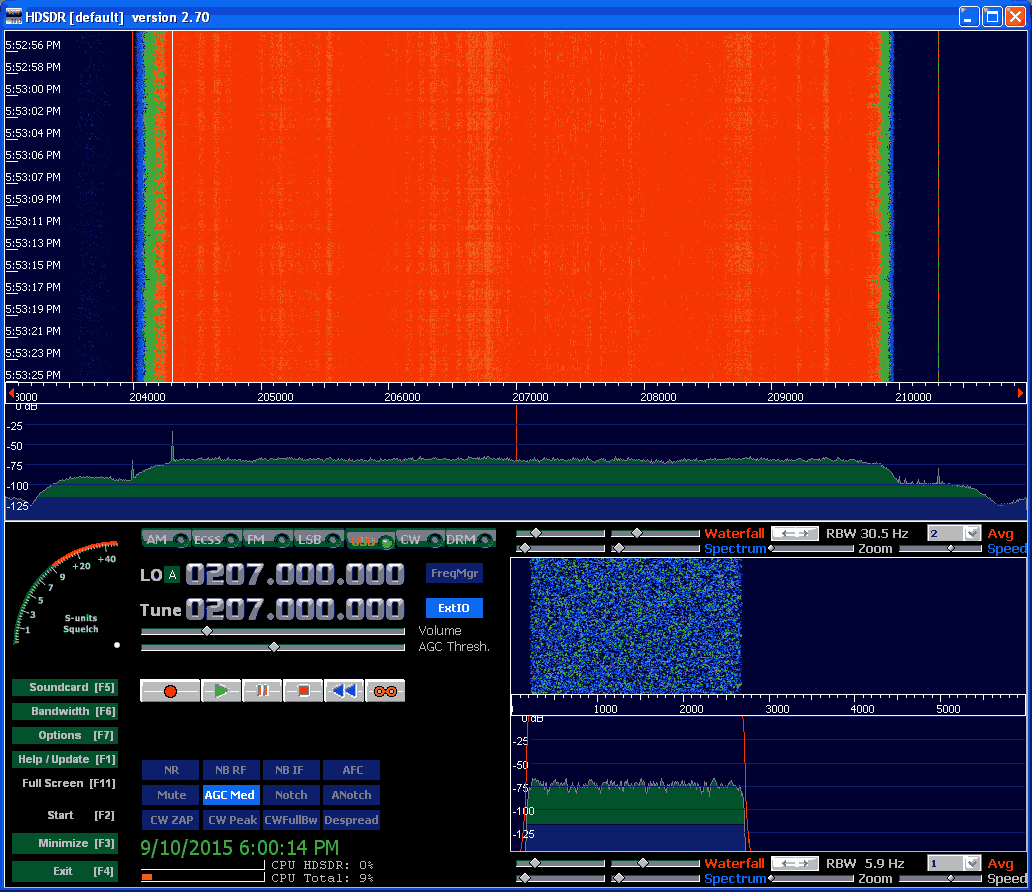
A few days ago some guy in Argentina was waiting for the pass of Meteor M-N2 and on SDRSharp waterfall he did see LRPT Digital signals on 137.100MHz, but Meteor M-N2 was not in sight yet…
This relatively strong signal was coming from the defunct Meteor M-N1 satellite left out of control in September 2014 last year and was shutdown, although LRPT Transmissions in the past where very limited and sporadic.
Meteor M-N1 did suffer from many problems at this was the first Russian digital weather satellite in the M-series onboard many hardware in experimental stages.
After this report I tried also to capture some signals from Meteor M-N1 (some other amateurs already got small portions of images) but the satellite only transmits in direct sunlight, batteries are not charging any more.
Indicating maybe like the other older ‘deadsat’ some chemical reaction did occur inside the batteries so the power goes from the solar panels directly to the transmission parts.
It did happen before, mostly on older satellite’s only a unmodulated carrier is present when the sunlight conditions are optimal.Surprisingly after I did record and process the 80K symbol rate QPSK signal from Meteor M-N1 with Vasili’s excellent QPSK Plugin a very nice image was generated!
Not only the sunlight provides power to the transmission part but also there is enough power to activate the imaging system which is quite amazing!
Visible channels 1-2-3 are fully working but the image is only Black and White Calibaration of the sensor are not okay so no color images can be created.
Nevertheless its a very nice addition for current LRPT weather amateurs and a big surprise its even working better when nobody controls it 😉
Because the stabilisation system failed there is no proper correction to orientate the camera and on some passes one can see the earths curve!
There are some conflicting reports about the status of Meteor M-N1 found on the internet:
Status Inactive
Details on Status (as available)
- MSU-MR was functional with limitations (calibration issues and higher noise level in the IR channels).
- MTVZA-GY instrument was functional with limitations due to failures of on-board memory and atmospheric sounding channels.
- Severjanin instrument non-operational.
- DCS was functional with limitations due to interferences to signals from ground sources.
- GGAK-M was operational with significant limitations.
- LRPT was functional with limitations due to information compression errors.
- Finally, the stabilisation system failed on 23 September 2014 and the instruments could longer be operated.
On October 1, 2014 Meteor-M No 1 was withdrawn from operational use and transferred to the study of the chief designer. The decision on further operation of the spacecraft will be taken upon completion of the research program.
Its not clear the problems did got solved, and I ‘think’ M-N1 started a second life on his own. Time will tell how long the satelitte will function.
Some details:
https://directory.eoportal.org/web/eoportal/satellite-missions/m/meteor-m-1
http://planet.iitp.ru/english/spacecraft/meteor-m-n1_eng.htm