Tagged: HF

Elektor SDR Hands-on Book + Arduino Shield HF SDR

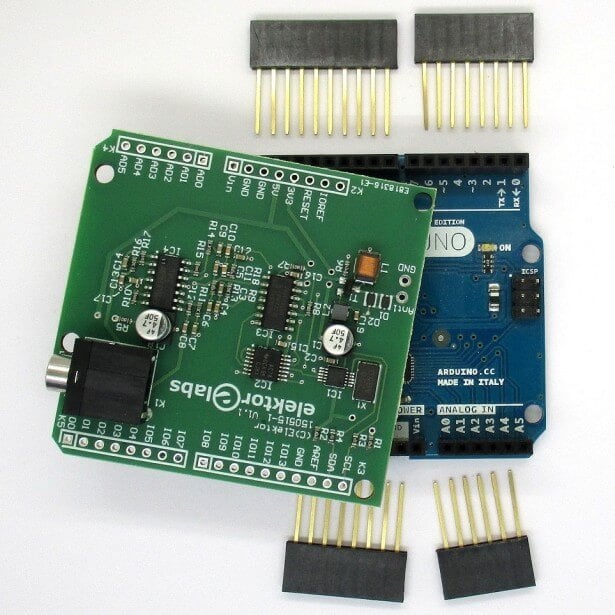
Elektor is a popular electronics magazine and hobbyist kit store. Recently they have published a book titled "SDR Hands-on Book" written by Burkhard Kainka. The book is intended as a companion to their Arduino SDR shield kit, which is a low cost module that allows you to turn an Arduino into a 150 kHz to 30 MHz capable SDR. It is based on the G8JCFSDR, which is an RF front end downconverter that allows a PC soundcard to be used as an SDR analog to digital converter.

Kainka's book goes over introductory topics such as shortwave reception, explains signal to noise ratio and interference, different types of antennas, software, digital modes, SDR measurements, receiving and finally WSPR and QRP transmission. If you're interested Jan Buiting also recently reviewed the book on the Elektor website.

Elektor are currently running a promotion and are selling the book + Arduino shield for a reduced price of €49.90.

The Elektor Arduino Shield HF SDR Kit.

Reducing HF Electrical Noise by Using a Faraday Cage for Switch-Mode Power Supplies

Over on his blog, DXer OH2-2192 was frustrated by lots of local electrical noise showing up on the HF bands on his Airspy + Spyverter SDR receiver. He discovered that the majority of the noise he was seeing was coming from the switch mode power supplies that power the electronic devices used in his setup. Switch mode power supplies are very common in the modern world, with almost every electronic device using one to efficiently convert wall AC into DC power. However, they convert power by rapidly switching on and off, and these on/off square wave pulses cause a lot of RF noise especially on the HF spectrum.

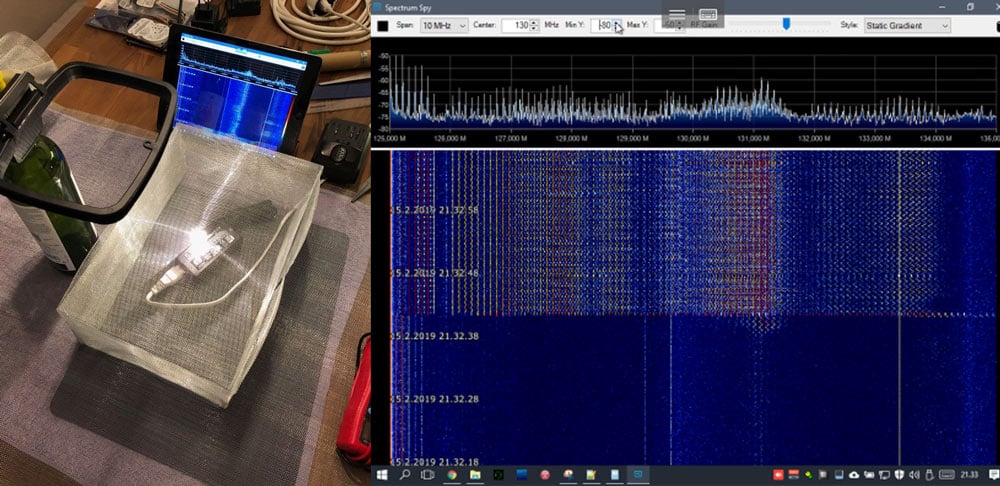
Instead of changing to noise free linear regulators which are expensive, very heavy and big, OH2-2192 decided that he'd try creating a Faraday cage shield out of metal mesh to enclose all his switch-mode power supplies. Using a simple AM loop antenna and Airspy's Spectrum Spy software he measured the amount of noise produced by a switch-mode supply placed inside and outside of the cage. The results he saw were very promising with the shielded supply eliminating the noise almost entirely.

Faraday Cage Shield for Switch Mode Power Supplies
Faraday Cage Shield for Switch Mode Power Supplies (Right image shows the results of a switching supply placed outside and inside the Faraday cage)

Using an Airspy HF+ with SDR# and WSJT-X to Decode FT8 + SpyServer FT8 Decoding Demo

Over on YouTube user TheGazLab has uploaded a video that reviews the Airspy HF+, and also shows how to use the HF+ with SDR# and WSJT-X in order to create a FT8 monitor. The Airspy HF+ is high dynamic range HF/VHF receiver designed for DXing.

In the video TheGazLab demonstrates to us the decoding in real time, and explains the CAT control SDR# plugin that he's using. The CAT control plugin when combined with a virtual serial port driver allows the WSJT-X program to automatically tune SDR# to the FT8 frequency selected in WSJT-X.

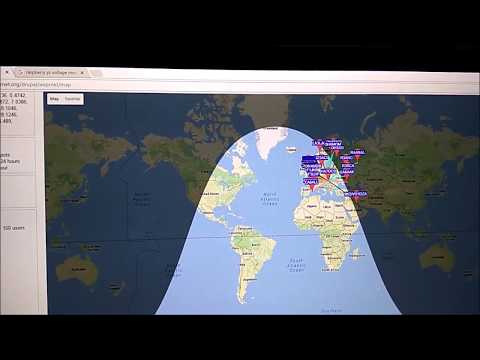
Later in the video he also discusses the SpyServer network which allows SDR# users to connect to remote public Airspy and RTL-SDR units over the internet. He demonstrates connecting to a public server in the UK, and decoding FT8 via the remote server. The video also shows the new SpyServer interface by  which nicely lays out the world SpyServer network on a map, making it easy to choose a desired location to listen to.

Airspy HFPlus, SDR# and WSJT-X with full CAT control decoding FT-8

Creating a Standalone WSPR Receiver with an RTL-SDR V3 and Raspberry Pi 3

Thank you to Zoltan for submitting his scripts for installing the rtlsdr-wsprd WSPR decoder onto a Raspberry Pi, and showing us how to configure it for an RTL-SDR V3 dongle running in direct sampling mode. This set up allows users to create an extremely low cost and permanent RX WSPR monitor.

WSPR is an amateur radio digital HF mode designed to be decodable even if the signal is transmitted with very low power and is very weak. It can be used to help determine HF radio propagation conditions as WSPR reception reports are typically automatically uploaded to wsprnet. Direct sampling mode on the RTL-SDR V3 allows you to receive HF signals without the need for an upconverter. For best results it is recommended to use a simple bandpass filter for the band of interest.

Zoltan's tutorial comes with a companion YouTube video where he demonstrates his set up. He uses a random wire antenna on his roof directly connected to an RTL-SDR V3, which is connected to a Raspberry Pi 3.  The Pi 3 communicates to his home network via an Ethernet cable.

Making a standalone WSPR receiver with RPi and RTL-SDR V3 using rtlsdr-wsprd

World Radio TV Handbook (WRTH) Reviews the Airspy HF+

The World Radio TV Handbook (WRTH) is a directory book (or CD) of world radio stations on LW, MW, SW and FM. In addition to the directory they also do reviews of radios/SDRs, and recently they reviewed the Airspy HF+ (pdf). The Airspy HF+ is high dynamic range HF/VHF receiver designed for DXing.

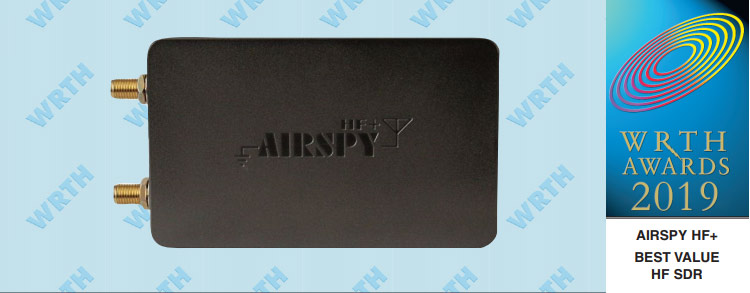
According to the review, WRTH give the Airspy HF+ the award of being the best value HF SDR for 2019. The review takes note of the HF+'s excellent dynamic range and then goes on to validate the manufacturers claimed specifications. Finally they write how they tested it during a contest at 7 MHz, and found no overloading or spurious responses apart from a minor noise floor increase when an extremely strong local CW station was encountered.

World Radio TV Handbook Review of the Airspy HF+

An Introduction to SDR and SDR Applications for Shortwave Listeners

Over on the SWLing Post blog, author Thomas Witherspoon K4SWL has uploaded a new article titled "Software Defined Radio Primer Part 1: Introduction to SDRs and SDR applications". The article originally appeared in the June 2018 issue of The Spectrum Monitor magazine, which can be purchased online for $3 per issue.

The idea behind the article is to introduce people to SDR from a shortwave listening point of view, so high performance HF SDRs like the Airspy HF+, Elad FDM-S2 and WinRadio Excalibur are discussed. Thomas notes that these SDRs can perform as well as traditional DX-grade receivers that can cost two to three times more. He also explains what advantages SDR's bring to the shortwave radio listening hobby. This may be a good article to show those still using older hardware radios that haven't yet converted to the SDR world. 

The article is currently part one of a three part series, with parts two and three to be released in October and November.

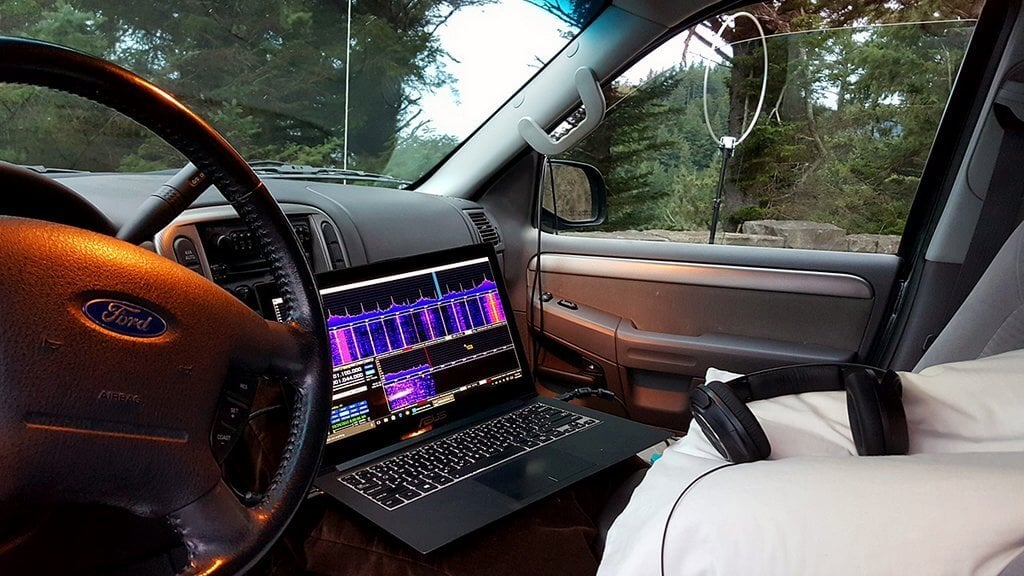
DXing with SDR in a Car
DXing with SDR in a Car (Photo: Guy Atkins)

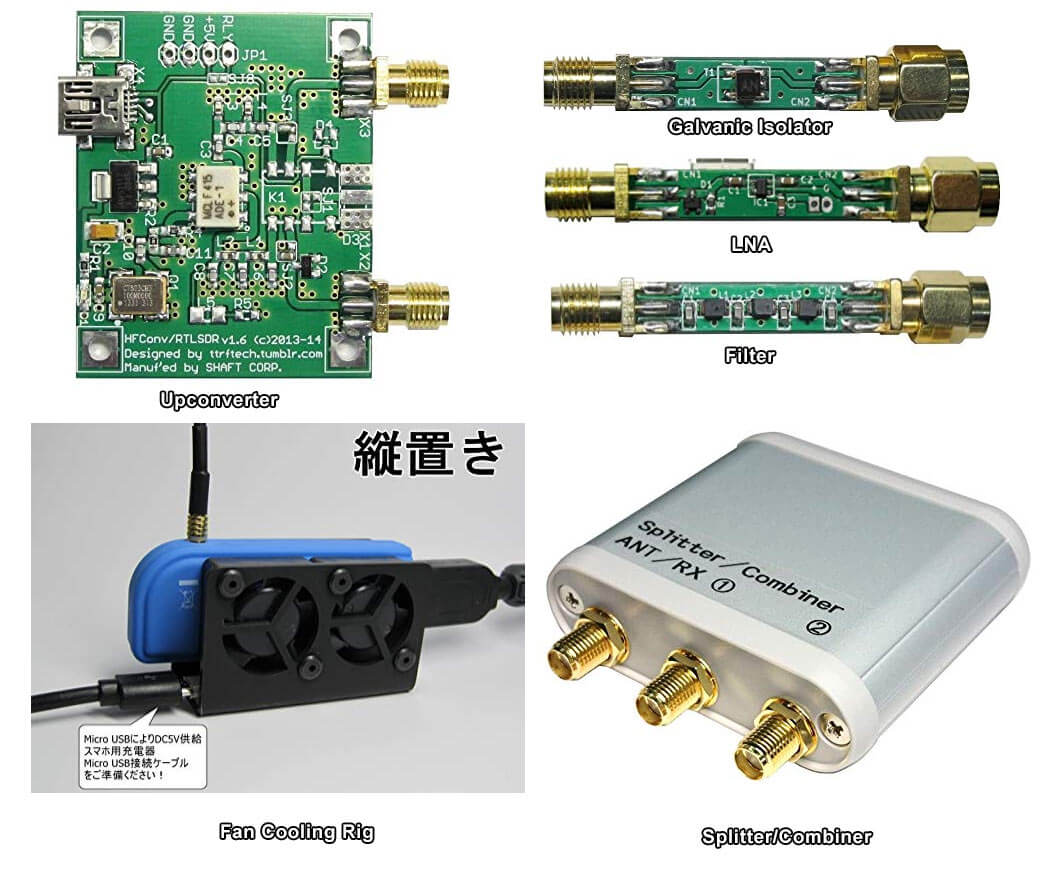
Japanese RTL-SDR Products Now Available for International Shipping on Amazon.co.jp

Thanks to 'Nobu' for letting us know that his RTL-SDR products sold on Amazon.co.jp are now available for international shipping (in Japanese, please use the Google Translated version if needed). Before Amazon.co.jp offered international shipping you had to use a third party Japanese forwarding service in order to purchase his products.

Japan has a strong RTL-SDR scene, with a few small Japanese companies and individuals (including Nobu) selling custom RTL-SDR products on their local Amazon store. Products such as upconverters, galvanic isolators, LNAs, filters, cooling products and more are available. Back in 2015 we reviewed some of these products in a post available here. Since then we've found continued use in particular with the galvanic isolator which helps reduce noise from the computer and nearby electronics at HF frequencies. 

Some Japanese RTL-SDR Products available for International Shipping on Amazon.co.jp
Some Custom Japanese RTL-SDR/RF Products available for International Shipping on Amazon.co.jp

Archiving Shortwave History with Software Defined Radio

Broadcast shortwave radio is not always archived for long at the station, so finding sound bites from interesting historical events can be difficult. We know that songs are of course recorded, but talk back radio, discussions in between music, news readings, weather updates, ads and pirate radio are all lost over time. Although these things may seem mundane now, future historians may be interested in listening in on this little slice of life.

At this years HOPE XIII conference, Thomas Witherspoon, owner of the popular SWLing Blog gave a talk titled "Creating a Radio Time Machine: Software-Defined Radios and Time-Shifted Recordings". Currently the talk is available as a full recording of all talks at the conference over on Livestream. Thomas' talk begins at about 9h03m45s (thanks to Aaron Kuhn from the comments for finding the talk. Hackaday also recently ran an article on the content of his talk.

Thomas' idea is to create a database of shortwave radio IQ recordings so that they can be archived for historical purposes. The project is called "The Radio Spectrum Archive" and has a website set up at spectrumarchive.org. To do this modern software defined radios like the RTL-SDR can be used to record a large bandwidth, however the problem is with data storage as IQ recordings can take up extremely large amounts of disk space. 

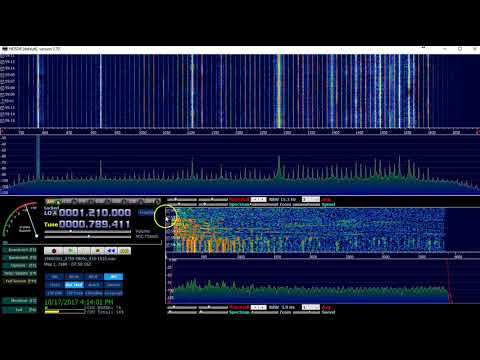
Interestingly, it turns out that people have actually been making IQ recordings since the 1980's by connecting their shortwave radios to VCR tape recorders. In the modern day these VCR recordings can be digitized into an IQ file, and played back in software like HDSDR. In the video below Thomas demonstrates the playback of a digitized VCR radio recording from May 1 1986. You can hear some interesting news tidbits on the soviet cover-up of Chernobyl, the Challenger disaster and the launch of a new hurricane tracking satellite. If recording was more popular it would have been interesting to hear soviet radio during this time too.

In addition to archiving IQ files, Thomas has been releasing a podcast of curated historical audio recordings from VCR tapes, as well as modern recordings that may be of interest over at shortwavearchive.com.

We envision a future where one day these recordings could be automatically turned into text logs via advanced speech to text software, so they could easily be searched through.

[Also seen on Hackaday]
Radio Spectrum Recordings: A short demonstration