If you weren't already aware, KrakenSDR is our 5-channel coherent radio based on RTL-SDRs, and it can be used for applications like radio direction finding. KrakenSDR is in stock and can be purchased from CrowdSupply or Mouser. More information is also available on our website at krakenrf.com.
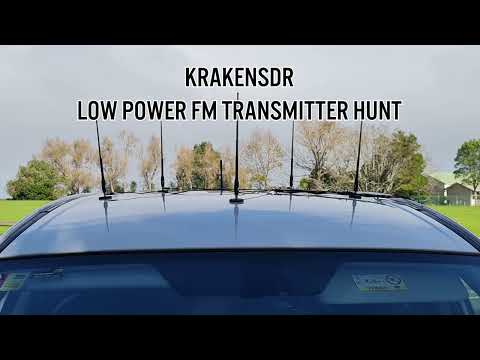
In this video we are using a KrakenSDR to hunt for the location of a low power FM transmitter (LPFM) station at 106.7 MHz. These low power FM transmitters are legal as unlicensed transmitters as long as they operate under certain restrictions, the main one being that they transmit at under 1 watt EIRP. LPFM stations are typically operated by local communities or niche radio stations.
Because they are unlicensed, there is no official record and their location doesn't show up in the radio spectrum management database. A requirement of LPFM is that the station broadcast the contact information of the owners regularly, but it can be difficult to locate non-compliant stations that don't do this. But the KrakenSDR makes finding them easy.
The array is 45cm in radius, which is about the maximum that my RAV4 car roof can fit. Some of the antennas sit on a slight curve on the roof, but this appears to have negligible effect. The spacing factor is about 0.19 (optimal is 0.5 - a much larger radius), but even 0.19 is sufficient to find the transmitter fairly easily.
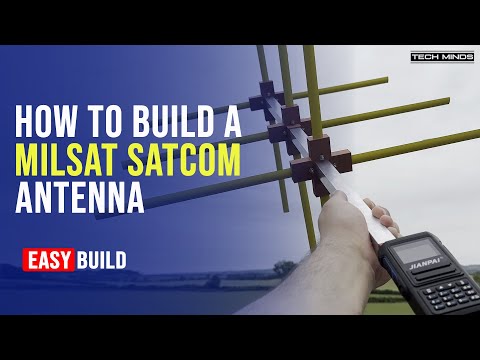
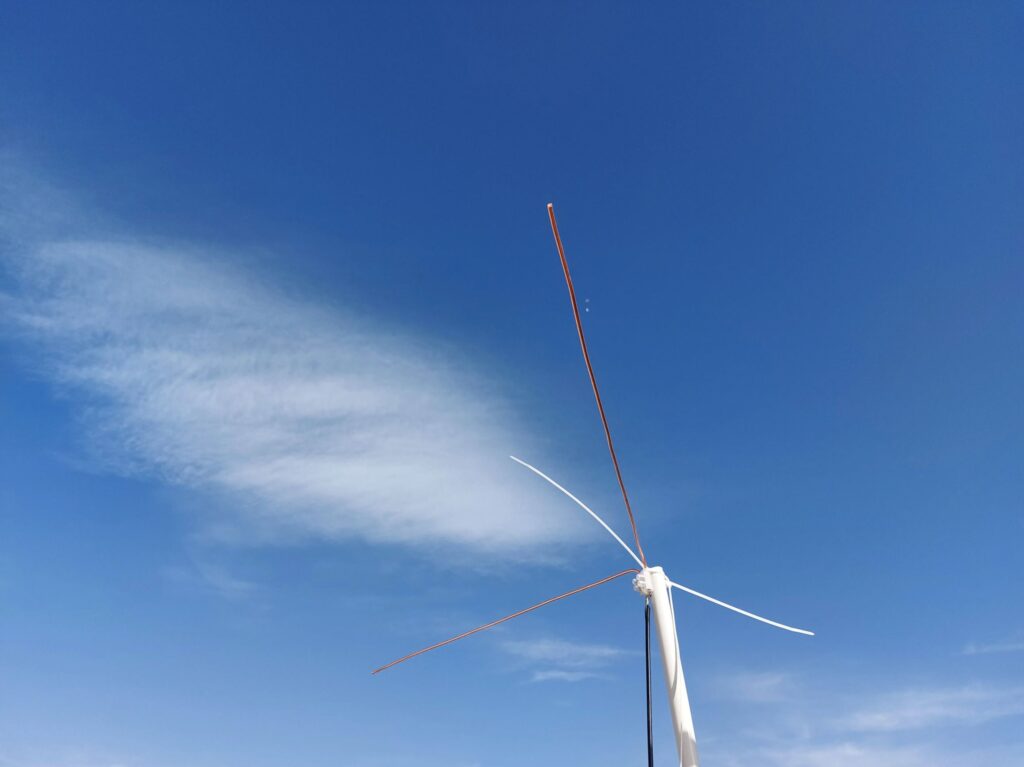
In his latest video Matt from the TechMinds YouTube channel shows us how to build a home made turnstile antenna for receiving the MILSAT SATCOM satellites where radio pirates from Brazil and other countries can often be heard.
The build involves 3D printed parts, metal measuring tape for the elements, some aluminum tubes and a coax phasing harness. After testing the VSWR with a meter, Matt tests the antenna with a handheld and finds it to be working well. He also later tests it with his SDRplay RSPdx and finds that the Turnstile outperforms his roof mounted vertical.
In his latest video Matt from the TechMinds YouTube channel has shown how it's possible to detect the RF echoes of meteors falling in the earths atmosphere which a software defined radio.
The concept is relatively straightforward. Meteors falling in the atmosphere generate an RF reflective ionized trail, which is highly reflective to RF. In the UK where Matt lives, the Sherwood Observatory of the Mansfield and Sutton Astronomical Society (MSAS) have set up a meteor detection beacon "GB3MBA" which transmits an 80W CW signal at 50.408 MHz.
When tuned to this frequency with an SDRplay RSPdx SDR, Matt shows how the shifted reflections of meteors can be seen as blips around the beacon's carrier frequency. What is also seen are reflections from aircraft which show up as longer doppler shifted lines. Matt notes that if you live within 200km of the beacon a simple dipole antenna is sufficient, however any further might require an antenna system with more gain like a Moxon or Yagi.
We note that in Europe a similar beacon called the GRAVES space radar in France which operates at 143.050 MHz can be used.
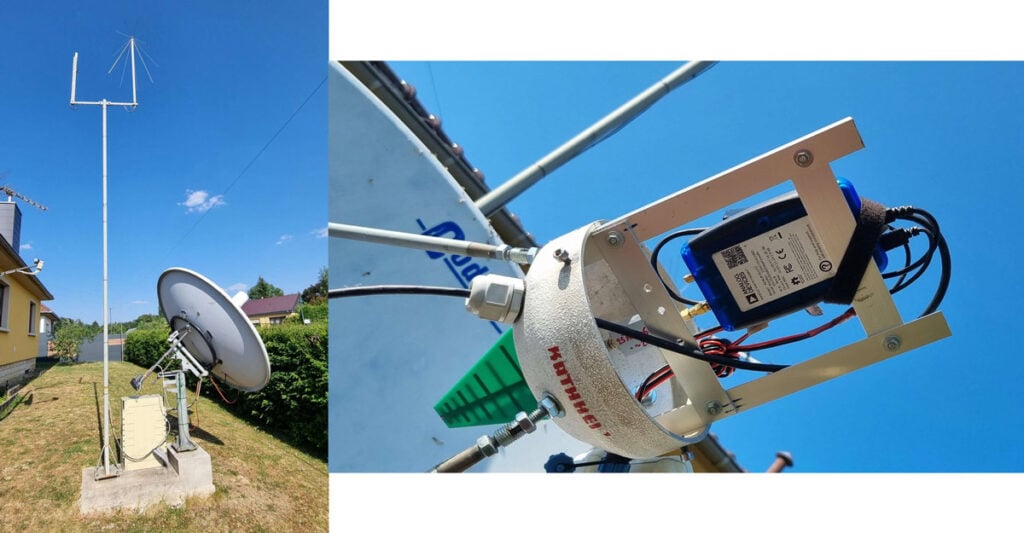
On his Medium.com blog, Mohsen Tahmasebi has posted an article about his journey into listening to satellites which started with his acquisition of an RTL-SDR Blog V3 dongle. The article begins by explaining his motivations for receiving satellites and how difficult hobbies like this are to get into in his home country of Iran. Despite the challenges he tasted success when he was able to receive NOAA APT signals on his second attempt using the included portable dipole antenna in a V-dipole configuration. Shortly after Mohsen was also able to receive Meteor-M2 LRPT.
Mohsen then built a more permanent V-dipole out of copper rods and optimized his antenna using NEC simulation software, finding that adding a reflector significantly improved reception. He then moved on to building a slightly more complex Turnstile antenna, which yielded even better results and allowed him to explore CubeSats at 435 MHz and contribute to SatNOGS. Finally, Mohsen ordered a Bullseye LNB and using a homemade bias tee, he received the QO-100 amateur radio transponder.
Overall, Mohsen's journey demonstrates that there is a lot of fun and learning available from internationally available satellites even in a country where equipment is hard to come by.
Mohsen's First Permanent V-Dipole for NOAA APT Reception
In the 70's and 80's the US government launched a fleet of satellites called "FLTSATCOM", which were simple radio repeaters up in geostationary orbit. This allowed the US military to easily communicate with each other all over the world. However, the technology of the time could not implement encryption. So security relied entirely on only the US militaries technological advantage at being the only ones to have radio equipment that could reach these satellites.
Of course as time progressed equipment which could reach the 243 - 270 MHz range of the satellites became common place, and the satellites began picking and repeating terrestrial broadcasts of things like cordless phones. These days the satellites are often hijacked by Brazilian radio pirates, who use the satellites for long range communications.
A common hobby of RTL-SDR users is to listen to these pirates. All you need is a simple antenna and to be based in a region where the satellites cover both your ground station and the pirates.
Over on YouTube the "saveitforparts" channel has uploaded an entertaining video overviewing the pirate phenomenon, and showing how it's possible to listen in using a cheap Baogeng scanner and RTL-SDR. He uses a homemade Yagi and cleverly makes use of an old security camera motorized PTZ mount to accurately aim the antenna. Once the Yagi antenna is aimed at the satellite, pirates can be heard on the radio.
Searching For Space Pirates On Old Military Satellites
On a previous post, we showed an interview by SignalsEverywhere and an anonymous Brazilian radio pirate who explains how and why they do what they do. If you search our blog for 'satcom' you'll also find several previous posts including examples of receiving SSTV from pirates.
In his most recent work Job has managed to detect the W3 star forming region at the Hydroxyl (OH) frequency of 1665.405 MHz.
W3 is an enormous stellar nursery about 6200 light-years away in the Perseus Arm, one of the Milky Way galaxy's main spiral arms, that hosts both low- and high-mass star formation. - Source
Hydroxyl (OH) can be observed both in emission and absorption. Emission frequently manifests itself as maser emission which is of specific interest. Energy Levels of OH Diatomic molecules like OH have numerous energy levels as they not only have electronically excited levels, but they can also vibrate and rotate. Both rotation and vibration are quantized and give rise to the large number of levels. Because of the wealth of energy levels, OH can be observed at various wavelength in the optical, infrared and radio regime. - Source
Over on the RTL-SDR Facebook group (not affiliated with this blog), Job has described his experiment in more detail (link requires a Facebook account and membership). He writes:
As you may know or not...., I have been busy the last few weeks trying to detect maser W3(OH) with my 1.5-1.9 dish. The W3 complex lies in a darkened part of the Perseus galactic arm, at a distance of ∼2.2 kpc, and is one of the most intensively studied star-forming regions in the Milky Way Galaxy. Quite a challenge! It looks like I have a hit now after all.
Adjusting the Feed, calibrating the position of the dish and a lot of trial and error and a lot of patience seem to be leading to a result after all.... For now, I will keep this as my W3(OH) registration at 1665.405 MHz. Taking into account the Vlsr of currently 17 km/s (speed of earth and rotation around the sun), the final result comes close to the correct measurement. 1665.789 MHz = -32.22 km/s. Vlsr according to my calculations in terms of location and time is 17 km/s. -32-17=49 km/s. I think and hope that -49 km/s is the correct velocity of W3(OH) also considering the reasonably clear peak in the measured values in the graph.
These W3(OH) results were done with a special 1665 bandpass filter and 2 mini circuits lna/s. I will keep measuring for a while in the coming days, but soon I will switch back to another Feed over, namely the now under construction 611 MHz Feed with associated bandpass filter to once again 'capture' pulsar B0329+54. My ultimate goal with this dish!
I was very close last six months, but after extensive research with fellow radio amateurs we unfortunately could not confirm with 100% (!) certainty that the pulsar was detected at 1420 MHz with the 1.9 dish.
Also that research continues with longer exposure times and now research at 611 MHz, there is still some soldering and drilling and sawing to be done..... But first things first. Glad with this result anyway. Takes a lot of perseverance and patience.
Job's Radio Telescope detects Maser W3(OH).Job's Radio Telescope detects Maser W3(OH).
In January we posted about the AntRunner, which is a $325 (incl. shipping) satellite antenna rotator shipped from China. Recently we've come across another low cost satellite rotator from Australia called the "SARCTRAC Mk3b" which was developed as part of a school amateur radio educational program. This rotator fully assembled comes in at AU$400 + AU$50 worldwide shipping (US$290 + US$40 = US$330), making it's price comparable with the AntRunner. SARCTRAC can be purchased from the sarcnet products page. Currently only the fully built unit is available, but in the future they plan to offer a cheaper kit option.
We're yet to test the SARCTRAC Mk3b, but based on an overall review of it's advertising, it appears that the SARCTRAC has some superior specifications and a superior design when compared to the AntRunner.
Unlike the AntRunner, SARCTRAC comes with all its components enclosed in a waterproof IP65 rated enclosure. Its design also makes use of a 3D position sensor with magnetometer, allowing the unit to know its orientation at all times, meaning that it should be able to automatically position itself from startup. The design also makes use of DC motors with a built in worm gear drive, so the the motors back driving is not possible.
The system is controlled via a built in Raspberry Pi 3B+ and can communicate with the controlling PC via WiFi. Raspberry Pi's have stable WiFi connections, so we shouldn't see the connection problems that we had with the ESP32 based AntRunner.
Just like the AntRunner, SARCTRAC is only a lightweight rotator with torque specs of 50kg.cm static and 25kg.cm dynamic. So it should be able to handle counterbalanced Yagi beams, and lightweight dish antennas.
The SARCTRAC Mk3b. An Australian designed and made light duty antenna rotator.
SARCTRAC Mk3 Satellite Antenna Rotator Controller and TRACker
Over on YouTube Jon Kraft has been uploading videos explaining some interesting beamforming experiments he's been doing with his PlutoSDR. One experiment shows how to create a DIY monopulse tracker, which is a type of radio direction finding technique.
The PlutoSDR has two RX ports and two TX ports, and in this experiment he uses two directional antennas for the RX and one monopole antenna for the TX. Part 1 of this series explains standard phased array beam forming, and part 2 moves on to explain monopulse with adaptive tracking.
If you were interested in this, check out Jon's other videos on his channel. A recent video explains how time delays work in digital beamforming.