Category: Applications

LeanHRPT – A set of tools for the manipulation of HRPT data

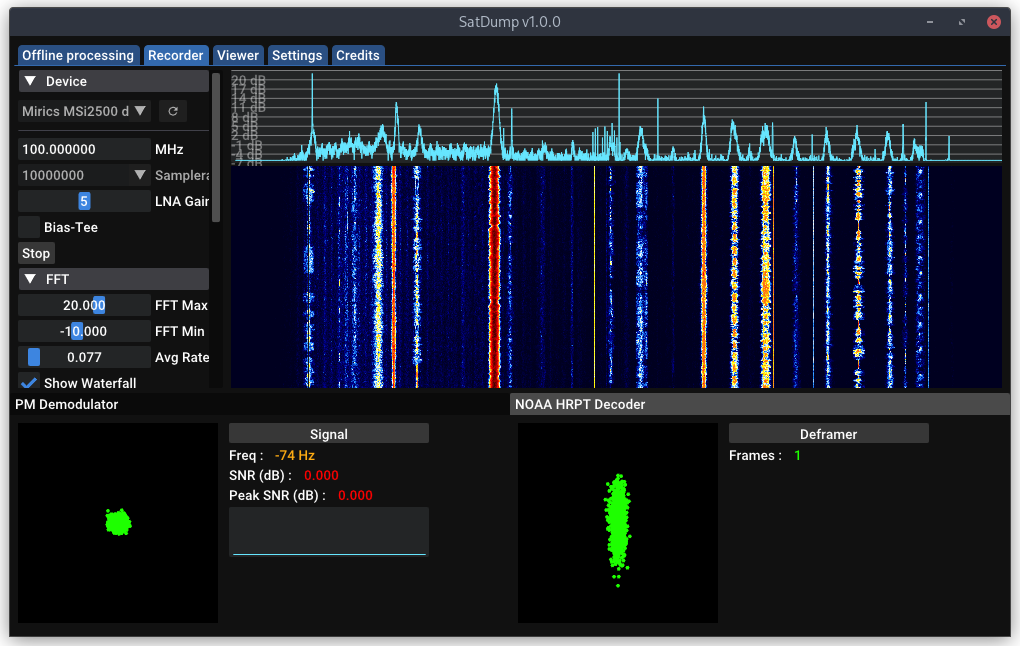
Over on Reddit u/Xerbot has posted about the release of his new software called "LeanHRPT". When combined with a software defined radio, this software can be used to decode and view HRPT weather satellite images received from satellites such as NOAA, Meteor, MetOp and FengYun. We note that unlike APT and LRPT weather satellite signals which transmit in the VHF bands, HRPT signals are generally at ~1.70 GHz and require a motorized or hand tracked satellite dish to receive. u/Xerbot writes:

LeanHRPT is a flexible, easy to use and powerful set of tools for the manipulation of HRPT data (maybe I could be convinced to add LRPT support).

When used properly LeanHRPT Decode can generate (almost) L1B data usable in actual land/weather observation, or just pretty images :)

You can get it here: https://github.com/Xerbo/LeanHRPT-Decode

The LeanHRPT project also contains LeanHRPT Demod, as you probably guessed, a HRPT demodulator. It features an incredibly high sensitivity as well as being able to do both realtime (through SoapySDR) and offline demodulation (baseband).

You can get it here: https://github.com/Xerbo/LeanHRPT-Demod

LeanHRPT Applying a map overlay on FengYun

GNU Radio Conference 2021 Talks Now Available on YouTube

The GNU Radio YouTube channel has recently finished uploading the talks from GRCon21, this years annual GNU Radio Conference. GNU Radio is an open source development toolkit for signals processing and is commonly used to build software demodulators and decoders for Software Defined Radios.

The GNU Radio conference talks are generally about cutting edge SDR research topics and the YouTube playlist contains 67 videos covering a gambit between what changes have been made in new releases of GNU Radio to presentations and demonstrations focusing on topics such as reverse engineering smart power meters and 5G cell detection among many others.

Some of the talks from this years conference that we found most interesting include:

GRCon21 - Keynote: Joe Gibbs Racing Team

Lightweight Windows Software uSDR Updated to Version 1.4.0

Back in July we posted about the release of Viol Tailor's "uSDR" software, which is a lightweight general purpose multimode program for Windows which supports the RTL-SDR, Airspy, BladeRF, HackRF and LimeSDR radios. Recently Viol has updated the software to V1.4.0. The new release brings SDRplay support, and various performance and GUI improvements listed below.

The software can be downloaded from SourceForce.

  • customizable tool panel behavior (fixed, floating, undocked)
  • SDRPlay frontend support (API v.2.13)
  • RTL-TCP streaming interface support, presets quick switch (server, port, description)
  • high precision Wav IQ file play back
  • support RIFF 8, 16, 24 and 32 bits integer, 32 bits float, FR64 file formats for playback
  • recognize Wav IQ file central frequency for play back
  • frequency offset (shift) for x-verters
  • swap IQ (invert spectrum) option
  • improved FFT spectrum calculation and visualization
  • waterfall color map range may be changed manually on the spectrum window as well as on tool panel, also included the auto scale option
  • color map palette can be customized and fast switched, palette presets are included
  • FIFO buffer size (IQ history time) may be changed on the fly, all memory allocations are under hood, no losses of previously stored history 
  • pass band may be attachment to global frequency as well as to local baseband frequency or to screen position
  • squelched threshold control and level indicator for demodulation (in addition to adjustable spectrum threshold detector)
  • stereo FM demodulator
  • low latency audio
  • frequency manager, groups and interactive markers, visualize, edit, navigate, tune the pass band
  • spectrum and waterfall popup menus
  • improved GUI controls
  • "fine tune" option: set pass band to rounded frequency (spectrum right click)
  • statistics visualization window
uSDR aka microSDR. A lightweight SDR receiver program from Windows.

SignalsEverywhere: Setting up the Retrogram Terminal Spectrum Analyzer for the PlutoSDR

This week on the SignalsEverywhere YouTube channel Sarah shows how to install the "Retrogram" software. This is a command line 'retro' styled spectrum analyzer designed to be used with the PlutoSDR. The software makes use of ASCII art to display the spectrum, meaning that a spectrum can be viewed directly in an SSH terminal, without any GUI. 

In the video Sarah goes through the steps to install the software before demonstrating it in action.

Retrogram - A Command Line Spectrum Analyzer For The PlutoSDR

Tech Minds: Testing the Cloudmarkers SDRuno Community Plugin

This week on the Tech Minds YouTube channel Matthew introduces the "Cloudmarkers" plugin for SDRuno. SDRuno is the official software for the SDRplay RSP line of software defined radios, but the EXTio version also supports the RTL-SDR.

Cloudmarkers is a plugin that allows users to query the online Cloudmarkers database to determine what an unknown signal at the currently tuned frequency might be. The database is created by other Cloudmarkers users, so if you have your own information to add you can add information about particular frequencies to the database for others to query later.

In the video Matthew shows  the Cloudmarkers plugin in operation and notes that the plugin can work with both SDRplay SDRs and the RTL-SDR.

CLOUDMARKERS - Community Plugin For SDRuno

SignalsEverywhere tests our RTL-SDR Blog Active L-Band Patch Antenna

Sarah from the SignalsEverywhere YouTube channel is back this week with a video review and demonstration of our RTL-SDR Blog Active L-Band patch antenna, which is designed for receiving Inmarsat and Iridium satellites between 1525 - 1660 MHz with an RTL-SDR or other bias tee capable SDR.

In the video Sarah demonstrates the patch antenna in action running in SDR++, discusses some of the features and compares it against another patch antenna. She goes on to briefly show JAERO receiving and decoding an 8400bps AERO voice channel.

If you're interested, this antenna has also been reviewed by Frugal Radio, Tech Minds, and Mike from SDRplay

The patch is currently in stock in our store for $49.95 shipped worldwide, or on Amazon USA for US customers. We note that previous problems (as explained in our earlier post) with cracks in the plastic in the latest batch with grey enclosures have been resolved now, and units shipping now are without defect.

What can you do with this antenna?

The Best L Band Antenna for The Money PERIOD

Imaging the Cassiopeia A Supernova Remnant with an RTL-SDR and Amateur Radio Telescope

Just a few days ago we posted about Job Geheniau's success at radio imaging the Cygnus-X star forming region at 1424 MHz with a 1.9m radio telescope, an RTL-SDR and some additional filtering and LNAs.

Now in his latest post on Facebook Geneniau has also shown that he has successfully imaged Cassiopeia A with the same equipment. Cassiopeia A is a supernova remnant known for being the "brightest extrasolar radio source in the sky at frequencies above 1 GHz" [Wikipedia]. Geheniau writes:

A new observation from JRT. These are driftscans of Cassiopeia A to make a radio plot. Several driftscans are made last week and combined. Always nice to see whats possible with a 1.5-1.9 meter dish. 2 LNA's and a bandpass filter, connected to a RTL-SDR at 1424 MHz. Happy that I got Cygnus complex and now Cassiopeia A which is the second radio source which is possible to receive with this dish.

The dish is fully remote controlled 50 km away.

Job Geheniau - The Netherlands

Cassiopeia A Radio Imaged with an RTL-SDR and 1.9m dish
Job's Radio Telescope

Imaging the Cygnus Star Forming Region with an RTL-SDR and Amateur Radio Telescope

Over on Facebook Job Geheniau has posted results from his latest radio astronomy experiment which involves imaging the Cygnus-X star forming region at 1424 MHz with a 1.9m radio telescope, an RTL-SDR and some additional filtering and LNAs. In the past we've posted about Geheniau's previous work which involved imaging the entire Milky Way at 1420 MHz, and measuring the basis for the dark matter hypothesis with a similar process and the same equipment. His latest post reads:

Cygnus-X is a massive star-forming region in the constellation Cygnus at a distance of 1.4 kiloparsecs (4600 light-years) from the Sun.

Cygnus-X has a size of 200 parsecs and contains the largest number of massive protostars and the largest stellar association within 2 kiloparsecs of the Sun. Cyg X is also associated with one of the largest molecular clouds known, with a mass of 3 million solar masses.
[Wikipedia]

The idea:
To take a radio picture of the Cygnus complex (Cygnus A + Cygnus X) with my 1.9 meter radio telescope.
Equipment:
1.5 - 1.9 meter radio telescope
Mini Circuits LNA ZX60-ULN33+
Bandpass filter 1200-1700 MHz
2nd LNA
RTL-SDR
VirgoSoft

Implementation:
Multiple 4-hour drift scans of the Cygnus complex and beyond.
In order not to be affected by HI at 1420 MHz, measurements were made at 1424 MHz. At this frequency there is Synchrotron radiation and no neutral hydrogen emission.
To be sure that no Milky Way synchrotron radiation is measured there would be no or hardly any measurable power change outside the Cygnus complex during the drift scan. This was also observed in these measurements and also confirmed earlier in test measurements.

A total of 7 drift scans of 4 hours were made at 1424 MHz. Because the start of the driftscan generates a lot of wrong data (the 'cooling down/warming up' of the RTL-SDR), this has been removed in the measurements.
The measurement starts at 2000 seconds and is always aborted at 12000 seconds in post-processing.

7 shots from RA 19 to RA 22. The declination varied each observation from DEC 36 to 43 degrees.

Because not every driftscan was perfect (heavy clouds gave worse results anyway as well as wind/rain or rfi) a total of 15 measurements were done, of which 7 were thus acceptable enough for editing.

In the end JRT performed measurements from 24 September to 9 October. Patience is a good thing.

Results:
By editing the driftscan data in Excel with Conditional Format (giving color to the data) the final result is a 'radio photo' of the complex.

Of course, in view of the dish diameter, the beam is 8 degrees and thus a somewhat rough image of the Cygnus complex is sketched here.

Job Geheniau - Netherlands.

Cygnus-X Imaged at 1424 MHz with an RTL-SDR based home radio telescope.