Category: Satellite

NOAA 15 and 19 To Be Decommissioned Within the Next Two Weeks

The National Oceanic and Atmospheric Administration (NOAA) have recently announced that they are planning to decommission NOAA 15 and NOAA 19 on August 12, 2025 and August 19, 2025 respectively.

Update #7: NOAA has completed End of Life (EOL) testing activities for NOAA-15 and NOAA-19 and will commence the decommission process shortly. These two remaining satellites in the NOAA Polar Operational Environmental Satellites (POES) Constellation are far beyond their primary mission design life. All have incurred subsystem and instrument degradation or failures and have entered a "twilight phase" where failure modes are increasingly likely. As a reminder, NOAA-18 was decommissioned on June 6, 2025 at 1740 UTC due to an unrecoverable failure to the S-Band transmitter. The remaining satellites in the legacy POES constellation will be decommissioned as follows: NOAA-15 on August 12, 2025 and NOAA-19 on August 19, 2025.

NOAA-15, NOAA-18, and NOAA-19 have long been core satellites for RTL-SDR users. For many of us, one of these would have been the first satellite from which we received weather data via the 137 MHz APT signal.

These NOAA satellites were marked end-of-life (EOL) back on June 16, 2025. However, EOL status still meant that transmissions would continue as normal. The EOL status simply marked that the satellites should no longer be used for mission-critical services, and that no attempts at repair or recovery would be made if needed.

On June 06, 2025, just before the EOL status officially went into effect, NOAA-18 was decommissioned and shut down due to a prior transmitter failure that left ground control in danger of being unable to control the satellite in the future. 

While nothing critical appears to have happened to the remaining NOAA-15 and NOAA-19 satellites as of yet, these are ageing satellites with various ongoing issues. NOAA-15 was launched in 1998, and NOAA-19 in 2009. They have long exceeded their design life.

As with NOAA-18's decommissioning, it does not appear that NOAA will deorbit the satellites. Instead, they will be left in orbit and put into a safe electrical state, with the transmitters shut down.

You can find more information about the decommissioning over on Carl Reinmann's usradioguy blog.

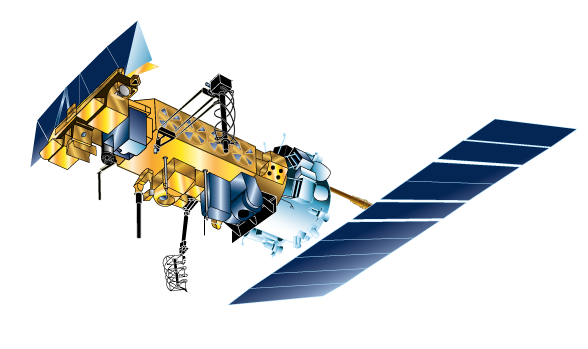
A Drawing of NOAA-19

Decoding Inmarsat AERO 1545 MHz with a Backfire Helix and JAERO

Thank you to Nagy István for writing in and sharing with us his video showing how he uses a home-made backfire helix antenna and the JAERO software to receive and decode Inmarsat Aero at 1545 MHz. AERO messages are a form of satellite ACARS, typically containing short messages from aircraft, and some channels also support digital voice communications.

The backfire helix is an antenna design that consists of a helically wound wire, typically wound around a 3D-printed frame, attached to a large backplane. Recently, a similar design called a 'heliocone' has become popular for use with 1.7 GHz polar orbiting satellites.

In the video, Nagy shows two designs, one of his own and the other by Digitalelektro, and the good SNR that he's achieved with them in JAERO.

Inmarsat Aero 1545Mhz decoding with Backfire helix / JAERO software

Decoding SSTV Transmissions from the QO-100 Satellite

Over on his YouTube channel dereksgc has uploaded a video showing how to decode Slow Scan Television (SSTV) transmissions from the QO-100 satellite. QO-100 is a commercial geostationary communications satellite available in some parts of the world that also carries a popular transponder for amateur radio. SSTV is an amateur radio communications analog protocol for transmitting images over a narrowband RF signal.

In the video dereksgc shows how to use SDR Console V3 together with a program like MMSSTV for decoding the image. He goes on to discuss the specific SSTV frequencies on QO-100, the different SSTV modes, and some demonstrations of images being received.

Decoding SSTV transmissions from the QO-100 satellite (QO-100 pt.2)

TechMinds: Testing out the SkyRoof Software for Receiving and Tracking Amateur Radio Satellites

At the beginning of this month, we posted about SkyRoof, a new software program by VE3NEA for receiving and tracking ham radio satellites with an RTL-SDR and other SDRs.

Recently, Matt from the TechMinds channel uploaded a video on YouTube testing out SkyRoof. In the video, Matt explains the software's various sections and features, such as Doppler correction. He then goes on to demonstrate various audio voice signals being received with the software.

SkyRoof - A Brand New Satellite Tracking Software With Built In SDR Software - This is awesome!

Updates To NOAA-18 Decommissioning: NOAA-18 Has Now Shut Down

A few days ago, we posted news that NOAA-18 was to begin decommissioning steps effective immediately due to a recent transmitter failure. Multiple reports have now confirmed that NOAA-18 has indeed shut down as of 1740 UTC 06/06/2025.

The usaradioguy.com blog has further updates for those who are interested. The official notice from NOAA can also be found here. Interestingly, it appears that NOAA-18 will not be de-orbiting as it lacks the required propulsion system to do so. So it will remain in orbit as space debris.

A user using a hobbyist station in Sweden also captured the shutdown remotely during APT image reception, as shown in the image below.

Farewell and thanks for your long service NOAA-18!

The final NOAA-18 APT pass captured by SA2KNG in Sweden, and processed remotely by Thomas:douwes.co.uk


SkyRoof: New Ham Satellite Tracking and SDR Receiver Software

Recently VE3NEA has released a new Windows program called "SkyRoof". SkyRoof is both a satellite tracking and SDR receiver program. It supports the RTL-SDR as well as Airspy and SDRplay devices.

The software is designed for tracking and receiving ham radio satellites, and it can provide detailed information about all ham satellites, tracking them in real time, and provide pass prediction. It also shows a skymap and SDR waterfall display. The receiver software supports demodulation of SSB/CW/FM, and it automatically compensates for doppler. It can also interface with antenna rotators that support hamlib.

SkyRoof Satellite Tracking and SDR Receiver Software Screenshot

Over on YouTube Johnson's Techworld has also recently uploaded a video showing him testing out Skyroof, which may be of interest to some.

Brief review of SkyRoof, the latest satellite tracking software!

NOAA18 to Begin Decommissioning Steps Immediately

In April, we posted news that the NOAA satellites would be classed as 'end-of-life' on June 16, 2025. According to the statements, the satellites were expected to remain in orbit and continue transmitting data that radio hobbyists could use, but no attempts would be made to rectify failures.

However, recent news from Carl Reinmann's usaradioguy.com blog has indicated that NOAA 18 will begin decommissioning steps immediately on June 3, 2025. The steps involve disabling batteries and transmitters, depleting remaining propellants, transitioning data and operations, and finally deorbiting, or moving the satellite to a safer orbit.

NOAA-18 may have been chosen to be decommissioned earlier than NOAA-15 and NOAA-19 as the S-band downlink transmitter failed last month, resulting in severe image degradation. The satellite has also been running on backup gyros since 2017, and has suffered various transmitter and sensor failures over the years. 

NOAA-18

AI Cloud Detection for GOES Weather Satellite Images on a Raspberry Pi

Over on his blog account at Hackser.io Justin Lutz has uploaded an article describing how he uses AI object detection to automatically detect clouds on weather satellite images that he's downloaded from GOES satellites via an RTL-SDR.

Lutz's blog post first describes and shows his RTL-SDR GOES reception setup. Then, it explains how he used Edge Impulse on his Raspberry Pi 4 to create an AI model that automatically detects the clouds in the image.

The process begins by importing 100 images into Edge Impulse, manually labelling the clouds in each image, training the model, and testing it. The result was an average detection accuracy of 90%.